
What is the NCLEX passing score? NCSBN sets it as a passing standard on a logit scale, 0.00 logits for the NCLEX-RN and -0.18 logits for the NCLEX-PN, and both stay in effect through March 31, 2029.
You pass when the exam places your ability at or above that standard. There’s no percentage cutoff and no set number of questions you have to get right.
A logit is the unit NCSBN uses to compare your ability estimate with the difficulty of the questions. Because the exam adapts to every answer, two people can answer a different number of questions and both pass.
Below, we’ll cover how the computer decides when to stop, what happens if time runs out, the latest pass rates, and how to prepare.
How Is the NCLEX Passing Score Decided?
Forget about needing a 75% or 80%. The NCLEX-RN or NCLEX-PN doesn’t work like that. Instead, it tracks your performance using Computer Adaptive Testing (CAT) and adjusts the difficulty of your questions in real time.
How the NCLEX Pass-Fail System Works:
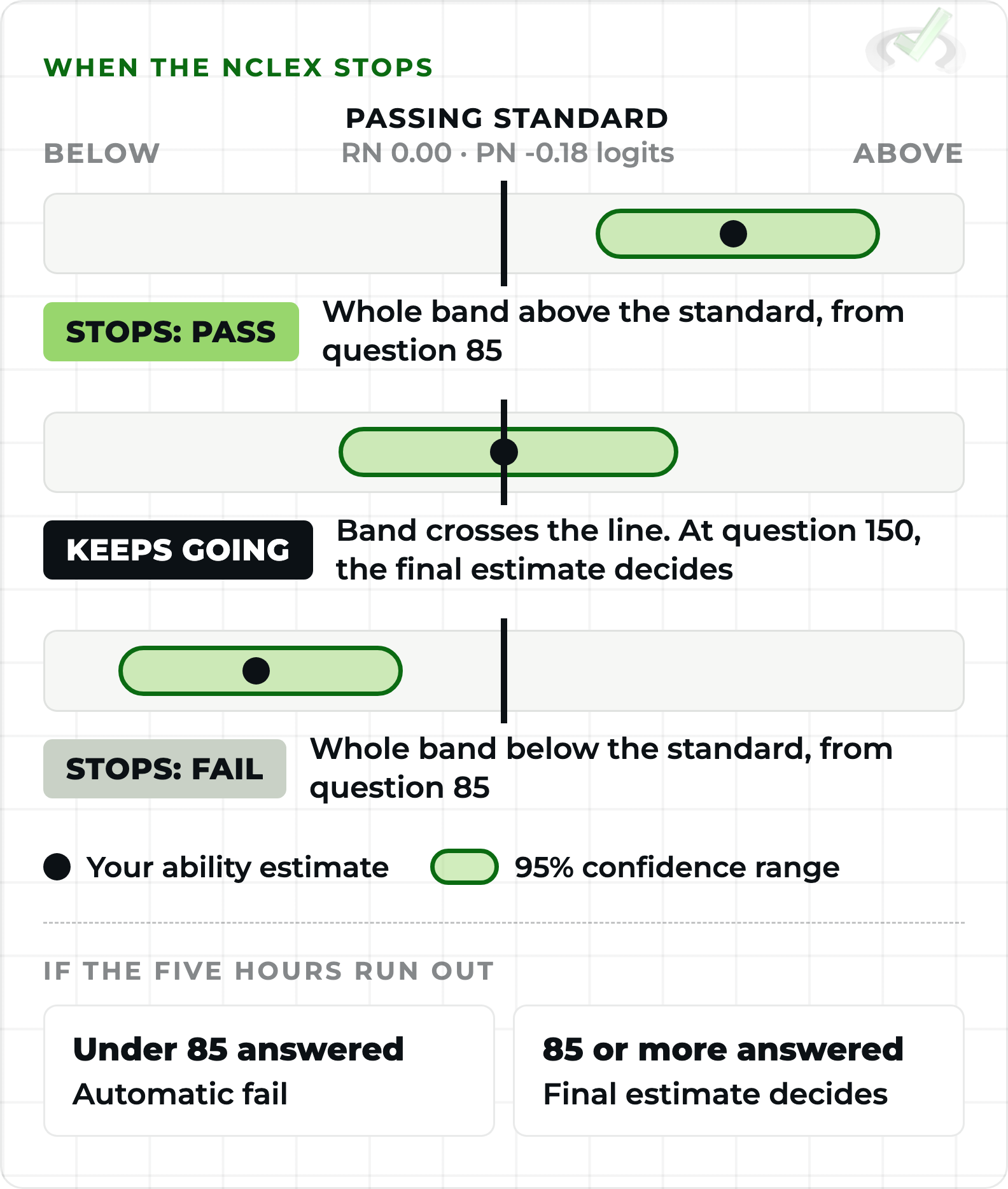
This is why some people pass in 85 questions, while others answer all 150. The test is measuring how well you handle difficult questions.
Understanding Logits: What Do They Mean?
A logit is a unit of measurement that compares your ability level to the difficulty level of NCLEX questions. Instead of a percentage, your performance is measured on a logit scale.
The NCLEX-RN passing standard is 0.00 logits, and the NCLEX-PN standard is -0.18 logits. NCSBN has set both through March 31, 2029. Your ability estimate has to be at or above the standard to pass.
In simpler terms: If you consistently answer higher-difficulty questions correctly, you pass. If you struggle with questions near the passing level, the system will keep testing you to determine where you stand.

Do Harder Questions Mean You’re Passing?
The NCLEX doesn’t test simple memorization. It measures critical thinking, judgment, and prioritization, the skills you’ll need as a working nurse.
These three groups are our rough way to picture the range. NCSBN calibrates each scored question’s difficulty on the same logit scale as the passing standard, and it writes most questions at the application level or higher.
1. Below Passing-Level Questions
These questions test basic recall. They involve definitions, normal lab values, and textbook knowledge.
Examples:
Answering these correctly does not mean you will pass. These questions are too basic to prove competency.
2. At Passing-Level Questions
These questions require critical thinking. They assess whether you can make nursing decisions based on patient conditions.
Examples:
Getting these right pushes you toward passing. These questions show that you understand how to apply nursing knowledge.
3. Above Passing-Level Questions
These are the toughest NCLEX-RN or NCLEX-PN questions. They require analysis, prioritization, and decision-making.
Examples:
Seeing these question types doesn’t tell you how you’re doing. NCSBN says candidates can’t reliably tell which items are easy and which are hard, and both strong and struggling test-takers find the later questions challenging.
A question’s format doesn’t set its difficulty either. NCSBN has no set share of select-all-that-apply or any other format, and it picks each question by your ability estimate and the question’s difficulty.
Will Your NCLEX End at 85 Questions or 150?
The number of questions on the NCLEX varies from person to person.
1. Passing Early (Fewer Than 150 Questions)
2. Continuing to the Maximum (150 Questions)
3. Failing Early
What Happens If You Run Out of Time?
If you run out of time before answering 85 questions, you fail.
If you have answered at least 85 questions, the system uses your final ability estimate, based on every answer you gave before time ran out:
Time matters. Don’t overanalyze early questions, because you need to reach at least 85 questions before time runs out.

NCLEX Pass Rates: How Many People Pass on Their First Attempt?
Passing the NCLEX on the first try gives you the best chance of success. Here are the latest pass rates:
(Source: NCSBN, 2025 NCLEX Examination Statistics, published June 2026)
Passing the NCLEX on your first try takes the right strategy. Get expert guidance, a daily NCLEX-style question, and insider tips delivered straight to your inbox with our NCLEX Daily Dose Emails. Stay on track and give yourself the best shot at passing.
Subscribe now and start preparing smarter.
Two Strategies That Help You Meet the NCLEX Passing Score
The NCLEX passing score depends on showing you can think critically. Preparing the right way can make all the difference, and using strategic methods can push your performance above the passing standard.
Let’s go over some of the best techniques to boost your NCLEX score and pass on the first attempt.
1. Study Based on NCLEX Categories, Not Just Random Topics
The NCLEX is structured around Client Needs Categories rather than individual subjects like anatomy or pharmacology. That means you need to focus on how questions are asked within these major categories:
Understanding these categories helps you study with intention instead of cramming broad topics that may not be relevant. The test asks you to apply nursing principles to patient scenarios.
Want a fast and effective way to study? Grab our NCLEX Cheatsheets. They cover question types, prioritization strategies, and must-know nursing concepts for test-day review or tough topics.
2. Simulate the NCLEX Testing Experience
The NCLEX is long. Sitting for up to five hours answering adaptive questions takes mental stamina. If you only study in short bursts, NCLEX test day will feel overwhelming.
To prevent this, take full-length practice tests under conditions similar to test day:
The more you train your brain to handle long periods of focus, the easier the actual NCLEX will feel.
Three Mistakes That Lower Your NCLEX Passing Score
Content knowledge matters, and so do your study and test-day habits.
Here are some things to avoid if you want to pass the NCLEX without stress.
1. Over-Relying on Memorization
The NCLEX is not a recall-based test. While it’s important to know lab values, medications, and procedures, memorizing facts alone won’t help much. The exam evaluates how well you apply knowledge to patient scenarios.
Example mistake:
A student memorizes that digoxin treats heart failure but doesn’t understand why monitoring potassium levels matters when giving it. This could lead to missing a priority question on digoxin toxicity.
What to do instead:
2. Not Practicing Enough NCLEX-Style Questions
Some students read textbooks for weeks but barely practice NCLEX-style questions. This is a big mistake. The way NCLEX questions are worded is different from classroom exams, and you need to get used to them.
The NCLEX is full of:
What to do instead:
3. Second-Guessing Answers Too Much
A common issue among test-takers is changing correct answers to incorrect ones because they second-guess themselves.
Example mistake:
A student picks the right answer but then doubts their reasoning, overanalyzes, and changes it to the wrong one. This leads to unnecessary mistakes.
What to do instead:

Three Things to Remember Before Test Day
The NCLEX passing score depends on how well you answer higher-level questions, with no percentage cutoff.
The best way to prepare for your exam? Practice NCLEX-style questions, focus on critical thinking, and train with full-length exams. The test checks whether you’re ready to think like a nurse.