| Questions Correct | Questions Answered | Time Spent | Status | Attempt Date | |
|---|---|---|---|---|---|
| -- | -- | -- | -- | -- |
| Questions Correct | Questions Answered | Time Spent | Status | Attempt Date | |
|---|---|---|---|---|---|
| -- | -- | -- | -- | -- |
Array
(
[passage] => WP_Post Object
(
[ID] => 559963
[post_author] => 12815
[post_date] => 2025-01-09 21:49:18
[post_date_gmt] => 2025-01-10 02:49:18
[post_content] => Practice Passage (Question 1-5)
*This passage is the property of Khan Academy and has been reformatted into an AAMC-style interface in their entirety by MedLife Mastery. MedLife Mastery does not endorse and is not an affiliate of Khan Academy.
The best available medical treatment for some diseases involves destroying or removing abnormal tissue. A gamma knife destroys those dangerous tissues without first cutting through sensitive healthy structures to reach the target. The gamma knife is used to treat patients who have intracranial tumors (or “brain cancers”) and other dangerous conditions inside their skulls.
A gamma knife is a helmet-like device with 200 samples of radioactive cobalt-60. As the Co-60 (half-life of 5 years) decays to stable nickel-60, it gives off beta- and gamma-radiation that travel away from the atom in random directions.
Figure 1. Co-60 decay chain
The Co-60 sources are embedded in collimators, devices that shape the radiation into a thin beam traveling in one direction.
Figure 2. Simplified schematic of a gamma knife showing only three of its 200 Co-60 sources and collimating devices with beam paths crossing at a brain tumor (green)
The gamma knife works because gamma ray photons do not deposit their energy in tissue quickly. Where beta ray electrons will deposit almost all of their energy in the first few centimeters of tissue, gamma ray photons deposit energy very slowly as they travel through the body. Depositing energy by both beta- and gamma rays ionizes atoms in the cells. If the rate of ionization is low, cells can usually repair the damage done by reactive ions. Large doses of ionization can overwhelm a cell’s ability to compensate and it will not survive. The cells along the paths of the gamma knife’s beams are generally able to repair themselves except at the points where many beam paths cross, yielding a much higher rate of ionization that kills the cells and destroys the tissue.
[post_title] => Gamma knife radiosurgery
[post_excerpt] =>
[post_status] => publish
[comment_status] => closed
[ping_status] => closed
[post_password] =>
[post_name] => gamma-knife-radiosurgery
[to_ping] =>
[pinged] =>
[post_modified] => 2025-01-09 21:49:18
[post_modified_gmt] => 2025-01-10 02:49:18
[post_content_filtered] =>
[post_parent] => 0
[guid] => https://medlifemastery.com/?post_type=passage&p=559963
[menu_order] => 0
[post_type] => passage
[post_mime_type] =>
[comment_count] => 0
[filter] => raw
)
[questions] => Array
(
[0] => Array
(
[quiz_unique_key] => 578908434
[question] => Gamma knife sources are replaced every ten years. What amount of radiation per unit time does a new gamma knife deliver relative to one that is about to have its Co-60 replaced?
[value] => Array
(
[answer] => 1
[description] => Reason for the Correct Answer:
Decaying over time decreases the amount of radiation released by a source.
The Co-60 source goes through two half-lives in one decade (ten years).
After 2 half-lives, one quarter of the Co-60 is left, and Ni-60 is stable so Ni-60 does not give off radiation.
If one quarter of the Co-60 is left after 10 years, it’s emitting one quarter as much radiation as it did when new. That means that a new source emits radiation at four times the rate of the sources that had been used for 10 years.
)
[answers] => Array
(
[0] => Array
(
[each_answer] => A. Four times the amount
)
[1] => Array
(
[each_answer] => B. The same amount
)
[2] => Array
(
[each_answer] => C. Half the amount
)
[3] => Array
(
[each_answer] => D. Twice the amount
)
)
)
[1] => Array
(
[quiz_unique_key] => 3873426850
[question] => Gamma knife sources are replaced every ten years. How much mass does a 10-year old Co-60/Ni-60 source have when compared to the source when it was new?
[value] => Array
(
[answer] => 4
[description] => Reason for the Correct Answer:
The Co-60 source decays into Ni-60.
Ni-60 is nearly identical in mass to Co-60.
Ni-60 is unlikely to escape from the source sample, as it is also a fairly heavy metal.
As almost no mass has left the system, the new and old sources will have nearly identical masses, even though they are now made from different types of metal.
)
[answers] => Array
(
[0] => Array
(
[each_answer] => A. The old source has almost twice the mass of the new one
)
[1] => Array
(
[each_answer] => B. The old source will have roughly one half the mass of the new one
)
[2] => Array
(
[each_answer] => C. The old source will have close to one quarter the mass of the new one
)
[3] => Array
(
[each_answer] => D. Both sources have nearly identical masses
)
)
)
[2] => Array
(
[quiz_unique_key] => 83407773
[question] => Gamma knife targeting must be very tightly controlled to destroy only dangerous tissue. What strategy would a medical physicist use to correct for the Earth’s magnetic field when installing and operating a gamma knife at her hospital?
[value] => Array
(
[answer] => 4
[description] => Reason for the Correct Answer:
Only charged particles are deflected by magnetic fields.
Photons are uncharged.
Magnetic fields act on moving charged particles. Photons are not charged, so they are not affected by magnetic fields. No correction is needed.
)
[answers] => Array
(
[0] => Array
(
[each_answer] => A. Put in place an electric field to cancel the deflection from the magnetic field
)
[1] => Array
(
[each_answer] => B. Align the device so that the direction of the collimated beams are parallel or antiparallel to the Earth’s field
)
[2] => Array
(
[each_answer] => C. Erect magnetic shielding to leave a near-zero magnetic field in the room where the gamma knife is used
)
[3] => Array
(
[each_answer] => D. No correction for Earth’s magnetic field is needed
)
)
)
[3] => Array
(
[quiz_unique_key] => 2377279144
[question] => What is the primary reason that the photons are collimated into a beam in a gamma knife?
[value] => Array
(
[answer] => 2
[description] => Reason for the Correct Answer:
Collimation is the process of creating a beam of particles that are all going in the same direction.
If the gamma ray sources were uncollimated, they would all deposit their energy in random places throughout the patient’s head and body.
If every source were depositing energy at every point in the brain, it would not be possible to specifically target the dangerous tissue.
Gamma ray photons are collimated so that their direction is controlled, allowing many paths to cross in only one area.
If the sources were placed near the patient’s head without collimation, all of the brain tissue would be indiscriminately irradiated by the uncollimated photons with the same dose as the dangerous tissue. This would damage the entire brain.
)
[answers] => Array
(
[0] => Array
(
[each_answer] => A. Collimation adjusts photon energy so that photons will be more likely to interact with the atoms in the target tissue.
)
[1] => Array
(
[each_answer] => B. Uncollimated photons would irradiate the entire head indiscriminately with a dose equivalent to that normally aimed at the dangerous tissue.
)
[2] => Array
(
[each_answer] => C. Collimation allows the beta ray electron to generate extra gamma ray photons through the bremsstrahlung process.
)
[3] => Array
(
[each_answer] => D. Collimation filters out beta ray electrons that would otherwise damage the tissue superficial to the dangerous tissue.
)
)
)
[4] => Array
(
[quiz_unique_key] => 2261298308
[question] => Using the information in this passage and your knowledge of periodic trends, does a neutral cobalt-60 atom have a larger radius than a nickel-60 atom?
[value] => Array
(
[answer] => 1
[description] => Reason for the Correct Answer:
In beta decay, a neutron breaks up to become a proton and an electron. The proton stays behind in the nucleus.
Because an electron was lost in beta decay, Ni-60 has one more proton than Co-60, so Ni-60 is farther to the RIGHT on the periodic table.
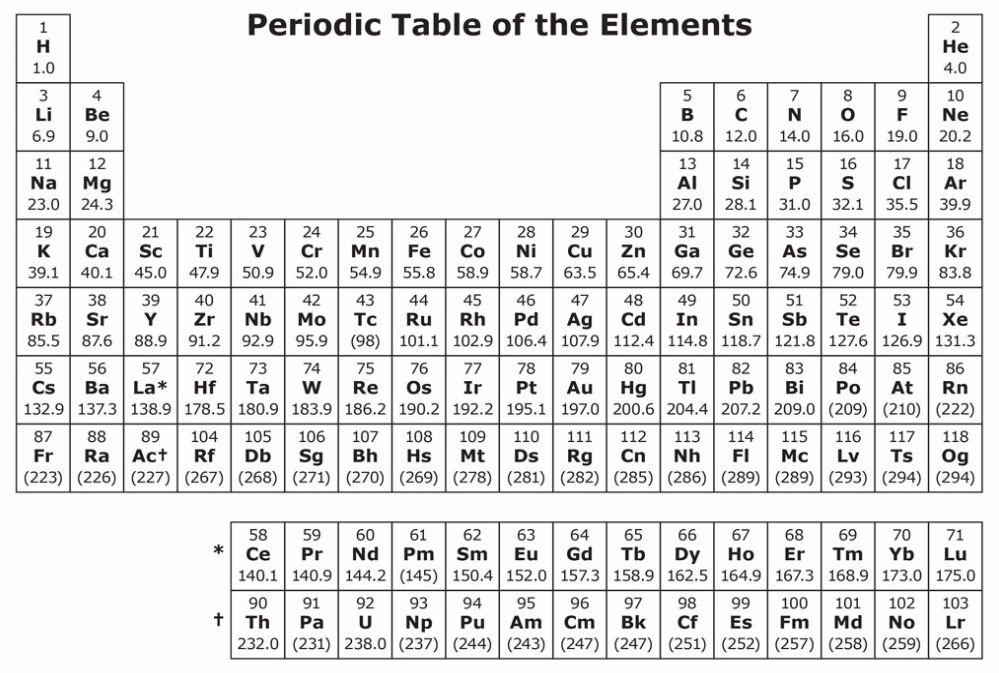
Co-60 and Ni-60 are in the same row on the periodic table, because they didn’t move far enough left or right to go past a noble gas or an alkali metal.
Within a row, the periodic trend is for elements farther to the left (cobalt-60 in this case) to have a larger radius, so cobalt-60 has a larger radius.
)
[answers] => Array
(
[0] => Array
(
[each_answer] => A. Cobalt-60 has a larger radius
)
[1] => Array
(
[each_answer] => B. More information is needed
)
[2] => Array
(
[each_answer] => C. Nickel-60 has a larger radius
)
[3] => Array
(
[each_answer] => D. Nickel-60 and cobalt-60 have the same diameter
)
)
)
)
[total_question] => 5
[correct_answers] => Array
(
[559963|1] => A
[559963|2] => D
[559963|3] => D
[559963|4] => B
[559963|5] => A
)
[hide_display_feedback_settings] =>
[hide_solutions] =>
)