Reason for the Correct Answer:
Subatomic particles include not only the protons, electrons, and neutrons, but also technically the quarks, so the total would far exceed what we are looking for.
The total number of nucleons is equal to the number of protons and neutrons, which is equal to the mass number (A).
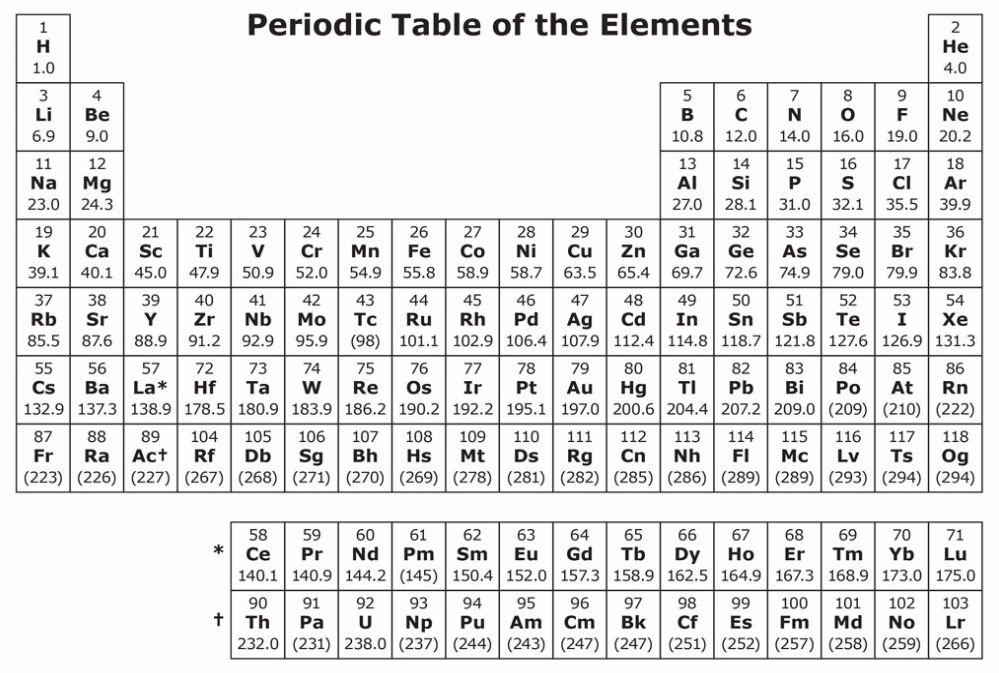
The number of electrons is equal to the number of protons, which is equal to the atomic number (Z).
Therefore, the total number of nucleons and electrons is equal to the sum of the atomic and mass numbers.
Which of the following is equal to the total number of nucleons and electrons in technetium-99?
A. Total number of protons and electrons
B. Total number of subatomic particles
C. Total number of neutrons and electrons
D. Sum of the atomic and mass numbers
SPECT is a procedure where the emissions from the radionuclide indicates area of capillary blood flow.
Gamma rays indeed have the most energy of the decay products, but its energy would not impact imaging.
Technetium-99 is the most readily available radionuclide in hospitals because of its optimal half-life and cost-effectiveness in production through generators. While Tc-99 is a gamma emitter, we cannot deduce that of all gamma emitters.
In order for a snapshot to be taken of the tissue, the radionuclide must emit radiation that is able to penetrate tissue to reach the cameras, so gamma rays is the best because of its penetrating ability.
Diagnostic procedures like single photon emission computed tomography (SPECT) use radionuclides to take cross-sectional snapshots of various parts of the body. Why are gamma emitters particularly suited for diagnostic purposes?
A. Gamma emitters are generally produced in reactors or generators which are cheaper to use.
B. Gamma rays are the most energetic of all the decay products.
C. Gamma rays are able to penetrate human tissue more easily.
D. Gamma emitters are much more readily available in hospitals than the others.
If two particles are annihilated, we can assume that their velocities are brought to zero, as well as their momenta.
We are looking for an answer that would give a scenario with zero momentum.
If the energy becomes one gamma ray with some velocity, this would violate the conservation of momentum law.
Electromagnetic radiation is always emitted as quantized packets of energy, the energy cannot be spread in all directions.
Two gamma rays of the same energy traveling in opposite directions to each other would satisfy the conservation of momentum law.
Beta-positive emitters are used in positron emission tomography or PET. When a particle interacts with its antiparticle, they both are annihilated entirely to create one or more particles. When a slow-moving positron is emitted, it instantly annihilates with an electron and gamma radiation is produced. What happens as a result of this pair annihilation?
A. One gamma ray is produced and continues in the same direction as the positron.
B. Two gamma rays are produced and continue in the same direction at 90 to each other.
C. Two gamma rays of the same energy are produced and travel in opposite directions to each other.
D. The energy is spread into many gamma rays which travel in all directions.
The technetium-99m generator produces 99mTc in the hospital for diagnostic use in imaging. There is a parent and daughter radionuclide, which are 99Mo and 99mTc, respectively.
Since we are producing technetium-99m, the half-lives concerned are for the parent nuclide molybdenum-99 and not 99mTc.
Each half-life is 2.74 days, so 3 half-lives would be around 8 days.
If the hospital waits 10 days, there will be a time period of just over 1 day when there may be insufficient amounts of 99mTc. So the hospital needs a new generator every week.
A large percentage of the 99mTc is produced in the first 3 half-lives of the technetium-99m generator, which needs to be replaced after that time period. How often will a hospital need a new generator for 99mTc production?
A. Every day
B. Every other day
C. Every week
D. Every 10 days
Radon-223 tells us that radon has a mass number of 223, which may be written as
223Rn. The mass number (A) indicates that there are 223 nucleons, aka protons and neutrons.
We look to the periodic table to find out that radon has 86 protons since atomic number (Z) is equal to the number of protons (86Rn), which is what defines an element. We can deduce that radon-223 has 137 neutrons.
The question stems tells us that radon emits 4 alpha particles, which are synonymous with helium nuclei. Each alpha particle comprises 2 protons and 2 neutrons, so 4 would comprise 8 protons and 8 neutrons.
We would subtract 8 from the atomic number and 16 from the mass number. 207 is the mass number, and 78 is the atomic number.
Each beta decay produces a proton and emitted electron from a neutron, so 4 would produce 4 protons with a loss of 4 neutrons. The mass number stays the same, but the atomic number increases by 4.
207 is the mass number, and 82 is the atomic number, which is lead.
Radon-223 emits 4 alpha particles and undergoes 4 beta decays to produce its final decay product. What is this decay product?
A. 207Pb
B. 199Re
C. 215Tl
D. 207Pt