Reason for the Correct Answer:
The empirical formula of a molecule expresses the simplest atomic ratio between the elements in the compound.
Acetic acid is composed of 2 atoms of carbon atoms, 4 atoms of hydrogen atoms, and 2 atom of oxygen atoms.
The simplified ratio of acetic acid’s atoms are: 1 atom of carbon, 2 atoms of hydrogen, and 1 atom of oxygen. Therefore, the empirical formula for acetic acid is CH2O.
What is the empirical formula of acetic acid (CH3COOH)?
A. CHO
B. CH2O
C. CH3COOH
D. C2H4O2
In Figure 1, the ethanol (CH3CH2OH) is oxidized by oxygen (O2) and forms acetic acid (CH3COOH).
Because ethanol is oxidized by the oxidation agent (oxygen), we expect the central carbon atom to increase in oxidation number.
In order to determine the oxidation number of an atom, we must draw the Lewis dot structure of the molecule. We then circle the electrons of each bond with the more electronegative atom of that bond (if two atoms are equal in electronegativity, we associate one electron onto each atom). We then determine the oxidation number of the atom of interest by subtracting the number of valence electrons found on the free atom of that element by the number of circled electrons.
The non-methyl carbon of ethanol has 4 valence electrons on its free atom and 5 electrons circled, yielding an oxidation number of -1.
Ethanol
The non-methyl carbon of acetic acid has 4 valence electrons on its free atom and 1 electrons circled, yielding an oxidation number of +3.
Acetic Acid
In the reaction shown in Figure 1, what is the oxidation number of the non-methyl carbon before and after the oxidation?
A. 0, +4
B. -1, +3
C. +4, 0
D. +1, -3
Since the question presents a quantity in one type of unit value and asks for the same quantity in another unit value, we need an expression that converts to the desired units while canceling out intermediary units.
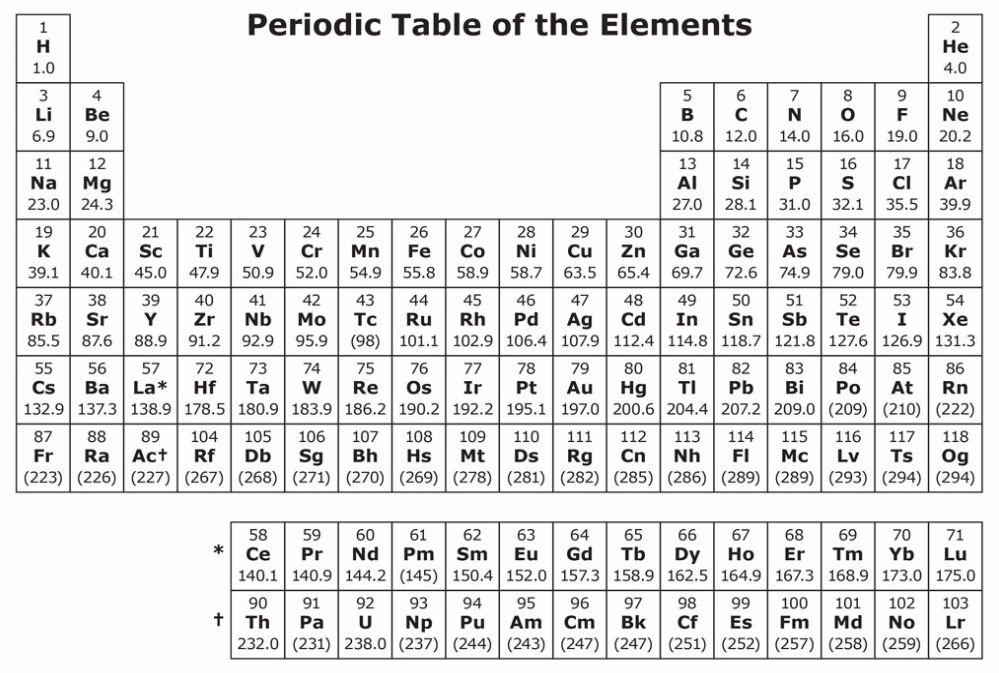
There are 1000 grams in a kilogram. Using the periodic table, we can derive the molar mass of acetic acid by adding the molar mass of each atom.
The molar mass of acetic acid is 60.05 g/mol.
Avogadro’s number tells us that there are 6.02E23 molecules per mole of a compound.
The expression that will cancel out intermediary units while obtaining our desired unit value is indicated here:
Suppose vinegar is 5% acetic acid by mass. Which of the following expressions would calculate the number of acetic acid molecules in 10 kilograms of vinegar?
A.
B.
C.
D.
The acid dissociation constant is an equilibrium constant for an acid dissociation chemical reaction and is shown in Figure 2.
An equilibrium constant is determined by a reaction quotient where equilibrium values of the product concentrations are on the numerator and the equilibrium values of the reactant concentrations are on the denominator.
In a reaction quotient, the contributions of pure liquid and solids is approximated to have a value of 1, therefore it is functionally omitted in the expression.
The products in the reaction of Figure 2 are CH3COO- and H3O+. The reactants in the reaction are CH3COOH and water. Since water is a liquid, we omit it from quotient. This yields the following expression: Ka=[CH3COOH]-[H30]+/[CH3COOH]
Which of the following quotients corresponds to the acid dissociation constant (Ka value) for acetic acid?
A. [CH3COOH]-[H30]+/[CH3COOH]
B. [CH3COOH]/[CH3COOH]-[H30]+
C. [CH3COOH]-[H30]+/CH3COOH
D. [CH3COO]-/[CH3COOH]
Adding additional catalyst would increase the reaction rate and therefore make the reaction approach the overall yield amount more quickly. However, it will not raise the overall yield amount of the reaction.
The passage states that the Monsanto process is performed under conditions where carbon monoxide (CO) is in excess. Adding additional CO will not increase the overall yield since the CO is not the limiting reagent.
Pressure is caused by gas molecules hitting the sides of the container. The more gas molecules you have in the container, the higher the pressure will be. Figure 3 indicates that there are molecules of gas in the reactants side of the reaction, while there are no molecules of gas in the products side of the reaction. According to Le Chatelier’s principle, decreasing the pressure will shift the position of the equilibrium towards the side with greater gas molecules. In this case, more reactants will form at the expense of the products.
Removing the acetic acid product as soon as it forms will push the equilibrium towards the products side of the reaction, thus increasing the overall yield of acetic acid.
Which of the following steps would increase the overall yield of acetic acid in the Monsanto process?
A. Removing acetic acid as soon as it forms.
B. Decreasing the pressure of reaction chamber
C. Adding additional rhodium catalyst.
D. Adding additional carbon monoxide.