| Questions Correct | Questions Answered | Time Spent | Status | Attempt Date | |
|---|---|---|---|---|---|
| -- | -- | -- | -- | -- |
| Questions Correct | Questions Answered | Time Spent | Status | Attempt Date | |
|---|---|---|---|---|---|
| -- | -- | -- | -- | -- |
Array
(
[passage] => WP_Post Object
(
[ID] => 559955
[post_author] => 12815
[post_date] => 2025-01-09 21:44:52
[post_date_gmt] => 2025-01-10 02:44:52
[post_content] => Practice Passage (Question 1-5)
*This passage is the property of Khan Academy and has been reformatted into an AAMC-style interface in their entirety by MedLife Mastery. MedLife Mastery does not endorse and is not an affiliate of Khan Academy.
Technetium-99m (Tc-99m), a nuclear isomer of technetium in the excited state, has numerous applications in medicine. Technetium-99m is the decay product of molybdenum-99 and undergoes gamma decay to form the ground state of technetium-99. Ground-state technetium-99 can further undergo decay to form ruthenium (element 44). The general synthesis and decay schematic is illustrated in Figure 1.
Figure 1. Tc-99m production and nuclear decay schematic with respective half lives for the decay reactions
The primary reaction of interest is the process by which Tc-99m decays to Tc-99. This reaction is utilized in cardiac perfusion imaging, where Tc-99m is injected directly into the bloodstream of the patient. Once it reaches the myocardium, it distributes proportionally to the myocardial blood flow. An instrument used to capture gamma rays emitted by the Tc-99m decay is employed to graphically depict the distribution of radioactive Tc-99m in blood.
Figure 2 shows the results of a Tc-99m myocardial perfusion study conducted on the same patient at rest and during exercise ("stress"). Three views of the heart are taken.
Figure 2. Tc-99m myocardial perfusion study conducted on the same patient during rest and activity
A study conducted at 25 cardiology centers compared the effectiveness of thallium-201 and technetium-99m perfusion tests in detecting myocardial under-perfusion among patients with different degrees of confirmed coronary artery blockage ("stenosis"). In this study, patients with confirmed 30%, 50%, and 75% coronary artery stenosis underwent sequential thallium-201 and technetium-99m perfusion studies. Their images were read by a panel of blinded cardiology experts to determine whether signs of perfusion defect in the myocardial tissue were evident in the imaging study. The study results comparing the mean detection rate of perfusion defects utilizing the two different imaging methods are shown in Figure 3.
Figure 3. Comparison of mean detection rates of perfusion defects utilizing thallium-201 and technetium-99m in patients with confirmed coronary artery stenosis
[post_title] => Technetium decay and its cardiac application
[post_excerpt] =>
[post_status] => publish
[comment_status] => closed
[ping_status] => closed
[post_password] =>
[post_name] => technetium-decay-and-its-cardiac-application
[to_ping] =>
[pinged] =>
[post_modified] => 2025-01-09 21:44:52
[post_modified_gmt] => 2025-01-10 02:44:52
[post_content_filtered] =>
[post_parent] => 0
[guid] => https://medlifemastery.com/?post_type=passage&p=559955
[menu_order] => 0
[post_type] => passage
[post_mime_type] =>
[comment_count] => 0
[filter] => raw
)
[questions] => Array
(
[0] => Array
(
[quiz_unique_key] => 578908434
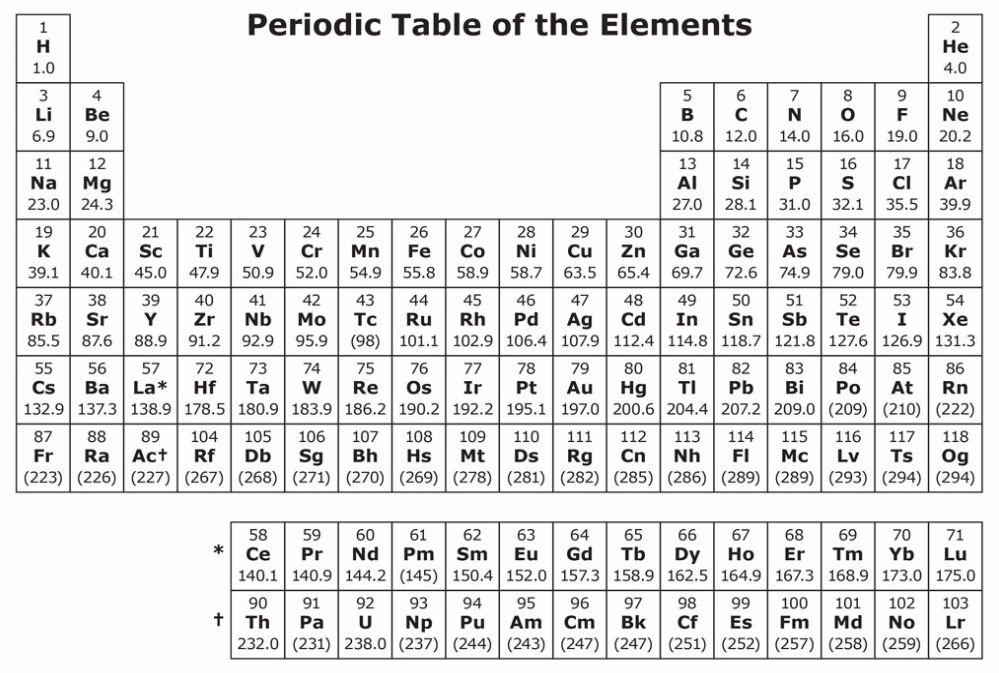
[question] => What property is the most similar among manganese, technetium, and rhenium (all Group 7 elements)?What property is the most similar among manganese, technetium, and rhenium (all Group 7 elements)?
[value] => Array
(
[answer] => 4
[description] => Reason for the Correct Answer:
Think about how the elements are distributed in the periodic table. Specifically, the location of the heavier elements and and what happens while moving across the rows (periods) and down the columns (groups) of the periodic table.
Moving down the group, atomic radius increases (additional electron shells) and ionization energy decreases (harder for the element to hold on to the outer electrons due to the increased atomic radius). Electronegativity measures how well an element attracts electrons to itself, and is similarly affected by atomic radius.
Electron configuration is the most similar among manganese, technetium, and rhenium, as all three elements would have 5 electrons in their respective d orbitals.
)
[answers] => Array
(
[0] => Array
(
[each_answer] => A. Ionization energy
)
[1] => Array
(
[each_answer] => B. Electronegativity
)
[2] => Array
(
[each_answer] => C. Atomic radius
)
[3] => Array
(
[each_answer] => D. Electron configuration
)
)
)
[1] => Array
(
[quiz_unique_key] => 3873426850
[question] => Comparison of mean detection rates of perfusion defects utilizing thallium-201 and technetium-99m in patients with confirmed coronary artery stenosis
[value] => Array
(
[answer] => 3
[description] => Reason for the Correct Answer:
Delta decay does not exist. Alpha decay emits an alpha particle (or helium-4; for example U-238 → Th-234 + α, or U-238 → Th-234 + He-4)
In ß+ decay, a proton is converted into a neutron and a positron. In ß– decay, a neutron is converted into a proton and an electron
ß– decay would be the correct answer, as a proton is gained between the transition from molybdenum to technetium, and then from technetium to ruthenium.
)
[answers] => Array
(
[0] => Array
(
[each_answer] =>
)
[1] => Array
(
[each_answer] =>
)
[2] => Array
(
[each_answer] =>
)
[3] => Array
(
[each_answer] =>
)
)
)
[2] => Array
(
[quiz_unique_key] => 83407773
[question] => Which is the correct path that injected Tc-99m travels to reach the myocardial tissues?
[value] => Array
(
[answer] => 1
[description] => Reason for the Correct Answer:
The coronary arteries are responsible for perfusing the myocardium.
The venous system transports deoxygenated blood to the right side of the heart, beginning from the right atrium then to the right ventricle. There, the blood goes on to the lungs for oxygenation.
The correct path is peripheral veins → right atrium → right ventricle → (pulmonary artery) (lungs) → (pulmonary veins) → left atrium → left ventricle → coronary arteries.
)
[answers] => Array
(
[0] => Array
(
[each_answer] => A. Peripheral veins → right atrium → right ventricle → left atrium → left ventricle → coronary arteries
)
[1] => Array
(
[each_answer] => B. Peripheral veins → right ventricle → right atrium → coronary arteries → left ventricle → left atrium
)
[2] => Array
(
[each_answer] => C. Peripheral veins → right atrium → right ventricle → coronary arteries → left atrium → left ventricle
)
[3] => Array
(
[each_answer] => D. Peripheral veins → right ventricle → right atrium → left ventricle → left atrium → coronary arteries
)
)
)
[3] => Array
(
[quiz_unique_key] => 2377279144
[question] => What can be concluded from Figure 2?
[value] => Array
(
[answer] => 1
[description] => Reason for the Correct Answer:
If Tc-99m distributes according to blood flow, the decay product (gamma rays) should be picked up by the sensor anywhere there is blood flow.
Compare carefully the three views of the heart and look for areas of poor perfusion (purple and green) and good perfusion (orange).
There are perfusion defects noted on all three views of the heart (at appropriately 3 o’clock position on the VLA view, the entire right portion (from 12 o’clock to 6 o’clock) on the HLA view, and again at approximately 3 o’clock position on the SA view).
)
[answers] => Array
(
[0] => Array
(
[each_answer] => A. There are perfusion defects noted on all three views of the heart.
)
[1] => Array
(
[each_answer] => B. There is no apparent perfusion defect between the exercise and resting state.
)
[2] => Array
(
[each_answer] => C. There is a perfusion defect noted on the VLA view of the heart.
)
[3] => Array
(
[each_answer] => D. There are perfusion defects noted on the VLA and HLA views of the heart.
)
)
)
[4] => Array
(
[quiz_unique_key] => 2261298308
[question] => What is the best conclusion that can be drawn from the study results shown in Figure 3?
[value] => Array
(
[answer] => 2
[description] => Reason for the Correct Answer:
Note carefully the p-values for comparisons at the three different levels. Only at the 75% stenosis level is the difference between technetium-99m and thallium-201 significant.
P-values can be used to determine whether differences are statistically significant, but does not provide information about causation or become clinical recommendations.
Since the p-value is not significant at 30% coronary artery stenosis (and also at 50%), detection rates of perfusion defects are similar between the two imaging methods. Per Hint 2, p-values cannot be used as the only factor in guiding clinical recommendations (for example, the toxicity and biological elimination of technetium-99m may need to be evaluated before it becomes the recommended detection modality at 75% stenosis). Also, p-values only provide information about statistical significance of the difference between two methods and does not represent efficiency. Both imaging modalities are arguably somewhat effective given that the two methods still detect >50% of perfusion defects across all levels of stenosis.
)
[answers] => Array
(
[0] => Array
(
[each_answer] => A. Neither method is effective for detecting perfusion defects at 30% or 50% coronary artery stenosis.
)
[1] => Array
(
[each_answer] => B. Detection rates of perfusion defects at 30% coronary artery stenosis are similar between technetium-99m and thallium-201.
)
[2] => Array
(
[each_answer] => C. Technetium-99m is the recommended imaging method for detecting perfusion defects at 75% coronary artery stenosis.
)
[3] => Array
(
[each_answer] => D. Thallium-201 should be used over Technetium-99m to detect perfusion defects at 50% coronary artery stenosis.
)
)
)
)
[total_question] => 5
[correct_answers] => Array
(
[559955|1] => D
[559955|2] => C
[559955|3] => A
[559955|4] => A
[559955|5] => B
)
[hide_display_feedback_settings] =>
[hide_solutions] =>
)