| Questions Correct | Questions Answered | Time Spent | Status | Attempt Date | |
|---|---|---|---|---|---|
| -- | -- | -- | -- | -- |
| Questions Correct | Questions Answered | Time Spent | Status | Attempt Date | |
|---|---|---|---|---|---|
| -- | -- | -- | -- | -- |
Array
(
[passage] => WP_Post Object
(
[ID] => 559907
[post_author] => 12815
[post_date] => 2025-01-09 21:35:28
[post_date_gmt] => 2025-01-10 02:35:28
[post_content] => Practice Passage (Question 1-5)
*This passage is the property of Khan Academy and has been reformatted into an AAMC-style interface in their entirety by MedLife Mastery. MedLife Mastery does not endorse and is not an affiliate of Khan Academy.
Interventional nuclear medicine is a specialty in medicine that uses radioactive isotopes to treat various medical ailments. These radioactive isotopes, or radioisotopes, are often attached to a specific biomolecular compound that targets a particular organ when injected intravenously or ingested orally. Once these radioisotopes reach their primary site of action, they remain in the targeted tissue until they undergo a radioactive decay process. This radioactive decay produces ionizing radiation that destroys the affected tissue. The short distance through which the radiation acts leaves the distant noninvolved tissues virtually unharmed.
There are various types of radioisotopes that are useful in destroying cancerous or hyperactive cells. Radioisotopes are selected for therapy based on their type and energy emissions, half-life, and chemical behavior.
Most therapeutic radioisotopes are either beta or alpha emitters. Beta emitters release highly energetic electrons that can penetrate several millimeters of tissues depending on their maximal energy emission (Emax). Alpha emitters release large helium nuclei into the surrounding tissues. These helium nuclei are roughly 100 to 1000 times more likely to cause significant biological damage than beta particles, but have a small range of action. Alpha emitters are used to deliver radiation in a highly localized manner, as most alpha-particles can only penetrate a few micrometers away from the source of emission. A table of some the most common therapeutic radioisotopes is provided Table 1.
Table 1: Characteristics of Various Therapeutic Radioisotopes
[post_title] => Therapeutic radioisotopes
[post_excerpt] =>
[post_status] => publish
[comment_status] => closed
[ping_status] => closed
[post_password] =>
[post_name] => therapeutic-radioisotopes
[to_ping] =>
[pinged] =>
[post_modified] => 2025-01-09 21:35:53
[post_modified_gmt] => 2025-01-10 02:35:53
[post_content_filtered] =>
[post_parent] => 0
[guid] => https://medlifemastery.com/?post_type=passage&p=559907
[menu_order] => 0
[post_type] => passage
[post_mime_type] =>
[comment_count] => 0
[filter] => raw
)
[questions] => Array
(
[0] => Array
(
[quiz_unique_key] => 578908434
[question] => Which of the following graphs correctly illustrates the radioactive decay curve of copper-64, iodine-131, and yttrium-90?
[value] => Array
(
[answer] => 2
[description] => Reason for the Correct Answer:
A decay curve displays how the concentration of a radioisotope decreases with respect to time.
Radioisotopes decay through a first order process, meaning that the rate of decay is depended on the concentration of the radioisotope.
Half-life is defined as the amount of time required for the radioisotopes to reach one half of its original concentration.
The smaller the half-life the faster a radioisotope will decay, and vice versa.
Look at the table provided in the passage to determine the half-life of copper-64, yttrium-90, and iodine-131.
Copper-64 has the smallest half-life, and hence will decay the fastest. Iodine-131 has the largest half-life, and will decay the slowest. Yttrium-90 has a half-life that is between the half-life of copper-64 and iodine-131, and therefore will decay at a rate in between the rates of the other two radioisotopes.
Graph 2 correctly illustrates the radioactive decay curve of copper-64, iodine-131, and yttrium-90
)
[answers] => Array
(
[0] => Array
(
[each_answer] =>
)
[1] => Array
(
[each_answer] =>
)
[2] => Array
(
[each_answer] =>
)
[3] => Array
(
[each_answer] =>
)
)
)
[1] => Array
(
[quiz_unique_key] => 3873426850
[question] => From the table provided in the passage, which radioisotope is best used to target and destroy large homogeneous tumors?
[value] => Array
(
[answer] => 1
[description] => Reason for the Correct Answer:
In order to eradicate a large homogenous tumor, a radioisotope needs to emit a particle is able to penetrate through the tumor.
Beta particles are far more penetrating than alpha particles, so a radioisotope that is a beta emitter would be preferred.
A radioisotope with a large emission energy will emit a particle that has a long range of action.
Yttirum-90 has the highest emission energy from the choices provided in the question, therefore it will be the most useful in targeting and destroying large homogeneous tumors.
)
[answers] => Array
(
[0] => Array
(
[each_answer] => A. Yttrium-90
)
[1] => Array
(
[each_answer] => B. Copper-67
)
[2] => Array
(
[each_answer] => C. Actinium-225
)
[3] => Array
(
[each_answer] => D. Bismuth-213
)
)
)
[2] => Array
(
[quiz_unique_key] => 83407773
[question] => Radioactive iodine-131 is given to patients for the treatment of hyperthyroidism caused by Grave’s disease. Which of the following equation correctly describes the radioactive decay of iodine-131?
[value] => Array
(
[answer] => 3
[description] => Reason for the Correct Answer:
Iodine-131 undergoes beta decay, which emits an electron and produces a proton from a neutron.
This increases the atomic number of the isotope by one because the nucleus now contains an extra proton.
The mass number does not change since, the total number of protons and neutron does not change.
The beta decay of iodine-131 produces xenon-131 along with a beta particle.
)
[answers] => Array
(
[0] => Array
(
[each_answer] =>
)
[1] => Array
(
[each_answer] =>
)
[2] => Array
(
[each_answer] =>
)
[3] => Array
(
[each_answer] =>
)
)
)
[3] => Array
(
[quiz_unique_key] => 2377279144
[question] => Phosphorus-32 is readily taken up and incorporated into the DNA of rapidly replicating cancerous cells. This unique property makes it useful as a radiopharmaceutical in eradicating malignant tumors. Which of the following is produced from the radioactive beta decay of phosphorus-32?
[value] => Array
(
[answer] => 1
[description] => Reason for the Correct Answer:
Phosphorus-32 undergoes beta decay which emits an electron and produces a proton from a neutron.
The atomic number, the number of protons, increases by one when an radioisotope undergoes beta decay.
The mass number, the total number of protons and neutrons, remains unchanged when a radioisotope undergoes beta decay.
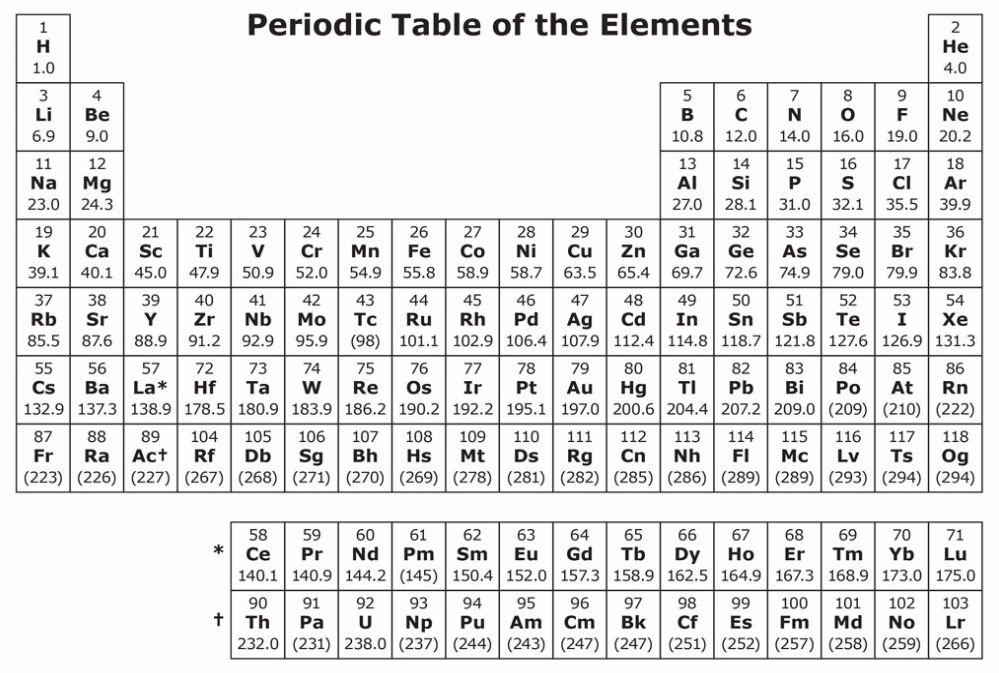
Use a periodic table, to determine which atom is formed when phosphorus-32 undergoes beta decay.
Phosphorus-32 gains an extra proton to become Sulfur-32.
)
[answers] => Array
(
[0] => Array
(
[each_answer] => A. Sulfur-32
)
[1] => Array
(
[each_answer] => B. Silicon-31
)
[2] => Array
(
[each_answer] => C. Sulfur-31
)
[3] => Array
(
[each_answer] => D. Silicon-32
)
)
)
[4] => Array
(
[quiz_unique_key] => 2261298308
[question] => Alpha particles and beta particles can be distinguished from each other based on their penetrating power, the ability of radiation to pass through matter. Which of the following depictions correctly illustrates the penetrating power of alpha and beta particles?
[value] => Array
(
[answer] => 3
[description] => Reason for the Correct Answer:
Alpha particles are far less penetrating than beta particles, because they have have a greater mass and charge than beta particles.
Having a greater mass and charge means that alpha particles are more likely to interact with matter present in the paper, and therefore will not be able to pass through.
Beta particles are electrons, which are much smaller than alpha particles. They can easily pass through the paper, but will be blocked by the much denser aluminum.
)
[answers] => Array
(
[0] => Array
(
[each_answer] =>
)
[1] => Array
(
[each_answer] =>
)
[2] => Array
(
[each_answer] =>
)
[3] => Array
(
[each_answer] =>
)
)
)
)
[total_question] => 5
[correct_answers] => Array
(
[559907|1] => B
[559907|2] => A
[559907|3] => C
[559907|4] => A
[559907|5] => C
)
[hide_display_feedback_settings] =>
[hide_solutions] =>
)