
Walking out of the NCLEX without knowing how it went is a hard place to be! The computer shut off, your brain feels fried, and you want an answer today. That restless feeling is completely normal.
Official results can take up to six weeks, and that’s why so many test-takers look for NCLEX early results. NCSBN’s Quick Results service shows an unofficial pass or fail two business days after your exam, if your board takes part.
Below, we’ll cover how Quick Results work, how to check them on Pearson VUE, whether they can be wrong, and what to do with the answer you get.
How NCLEX Early Results Work: Quick Results Explained
NCLEX early results come from Quick Results, a service NCSBN runs through your Pearson VUE account. If your nursing regulatory body (NRB) takes part, you can see an unofficial pass or fail two business days after your exam.
That’s a lot sooner than six weeks! Your NRB, usually your state board of nursing, sends the official result within six weeks. A Quick Result doesn’t authorize you to practice as a nurse.
Who can use NCLEX Quick Results
- Candidates seeking U.S. licensure whose NRB takes part. It isn’t available for licensure in Canada or Australia.
- Bought through your Pearson VUE account.
- Costs $7.95, charged only if your result is available.
- Shows only pass or fail, with no score or performance breakdown.
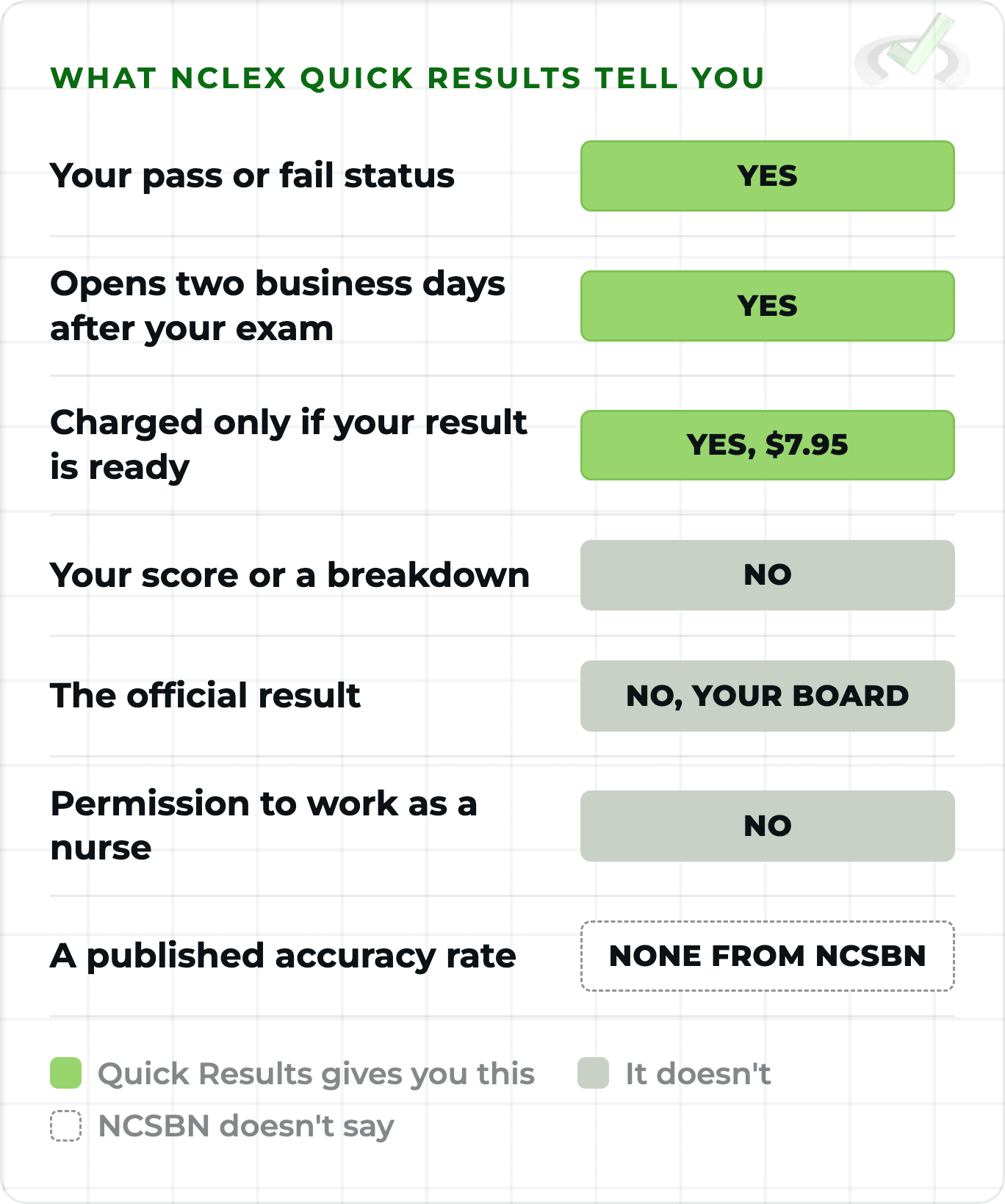
Official NCLEX results come only from your NRB. NCSBN asks candidates not to call NCSBN, Pearson VUE or the test center for results. NCSBN’s results page has the details.
How to Check NCLEX Quick Results on Pearson VUE
If your board takes part, checking takes a few minutes! Have your Pearson VUE sign-in and a credit card ready, then follow NCSBN’s steps.
- Wait two business days. Quick Results open two business days after your exam.
- Sign in to your Pearson VUE account with the username and password you registered with.
- Select Quick Results. It’s under “My Account.” If your result is available, click “Purchase.”
- Complete your order. Enter your payment information, click Next, then click “Submit Order.”
- View your result. It appears on the receipt page.
NCSBN only charges the $7.95 fee if your result is available. Fingers crossed for you!
Not through NCSBN. Quick Results is its only early option, and it opens two business days after your exam. An exam late in the week can mean waiting through the weekend. Hang in there!
Why NCLEX Early Results Take Two Business Days
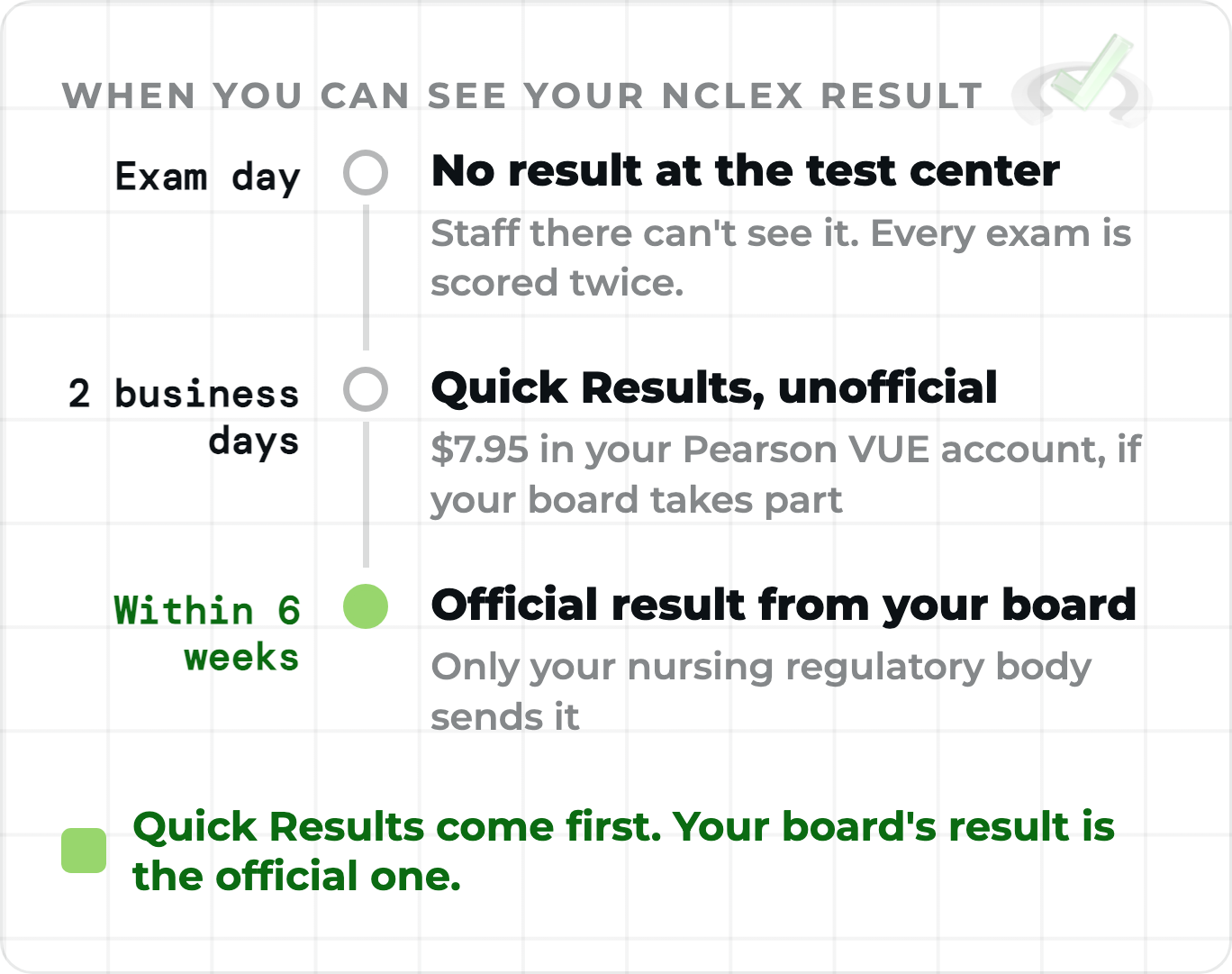
The computer scores your exam at the test center as you answer, but no result is released there, and test center staff can’t see it.
Every NCLEX is scored twice for quality control, once by the computer at the test center and again after your exam record reaches Pearson VUE. NCSBN doesn’t say why Quick Results post after two business days.
Is it 48 hours from the start or the end of your exam?
NCSBN’s Quick Results page says two business days after your exam. Its FAQ says 48 hours after your exam date and time.
Neither one says whether the clock starts when you begin or when you finish, so we’d give it the full two business days before you check. Our guide to how long NCLEX results take covers the whole timeline. We know the wait is tough!
Are NCLEX Quick Results Accurate? Can They Be Wrong?
If you’ve seen a pass or fail on Quick Results, you want to know if you can trust it. That’s a fair worry when so much rides on one screen, and we get it!
NCSBN doesn’t publish an accuracy rate for Quick Results, so no official figure answers this. NCSBN does say four things that bear on it.
- Every NCLEX is scored twice, once at the test center and again after the record reaches Pearson VUE.
- A Quick Result is unofficial, and only your NRB sends the official result.
- NCSBN can cancel or withhold a result if it has a good-faith reason to question it. Evidence can include unusual answer patterns or unusual score increases from one exam to another.
- A broken testing rule can put a result on hold. Writing on anything other than the noteboard is one example.
Can unofficial NCLEX results change from fail to pass?
NCSBN doesn’t publish whether, or how often, a Quick Result differs from the official one.
Until your NRB sends the official result, treat NCLEX early results as unofficial. Wait for the official word before you act on it, for example before you tell an employer you’re licensed.
Your NRB’s result is the confirmed answer. Until it arrives, a Quick Result is an early look, so try to hold your plans loosely for a few weeks. You’ve got this!
Does Every State Offer NCLEX Early Results?
Almost every one does! As of November 2026, NCSBN’s participating list covers every state except Delaware, plus Washington, D.C., the Northern Mariana Islands and the U.S. Virgin Islands.
Quick Results isn’t available for candidates seeking licensure in Canada or Australia. If your NRB doesn’t take part, NCLEX early results aren’t an option, and you’ll need to wait for the official result from your NRB.
The list can change, so check NCSBN’s Quick Results page before you test.
How the NCLEX Decides Your Pass or Fail Status
NCLEX early results show only pass or fail, and that result comes from how the exam scores you. The NCLEX uses computerized adaptive testing (CAT).
There’s no fixed number of questions, and you don’t pass based on a percentage score.
- Everyone starts with a question of relatively low difficulty.
- After each answer, the computer re-estimates your ability from all your answers so far.
- It then picks a question you have about a 50% chance of answering correctly.
Your ability estimate is compared with the passing standard, which is 0.00 logits for the NCLEX-RN and -0.18 logits for the NCLEX-PN through March 31, 2029. Our NCLEX passing score guide explains what those numbers mean.
Three ways the NCLEX can end
- You answer at least the minimum number of questions (85 for both the NCLEX-RN and the NCLEX-PN). The exam stops as soon as the computer is 95% certain your ability is clearly above or clearly below the passing standard.
- You reach the maximum number of questions (150 for both exams). The computer sets aside the 95% rule and uses your final ability estimate. At or above the passing standard, you pass.
- You run out of time. The exam has a five-hour limit. With fewer than 85 questions answered, you don’t pass. With 85 or more, the computer uses your final ability estimate, based on every answer you gave.
NCSBN also says the number of questions alone doesn’t determine or reveal a pass or fail, so the length of your exam doesn’t tell you your result. Our guide to how to know if you passed the NCLEX checks each sign people read into.
Every candidate gets the same rules, even when the exam doesn’t feel fair in the moment!
Pearson VUE Trick vs. NCLEX Early Results
People online talk about the Pearson VUE Trick (PVT). After the exam, you try to register for the NCLEX again and watch which message appears.
Neither NCSBN nor Pearson VUE offers the trick as a way to check your result, and NCSBN says official results come only from your NRB. If you’d like an early answer, Quick Results is NCSBN’s only early option.
Already tried it? Try not to read much into the screen you saw, good or bad. Trust Quick Results or your board’s result instead 🙂 We go deeper in our guide to the good and bad pop-ups and the Pearson VUE trick.
What If Your NCLEX Early Results Say You Failed?
Seeing “fail” on that receipt page hurts, and it’s okay to sit with that for a while. You’re not alone! This result doesn’t define you or your potential to be a great nurse.
In NCSBN’s 2025 statistics, 52.7% of repeat U.S.-educated NCLEX-RN candidates passed, and 41.7% of repeat U.S.-educated NCLEX-PN candidates did.
Wait for your Candidate Performance Report (CPR)
When a candidate fails, the NRB sends a Candidate Performance Report (CPR). It gives the number of questions you answered and summarizes your relative strengths and weaknesses across the test plan. Think of it as a map for next time!
Find your weak areas
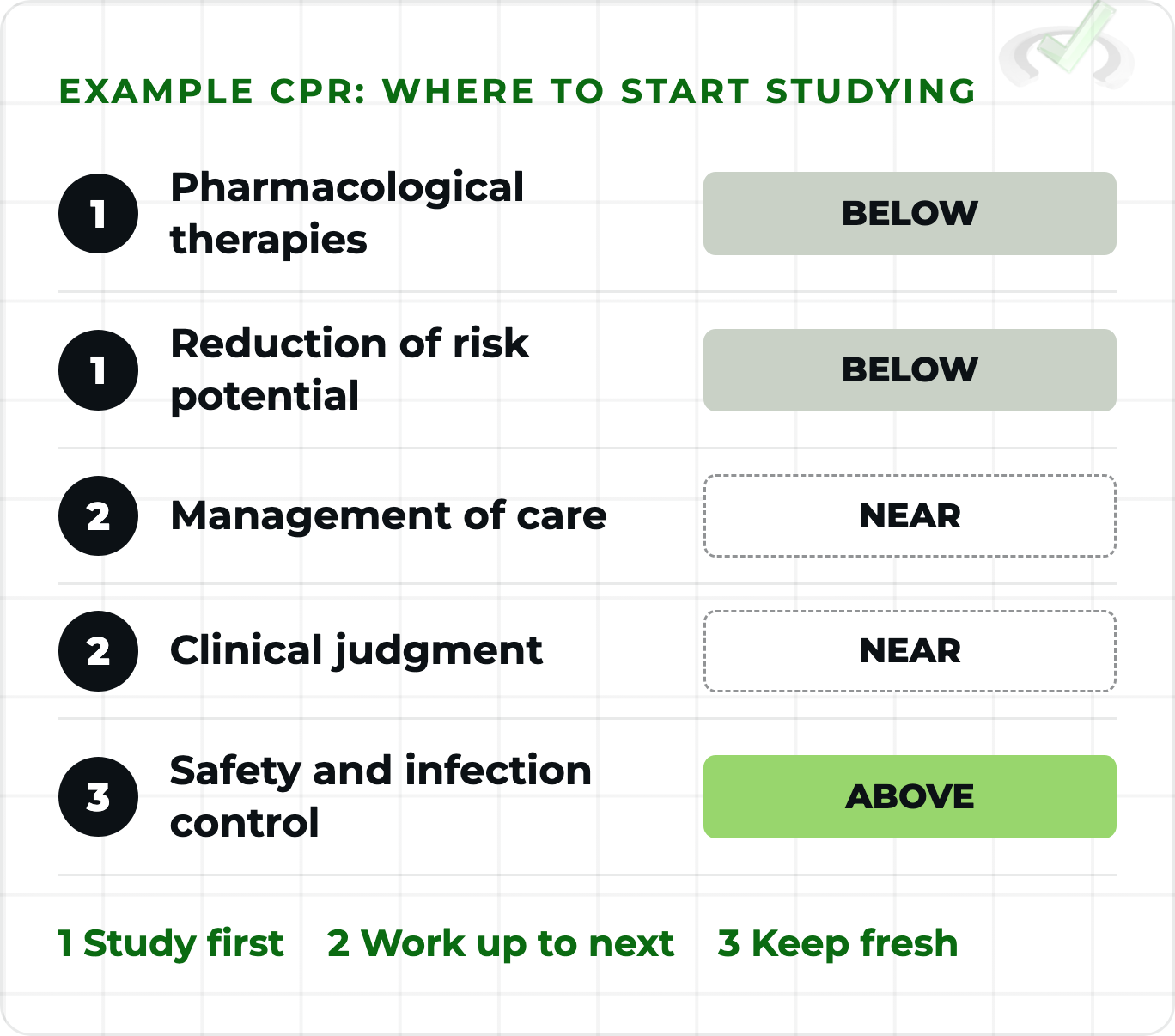
The NCLEX test plan has four Client Needs categories, and two of them split into subcategories, for eight content areas in all. The CPR rates each content area and clinical judgment as below, near or above the passing standard.
NCSBN suggests starting with the areas marked below the passing standard, then working up to the ones near it, and studying your stronger areas too so they stay fresh. One step at a time!
Plan your retake
- Contact your NRB and tell it you plan to retake. It will tell you which fees or materials it needs.
- Reregister with Pearson VUE.
- Wait for your new Authorization to Test (ATT).
- Schedule your new exam.
We suggest you prepare differently for your retake, with more practice questions and active recall and less rereading. Our free NCLEX cheat sheets cover every area of the RN and PN test plans, so start with the ones your CPR marks below the passing standard.
For a daily NCLEX-style question, a mnemonic and a study tip in your inbox, sign up for our free NCLEX Daily Dose emails near the top of this page. Our NCLEX retake tips go further. You can do this!
How to Prepare for the NCLEX and Your Retake
Taking the NCLEX is a major step toward your nursing license, and the adaptive format can feel unpredictable. A solid study plan and a calm test-day routine both help, on a first attempt or a retake.
Build a study plan that fits you
- Set a realistic schedule. Break your study time into shorter, focused sessions.
- Give your weaker areas more time. The NCLEX test plan has eight content areas, laid out in our NCLEX-RN content outline and NCLEX-PN content outline.
- Use active recall. Test yourself with flashcards or practice questions.
- Mix your study methods. Alternate between question banks, video lessons and textbook review.
- Practice under test conditions. Take full-length timed practice exams.
Our NCLEX study plans lay this out day by day, from one week to three months. Pick the one closest to your test date!
Do practice questions every day
The NCLEX measures clinical judgment, so focus on why each answer is right.
- Pick a daily question count you can finish and review in full. NCSBN doesn’t set one.
- Read every rationale, including the ones for questions you got right.
- Track your weak areas and review them more often.
Small daily sets build the habit, and you’ve got this!
The day before the NCLEX
- Get a full night’s sleep. Skip late-night studying so you can rest.
- Prepare your ID. It must be valid, government-issued and physical, with a recent photo, and its first and last names must match the ones you registered with.
- Know your test center location, and plan to arrive early.
- Keep last-minute review light. Trust the work you’ve put in.
Then rest. You’ve earned it!
During the exam
- Keep a steady pace. Read each question carefully.
- Rule out wrong answers, then compare what’s left.
- Settle each question before you move on. The NCLEX won’t let you go back to an earlier question.
- Breathe and reset if you feel overwhelmed. Breaks are optional, and they count toward your five hours.
Our day-before tips and NCLEX test day guide cover the rest.
NCLEX early results let you check an unofficial pass or fail two business days later. Whatever it says, this test doesn’t define your ability to be a great nurse!
NCLEX Early Results: Quick Answers
How much do NCLEX Quick Results cost?
$7.95, and NCSBN only charges your card if your result is available. No result, no charge!
When are NCLEX Quick Results available?
Two business days after your exam, through your Pearson VUE account, if your NRB takes part. Fingers crossed!
Are NCLEX early results official?
No. NCSBN calls Quick Results unofficial, and only your NRB sends the official result, within six weeks.
Can NCLEX Quick Results be wrong?
NCSBN doesn’t publish an accuracy rate. Treat NCLEX early results as unofficial until your NRB’s result arrives.
Do you get NCLEX results right away?
No. The test center doesn’t release results, so Quick Results two business days after your exam is the soonest. Hang tight!
Final Thoughts on NCLEX Early Results
Waiting on your NCLEX result is nerve-wracking, and you’ve already done the hardest part! NCLEX early results give you an unofficial pass or fail two business days after your exam, before your NRB sends the official result.
If you pass, congratulations! Check your NRB’s website for its licensing steps, and wait for the official result before you tell employers you’re licensed. If you don’t, you can start preparing for a retake while you wait for your CPR.
Our free NCLEX cheat sheets, our study plans and the NCLEX Daily Dose emails are here whenever you’re ready. We’re rooting for you 🙂