
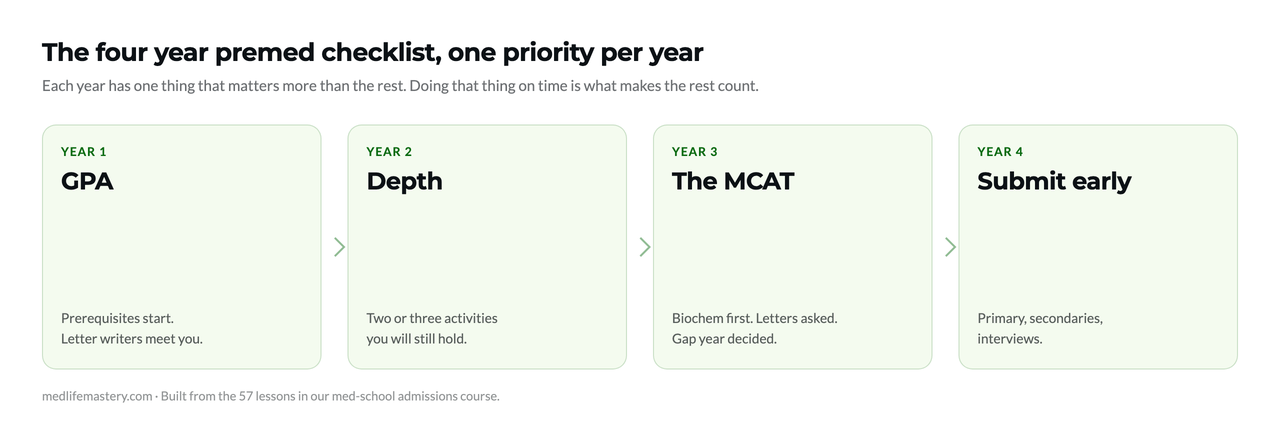
This four year premed checklist lays out what to do in each year of college to arrive at a medical school application that holds up. It is built from the 57 lessons in our med-school admissions course, laid onto the timeline rather than left as a library you have to sequence yourself.
Find the year you are in and work on that block. The years after it will still be there when you reach them.
- Why a four year premed checklist beats a to-do list
- Year one
- Year two
- Year three
- Year four
- Common questions
Free checklist
One page per year of college, with what to do and what it decides
The four year premed checklist, built from the 57 lessons in our admissions course.
On its way.
Check your inbox in the next minute.
Why a four year premed checklist beats a to-do list
Almost everything on a premed to-do list is true. Get clinical hours. Keep your GPA up. Find research. What a list leaves out is when, and when is what decides whether the work counts.
Letters of recommendation are the clearest example. A letter from a professor who taught you in second year and supervised you in third reads differently from one written by someone you asked in your final semester. Same professor, same student, different letter, because the timing changed what they had to say.
Year one: protect the number that compounds
The one thing that matters. Your GPA. A weak first year takes three years of strong grades to pull up and no single year undoes it. Admitted applicants average around 3.7 to 3.8 cumulative and 3.6 to 3.7 in science coursework.
- Start the prerequisite sequence: general chemistry and biology, with the math your school requires.
- Pick the major you will get the highest grades in while finishing prerequisites. A 3.8 in history beats a 3.2 in biology.
- Find one clinical setting that takes volunteers and start logging hours. Consistency over four years reads better than a burst in senior year.
- Go to office hours from week one. This is how the letter writers in year three get to know you.
What our mentors add here. Our lesson How To Be A Strong Med School Applicant spends most of its 27 minutes on this year, because the decisions are cheap now and expensive later.
Year two: start the things that need years, not weeks
The one thing that matters. Depth. Committees can tell the difference between four activities held for three years and twelve held for one semester each.
- Commit to two or three activities you will still be doing at application time.
- Approach a professor about research. Ask to help with something specific rather than asking whether they have space.
- Keep the prerequisite sequence moving: organic chemistry and physics usually land here.
- Begin a running document of what you did, when, and what happened. Your AMCAS activities section asks for exactly this, and reconstructing it in year four is where good experiences get lost.
Where students go wrong. Our How To Choose Your Activities lesson exists because the common failure is collecting activities rather than choosing them.
Get The Four Year Premed Checklist as a printable page per year
On its way.
Check your inbox in the next minute.
Year three: the MCAT year, and the year letters get earned
The one thing that matters. The MCAT, and it is the only item on this four year premed checklist with a hard external deadline.
- Finish biochemistry before you sit the exam. It is the prerequisite most students leave too late.
- Plan three to six months of dedicated preparation. Sit the exam by spring if you intend to apply that summer without a gap year.
- Work out the score your school list actually asks for rather than aiming at a national average. Our target score tool does that across 221 US and Canadian programs.
- Ask for letters this year, from people who have both taught and supervised you. Our three-part How To Get Recommendation Letters lessons cover who to ask and in what order.
- Decide on a gap year now rather than in spring. Taking one is normal and increasingly common, and the AAMC applicant resources report the same.
Year four: the application is a writing year
The one thing that matters. Getting the primary in early. Most schools review on a rolling basis, so a June submission and an August submission are not the same application.
- Primaries open late spring. Write the personal statement over months, not weeks.
- Build the school list against your real numbers rather than reputation. Our How to Make Your School List lesson runs 17 minutes on this alone.
- Budget for it. Applying to 20 schools with secondaries and travel runs into thousands, which our Cost of Applying to Medical School lesson breaks down properly.
- Prepare for secondaries before they arrive. They land within weeks of the primary and most of them are the same five questions in different words.
- Interview preparation starts in autumn. Traditional and MMI formats need different practice.
What this four year premed checklist deliberately leaves out
Specialty. You do not choose one in undergraduate study and choosing early carries no advantage, because the decision happens in the third year of medical school after clinical rotations. If you are here because you have already picked one, the premed roadmap shows where that choice actually sits.
Also missing: any claim that a particular college gets you in. AAMC data shows admitted applicants coming from every kind of institution and every major.
Common questions about the four year premed checklist
What if I am already in year three and behind?
Then a gap year is the answer, and it is a normal one. Our lesson Playing Catch-up: Switching to Premed Halfway Through Undergrad exists for exactly this, because a compressed timeline done properly beats a rushed application.
How many clinical hours do I need?
There is no published minimum, and hour counts matter less than what you can say about them. A hundred hours you can discuss in depth reads better than four hundred you cannot.
Does my major matter?
No. The prerequisites matter. Medical schools admit applicants from every major, and AACOM reports the same for osteopathic programs.
When exactly should I take the MCAT?
Spring of your third year for a summer application without a gap year, and after biochemistry either way. Our guide on when to take the MCAT covers the timing in full.
Is a gap year a disadvantage?
No. It is common enough that the average matriculant is now well past 22, and a year that produces real clinical or research experience strengthens the application rather than delaying it.
Where do I get the whole checklist?
The download above is this four year premed checklist as a printable page per year, and every free premed and MCAT resource we publish sits in the free resource library, and our application coaching picks up where the checklist ends.
This four year premed checklist lays out what to do in each year of college to arrive at a medical school application that holds up. It is built from the 57 lessons in our med-school admissions course, laid onto the timeline rather than left as a library you have to sequence yourself.
Find the year you are in and work on that block. The years after it will still be there when you reach them.
- Why a four year premed checklist beats a to-do list
- Year one
- Year two
- Year three
- Year four
- Common questions
Free checklist
One page per year of college, with what to do and what it decides
The four year premed checklist, built from the 57 lessons in our admissions course.
On its way.
Check your inbox in the next minute.
Why a four year premed checklist beats a to-do list
Almost everything on a premed to-do list is true. Get clinical hours. Keep your GPA up. Find research. What a list leaves out is when, and when is what decides whether the work counts.
Letters of recommendation are the clearest example. A letter from a professor who taught you in second year and supervised you in third reads differently from one written by someone you asked in your final semester. Same professor, same student, different letter, because the timing changed what they had to say.
Year one: protect the number that compounds
The one thing that matters. Your GPA. A weak first year takes three years of strong grades to pull up and no single year undoes it. Admitted applicants average around 3.7 to 3.8 cumulative and 3.6 to 3.7 in science coursework.
- Start the prerequisite sequence: general chemistry and biology, with the math your school requires.
- Pick the major you will get the highest grades in while finishing prerequisites. A 3.8 in history beats a 3.2 in biology.
- Find one clinical setting that takes volunteers and start logging hours. Consistency over four years reads better than a burst in senior year.
- Go to office hours from week one. This is how the letter writers in year three get to know you.
What our mentors add here. Our lesson How To Be A Strong Med School Applicant spends most of its 27 minutes on this year, because the decisions are cheap now and expensive later.
Year two: start the things that need years, not weeks
The one thing that matters. Depth. Committees can tell the difference between four activities held for three years and twelve held for one semester each.
- Commit to two or three activities you will still be doing at application time.
- Approach a professor about research. Ask to help with something specific rather than asking whether they have space.
- Keep the prerequisite sequence moving: organic chemistry and physics usually land here.
- Begin a running document of what you did, when, and what happened. Your AMCAS activities section asks for exactly this, and reconstructing it in year four is where good experiences get lost.
Where students go wrong. Our How To Choose Your Activities lesson exists because the common failure is collecting activities rather than choosing them.
Get The Four Year Premed Checklist as a printable page per year
On its way.
Check your inbox in the next minute.
Year three: the MCAT year, and the year letters get earned
The one thing that matters. The MCAT, and it is the only item on this four year premed checklist with a hard external deadline.
- Finish biochemistry before you sit the exam. It is the prerequisite most students leave too late.
- Plan three to six months of dedicated preparation. Sit the exam by spring if you intend to apply that summer without a gap year.
- Work out the score your school list actually asks for rather than aiming at a national average. Our target score tool does that across 221 US and Canadian programs.
- Ask for letters this year, from people who have both taught and supervised you. Our three-part How To Get Recommendation Letters lessons cover who to ask and in what order.
- Decide on a gap year now rather than in spring. Taking one is normal and increasingly common, and the AAMC applicant resources report the same.
Year four: the application is a writing year
The one thing that matters. Getting the primary in early. Most schools review on a rolling basis, so a June submission and an August submission are not the same application.
- Primaries open late spring. Write the personal statement over months, not weeks.
- Build the school list against your real numbers rather than reputation. Our How to Make Your School List lesson runs 17 minutes on this alone.
- Budget for it. Applying to 20 schools with secondaries and travel runs into thousands, which our Cost of Applying to Medical School lesson breaks down properly.
- Prepare for secondaries before they arrive. They land within weeks of the primary and most of them are the same five questions in different words.
- Interview preparation starts in autumn. Traditional and MMI formats need different practice.
What this four year premed checklist deliberately leaves out
Specialty. You do not choose one in undergraduate study and choosing early carries no advantage, because the decision happens in the third year of medical school after clinical rotations. If you are here because you have already picked one, the premed roadmap shows where that choice actually sits.
Also missing: any claim that a particular college gets you in. AAMC data shows admitted applicants coming from every kind of institution and every major.
Common questions about the four year premed checklist
What if I am already in year three and behind?
Then a gap year is the answer, and it is a normal one. Our lesson Playing Catch-up: Switching to Premed Halfway Through Undergrad exists for exactly this, because a compressed timeline done properly beats a rushed application.
How many clinical hours do I need?
There is no published minimum, and hour counts matter less than what you can say about them. A hundred hours you can discuss in depth reads better than four hundred you cannot.
Does my major matter?
No. The prerequisites matter. Medical schools admit applicants from every major, and AACOM reports the same for osteopathic programs.
When exactly should I take the MCAT?
Spring of your third year for a summer application without a gap year, and after biochemistry either way. Our guide on when to take the MCAT covers the timing in full.
Is a gap year a disadvantage?
No. It is common enough that the average matriculant is now well past 22, and a year that produces real clinical or research experience strengthens the application rather than delaying it.
Where do I get the whole checklist?
The download above is this four year premed checklist as a printable page per year, and every free premed and MCAT resource we publish sits in the free resource library, and our application coaching picks up where the checklist ends.