What MCAT Score Do You Need? [Free MCAT Target Score Tool]
Working out what MCAT score you need starts with your school list. Add yours below.
The MCAT score calculator converts your raw section scores from the free AAMC unscored sample test into a scaled score and percentile rank, and links you to the test if you have not sat it yet.
How to read your target
What score do you need? The answer depends on where you are applying. A list built around in-state MD programs asks for a different number than one topped with research-heavy privates, and a DO list is different again.
Aim for is the middle of your list, measured at the top of each school's published range. Hit it and you sit at or above the typical admitted student at roughly half your schools, and within reach at most of the rest.
Comfortable sits a point clear of the upper quarter of your list. It is the target that holds up even when the rest of your application is only average.
Toughest on your list is the single highest figure among the schools you picked. When that number sits far above the others, one school is setting your whole target, and it is worth asking whether it belongs on the list.
Your gap is the distance from your current total to the aim-for figure. A gap of one or two points falls inside the measurement error of the exam itself, which is what MCAT confidence bands describe.
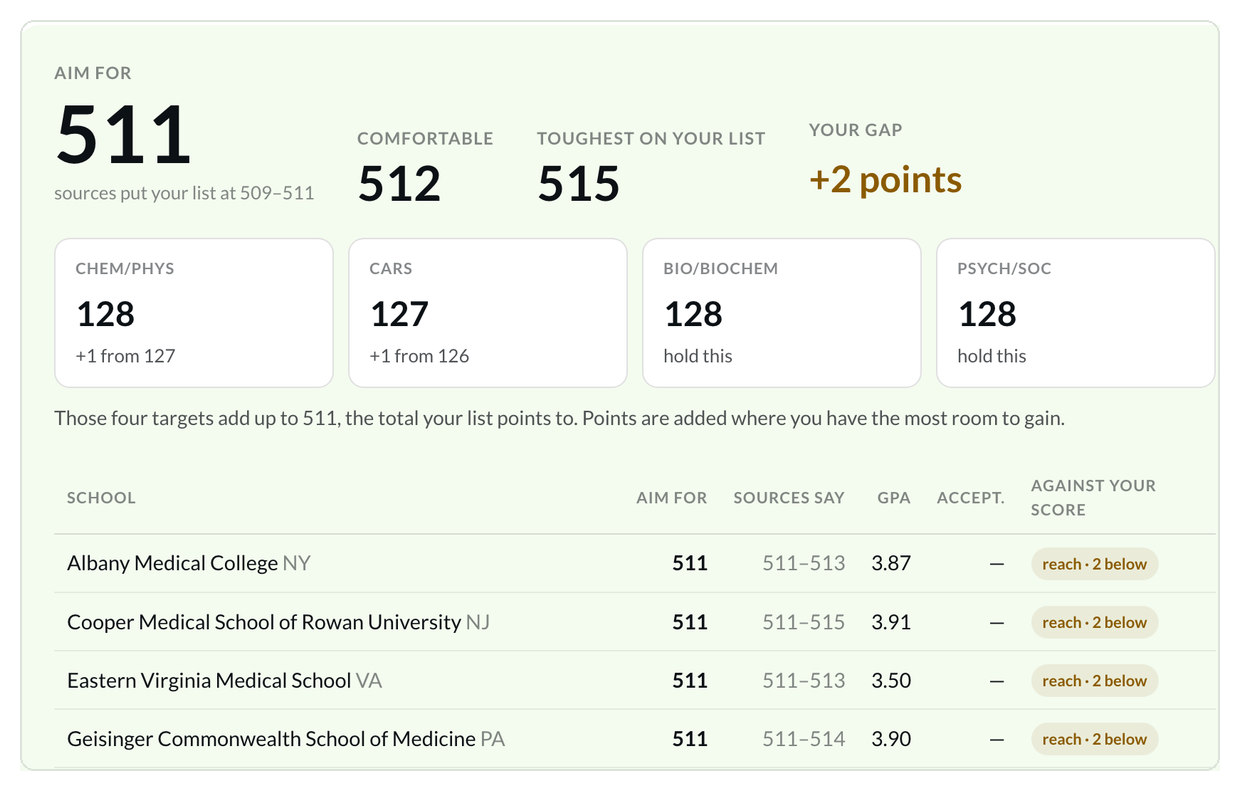
Sample only: ten Midwest schools and a current 509, giving a 512 target with all three points in CARS.
Why the section split matters
Two students holding a 509 can be in very different positions. A 130/124/128/127 and a 127/127/127/128 need different work over the next month, and some schools read the four numbers as closely as the total. The tool adds your missing points where you have the most room to gain, which is usually your weakest section. Score profiles covers how admissions committees read the split.
Where these numbers come from
Each school's figure is reconciled across six published sources rather than taken from one. Where the sources agree, you see a single number. Where they disagree, the range beside it shows by how much, and the aim-for column uses the figure that recurs most often across the sources.
These are averages of admitted students. They are not cut-offs, and half of the students admitted to any school scored below the number shown. A school stays realistic below its average when the rest of the application carries weight.
For the underlying tables, see MCAT scores for US medical schools and Canadian medical school averages.
Common questions about what MCAT score you need
What MCAT score do I need for medical school?
There is no one number, which is why what MCAT score you need is a question this page asks for your list before answering. Across the 238 US MD programs in this dataset the average sits at 512.7, and across the 50 DO programs it sits at 504.5. The AAMC publishes the national MD figures each cycle, and AACOM does the same for DO programs. Individual schools run from 498 to 523, so two applicants with sensible lists can be chasing targets ten points apart.
Should I aim for a school's average or above it?
Aim above. Landing exactly on the average means half the admitted class scored higher than you did, and the rest of your application has to carry that difference. The comfortable figure in the tool is the version of your target that survives an ordinary GPA and an ordinary set of extracurriculars.
Is a school's average MCAT a cut-off?
No. Most schools do screen, but the screen sits well below the average, and many programs publish no threshold at all. Read the average as where the middle of the admitted class landed, which is the honest way to think about what MCAT score you need for that school, then decide how much of your gap is worth closing before you apply.
Does my target change if my GPA is low?
In practice, yes. A GPA below a school's admitted average puts more weight on the MCAT, and applicants in that position usually chase the comfortable figure rather than the average. Add your GPA in the tool and you can see which schools on your list you already clear on both measures, which shifts what MCAT score you need up or down accordingly.
Do the sections matter or only the total?
Both. The total gets you past the screen and the sections get read afterwards. A section in the low 120s draws attention even when the total looks healthy, and a handful of schools state a section minimum outright. That is why the tool hands you a split rather than one number: what MCAT score you need is really four numbers wearing one label.
What if my target is more than ten points above my score?
Ten points is an ordinary move across a full prep cycle and a rare one across four weeks. Start with the section split, because gaps that size almost always sit in one or two sections rather than spread evenly across all four, and that changes what you should be working on. The score improvement guides break the work down by section.
Why do the sources disagree on some schools?
Published aggregators pull from different application cycles and sometimes report different things: one lists the matriculant average, another the applicant average, a third a stated minimum. Where the spread reaches three points or more, the tool shows the range so you can see the uncertainty instead of inheriting it silently.
Does this cover DO and Canadian schools?
Yes. The dataset holds 238 US MD programs, 50 US DO programs and 9 Canadian MD programs. Canadian schools are marked CA in the results and DO programs are marked DO. McMaster is left out because it weighs CARS on its own rather than the total.
How current is this data?
The figures reflect the most recently published cycle available from each source at the time of the last update. Schools report on their own timetable, so a handful lag the others by a cycle. Check the school's own admissions page, or the AAMC applicant resources, before you make a final call on a borderline program.