
This premed roadmap lays out the whole route from where you are now to practising in a medical specialty. Five stages, a fixed order, and a total that runs from eleven years to fifteen depending on the specialty you end up in.
If you arrived here searching for the best college for a specialty, the useful thing to know first is that no undergraduate degree leads to one. Every doctor in the United States takes the same path, and the specialty gets chosen most of the way along it.
What this premed roadmap covers
Free guide
The whole premed roadmap on one sheet, from high school to practising in a specialty
Every stage, how long each specialty takes, and what to do in the year you are in.
On its way.
Check your inbox in the next minute.
The five stages, in order
Every stage has one job. Doing the job of the stage you are standing in beats worrying about the stages past it.
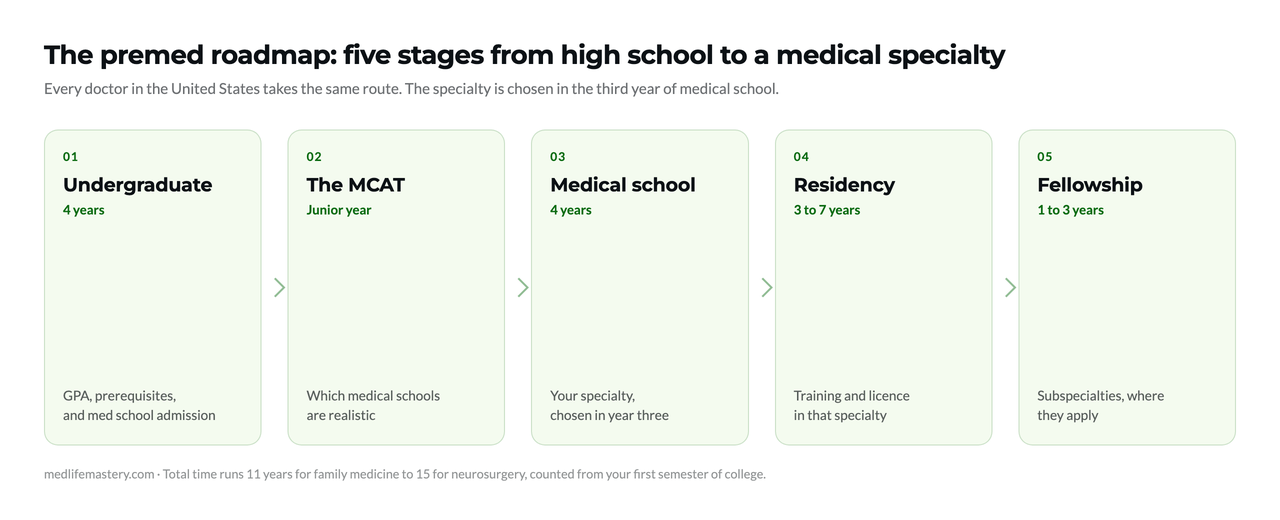
| Stage | Length | What it decides |
|---|---|---|
| Undergraduate | 4 years | Your GPA, your prerequisite coursework, and whether you get into medical school at all. |
| The MCAT | Usually junior year | Alongside GPA, which medical schools are realistic for you. |
| Medical school | 4 years | Your specialty. Chosen in year three, applied for in year four. |
| Residency | 3 to 7 years | Where you train in that specialty and become licensed to practise it. |
| Fellowship | 1 to 3 years, optional | Subspecialties. Cardiology, forensic pathology and sports medicine sit here. |
Residency programs are accredited by the Accreditation Council for Graduate Medical Education, which sets the minimum length for each specialty. Those lengths are the numbers this premed roadmap is built on.
What actually decides your specialty options
Specialties differ in how competitive they are, and competitiveness is settled inside medical school rather than before it. Your Step 2 score, your clinical grades, your research output and your letters do the work, and all four sit three or four years past where you are standing.
Which is why a high school student set on neurosurgery gets the same advice as one set on family medicine: get into medical school. Once you are in, every door is still open, and two years of coursework will have changed your mind about which door you want. The National Resident Matching Program publishes the data on how each specialty actually fills.
How long each specialty takes
Residency length is fixed by the specialty, so it is one of the few numbers on this premed roadmap you can plan around from a standing start. Years below count from your first semester of undergraduate study and include an intern year where one is required.
| Specialty | Residency | Total from starting college |
|---|---|---|
| Family medicine | 3 years | 11 years |
| Internal medicine | 3 years | 11 years |
| Pediatrics | 3 years | 11 years |
| Emergency medicine | 3 to 4 years | 11 to 12 years |
| Pathology | 3 to 4 years | 11 to 12 years |
| Psychiatry | 4 years | 12 years |
| Anesthesiology | 4 years | 12 years |
| Neurology | 4 years | 12 years |
| Obstetrics and gynecology | 4 years | 12 years |
| Dermatology | 4 years | 12 years |
| Ophthalmology | 4 years | 12 years |
| Radiology | 5 years | 13 years |
| General surgery | 5 years | 13 years |
| Urology | 5 years | 13 years |
| Orthopaedic surgery | 5 years | 13 years |
| Plastic surgery | 6 years | 14 years |
| Neurosurgery | 7 years | 15 years |
Subspecialties add a fellowship on top. Forensic pathology is pathology plus one year, so thirteen in total. Cardiology is internal medicine plus three, so fourteen. Sports medicine is usually a primary care residency plus one, so twelve. Our guides to each specialty go through them one at a time.
Get The Premed Roadmap as a printable guide
On its way.
Check your inbox in the next minute.
What matters in undergraduate study
Your major does not matter. Your prerequisites do.
Medical schools accept applicants from every major, and AAMC data shows non-science majors admitted at rates comparable to biology majors. What every school requires is a set of prerequisite courses: general chemistry, organic chemistry, biology, physics, biochemistry, and usually English, math and a social science.
Pick the major you will get the highest grades in while completing those courses. A 3.8 in history with the prerequisites done beats a 3.2 in biology.
Your GPA compounds, so first year counts more than it feels like it should
A weak freshman year takes three years of strong grades to pull up, and no single year undoes it entirely. Admitted applicants average around 3.7 to 3.8 cumulative, and around 3.6 to 3.7 in science coursework specifically.
Clinical exposure is what makes the application credible
Shadowing, scribing, hospital volunteering, working as an EMT or a medical assistant. Admissions committees are checking that you have seen the job before committing to it. Starting in your first or second year gives you hours nobody can question and time to find out whether you like it.
What to do this year
Find yourself on this part of the premed roadmap and work on that row. The rest will still be there when you reach it.
If you are in high school
Take the hardest science and math your school offers, get into a college you can afford and do well at, and find any clinical setting that will take a volunteer. Where you go to college matters far less than your grades once you are there.
If you are in your first or second year
Protect your GPA above everything else, start the prerequisite sequence, and begin accumulating clinical and volunteer hours. Find a professor whose research interests you and ask to help.
If you are in your third year
This is the MCAT year for most applicants. Plan three to six months of dedicated preparation and sit the exam by spring if you intend to apply that summer without a gap year. Our guide on when to take the MCAT goes through the timing, and the target score tool works out the number your school list actually asks for.
If you are in your fourth year or beyond
You are in application territory. Primary applications open in late spring, secondaries follow within weeks, and interviews run through the following winter. See the full medical school application timeline. A gap year is normal and increasingly common.
Common questions about the premed roadmap
Do I have to decide on a specialty now?
No, and deciding now carries no advantage. Most medical students change their minds during clinical rotations, which is what rotations are for.
Does the medical school I attend decide my specialty?
It influences the odds at the most competitive specialties, mostly through research access and home-program connections. It does not determine them, and students match into competitive fields from schools of every rank every year.
What GPA and MCAT will I need?
It depends entirely on the schools you apply to. Across US MD programs the admitted average sits near 512, and across DO programs nearer 504, with individual schools running from 498 to 523. The MCAT scores by medical school table has the figures per program.
Can I do this if I did not study science?
Yes. You need the prerequisite courses rather than the major. Career changers complete them through post-baccalaureate programs, and medical schools admit non-traditional applicants every cycle.
How much does the whole thing cost?
Four years of undergraduate study plus four years of medical school, and residency pays a salary that is modest against the hours. Median medical school debt at graduation sits around two hundred thousand dollars. It is worth planning for early, and it is why the years-to-completion table above is the part of this premed roadmap worth reading twice.
Where can I get the whole thing as a guide?
The download above is this premed roadmap as a printable PDF, and every free premed and MCAT resource we publish sits in the free resource library.
This premed roadmap lays out the whole route from where you are now to practising in a medical specialty. Five stages, a fixed order, and a total that runs from eleven years to fifteen depending on the specialty you end up in.
If you arrived here searching for the best college for a specialty, the useful thing to know first is that no undergraduate degree leads to one. Every doctor in the United States takes the same path, and the specialty gets chosen most of the way along it.
What this premed roadmap covers
Free guide
The whole premed roadmap on one sheet, from high school to practising in a specialty
Every stage, how long each specialty takes, and what to do in the year you are in.
On its way.
Check your inbox in the next minute.
The five stages, in order
Every stage has one job. Doing the job of the stage you are standing in beats worrying about the stages past it.
| Stage | Length | What it decides |
|---|---|---|
| Undergraduate | 4 years | Your GPA, your prerequisite coursework, and whether you get into medical school at all. |
| The MCAT | Usually junior year | Alongside GPA, which medical schools are realistic for you. |
| Medical school | 4 years | Your specialty. Chosen in year three, applied for in year four. |
| Residency | 3 to 7 years | Where you train in that specialty and become licensed to practise it. |
| Fellowship | 1 to 3 years, optional | Subspecialties. Cardiology, forensic pathology and sports medicine sit here. |
Residency programs are accredited by the Accreditation Council for Graduate Medical Education, which sets the minimum length for each specialty. Those lengths are the numbers this premed roadmap is built on.
What actually decides your specialty options
Specialties differ in how competitive they are, and competitiveness is settled inside medical school rather than before it. Your Step 2 score, your clinical grades, your research output and your letters do the work, and all four sit three or four years past where you are standing.
Which is why a high school student set on neurosurgery gets the same advice as one set on family medicine: get into medical school. Once you are in, every door is still open, and two years of coursework will have changed your mind about which door you want. The National Resident Matching Program publishes the data on how each specialty actually fills.
How long each specialty takes
Residency length is fixed by the specialty, so it is one of the few numbers on this premed roadmap you can plan around from a standing start. Years below count from your first semester of undergraduate study and include an intern year where one is required.
| Specialty | Residency | Total from starting college |
|---|---|---|
| Family medicine | 3 years | 11 years |
| Internal medicine | 3 years | 11 years |
| Pediatrics | 3 years | 11 years |
| Emergency medicine | 3 to 4 years | 11 to 12 years |
| Pathology | 3 to 4 years | 11 to 12 years |
| Psychiatry | 4 years | 12 years |
| Anesthesiology | 4 years | 12 years |
| Neurology | 4 years | 12 years |
| Obstetrics and gynecology | 4 years | 12 years |
| Dermatology | 4 years | 12 years |
| Ophthalmology | 4 years | 12 years |
| Radiology | 5 years | 13 years |
| General surgery | 5 years | 13 years |
| Urology | 5 years | 13 years |
| Orthopaedic surgery | 5 years | 13 years |
| Plastic surgery | 6 years | 14 years |
| Neurosurgery | 7 years | 15 years |
Subspecialties add a fellowship on top. Forensic pathology is pathology plus one year, so thirteen in total. Cardiology is internal medicine plus three, so fourteen. Sports medicine is usually a primary care residency plus one, so twelve. Our guides to each specialty go through them one at a time.
Get The Premed Roadmap as a printable guide
On its way.
Check your inbox in the next minute.
What matters in undergraduate study
Your major does not matter. Your prerequisites do.
Medical schools accept applicants from every major, and AAMC data shows non-science majors admitted at rates comparable to biology majors. What every school requires is a set of prerequisite courses: general chemistry, organic chemistry, biology, physics, biochemistry, and usually English, math and a social science.
Pick the major you will get the highest grades in while completing those courses. A 3.8 in history with the prerequisites done beats a 3.2 in biology.
Your GPA compounds, so first year counts more than it feels like it should
A weak freshman year takes three years of strong grades to pull up, and no single year undoes it entirely. Admitted applicants average around 3.7 to 3.8 cumulative, and around 3.6 to 3.7 in science coursework specifically.
Clinical exposure is what makes the application credible
Shadowing, scribing, hospital volunteering, working as an EMT or a medical assistant. Admissions committees are checking that you have seen the job before committing to it. Starting in your first or second year gives you hours nobody can question and time to find out whether you like it.
What to do this year
Find yourself on this part of the premed roadmap and work on that row. The rest will still be there when you reach it.
If you are in high school
Take the hardest science and math your school offers, get into a college you can afford and do well at, and find any clinical setting that will take a volunteer. Where you go to college matters far less than your grades once you are there.
If you are in your first or second year
Protect your GPA above everything else, start the prerequisite sequence, and begin accumulating clinical and volunteer hours. Find a professor whose research interests you and ask to help.
If you are in your third year
This is the MCAT year for most applicants. Plan three to six months of dedicated preparation and sit the exam by spring if you intend to apply that summer without a gap year. Our guide on when to take the MCAT goes through the timing, and the target score tool works out the number your school list actually asks for.
If you are in your fourth year or beyond
You are in application territory. Primary applications open in late spring, secondaries follow within weeks, and interviews run through the following winter. See the full medical school application timeline. A gap year is normal and increasingly common.
Common questions about the premed roadmap
Do I have to decide on a specialty now?
No, and deciding now carries no advantage. Most medical students change their minds during clinical rotations, which is what rotations are for.
Does the medical school I attend decide my specialty?
It influences the odds at the most competitive specialties, mostly through research access and home-program connections. It does not determine them, and students match into competitive fields from schools of every rank every year.
What GPA and MCAT will I need?
It depends entirely on the schools you apply to. Across US MD programs the admitted average sits near 512, and across DO programs nearer 504, with individual schools running from 498 to 523. The MCAT scores by medical school table has the figures per program.
Can I do this if I did not study science?
Yes. You need the prerequisite courses rather than the major. Career changers complete them through post-baccalaureate programs, and medical schools admit non-traditional applicants every cycle.
How much does the whole thing cost?
Four years of undergraduate study plus four years of medical school, and residency pays a salary that is modest against the hours. Median medical school debt at graduation sits around two hundred thousand dollars. It is worth planning for early, and it is why the years-to-completion table above is the part of this premed roadmap worth reading twice.
Where can I get the whole thing as a guide?
The download above is this premed roadmap as a printable PDF, and every free premed and MCAT resource we publish sits in the free resource library.