
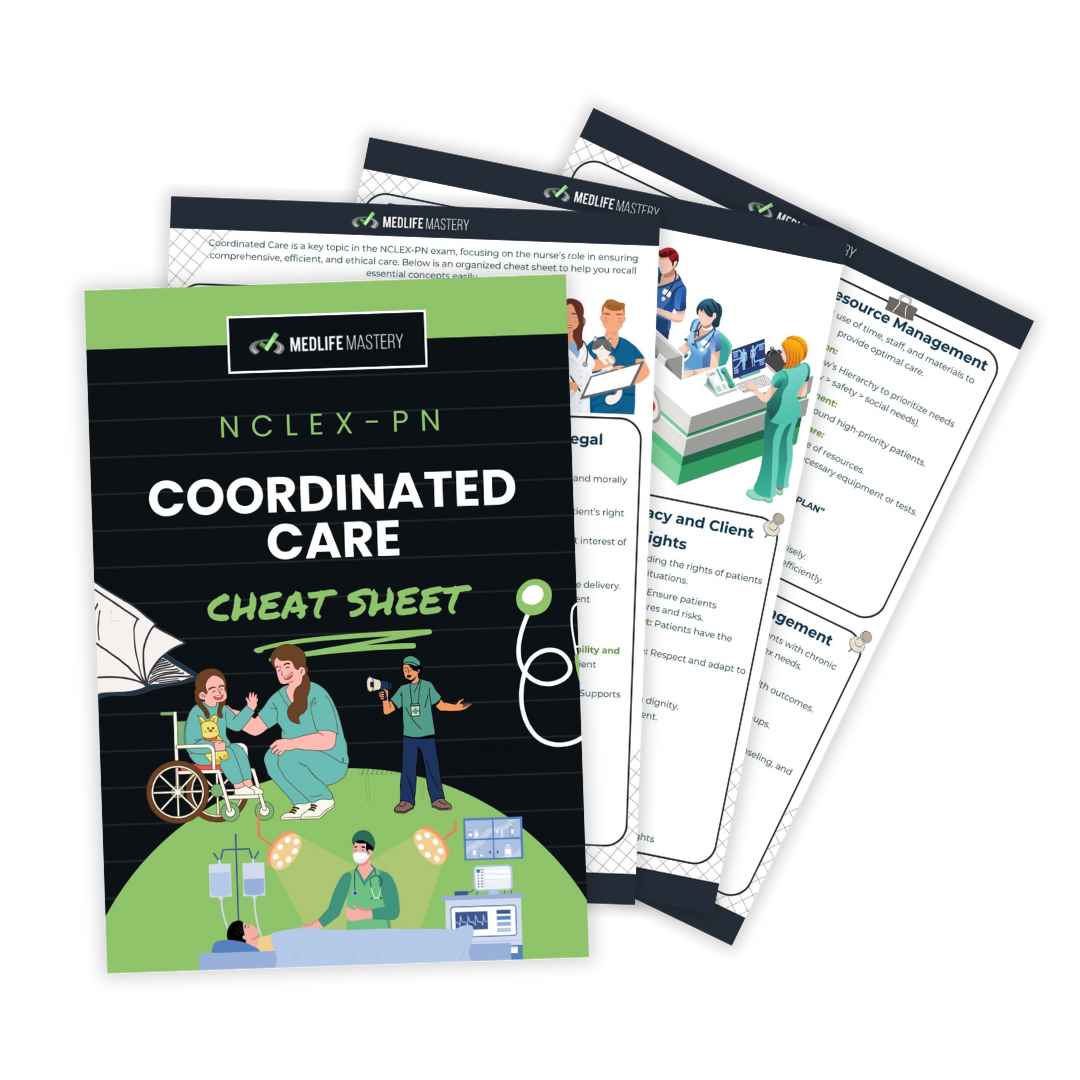
Coordinated Care PN Cheat Sheet - Free PDF Download
Consider entering a hospital on a hectic Monday morning. Patients wait in line, nurses hurry between beds, and physicians whisper about their treatment plans. Coordinated care is what separates chaos from calm in the midst of all of this.
For students studying practical nursing, comprehending this idea is more than just checking a box. Coordinated care in NCLEX-PN covers key skills like delegation, prioritization, and advocacy. These aren’t just theoretical—they’re what you’ll do every day as a licensed practical nurse (LPN).
Mastering them doesn’t just help you ace the test; it lays the foundation for safe, efficient, and compassionate care.
Let’s unpack coordinated care step by step, covering everything you need to know for the NCLEX-PN and beyond.
What Does Coordinated Care in NCLEX-PN Really Mean?
Coordinated care means getting everyone on the same page. It’s about teamwork, communication, and always keeping the patient’s best interest in mind. On the NCLEX-PN, it’s a major topic because it’s the glue that holds nursing together.
This includes:
Picture yourself as the central hub of a busy healthcare team. Your job is to make sure every piece connects smoothly. Sounds like a lot? Let’s break it down.
Delegation and Prioritization: Your Ticket to Efficient Care

Delegation is an art. It’s not just about telling others what to do; it’s about knowing who can handle specific tasks safely. The NCLEX-PN expects you to understand this distinction.
Tasks You Can Delegate (And Those You Can’t)
Here’s how it works:
Delegation is more than just assigning tasks to others. It has to do with accountability. Make an informed decision because you are still in charge of the result.
Prioritization Saves Lives
Prioritization is a key component in determining what to do first when you have a long to-do list. The most important things are always life-threatening. Use Maslow’s hierarchy of needs or the ABCs (airway, breathing, circulation) to guide you.
Collaboration with Healthcare Teams: You’re Not Alone
No nurse works in isolation. Coordinated care in NCLEX-PN highlights how you interact with other professionals. From doctors to dietitians, every member of the team has a role. Your job is to keep communication clear and smooth.
How to Collaborate Effectively
Communication is your superpower. Use the SBAR method to share patient information:
Patient Advocacy: Your Voice, Their Safety
Patients rely on nurses to protect their interests. Advocacy involves speaking up when something isn’t right. The NCLEX-PN loves scenarios where nurses must act quickly to prevent harm.
Common Advocacy Scenarios on NCLEX-PN
Being combative is not the goal of advocacy. It's about assertiveness and patient-centeredness.
Continuity of Care: Connecting the Dots
Continuity of care ensures patients don’t fall through the cracks. It matters whether they’re moving from one shift to the next or from the hospital to home. The NCLEX-PN tests how well you can manage these transitions.
Discharge Planning: A Key NCLEX-PN Focus
Early planning is key. It entails setting up follow-up appointments, educating patients about their prescriptions, and putting them in touch with resources such as home health services.
An inventory for discharge:
For instance, a patient with heart failure is prepared to leave the hospital. You ensure they have their prescriptions, set up a follow-up with the cardiologist, and explain the importance of weighing themselves daily. Simple steps prevent complications.
Ethical and Legal Principles in Coordinated Care

Ethical and legal knowledge forms the backbone of safe practice. The NCLEX-PN tests your ability to balance patient rights, safety, and professional accountability.
Common Legal and Ethical Scenarios
These aren’t just rules; they protect patients and maintain trust in the healthcare system.
Tackling Coordinated Care Questions on NCLEX-PN
Here’s the thing: the NCLEX-PN doesn’t throw curveballs. The questions are practical, but they test your critical thinking.
Practice with realistic scenarios. This helps you spot patterns and choose the best option under pressure.
Real-Life Applications of Coordinated Care for LPNs
Coordinated care isn’t just for exams. It’s what you do every day on the job. Whether in hospitals, clinics, or home health, these skills shape your practice.
Examples from the Field
Every setting has its challenges, but coordinated care makes everything smoother—and safer.
The Role of Technology in Coordinated Care
Technology has changed the way healthcare works, and it’s playing a big role in coordinated care. As an LPN, you might think technology is more for doctors or advanced practice nurses, but it’s a tool you’ll use every day.
On the NCLEX-PN, you’ll encounter questions about how technology helps ensure patient safety, improves communication, and keeps everything organized. Understanding how to leverage these tools will not only help you pass the exam but also make your job easier.
Electronic Health Records (EHRs): Your Go-To Source
EHRs are the digital backbone of healthcare. Gone are the days of bulky paper charts and illegible handwriting. EHRs store everything you need to know about a patient—medications, allergies, lab results, and more. Better care and fewer errors result from these systems' ability to provide real-time updates.
Imagine, for instance, that you are caring for a patient who has diabetes. You view their insulin dosage, most recent doctor orders, and their most recent blood sugar reading when you access their electronic health record. You can act swiftly, precisely, and without hesitation with the help of this information.
Keep these things in mind when using EHRs:
EHRs streamline care and keep everyone—from nurses to doctors—on the same page.
Telehealth: Expanding Coordinated Care
Telehealth is more than a pandemic trend. It’s now a staple in healthcare, making it easier to coordinate care for patients who live far away or can’t visit the clinic regularly.
Here’s how telehealth connects to coordinated care:
As an LPN, your role might involve helping patients set up telehealth appointments or explaining how to use remote monitoring devices, like blood pressure cuffs or glucose meters. These tools empower patients to take charge of their health while keeping you and the healthcare team informed.
Smart Devices and Alerts: Your Safety Net
Smart devices have turned ordinary equipment into life-saving tools. Beds that detect when patients try to get up, IV pumps that beep if there’s an issue, or monitors that alert you to vital sign changes—all these gadgets keep you one step ahead.
On the NCLEX-PN, you’ll face questions about responding to these alerts. Here’s the trick: prioritize the alerts that signal life-threatening issues. For instance, if an IV pump signals an occlusion, you check it right away because it can delay medication delivery.
These devices are like having an extra pair of eyes, but they don’t replace your judgment. Always rely on your assessment skills alongside the technology.
Challenges of Technology in Coordinated Care
While technology improves care, it’s not foolproof. EHRs can lag, alerts can be ignored, and telehealth can experience glitches. The NCLEX-PN might throw questions at you about handling these challenges.
For example:
Your focus should always return to the patient. If the tech fails, fall back on your communication skills and manual processes. Write down updates, share them with the team in person, and double-check everything to prevent errors.
Conclusion: Mastering Coordinated Care in NCLEX-PN

Coordinated care in NCLEX-PN isn’t just about passing a test. It’s about becoming the kind of nurse patients trust and colleagues respect. By mastering delegation, prioritization, advocacy, and communication, you’ll step into your career ready to handle anything.
Start small. Review the basics. Practice scenarios. Build your confidence. Coordinated care isn’t just a skill—it’s what makes great nurses stand out.