
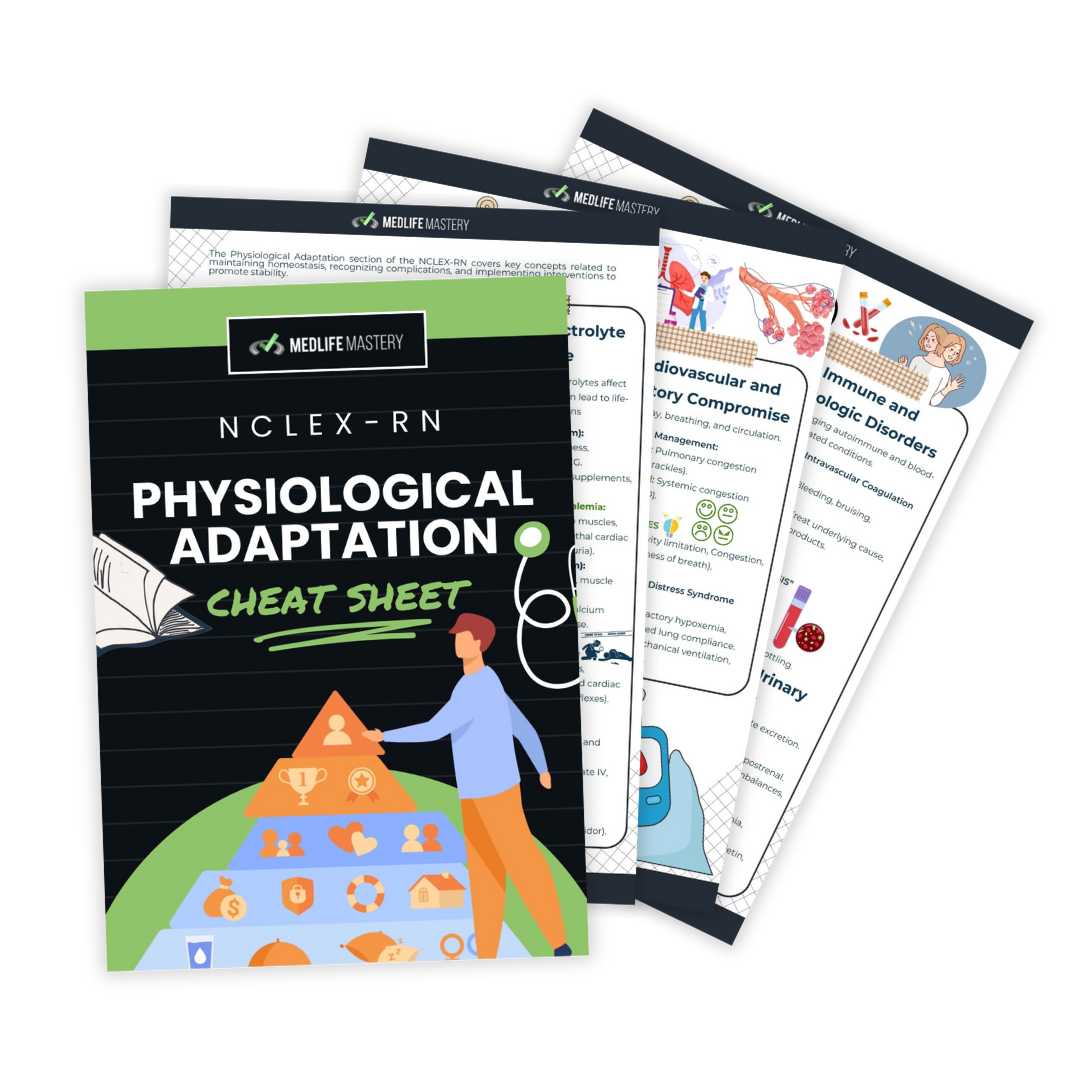
Physiological Adaptation RN Cheat Sheet - Free PDF Download

Let’s paint the picture. You’re sitting for the NCLEX-RN, staring at the next question. It’s asking about a patient who’s suddenly hypoxic or dealing with electrolyte chaos. You’re thinking: “How do I even begin?”
But instead of panicking, you feel prepared. You’ve studied physiological adaptation, and you know exactly what to do. Physiological adaptation in NCLEX-RN focuses on how the body copes when something’s wrong.
It’s about recognizing red flags, acting decisively, and restoring balance. This section isn’t just memorization—it’s about understanding how the body works and responding like a true professional. Let’s break it down and turn this topic into one of your strengths.
What Is Physiological Adaptation in NCLEX-RN?
Physiological adaptation in NCLEX-RN tests your ability to manage situations where the body’s normal balance, or homeostasis, is disrupted. The questions test your ability to solve problems and use clinical judgment regardless of the situation—a critical illness, an electrolyte imbalance, or an acid-base catastrophe.
The situations are plausible. They test your ability to recognize early warning indicators, make wise treatment decisions, and avoid problems. Imagine it as a practice run for the real world, except without the midnight shifts and beeping monitors.
Why Is Physiological Adaptation Vital for the NCLEX-RN?
This isn’t just another topic to tick off your study list. It’s a test of how well you can step into the role of a nurse. Patients depend on you to make quick, safe decisions.
When you understand physiological adaptation, you don’t just pass the exam—you build confidence in your ability to care for real patients. From recognizing electrolyte imbalances to managing respiratory distress, this category prepares you for the challenges of nursing.
The bottom line? This section is your opportunity to show that you’ve got what it takes to deliver safe, effective care.
Breaking Down Physiological Adaptation in NCLEX-RN
Let’s take the mystery out of this category. Physiological adaptation is broad, but it boils down to a few core topics. Knowing these inside and out will give you an edge.
Common Topics in Physiological Adaptation
You’ll see these concepts repeatedly. The more comfortable you are with them, the better you’ll perform.
Acid-Base Balance
Acid-base balance questions ask you to interpret lab values and connect them to symptoms. These aren’t trivia questions—they test how you think on your feet.
Recognize patterns in the symptoms and labs. It’s not about memorizing; it’s about understanding the body’s SOS signals.
Fluid and Electrolyte Imbalance
Fluids and electrolytes keep the body in check. When they’re off, the entire system goes haywire.
Physiological Adaptation to Stressors

Stress throws the body into overdrive. When it can’t adapt, your interventions become lifesaving.
Hemodynamic Monitoring
Hemodynamic monitoring looks beyond vital signs to give a complete picture of a patient’s stability.
Coping with Chronic Illness
Chronic conditions like diabetes and hypertension demand constant adaptation from the body—and from the nurse.
How To Study Physiological Adaptation for NCLEX-RN
Studying doesn’t have to feel overwhelming. A clear plan helps you focus on what matters most.
Focus on Prioritization
The NCLEX loves to ask what you should do first. Prioritization questions separate safe nurses from risky ones.
Master Lab Values
Lab values are at the core of physiological adaptation. It’s not enough to memorize ranges—you must interpret them in context.
The “Need-to-Know” Nursing Interventions

Interventions are where knowledge meets action. Know what to do in both acute and long-term scenarios.
Managing Acute Conditions
Emergencies require quick thinking and even faster actions.
Supporting Recovery
Recovery is about more than fixing the immediate problem. Patients need guidance to prevent relapses and manage chronic conditions.
Practical Tips for Answering Physiological Adaptation Questions
It takes strategy to answer physiological adaptation questions on the NCLEX-RN, not just content knowledge. Your ability to think critically, set priorities, and think quickly is evaluated by these questions.
There are, thankfully, a few practical tactics that can make a big difference. Let us look at how to respond to these inquiries and improve your prospects of success
Understand the NCLEX-RN Format
Physiological adaptation questions often fall into two main formats: multiple-choice and select-all-that-apply (SATA). For multiple-choice questions, look for the answer that directly addresses the patient’s immediate need. If the question is SATA, remember that each option stands alone—you’ll need to evaluate each one as true or false.
When reading the question, focus on keywords like “priority,” “immediate action,” or “first.” These terms guide you in choosing the response that aligns with patient safety. Eliminate distractors—answers that are correct but don’t apply to the scenario or address the most urgent need.
Break Down Complex Scenarios
Some physiological adaptation questions might feel overwhelming at first glance. Don’t rush. Break the scenario into smaller pieces by identifying the problem, symptoms, and what the question asks you to do. Look for patterns, such as lab values that are out of range or symptoms that signal a worsening condition.
For example, if a question describes a patient with muscle weakness and a potassium level of 2.8 mEq/L, focus on hypokalemia. Identify how this imbalance affects the body and think about interventions like potassium replacement. Simplifying the problem this way helps you focus on the right solution.
Prioritize Interventions
The NCLEX loves to test your ability to prioritize nursing interventions. A good rule of thumb is to follow the ABCs: airway, breathing, and circulation. Address anything that impacts these first. After that, focus on issues like pain, infection, or lab abnormalities.
For example, if a patient shows signs of hypoxia—restlessness, confusion, or cyanosis—you should administer oxygen before checking lab results or performing other interventions. Always think, “What keeps this patient alive right now?”
Trust the Process
Lastly, trust your preparation. These questions can feel tricky, but they follow predictable patterns. Stay calm, read carefully, and apply what you know. Confidence in your strategy makes all the difference.
By combining strong content knowledge with a clear approach, you’ll feel ready to handle any physiological adaptation question the NCLEX throws your way. It’s not just about knowing the material—it’s about thinking like a nurse.
Exam Day Strategy for Physiological Adaptation in NCLEX-RN

The NCLEX tests how you think, not just what you know. Confidence comes from preparation.
Conclusion: Owning Physiological Adaptation in NCLEX-RN
Your opportunity to demonstrate your readiness for the demands of nursing is the physiological adaptation section of the NCLEX-RN. You can better manage emergencies in the real world if you know how the body reacts to disturbances. If you are prepared and focused, you can confidently answer these questions.
You can demonstrate your critical thinking abilities in response to each question. Practice perseverance and making connections are key to mastering this category. With the resources at your disposal, it's time to have faith in your skills and keep going.