
COMLEX vs USMLE (2026)
If you are a DO student, COMLEX vs USMLE is not an academic question. It decides how many exams you sit, how long your dedicated period runs, and which doors stay open at match time.
Both are licensing exams. They are written by different boards, they test overlapping but different material, and residency programs treat them differently!
What separates them comes down to four things, and whether you need both comes down to where you want to match!
- COMLEX vs USMLE, what each exam is
- COMLEX vs USMLE at a glance
- COMLEX vs USMLE, the differences that matter
- Attempt limits, COMLEX vs USMLE
- What COMLEX Level 1 weights, COMLEX vs USMLE
- COMLEX vs USMLE, level by level
- Who can sit each one, COMLEX vs USMLE
- Should you sit both, COMLEX vs USMLE
- What sitting the USMLE involves, COMLEX vs USMLE
- When to sit them
- Preparing for both, COMLEX vs USMLE
- COMLEX vs USMLE, common questions
- Related reading
COMLEX vs USMLE, what each exam is
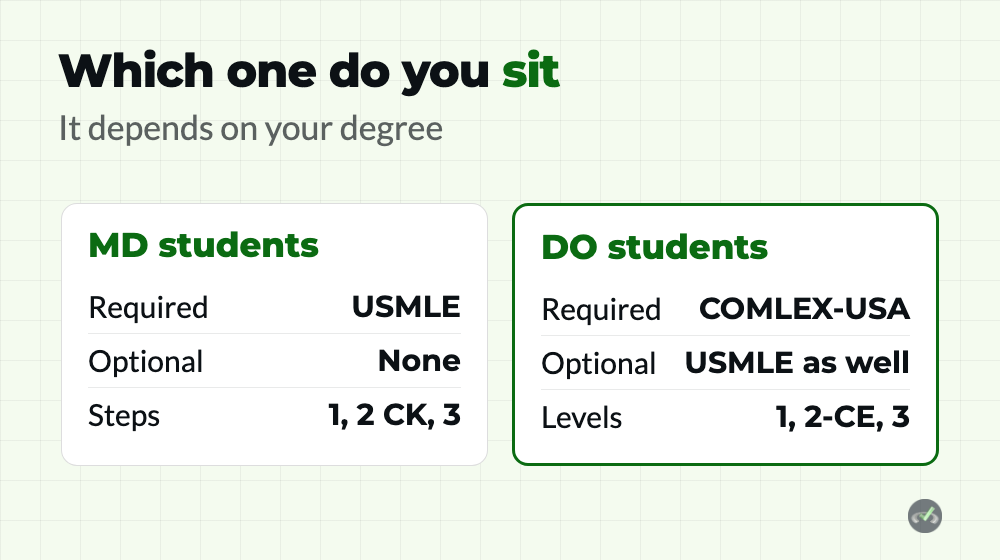
The COMLEX-USA is the osteopathic licensing sequence, written by the NBOME. It is the exam DO students are required to pass to practice.
The USMLE is the allopathic licensing sequence, written by the NBME and the FSMB. MD students are required to pass it, and DO students may sit it as well!
Both run in three parts. COMLEX has Level 1, Level 2-CE and Level 3, and the USMLE has Step 1, Step 2 CK and Step 3!
Every DO student takes COMLEX. Some also take the USMLE, by choice, to be judged on the same scale as their MD classmates. No MD student needs COMLEX.
COMLEX vs USMLE at a glance
Row three decides most of it. COMLEX is required of every DO student, and the USMLE is the only one anybody chooses, so the whole question is what a DO student adds on top!
COMLEX vs USMLE, the differences that matter
Four things separate them once you are studying.
- Osteopathic content. The NBOME sets osteopathic principles, practice and manipulative treatment at a 12% minimum of COMLEX Level 1, with osteopathic patient care at a further 6% minimum. The USMLE has none of it, so that is COMLEX-only study.
- Question style. Students consistently describe COMLEX stems as less predictable in wording than USMLE stems, which are heavily standardized. Working question banks for both is how people bridge that.
- Scoring. COMLEX Level 1 and USMLE Step 1 both report pass or fail. COMLEX adds a Formative Performance Profile comparing you against other passing first-time takers, which the USMLE does not. The second exams in both sequences still carry a number.
- Who reads it. Osteopathic programs know COMLEX. Some allopathic programs are far more fluent in USMLE scores, which is the whole reason the question exists.
Attempt limits, COMLEX vs USMLE
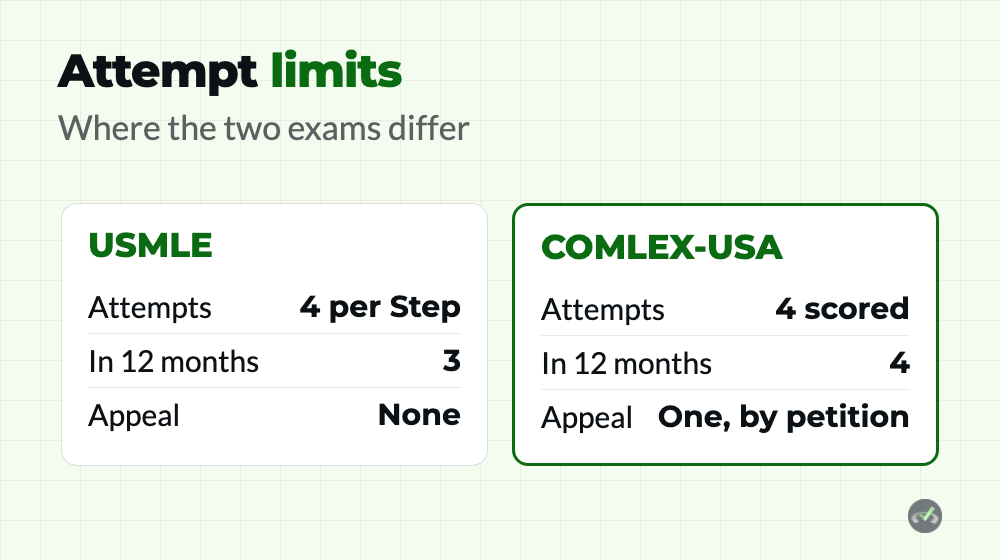
Both sequences cap how many times you can sit an exam, and the caps are not identical.
The difference in the last row matters. COMLEX has a petition route, needing a written request from a licensing agency plus confirmation from your dean that you are in good standing.
The USMLE has no equivalent. Four failed attempts closes the sequence!
Sources are the NBOME Bulletin of Information and the USMLE Bulletin of Information. State licensing boards can set their own limits on top of both.
What COMLEX Level 1 weights, COMLEX vs USMLE
The NBOME publishes minimum weightings for each competency domain on Level 1. They are the clearest answer to how big the osteopathic half of the workload is.
Osteopathic principles and patient care together are a minimum of 18% of Level 1, and none of it appears on the USMLE.
That is the concrete size of the extra study, and the number to weigh when somebody tells you the two exams are "mostly the same"!
These are published at nbome.org alongside ten clinical presentation areas with their own minimums.
COMLEX vs USMLE, level by level
The two sequences line up closely. Where they stop lining up is where the study time goes.
Both boards retired their hands-on skills exam within about a year of each other, and neither has replaced it with another exam.
COMLEX now handles it through attestation. Your dean confirms you graduated with a DO degree and demonstrated fundamental osteopathic clinical skills, and that verification is what makes you eligible for Level 3.
Anything you read describing Level 2-PE or Step 2 CS as merely paused is at least four years out of date, and a lot of it is still online!
Who can sit each one, COMLEX vs USMLE
COMLEX is for students and graduates of colleges of osteopathic medicine accredited by COCA.
The USMLE is open to three groups. Students and graduates of LCME-accredited MD programs, students and graduates of COCA-accredited DO programs, and students and graduates of medical schools outside the US listed in the World Directory as meeting ECFMG requirements.
That second group is the whole reason this article exists. A DO student is eligible for both, so the choice is one you have to make rather than one made for you!
You have to satisfy the requirement both when you apply and on the day you sit, which catches people who apply in a window they then graduate out of. Both boards publish the current wording, at usmle.org and nbome.org.
Should you sit both, COMLEX vs USMLE
There is no universal answer, and anyone who gives you one is selling something. There is a way to decide, though!
Sitting both makes sense if you are aiming at competitive allopathic programs, if the specialties you want have historically favored USMLE scores, or if you want the option without deciding this year.
Sitting COMLEX alone makes sense if you are aiming at osteopathic programs, if your COMLEX preparation is already stretched, or if adding a second exam would cost you a pass on the first!
The honest trade is time. A second exam is weeks of dedicated you do not get back, and a narrow pass on both is worse than a comfortable pass on one.
Four failed USMLE attempts ends the sequence, and no appeal exists.
What sitting the USMLE involves, COMLEX vs USMLE
If you are weighing the second exam, it helps to know what the day looks like.
Step 1 changed on 14 May 2026. It now runs as fourteen 30-minute blocks of up to 20 questions each, inside one 8-hour session, with a minimum of 55 minutes of break time and a 5-minute optional tutorial.
Before that date it was seven 60-minute blocks of up to 40. The question total is unchanged at up to 280, so what moved is the rhythm rather than the volume!
The USMLE also allows four attempts per Step, with no more than three in any 12-month period.
A fourth attempt has to come at least 12 months after your first and 6 months after your most recent, and four failed attempts make you ineligible for the whole sequence!
Both sets of rules come from usmle.org. Check nbome.org for the COMLEX equivalents, because they are set separately!
When to sit them
The first exams in both sequences come after preclinical work, and the second after core rotations. That much is fixed by your school calendar.
What is not fixed is the gap between them. Students who sit both usually take them close together, because the shared science is at its freshest and splitting them means relearning it twice.
Close together does not mean cramming, though. The outcome to avoid is a narrow pass on the first because you were busy protecting the second!
If your practice scores are close to the line on either, that is the signal to slow down rather than add an exam. Our comparison of Step 1 tutors covers when outside help earns its cost and when it does not.
Ask a resident in the specialty you want what they were asked for. Programs vary, published guidance lags reality, and somebody two years ahead of you has the current answer!
Preparing for both, COMLEX vs USMLE
Most of the science is shared, so a second exam costs far less than double!
The efficient shape is to build one content base, work question banks for both, and treat osteopathic material as COMLEX-specific study on top rather than as a separate track.
Where students lose time is running two plans in parallel instead of one plan with a COMLEX extension. If you want somebody to build that with you, our Step 1 tutoring covers the USMLE side one to one, with mentors who sat these exams recently!
COMLEX vs USMLE, common questions
Do DO students have to take the USMLE?
No. COMLEX is the required sequence for DO students. The USMLE is optional and taken by choice.
Is COMLEX easier than the USMLE?
Neither is easier, and students who sit both usually say they are differently hard. COMLEX adds osteopathic content, and USMLE stems are more standardized!
Are both exams pass/fail now?
The first exam in each sequence reports pass or fail. The second still reports a number, which is what residency programs read.
Can I use the same study resources for both?
Largely yes for the shared science, and no for osteopathic principles and manipulative medicine, which is COMLEX-only material and needs its own resource.
Related reading
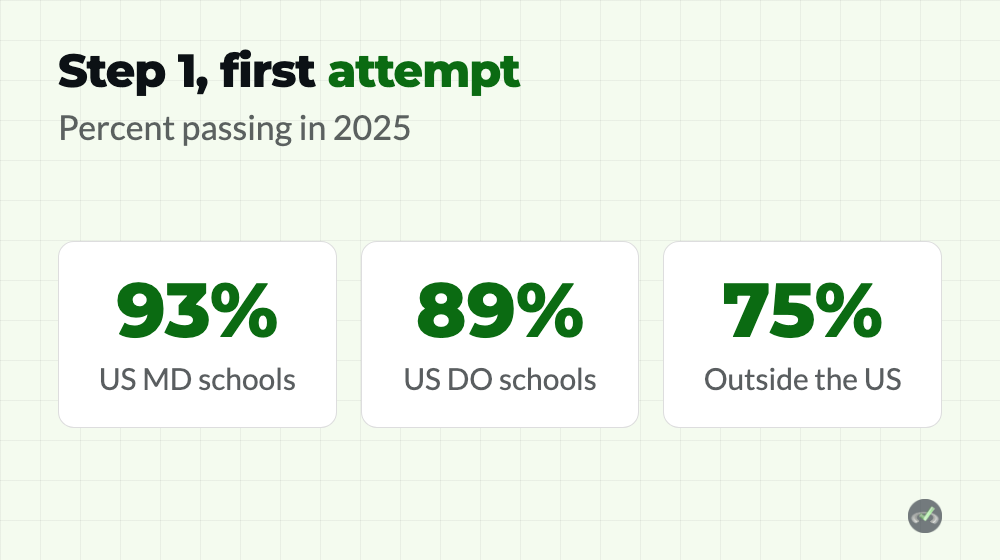
- The USMLE exam guide, what each Step asks of you and the 2025 pass rates
- 8 best USMLE Step 1 tutors, compared, and when to skip tutoring
- USMLE Step 1 tutoring, our packages and how matching works
- Ask us a question about your own situation, and we will give you a straight answer 🙂