
Most medical schools ask you to finish a set list of premed courses before you start. Some schools have dropped that list, which opens the door for English majors, career changers and anyone who took a different path to medicine!
This guide covers 8 medical schools with no prerequisites, what each one asks for instead, and how to plan your courses around them. We checked every school on its own admissions page in November 2026, for the 2026 to 2027 application cycle.
The Premed Roadmap · Free, 4 pages
Skipping Prerequisites? See Where That Fits on the Whole Route to Med School, So You Plan Around It Early
Residency length and total years for 17 specialties, plus what to do in each year.
Join 12,000+ students using our free resources
On its way.
Check your inbox in the next minute.
What Are the Prerequisites for Medical School?
A prerequisite is a course or other requirement you have to finish before a program admits you. For medical school, that usually means a list of college science courses, and each school sets its own.
Courses are one part of the picture. Your GPA, MCAT score, letters of recommendation and clinical activities all count too, and every school weighs them in its own way.
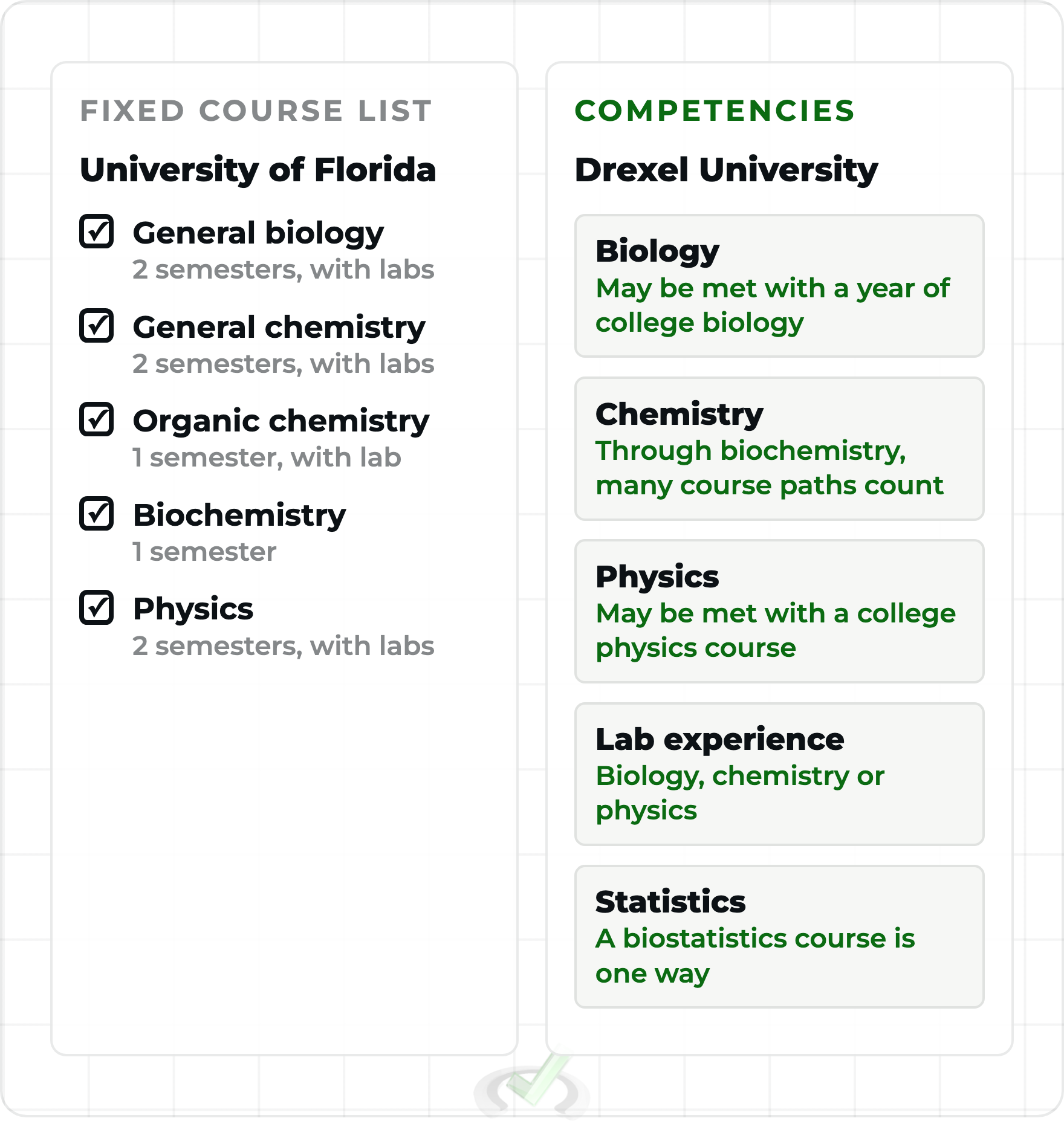
For students starting in 2027, the University of Florida College of Medicine has a fixed list. It asks for these courses, each with a grade of C or higher:
UF also recommends genetics, microbiology, immunology or physiology if you'd like more background. Other schools add statistics, psychology, sociology or writing, so the lists differ from school to school.
Our guide to pre med requirements walks through the usual courses and the order to take them in!
Are There Medical Schools With No Prerequisites?
Yes! A small group of MD programs has no required course list. When a school drops its prerequisites, it usually goes one of two ways:
- It recommends courses. Mayo Clinic, NYU, Temple, Tulane and Stanford each name the courses they'd like to see, and none of those courses is required.
- It asks for competencies. Drexel, Vanderbilt and Duke describe what you should know, like how chemistry works in living systems, and let you show it through the courses you choose.
Either way, medical schools with no prerequisites still expect a bachelor's degree. Every school on our list also requires the MCAT, which tests the same sciences a prerequisite list covers.
You choose how to prepare. The school still expects you to show you can handle the science, through your grades, your MCAT score and your letters.
8 Medical Schools With No Prerequisites
Each of these medical schools with no prerequisites says on its own admissions page that it has no required premed courses, or that it uses competencies in their place. We read each page on November 10, 2026, and each row links straight to it!
Policies can change from one cycle to the next, so open the school's page again before you apply. Here's a closer look at each one!
Mayo Clinic Alix School of Medicine
Mayo Clinic Alix School of Medicine, based in Rochester, Minnesota, doesn't require any specific prerequisite college courses. It recommends biology, microbiology, biochemistry, chemistry and physics to prepare you for the MCAT and the curriculum.
For the 2026 to 2027 cycle, Mayo asks for an MCAT score of at least 510, from a test taken between January 2024 and September 2026. You'll also need a bachelor's or PharmD degree from an accredited school in the US or Canada.
NYU Grossman School of Medicine
NYU Grossman School of Medicine in New York City says it doesn't have prerequisites. It recommends these premed courses:
- Inorganic chemistry, organic chemistry and biochemistry, with lab
- General biology, with lab
- General physics, with lab
- Statistics
- Genetics
- English
NYU requires the MCAT. For letters, it asks for a premed committee letter, or two letters from professors who taught you, with at least one in a science.
Its most recent incoming class had a median MCAT of 523 and a median GPA of 3.97. That's a high bar, and the recommended list gives you a clear place to start!
Drexel University College of Medicine
Drexel University College of Medicine in Philadelphia moved from a premed requirements model to competency-based recommendations, and it no longer requires specific coursework. Your classes and activities can meet these competencies:
- Biology, with an emphasis on cells and molecules (a year of college biology is one way)
- Chemistry, from general chemistry through biochemistry
- Physics (one college physics course is one way)
- Lab experience in biology, chemistry or physics
- Statistics and probability
- English and writing
- Behavioral and social sciences
- Community service
- Clinical experience with direct patient contact
Drexel requires the MCAT, and for 2027 applicants it reviews scores from 2024 or later. It also welcomes applicants with careers outside medicine, so if you're changing paths, this setup gives you room to show what you've learned at work and in service!
Get the Premed Roadmap (4 pages)
On its way.
Check your inbox in the next minute.
Lewis Katz School of Medicine at Temple University
The Lewis Katz School of Medicine at Temple University, also in Philadelphia, has no absolute course requirements. It recommends biology, general and organic chemistry, biochemistry, physics, psychology and sociology, plus a broad humanities education and strong writing skills!
Katz prefers at least 90 semester hours from a US or Canadian university. Every applicant takes the MCAT and the Casper test.
Tulane University School of Medicine
Tulane University School of Medicine in New Orleans calls its premed courses recommendations. They cover biology, chemistry, biochemistry, physics, genetics, statistics, math, psychology, sociology, expository writing, and lab or field experience.
Tulane does require the MCAT, taken within three years of the application cycle year. It sets no minimum GPA or MCAT score for a secondary application or an interview!
Stanford Medicine
Stanford Medicine, in Stanford, California, has no specific course requirements. It recommends coursework and experiences that build depth in biology, chemistry and physics, math, the behavioral and social sciences, communication, and lab or field work.
If you majored outside the sciences, that broad list leaves you plenty of room!
For the 2026 to 2027 cycle, Stanford asks for at least one MCAT taken after January 2023 and by August 22, 2026.
Vanderbilt University School of Medicine
Vanderbilt University School of Medicine in Nashville moved from requirements to recommendations. It wants applicants to show competency in biology, chemistry and biochemistry, math, statistics and physics, and the social sciences and communication.
Vanderbilt requires the MCAT and sets no minimum GPA or MCAT score. For the 2026 to 2027 cycle, it accepts MCAT scores from January 2023 to September 2026. You can build your science background in the way that fits your degree!
Duke University School of Medicine
Duke University School of Medicine in Durham, North Carolina, lists academic expectations in place of prerequisites. It names biochemistry, cell biology, statistics, physics, sociology, psychology and expository writing.
Duke marks those courses as not required, and says they'd help you prepare for the MCAT and your first year.
Duke does set minimums. You need at least a 3.0 GPA and a 500 on the MCAT to be reviewed, and for the 2026 to 2027 cycle your MCAT has to be taken by September 12, 2026.
Which Med Schools Don't Require Physics?
None of the 8 schools above requires a physics course! Each one still names physics in its recommendations or competencies, and Duke notes that physics labs are optional.
Physics also shows up on test day. About a quarter of the MCAT's Chemical and Physical Foundations section is introductory physics, according to AAMC.
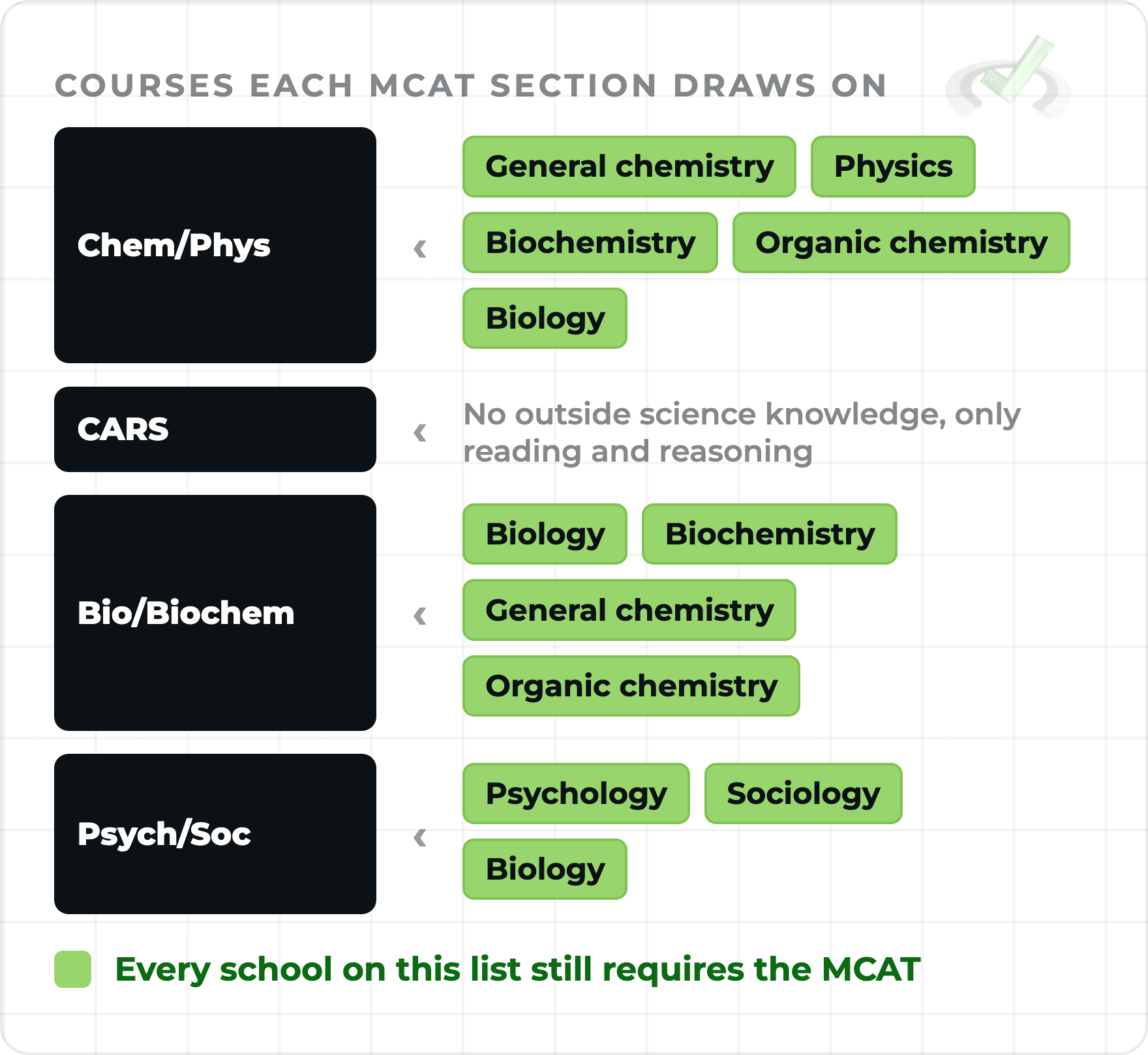
So medical schools with no prerequisites can drop physics and still expect you to know it for the MCAT. If physics is what's holding your score back, our 1:1 MCAT tutors scored 515 or higher and can work through it with you!
If any school on your list requires physics, plan for two semesters with labs, the way UF asks. If none does, take enough physics to feel ready for the Chem/Phys section.
Should You Take Premed Courses Anyway?
In most cases, yes! Your school list will likely include schools with fixed course lists, and you'll need their courses to apply there.
The MCAT is the other reason. Biology, chemistry, physics, biochemistry, psychology and sociology all show up on it, whether or not a school asks for those courses by name.
Medical schools with no prerequisites help most if you're a non-science major or a career changer missing a course or two. They can judge what you know, wherever you learned it!
To plan your classes, build your school list first and find the strictest course list on it. Take every course on that list, then add what the other schools recommend.
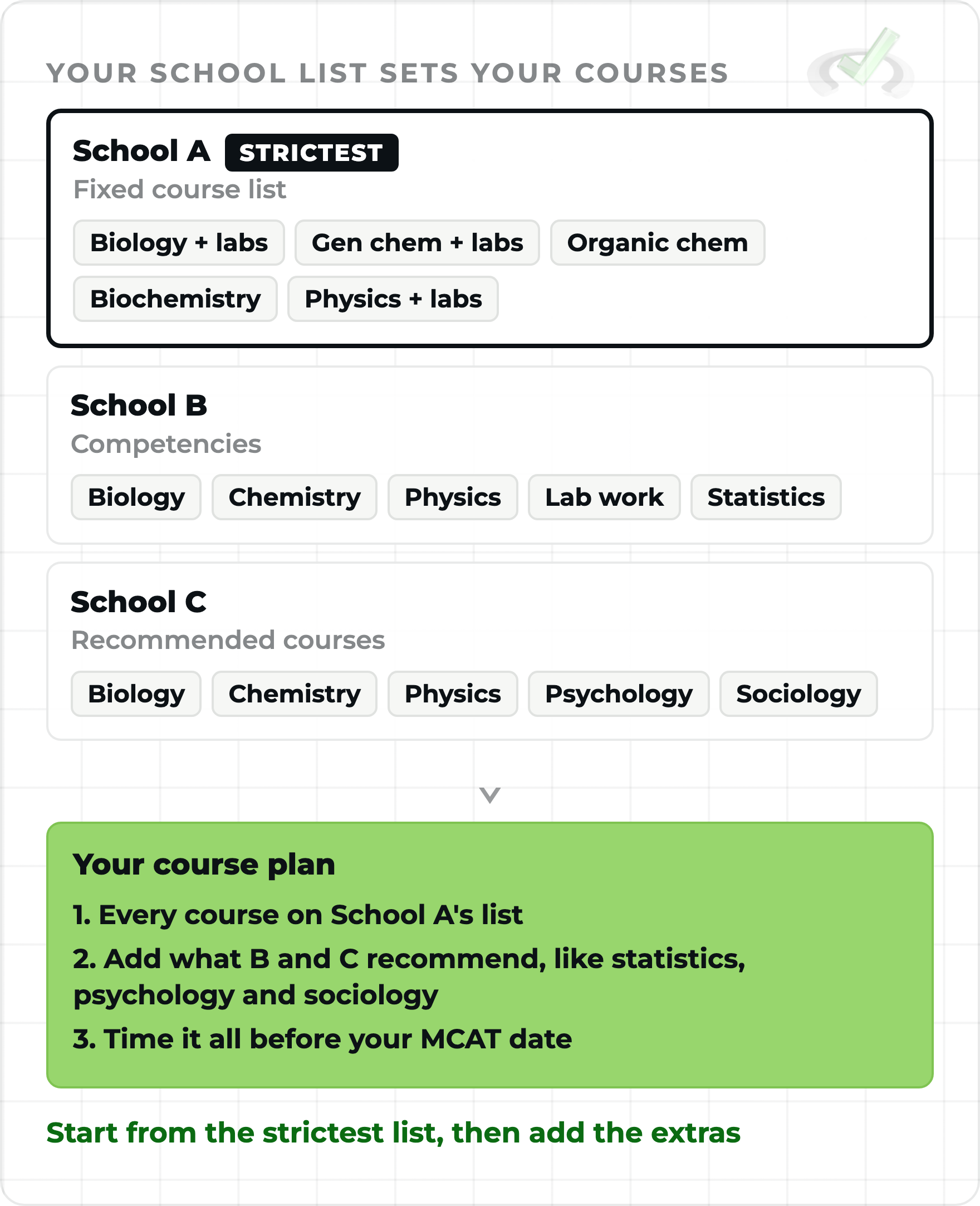
Time it all so you finish the science before your MCAT date. (Optional) A strategic advising session with one of our med school application coaches can help you sort out your school list and timeline :)
Plan your courses for the strictest school on your list. Meeting its list keeps every other school open too.
FAQs About Medical Schools With No Prerequisites
Do Medical Schools With No Prerequisites Still Require the MCAT?
Yes! All 8 schools on this page require the MCAT, and some set a minimum. Mayo asks for 510 or higher and Duke for 500, for the 2026 to 2027 cycle.
What Do Premed Students Do If They Don't Get Into Med School?
A rejection hurts, and it's okay to take some time with it. You still have options! Some applicants get in on their second, third or even fourth try.
You can strengthen your application and reapply, apply to more schools, take a gap year for clinical or research work, or do a master's or postbaccalaureate program.
If you'd like help seeing what to change, our application coaches can go through your last application with you. You don't have to figure it out alone.
What Is the Easiest Medical School to Get Into?
No medical school is easy to get into. A better question is which schools fit your grades, scores and story. AAMC's MSAR lists each school's GPA and MCAT ranges, so you can build a realistic list!
What Medical School Has the Lowest GPA Requirement?
Among the medical schools with no prerequisites on our list, Vanderbilt and Tulane both say they set no minimum GPA. Duke reviews applicants with a 3.0 or higher.
Tulane also encourages applicants with a 3.30 GPA or higher and an MCAT of 505 and above. For more options, see our guide to getting into medical school with a low GPA!
Get Help Planning Your Medical School Application
Medical schools with no prerequisites give you more ways in, and you now know what each one asks for. You've got this!
If you'd like support through the whole application, our 1:1 medical school application coaching pairs you with a mentor who's in medical school now. Your coach can help with your personal statement, AMCAS activities, secondaries and interview prep!
Our free application guides cover each step too.
If you'd rather focus on planning, you can use your sessions for strategic advising, like choosing your courses and building your school list. We'd love to help you get there :)