
USMLE Step 1, The Complete Guide (2026)
USMLE Step 1 is the first of the three exams you have to clear to practice medicine in the United States, and the hardest of the three to plan for!
It reports pass or fail and nothing else. There is no score to aim at and no credit for a near miss, so a year of work resolves into one word!
This guide covers what the exam tests, how the day is built, what passing takes, and what happens if it does not go your way!
- What USMLE Step 1 tests
- How the USMLE Step 1 day is built
- What is on USMLE Step 1, by weight
- USMLE Step 1 scoring, and what passing takes
- Who can sit USMLE Step 1
- How many attempts you get at USMLE Step 1
- Preparing for USMLE Step 1
- How long to study for USMLE Step 1
- USMLE Step 1 results, and how long they take
- What happens if you do not pass USMLE Step 1
- What USMLE Step 1 means for the rest of your application
- USMLE Step 1, common questions
- Related reading
What USMLE Step 1 tests
Step 1 tests the basic sciences and, more than that, whether you can use them on a clinical problem. Recognizing a fact is not what it asks for.
The content is drawn across anatomy, physiology, biochemistry, pathology, pharmacology, microbiology, immunology, genetics, behavioral science, and biostatistics and epidemiology.
Questions are organized by organ system rather than by subject, which is why studying subject by subject and then meeting a systems-based exam catches people out!
Step 1 reports pass or fail. There is no score, and no credit for a near miss.
Almost every question is a clinical vignette, giving you a patient, a set of findings, and a question about what is happening or what follows!
That means the work is connecting mechanisms under time pressure, not reciting them.
How the USMLE Step 1 day is built
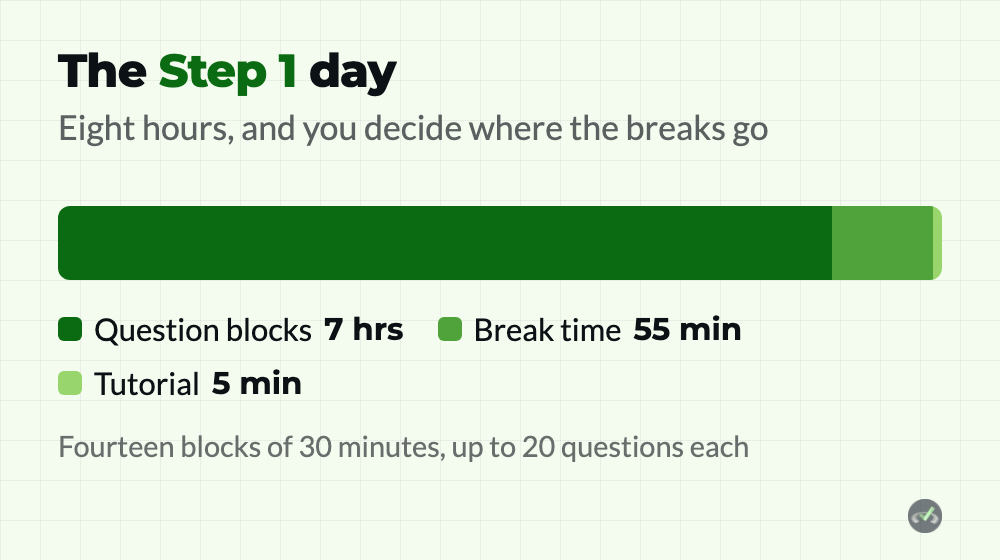
Step 1 changed on 14 May 2026, and most of what is written about it online still describes the old shape.
The question total did not change. What changed is the rhythm, from seven long blocks to fourteen short ones, with ten more minutes of break to spread across the day!
That matters for how you practice. Timed sets of 20 now match the exam, and drilling 40-question blocks trains you for a format that no longer exists!
These specifications come from usmle.org, and the boards do change them.
Rebuild your blocks at 20 questions and 30 minutes. Stamina still matters across eight hours, but the unit you need to be sharp for is now half what it was!
What is on USMLE Step 1, by weight
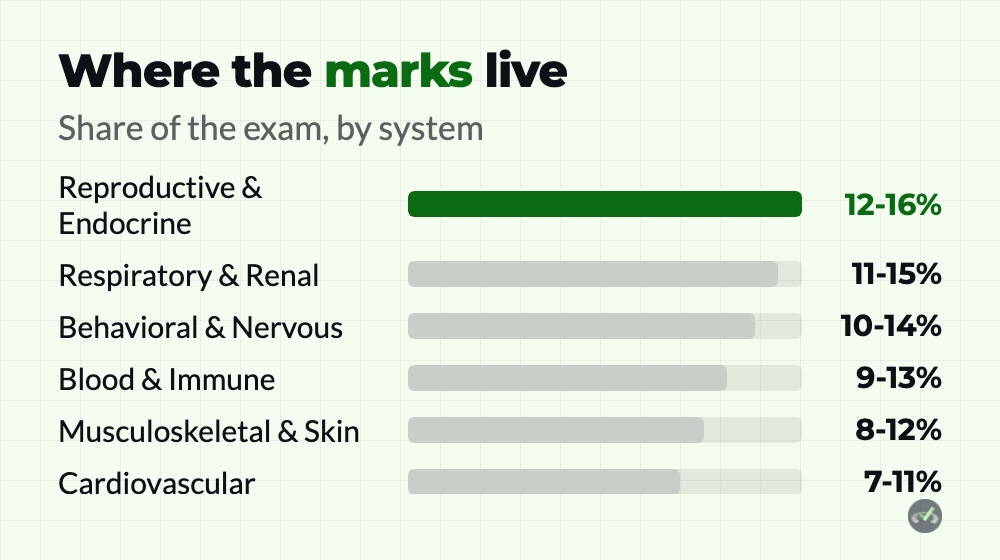
Step 1 is built along two dimensions, system and process, and the boards publish the ranges each one occupies. These are the closest thing to an official answer to "what should I study".
By discipline the picture looks different, and usually more surprising!
Those add to more than 100% because a single question can be counted under several disciplines at once. Read them as weight rather than as a timetable!
The competency split is the other half of it. Applying foundational science accounts for 60-70%, diagnosis for 20-25%, communication and interpersonal skills for 6-9%, and practice-based learning for 4-6%.
All of these ranges are published at usmle.org and are subject to change.
USMLE Step 1 scoring, and what passing takes
Since January 2022, Step 1 has reported pass or fail. No three-digit score is released.
That changed what the exam is for. It is now a hurdle rather than a ranking, and the number that carries weight in residency applications moved to Step 2 CK.
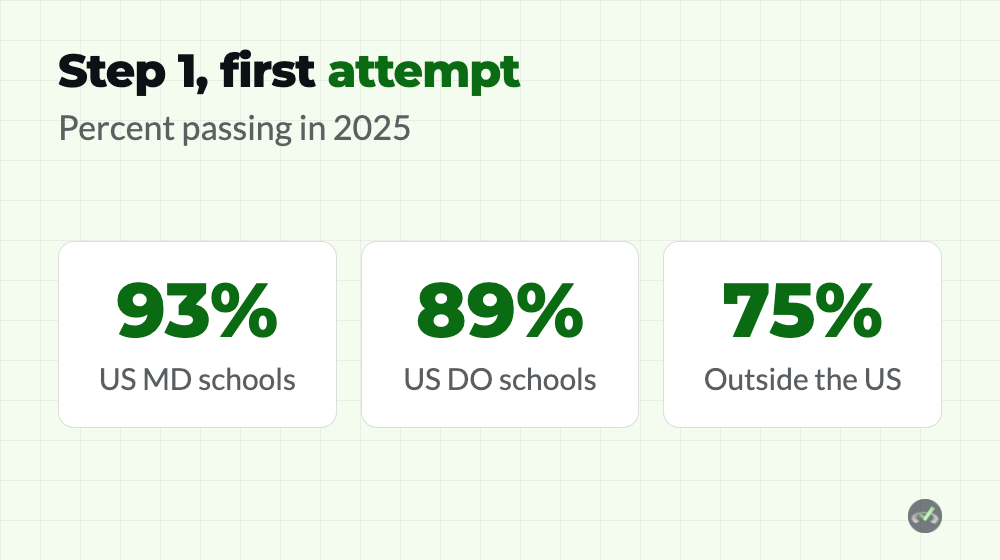
Here is where first-time takers landed in 2025.
- 93% of students at US and Canadian MD schools passed
- 89% of students at US DO schools passed
- 75% of international medical graduates passed
Those figures come from the official performance data published at usmle.org. That third row is why international graduates make up so much of who we are asked to help!
Who can sit USMLE Step 1
Three groups are eligible, and you have to qualify both when you apply and on the day you sit.
- Students and graduates of US medical schools leading to an MD, accredited by the LCME
- Students and graduates of US medical schools leading to a DO, accredited by COCA
- Students and graduates of medical schools outside the US listed in the World Directory as meeting ECFMG requirements
DO students are eligible but not required. COMLEX Level 1 is their required exam, and the USMLE is a choice on top of it. Our COMLEX vs USMLE comparison covers how to make that call!
The current wording is at usmle.org. That is the version that counts, not ours!
How many attempts you get at USMLE Step 1
Four scored attempts per Step, and the spacing is regulated as well as the total.
- No more than three attempts in any 12-month period
- A fourth attempt must come at least 12 months after your first and at least six months after your most recent
- After four attempts without passing, you are ineligible for any Step in the sequence
There is no petition and no appeal. Understand that before a second retake rather than after one.
State medical boards can also set their own limits on top of the USMLE's, so a board may accept fewer attempts than the four the exam allows!
Preparing for USMLE Step 1
There is no single right plan. There is a shape that most of the ones that work share, though!
- One content pass, then questions. The content pass is scaffolding. The learning happens when you are made to use it.
- A question bank as the spine. Working questions early is uncomfortable, and it builds the reasoning this exam is testing!
- Review that finds the reason. Reading the explanation of a missed question tells you the answer. Working out why your reasoning went where it did is what stops it repeating!
- Practice exams under exam conditions. A self-assessment sat in one uninterrupted sitting tells you about stamina and timing as well as knowledge.
- Slack in the plan. A schedule with no spare days breaks the first week something goes wrong, and something always does.
The most common message we get is some version of "my NBME scores have stopped improving and I do not know why".
A plateau has three possible causes. Gaps in the content, how you meet the question, or the shape of your weeks. Each has a different fix, so start by working out which you have!
Our comparison of Step 1 tutors covers when outside help earns its cost.
How long to study for USMLE Step 1
Dedicated periods commonly run somewhere between four and ten weeks, on top of the preclinical work your school has already put you through.
Your practice scores decide the right length, not what your classmates are doing. A student comfortably above the line for six weeks is wasting time. A student below it with two weeks left has a different problem entirely.
Let the NBMEs decide it. Sit one early, sit them regularly, and let the trend rather than the calendar tell you when you are ready 🙂
USMLE Step 1 results, and how long they take
Results are typically available two to four weeks after your test date.
The boards advise allowing at least eight weeks, though. Plan around eight rather than four, or you risk booking something that depends on a result you do not have yet!
Since 26 January 2026, students and graduates of LCME or COCA accredited programs get an email from NBME when the report is ready, and the report stays on the MyUSMLE portal for about 365 days.
Download it when it arrives. A year sounds long until it is not 🙂
What happens if you do not pass USMLE Step 1
You get four attempts per Step, and the spacing is regulated as well as the count.
Those rules are published in the USMLE Bulletin of Information. Read the last row twice, because it ends the sequence entirely!
A failed attempt also stays on your record and is visible to programs. Better to hear that now than to find out later, and it is survivable. People retake, pass and match every year!
Better to hear that now than to discover it later. It is also survivable, and people retake, pass and match every year!
What matters most is diagnosing what went wrong before you rebook. Sitting again on the same plan that did not work the first time is the mistake to avoid!
What USMLE Step 1 means for the rest of your application
Passing Step 1 clears the hurdle and stops helping you there.
Because it reports pass or fail, no amount of margin above the line shows up anywhere. The number that programs read is Step 2 CK, and that shifted a lot of weight onto an exam that used to be the second one people thought about.
What that means in practice is that time spent grinding well past a comfortable pass on Step 1 is time taken from the exam that carries a number!
Sit your practice exams, and once the trend sits clear of the line, start thinking about what comes next rather than adding weeks here.
A fail is still visible, and attempt counts still follow you. Pass/fail lowered the ceiling on what a good performance buys you. It did not lower the floor!
USMLE Step 1, common questions
Is USMLE Step 1 still scored?
No. Since January 2022 it reports pass or fail only. Step 2 CK still reports a number.
Does Step 1 still matter now it is pass/fail?
Yes, because you cannot progress without passing it, and a fail is visible. What changed is that a high performance no longer helps you the way a high score once did!
How many questions are on Step 1?
It runs as blocks of questions across a single day of roughly eight hours. The current block and question limits are published at usmle.org.
Do DO students take Step 1?
Only by choice. COMLEX Level 1 is the required exam for DO students, and some sit both. Our COMLEX vs USMLE comparison covers how to decide.
How soon do results come back?
Results take a few weeks rather than days, and the exact window is published by the boards. Plan your next steps around the wait rather than assuming a fast turnaround.
Related reading
- Build your Step 1 study plan, a free tool that sizes the phases below to your own weeks and practice scores
- The USMLE exam guide, all three Steps and how they fit together
- 8 best USMLE Step 1 tutors, compared, and when to skip tutoring
- COMLEX vs USMLE, if you are a DO student deciding whether to sit both
- USMLE Step 1 tutoring, our packages and how matching works
- Ask us a question about your own situation 🙂