
USMLE Step 1 Study Schedule, 3 Weeks to 6 Months
A Step 1 study schedule is only useful if it fits the time you have and the scores you are starting from. Both of those are yours, so what follows is a shape rather than a prescription.
From a three-week dedicated period to a six-month run alongside coursework, every length people sit is covered here.
Pick your length from the table below, then read the section for your band. At every length the phases stay the same. What changes is how much room each one gets, and what is most likely to go wrong!
- Pick the length of your Step 1 study schedule
- The four phases every Step 1 study schedule runs
- Short runs, 3 to 4 weeks
- Standard runs, 5 to 10 weeks
- Long runs, 3 months and up
- Build your blocks to the current format
- Which systems carry the most weight
- What a week inside a Step 1 study schedule looks like
- The same week, in the form you would put in a calendar
- What to use inside it
- The final week
- What to do when you fall behind
- Adjusting when a score comes back
- When a schedule is not the answer
- Step 1 study schedule, common questions
- Related reading
Pick the length of your Step 1 study schedule
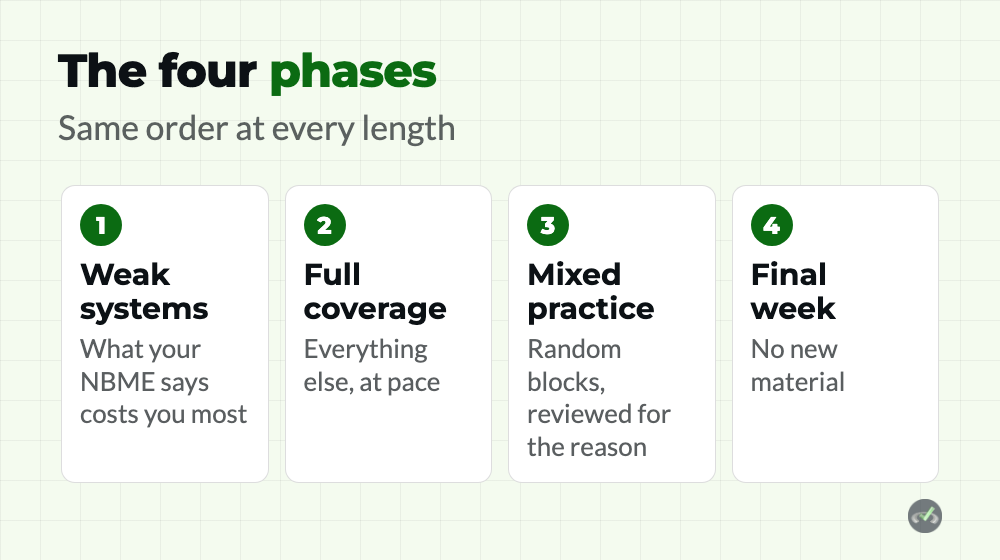
Every Step 1 study schedule below runs the same four phases, and you can build yours from your own scores in about four minutes. Weak systems first, then full coverage, then mixed practice, then a final week that adds nothing new.
Which row you are on is decided by your practice scores, and the calendar only decides what is possible. Comfortably above the line with eight weeks left is a different problem from sitting below it with eight weeks left!
Sit a full-length NBME before you build any of this. One day spent there turns a generic plan into yours.
The four phases every Step 1 study schedule runs
The lengths change with your run. The order does not. Every Step 1 study schedule here is front-loaded on content, because questions teach you far more once you have something to attach them to!
Sit an NBME at the end of phase one and again at the end of phase three, with one more in the final week if the trend is unclear. On runs of three months or more, monthly is better!
Below three weeks there is no room for four distinct phases, so mixed practice folds into the final week. Everything else on this page still applies 🙂
Short runs, 3 to 4 weeks
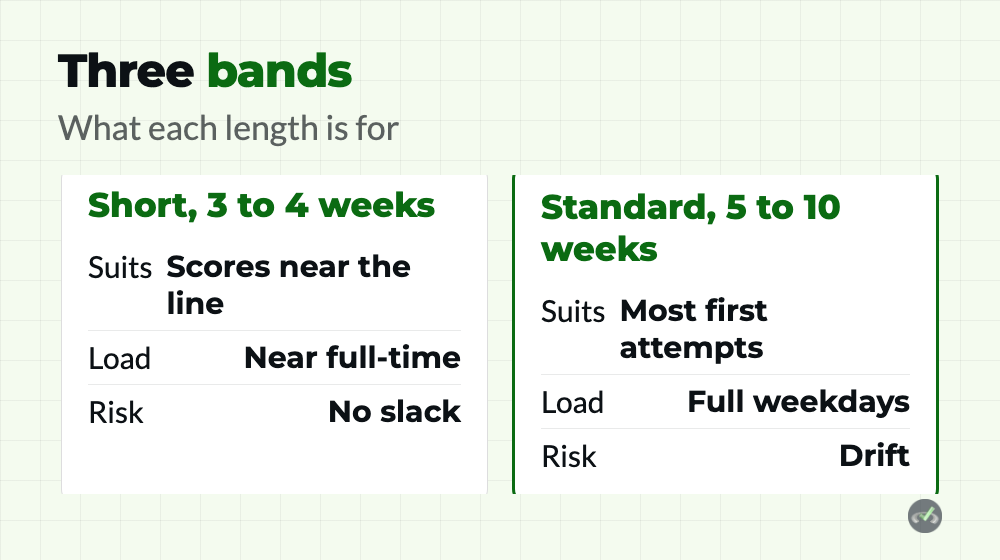
A short Step 1 study schedule suits somebody with a date already booked and content mostly in place.
A run this short only works from a standing start. If your first pass is not finished, no arrangement of these weeks fixes that, and the honest move is to change the date rather than the schedule.
Assume you will cover your weakest systems properly and skim the rest. That is the trade a short run makes, and making it deliberately beats discovering it in week three!
How much of the day this takes. Expect this to be close to full-time. A short run is not a light one.
There is no slack. One illness, one funeral, one bad week and the plan is gone, because nothing in it was spare.
Build the recovery in advance. Decide now which system you would drop, so that decision is not made at midnight by a tired version of you.
Standard runs, 5 to 10 weeks
A standard Step 1 study schedule suits most people sitting a first attempt with a finished content pass.
This is the length most dedicated periods run, and the one the resources are built around.
It gives you room for two or three practice exams with time to act on each. Shorter runs cannot buy that!
How much of the day this takes. Full days on weekdays, with one lighter day a week, is the usual shape.
Drift. There is enough time that week two feels relaxed, and enough pressure by week five that the plan gets abandoned rather than revised.
The checkpoints are what stop that, so treat a scheduled NBME as immovable even when you feel unready for it. Especially then!
Long runs, 3 months and up
A long Step 1 study schedule suits somebody planning well ahead, often alongside coursework or a rotation.
Over a run this long the enemy stops being time and becomes decay. What you learn in month one is gone by month four unless something keeps bringing it back.
Spaced repetition stops being optional here. So does re-testing systems you have already covered, because covered is not the same as retained!
How much of the day this takes. A few hours daily around your other commitments, rather than full days.
Losing the thread. A schedule measured in months has no urgency in it until the last few weeks, and that is when people discover the early material is gone.
Sit an NBME monthly rather than at phase boundaries. On a long run the trend matters more than any single score.
Build your blocks to the current format
Step 1 changed on 14 May 2026, and it changes how you should practice inside any Step 1 study schedule written before that date.
The exam now runs as fourteen 30-minute blocks of up to 20 questions, inside one 8-hour session, with a minimum of 55 minutes of break time. It used to be seven 60-minute blocks of up to 40 questions.
At up to 280 questions the total is unchanged, so what changed is the rhythm. Practice in sets of 20 at 30 minutes, because 40-question blocks now train you for a format that no longer exists!
The specification is at usmle.org. Trust that page over anything else you read. A forum post written last year is describing a different exam!
Which systems carry the most weight
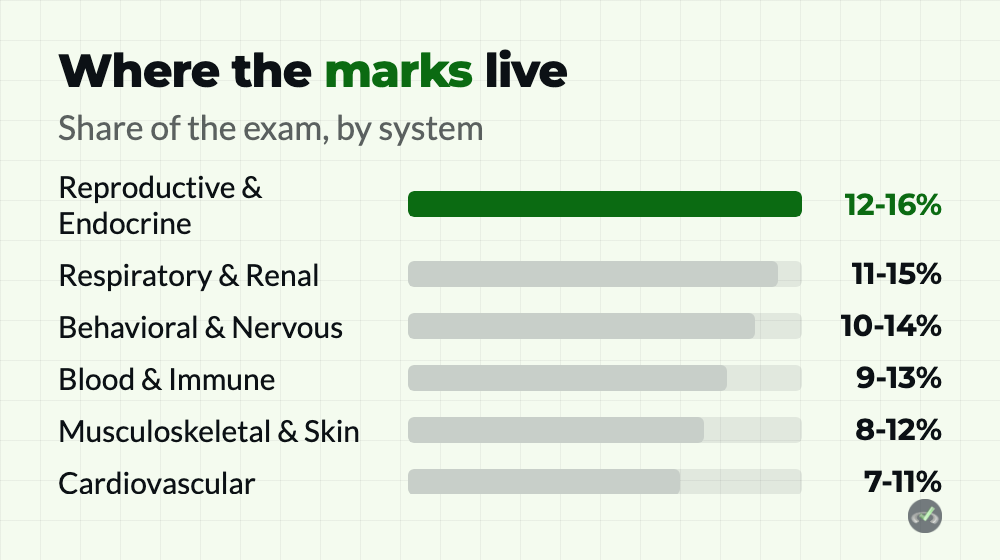
Discipline weight tells you what to study. For the order of your phases, look at system weight instead, because the exam is built along systems first!
Cross this table with your own NBME breakdown and you have the order for phase one of your Step 1 study schedule. A weak system near the top earns more days than a weak system near the bottom.
Across disciplines, pathology occupies 45 to 55% of the exam and physiology 30 to 40%, so a gap in either costs you across every system on the list!
Both sets of ranges are published in the content outline and change from time to time.
What a week inside a Step 1 study schedule looks like
The phases set what you study. Whether it sticks is decided by the week, and that gets left to chance more often than it should!
- A timed block every day, from day one, even in the content phase.
- Review that outlasts the block. Budget more time for reviewing a block than for sitting it, because that is where the learning is.
- One lighter day a week. A day with enough give in it to absorb the week going wrong without wrecking the plan.
- Sleep as part of the schedule. Running a deficit through the last fortnight costs you more than the extra hours buy!
Between a three-week run and a six-month one, none of that changes. At any length, the week is the unit that holds a Step 1 study schedule together!
The same week, in the form you would put in a calendar
Phases set the shape. Days are where a Step 1 study schedule either holds or stops being followed without anyone announcing it, so here is one in calendar form.
New material sits in the mornings, when it tends to stick best. Put the timed block in the afternoon so every day of your Step 1 study schedule ends on practice!
Nothing here is sacred except the checkpoints. Move the rest around your rotations, your commute and the week your car breaks down 🙂
What to use inside it
A Step 1 study schedule is a container. What goes in it matters more than the boxes do, so pick these four before day one.
- One question bank as the spine. Pick it before day one and stay with it. Half of two banks is worse than all of one!
- One content resource you annotate rather than reread. Over a few weeks it grows into your own notes instead of staying somebody else's.
- Spaced repetition for the facts that will not stick, kept small. A deck growing faster than you can review it becomes a second job.
- NBME self-assessments as the measuring stick, because they are written by the people who write the exam.
How you will review a block. Reading the explanation of every question is slower than it looks and teaches less than working out why your reasoning went where it did.
Decide the method now and the schedule holds. Decide it in week three and you lose the weeks before it 🙂
The final week
In the last week of any Step 1 study schedule the job changes.
- No new material. Anything learned in the last seven days is the least secure thing you know on test day.
- Practice at the exam's own rhythm, in 30-minute sets of 20, so the pacing is familiar rather than new.
- Rehearse the breaks. You get a minimum of 55 minutes across the day. Decide in advance where they go rather than improvising when you are tired!
- Nothing new on the last day. Rest is a study activity that week.
Exam-day rules are published at usmle.org, and they changed in 2026, so read them rather than trusting what a friend remembers.
What to do when you fall behind
By the end of the second phase, most people have fallen behind. A Step 1 study schedule is written by somebody rested and followed by somebody who is not!
The instinct is to add hours and catch up. For a day that works, and then it costs you the following week, because the deficit was never the hours.
Repairing a Step 1 study schedule means cutting something. Choosing what to cut beats letting a bad week choose for you!
- Cut coverage, keep the checkpoints. A system you skim is recoverable. Miss an NBME and you fly blind for a fortnight!
- Drop the second pass before you drop the questions. Of everything in the plan, rereading is the most expendable.
- Reforecast once, out loud. Write the new end date down. A plan you are secretly two weeks behind on is worse than a shorter plan you are on top of!
Rescheduling is a legitimate answer, and it costs you less the earlier you take it. Our complete Step 1 guide covers what passing takes and how people usually get there 🙂
Adjusting when a score comes back
A Step 1 study schedule written on day one and never revised stops being a schedule by week three.
When an NBME comes back, change the plan rather than your feelings about it. Is a system still costing you? It gets more of the next phase. Has it come up? It gets less!
A dipping score close to the date is the night people start pricing a postponement. Look at the breakdown with somebody rather than alone, which is what our Step 1 tutoring is for 🙂
When a schedule is not the answer
Two situations where no length of Step 1 study schedule is the right plan.
Your first content pass is unfinished, in which case a schedule of any length is premature and finishing the pass comes first.
Or your practice scores sit well below the line with no upward trend, in which case more weeks on the same method will not fix it. What needs changing is the method!
Our comparison of Step 1 tutors covers how to tell those apart, including the three situations where outside help is the wrong call.
Step 1 study schedule, common questions
How long should a Step 1 study schedule be?
Your practice scores decide it, not the calendar. Comfortably above the line and four weeks is plenty. Well below it with no upward trend, and the method needs changing before the length does!
How many practice exams should a Step 1 study schedule include?
Enough to see a trend rather than a single reading, spaced so each one can change what you do next. Two at a minimum, three if the picture is unclear, and monthly on a long run.
Should I take days off?
Yes, and please do 🙂 A month without one is the most common thing we hear from students whose scores have gone flat, and from the inside burnout looks identical to a plateau.
What if my score drops in the final week?
Until the trend agrees with it, a single reading is noise. Look at the breakdown before deciding anything, and get a second pair of eyes on it if you can!
Is three weeks ever enough?
Only from a standing start, with a finished content pass and practice scores already near the line. From below the line, three weeks is not a schedule problem.
Does the same schedule work for COMLEX?
The shape carries over, and the content weighting does not, because COMLEX Level 1 adds osteopathic principles and practice on top!
Related reading
- Build your Step 1 study plan, a free tool that sizes the phases below to your own weeks and practice scores
- The complete USMLE Step 1 guide, what the exam tests and what passing takes
- 8 best USMLE Step 1 tutors, and when a Step 1 study schedule needs outside help
- USMLE vs COMLEX, which one you sit and whether you sit both
- The USMLE exam guide, all three Steps
- USMLE Step 1 tutoring, our packages and how matching works