
What Is the USMLE
The USMLE exam is the three-part examination you have to pass to practice medicine in the United States. It stands for United States Medical Licensing Examination, and it is run jointly by the Federation of State Medical Boards and the National Board of Medical Examiners.
Almost everything about it changed in 2026, so a description written last year is describing a different set of exams. What follows is current as of September 2026, and you can trust the numbers here 🙂
- What the USMLE is, in one paragraph
- The three Steps at a glance
- Step 1, the science
- Step 2 CK, the clinic
- Step 3, independent practice
- Who has to take the USMLE exam
- When you take each one
- How the USMLE exam is scored
- What happens if you fail
- What the USMLE exam costs
- Pass rates
- How many attempts you get
- Common questions about the USMLE exam
- Related reading
What the USMLE is, in one paragraph
A license to practice medicine in the United States is granted by a state medical board, and every one of those boards requires evidence that you can do the job safely. The USMLE exam sequence is that evidence.
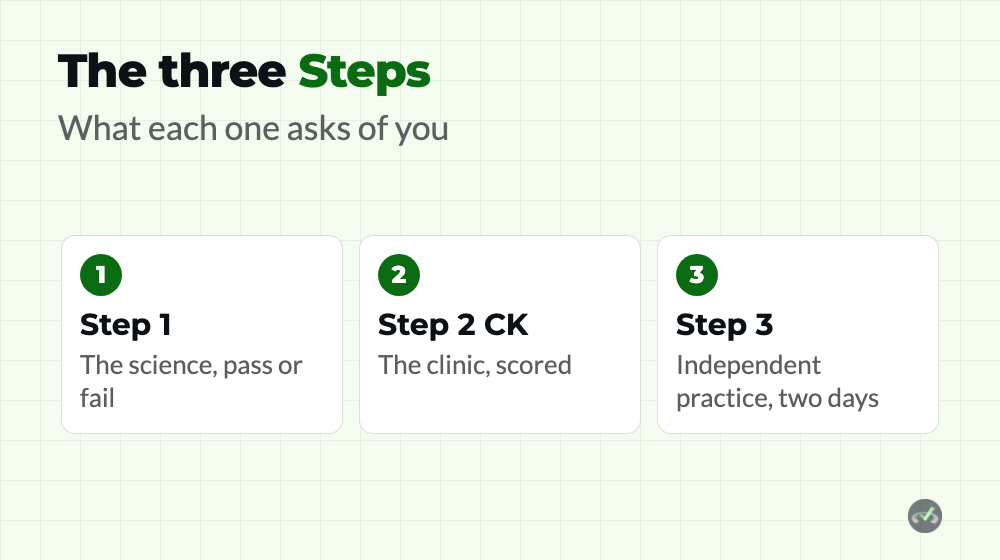
Three Steps, taken years apart, each answering a different question. Do you understand the science? Can you apply it to a patient? Can you be trusted with a patient on your own?
Put that way it sounds enormous, and thousands of people clear it every year!
Nothing in the USMLE exam sequence is optional, and nothing in it is graded on a curve against the people sitting the same day as you.
Passing all three Steps is a requirement for licensure. It is not a ranking, and no state issues a license without it.
The three Steps at a glance
Every figure in this table is current for USMLE exam sittings from May 2026 onward!
The Step 1 and Step 2 CK formats above took effect on 14 May 2026 and 7 May 2026. Before those dates both ran in 60-minute blocks of up to 40 questions, which is what most published advice still describes!
Every figure here is published at usmle.org and is subject to change without much notice.
Step 1, the science
The first USMLE exam asks whether you understand the sciences underneath medicine, and whether you can apply them. Anatomy, physiology, pathology, pharmacology, microbiology, biochemistry, behavioral science and biostatistics, organized by body system rather than by subject.
It runs as fourteen 30-minute blocks of up to 20 questions in a single 8-hour session, with a minimum of 55 minutes of break time and a 5-minute tutorial. A long day, and a well-signposted one!
Since 26 January 2022 the result is pass or fail with no number attached. Residency programs lost their favorite filter that day, and most of the weight shifted onto Step 2 CK!
Our complete Step 1 guide covers what it tests in detail, and our Step 1 study schedule covers how to prepare for it.
Step 2 CK, the clinic
The second USMLE exam tests whether you can apply that science to a patient under supervision. Diagnosis, investigation, management, health promotion and disease prevention, almost all of it delivered as clinical vignettes.
From 7 May 2026 it runs as sixteen 30-minute blocks of up to 20 questions in one 9-hour session, with a minimum of 55 minutes of break time. An hour longer than Step 1, and two more blocks!
It is scored on a three-digit scale, and the minimum passing score rose to 218 on 1 July 2025. With Step 1 now pass/fail, this is the number residency programs look at.
Step 2 Clinical Skills was suspended in 2020 and permanently discontinued in January 2021. Plenty of guides still describe it as paused or coming back, and it is neither.
If a resource you are reading tells you to prepare for CS, that resource has not been updated in five years and its other advice deserves the same suspicion!
Step 3, independent practice
The last USMLE exam is the only one taken over two days, and most people sit it during residency.
- Day one, Foundations of Independent Practice. 232 multiple-choice questions in 12 blocks of 18 to 20, 30 minutes a block, across roughly 7 hours.
- Day two, Advanced Clinical Medicine. 180 multiple-choice questions in 9 blocks of 20, then 13 to 14 computer-based case simulations of 10 or 20 minutes each, across roughly 9 hours.
The case simulations are what make Step 3 different. You manage a patient in real time, ordering tests and treatments and advancing the clock, rather than picking from five options!
It is scored on the three-digit scale and the minimum passing score has been 200 since 1 January 2024. By the time you reach it you have sat two of these already, which helps 🙂
Who has to take the USMLE exam
Three groups sit the USMLE exam, by different routes.
- US and Canadian MD students. Register through the NBME. Step 1 usually after the pre-clinical years, Step 2 CK in the clinical years, Step 3 in residency.
- DO students. Sit COMLEX-USA for osteopathic licensure, and many sit the USMLE as well, because some residency programs still ask for it. Our USMLE vs COMLEX comparison covers whether you need both.
- International medical graduates. Register through ECFMG and need ECFMG certification, which requires Step 1 and Step 2 CK, before Step 3 and before entering US residency.
When you take each one
The USMLE exam sequence runs across most of your training rather than in one block.
Since Step 1 became pass/fail, some students sit Step 2 CK first so that a strong score is on the transcript earlier in the application cycle. Both orders are allowed.
Your school will usually have its own policy on when you can sit Step 1, and that policy is stricter than the USMLE's own rules more often than not. Ask early rather than assuming 🙂
How the USMLE exam is scored
Steps 2 CK and 3 report a three-digit score. Step 1 reports pass or fail and nothing else.
- It is not a curve. The passing standard is set against the content, so in principle everybody sitting could pass, or nobody could.
- Roughly 60% correct. The USMLE program says examinees typically need to answer around that share of questions correctly, and the exact figure varies by exam form.
- Open every block. Leaving a block unopened can mean the attempt is not scored at all, and it is reported as incomplete on your transcript.
- Every attempt stays on the transcript. Passes, fails and incompletes, and programs see all of them!
Score reports usually arrive within a few weeks, and the schedule is published in advance at usmle.org, so the wait has an end date on it!
What happens if you fail
A failed USMLE exam is recoverable, and plenty of practicing doctors have one behind them. The attempt does appear on your transcript permanently, and residency programs see it.
You can register again once the result is reported, subject to the attempt limits above. Most schools want a plan before you rebook, and the pass rates for repeat attempts are a reason to take that seriously.
Repeat attempts pass at 71% for US MD candidates and 54% for graduates of non-US schools, against 93% and 75% on a first attempt. Doing the same preparation again is what produces those numbers, so change something before you sit it again!
What specifically went wrong. Content gaps, timing, stamina and test anxiety all produce the same result and none of them respond to the same fix.
Your score report breakdown answers part of it. A practice exam sat properly answers most of the rest 🙂
What the USMLE exam costs
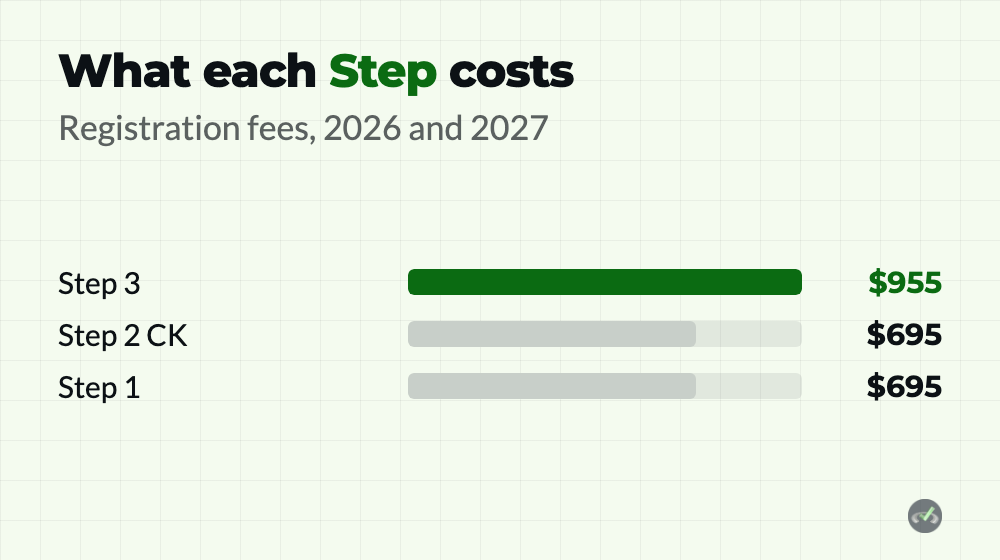
Fees are set for 2026 and 2027 and are non-refundable.
The regional surcharge is charged by the test delivery provider rather than by the USMLE program. Testing in India carries a further 18% goods and services tax, applied since 4 December 2024.
Sitting all three once, inside the US, comes to $2,345. Add a retake and the arithmetic changes fast, which is the argument for getting each one right the first time!
If money is part of your timing, the NBME runs a fee assistance program and applications open each year 🙂
Current fees are at usmle.org.
Pass rates
Pass rates on the USMLE exam vary more by where you trained than by which Step you are sitting. These are the 2025 figures published by the USMLE program.
Two things stand out. Step 1 is where people fail, and a repeat attempt passes at a much lower rate than a first one across every group and every Step!
That second point is the case for preparing properly the first time rather than treating an attempt as a diagnostic!
Full tables by year are at usmle.org.
How many attempts you get
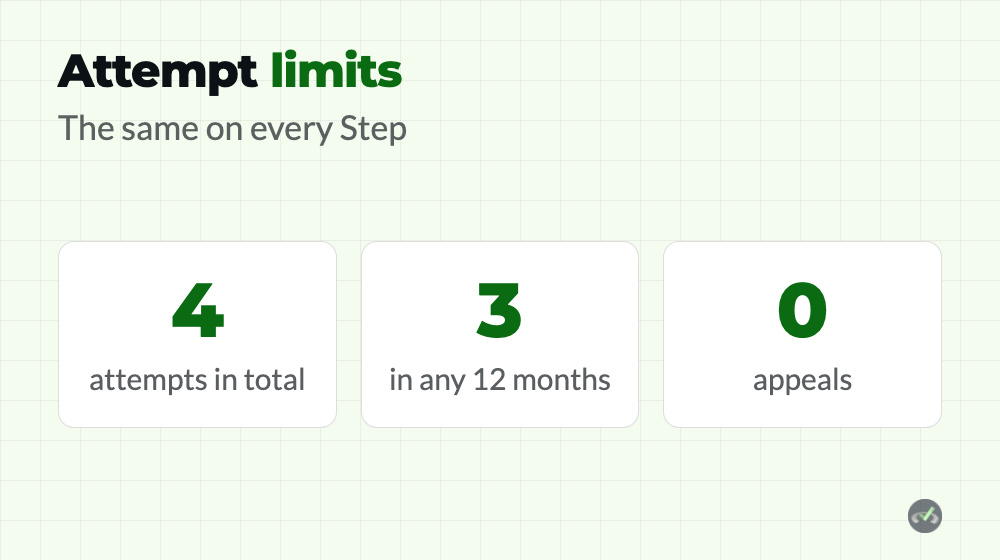
Each USMLE exam allows four attempts in total, for life. Incomplete attempts count!
- No more than three attempts at the same Step within any 12 months.
- A fourth attempt must be at least 12 months after your first attempt at that Step, and at least 6 months after the most recent one.
- Once you have passed a Step you cannot retake it, except where a state board requires it.
There is no appeal and no exception process. Somebody on their third attempt is in a very different position from somebody on their first, so plan around the limit rather than discovering it 🙂
Common questions about the USMLE exam
What does the USMLE exam stand for?
United States Medical Licensing Examination. It is run jointly by the Federation of State Medical Boards and the National Board of Medical Examiners.
How long does the whole USMLE exam sequence take?
Years rather than months. Step 1 typically comes after the pre-clinical years, Step 2 CK during the clinical years, and Step 3 during residency.
Is Step 1 still scored?
No. Every Step 1 exam sat on or after 26 January 2022 is reported as pass or fail with no number attached.
What percentage do you need to pass?
The USMLE program says examinees typically need to answer around 60% of questions correctly, and that the exact figure varies by Step and by exam form.
Can I take the USMLE without going to medical school?
No. Eligibility requires enrollment in, or graduation from, a medical school that meets the requirements set out in the Bulletin of Information.
Do DO students have to take it?
Not for osteopathic licensure, which runs on COMLEX-USA. Many sit it anyway for residency applications, and our comparison of the two covers when that makes sense 🙂
Related reading
- The complete USMLE Step 1 guide, what it tests and what passing takes
- USMLE Step 1 study schedule, 3 weeks to 6 months
- 8 best USMLE Step 1 tutors, and when to skip tutoring
- USMLE vs COMLEX, which one you sit and whether you sit both
- The USMLE exam guide, all three Steps
- USMLE tutoring, our packages and how matching works