
USMLE Step 1 Dates, Scheduling and Rescheduling
There is no fixed calendar of USMLE Step 1 dates. You register, receive a three-month eligibility period, and book any available day inside it at a Prometric center.
That is changing. From January 2029 the USMLE moves to a small number of designated testing dates each year, and every school and student planning past 2028 needs to know it!
Everything below is checked against usmle.org this month, so you can plan from it 🙂
- How USMLE Step 1 dates work today
- The eligibility period
- Changing your USMLE Step 1 date
- Who you register through
- Five scheduling mistakes that cost people money
- When to take USMLE Step 1
- Designated testing dates, arriving in 2029
- Planning your date backwards
- USMLE Step 1 dates, common questions
- Related reading
How USMLE Step 1 dates work today
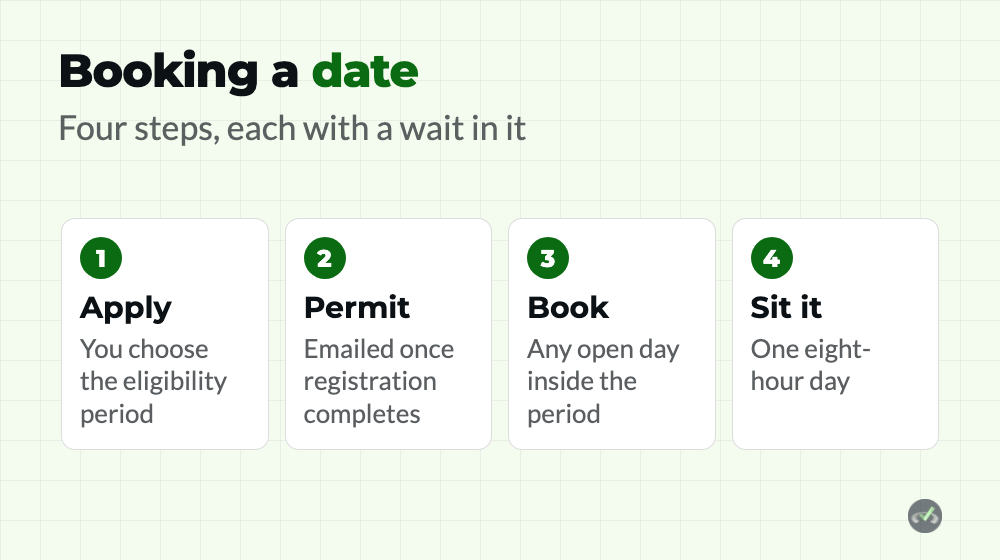
Four steps, in order, and each one has a wait in it. Start earlier than feels necessary!
Dates go first come, first served, and the USMLE program does not guarantee that any particular center has space. Book as soon as your permit arrives rather than when you feel ready!
Book early in your eligibility period, not late. That leaves room to move the date without leaving the period.
The eligibility period
Your eligibility period is a three-month window, and your exam has to happen inside it. Three months is more room than it sounds like, if you choose the window well 🙂
- You pick it when you apply, so pick it around your preparation rather than around the earliest date available.
- One extension is possible. A single contiguous extension can be requested from whoever registered you, and it carries a fee.
- Letting it lapse is expensive. A new application and the full fee again, with nothing carried over.
- Rescheduling stays inside it. Any new date has to fall within the original or extended period!
The rules are set out in the Bulletin of Information, which is the document you agree to at registration.
Changing your USMLE Step 1 date
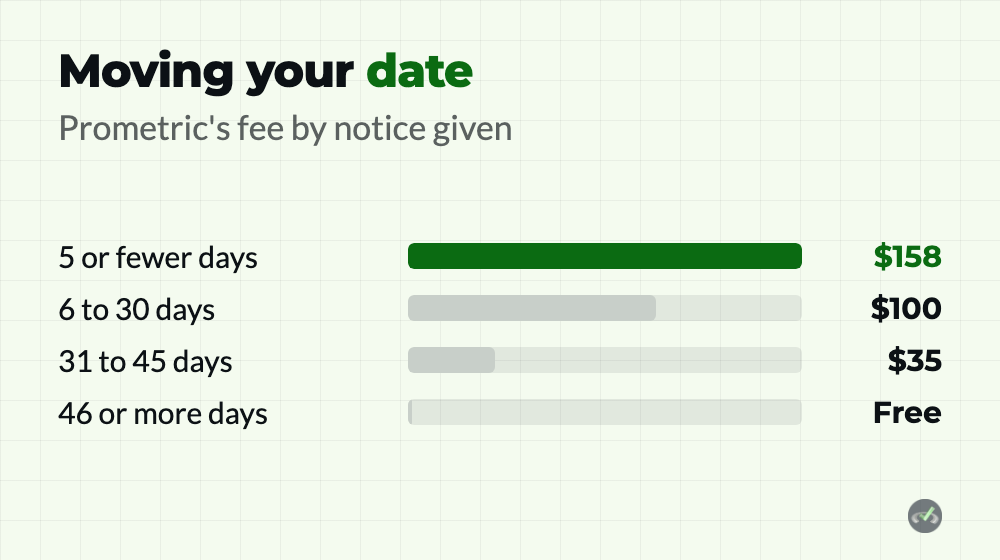
Rescheduling with Prometric is free early and expensive late. The fee is decided by how many days of notice you give.
The count runs from the day you make the change, in local time at your regional registration center, and it excludes the test date itself. Count carefully!
Make the decision at 46 days rather than at 45. One day either side of that boundary is the difference between free and $35, and inside a week it is $158 🙂
The fee table is published at usmle.org.
Rescheduling moves your appointment inside your existing eligibility period. Extending moves the period itself, and it goes through whoever registered you rather than through Prometric.
People discover the difference at the point where they need both, which is the worst time to learn it!
Who you register through
Which organization handles your USMLE Step 1 registration depends on where you go to medical school, and it decides who you contact about eligibility periods later.
Whoever registered you is also who you ask about an eligibility period extension. Prometric only handles the appointment itself, so a call to the wrong one costs you a day!
Five scheduling mistakes that cost people money
All five are avoidable, and every one of them shows up in our inbox 🙂
- Choosing an eligibility period that starts too soon. The period is picked at application, before you know how preparation will go, so choose it around a realistic run.
- Booking on the last available day of the period. There is then nowhere to move to without requesting an extension.
- Waiting for the permit before checking center availability. Look at what is open near you first, because dates go first come, first served.
- Deciding to move the date at 44 days. Two days earlier, it is free.
- Assuming a fee transfers. Registration fees are non-refundable and non-transferable between periods and between applications!
When to take USMLE Step 1
Most US and Canadian students sit it at the end of the pre-clinical years, after a dedicated study period. That is a convention rather than a rule, and there is more room in it than you think!
- Your school's policy is usually the binding one. Many schools require a passing practice score before they will certify you, and that is stricter than the USMLE's own rules.
- Your practice scores decide the exact day. A date booked around a calendar rather than around an NBME result is the most common story behind a fail.
- Step 1 and Step 2 CK can be taken in either order. Since Step 1 went pass/fail, some students sit Step 2 CK first to get a score on the transcript earlier.
- International graduates need both for ECFMG certification, before Step 3 and before entering US residency.
Our Step 1 study schedule covers how long to leave yourself, from three weeks to six months!
Designated testing dates, arriving in 2029
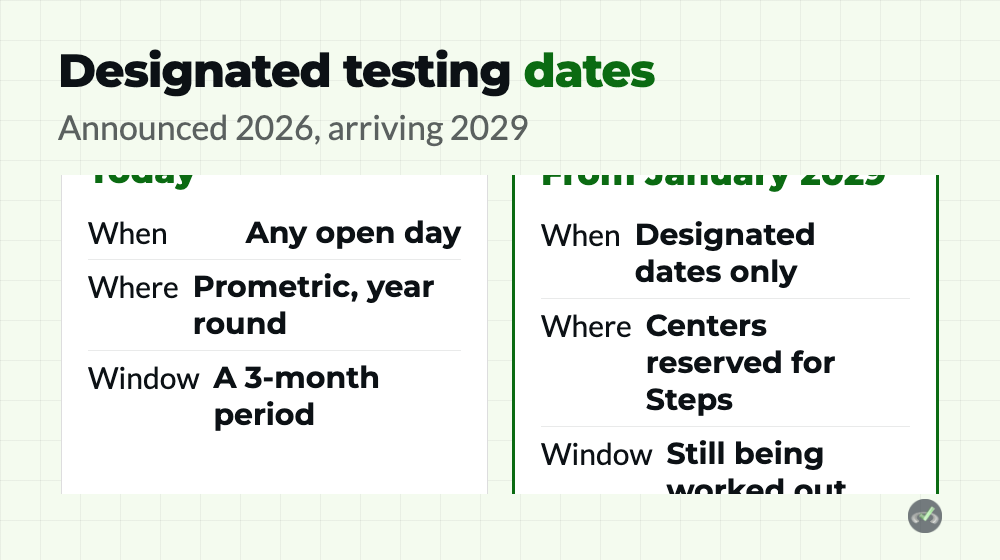
The USMLE program announced on 23 June 2026 that it will cut the number of Step exam administrations each year, and confirmed on 6 August 2026 that the change lands in January 2029 rather than 2028.
Under that model, Prometric centers are reserved exclusively for Step exams on a set of designated dates, and testing outside those dates stops.
- The stated reason is exam security, standardization and fairness.
- Booking becomes competitive. Fewer administrations means capacity in your region matters in a way it never has.
- School policies will have to move. The USMLE program has asked schools to review requirements that constrain when students sit the Steps.
- An implementation panel of educators, examinees, state boards and members of the public was set up in August 2026 to shape the transition.
If you start medical school in 2026 or later, this is the model you will sit under. Details are at the USMLE's information hub, and they are still being worked through!
Planning your date backwards
The date is the last decision, and most people make it first. Doing it in this order takes a surprising amount of pressure off 🙂
- Sit a full-length NBME before anything else, under timed conditions.
- Pick the length of your run from where that score lands, not from what your friends are doing.
- Count backwards from the end of that run to the eligibility period you need, and choose that period at application.
- Book early inside the period, so there is room to move without extending.
- Reassess at each NBME, and settle the date question at 46 days out rather than at 5.
The exam day itself is eight hours, so leave the day after it clear too 🙂
USMLE Step 1 dates, common questions
Are there fixed USMLE Step 1 dates?
Not today. You book any available day at a Prometric center inside your three-month eligibility period. From January 2029 the exam moves to designated testing dates each year.
How far ahead can I book?
Scheduling is not available more than six months in advance, and dates are first come, first served.
What if I need to move my date?
Free with 46 or more days of notice, $35 inside 45 days, $100 inside 30 and $158 inside five. The new date has to sit inside your eligibility period.
What if I cannot test inside my eligibility period?
Ask whoever registered you about a one-time contiguous extension, which carries a fee. Let the period lapse and you reapply at the full fee.
Can I sit Step 2 CK before Step 1?
Yes, and a growing number of students do since Step 1 stopped reporting a score. Our USMLE overview covers how the Steps fit together!
Is Step 1 offered outside the United States?
Yes, at international Prometric centers, with a $210 test delivery surcharge on top of the registration fee.
Related reading
- How long is USMLE Step 1, the eight-hour day block by block
- USMLE Step 1 study schedule, 3 weeks to 6 months
- USMLE cost, every fee for all three Steps
- The complete USMLE Step 1 guide, what it tests and what passing takes
- 8 best USMLE Step 1 tutors, and when to skip tutoring
- The USMLE exam guide, all three Steps