
A T20 medical school can feel like a goal that belongs only to people with flawless numbers, stacked resumes and a perfectly engineered application. That's one of the biggest misconceptions in this process!
In the video above, Srikar, one of our mentors and now a med student at Columbia, says he knew people with excellent stats who didn't land where they expected. He also knew people with less-than-perfect GPAs or MCAT scores who got into incredible programs.
This guide covers what a T20 medical school is, the 20 schools with their median MCAT and GPA, three myths that trip applicants up, and the three things that helped Srikar get in.
Free download
A T20 application is the same cycle, run earlier and tighter. Here is the cycle.
Every phase, what is due when, and where applications lose ground without noticing.
On its way.
Check your inbox in the next minute.
What Is a T20 Medical School?
T20 is shorthand for the 20 top-ranked medical schools in the U.S. News & World Report research rankings. It's an informal label, and the schools it covers are known for clinical training, research, reputation and opportunities.
Since its 2024 edition, U.S. News has grouped medical schools into tiers with no numbered ranks. So T20 now points back to the schools at the top of the older numbered lists, and which 20 you get depends on the year someone uses.
Any way you count them, these schools are selective and holistic, and they're very interested in who you are beyond your stats!
There's no official T20 list. A school's spot on a ranking also tells you little about whether it fits you, so treat the label as a starting point for your research.
T20 Medical School List With Median MCAT and GPA
Here are the 20 schools at the top of U.S. News's 2021 Best Medical Schools: Research list, the same list our table of median MCAT scores and GPAs at the top 100 U.S. medical schools uses.
Later numbered editions moved some of these schools up or down, so other T20 medical school lists you see may swap a school or two!
MCAT and GPA figures are medians for the 2026-27 application cycle. An asterisk marks a school whose figure comes from an earlier cycle and may be an average. Each school's name links to its own admissions page.
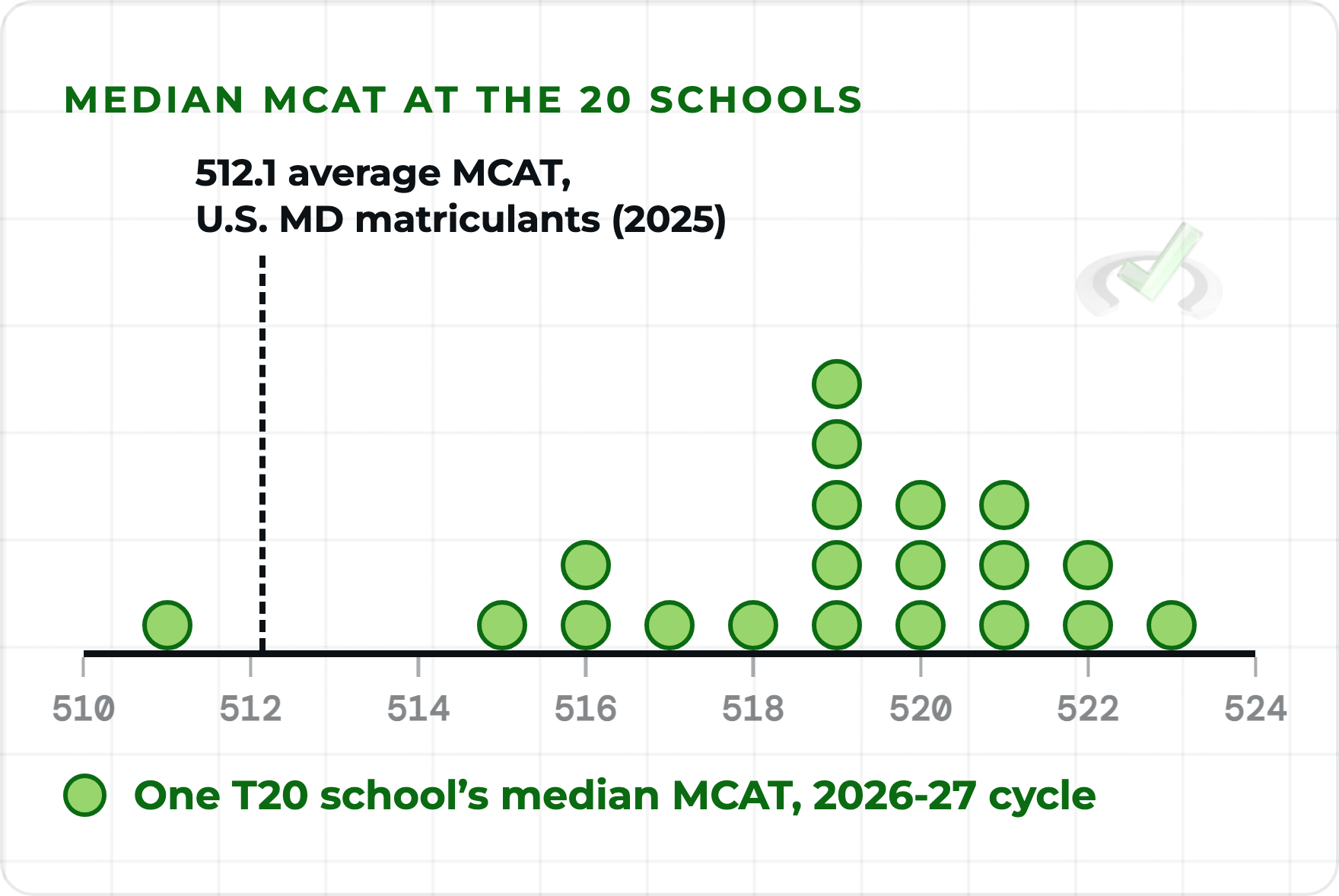
For comparison, the 2025 entering class at U.S. MD schools averaged 512.1 on the MCAT and a 3.81 GPA, according to the AAMC’s 2025 enrollment report. Every T20 median but one sits above that average, and they run from 511 to 523.
The MSAR from AAMC shows each school's medians, how many applicants it interviews, and its in-state and out-of-state numbers. It's a great place to check a school before it goes on your list!
Three Myths About Getting Into a T20 Medical School
Myth 1: Your GPA and MCAT Are Everything
Strong numbers matter, and they help a lot. Think of them as door openers! A high GPA and MCAT can get admissions committees to take your application seriously and help you clear an initial screen.
The medians at these schools sit high, as the dots below show, so it's easy to treat them as the whole test. They do their job early, and then the rest of your application gets to carry you!
I had strong stats and still did not get interviews at some schools. That alone should tell you something. If numbers were enough, that would not happen.
Srikar, MedLife mentor and Columbia med student
Srikar also saw applicants with more modest metrics earn acceptances, because they showed things committees care about just as much:
- Clear fit with the school
- Meaningful extracurricular involvement
- A believable reason for pursuing medicine
- Maturity and self-awareness
- The ability to communicate their story well
Myth 2: You Need Research and Publications
This one causes a huge amount of stress! Research can help, especially at academically intense schools. Having research and having publications are two different things, though, and neither one is a universal requirement for a T20 medical school.
I did research myself, but I did not have publications. During the application cycle, that felt like a big deal. It turned out to matter much less than I thought.
What mattered more was whether I could talk about the experience in a thoughtful, engaged way.
Srikar, MedLife mentor and Columbia med student
So if you did research, be ready to talk about it well. If you didn't, your chances at a T20 medical school are still open! Committees want to see a commitment that runs deep somewhere in your application.
Myth 3: You Need to Fill Every Activity Slot
More activities won't automatically make a stronger application. A T20 medical school looks for signs of meaning, growth and intentionality, and three or four experiences can carry a lot of weight if you can explain:
- Why you chose them
- What you learned
- How they affected the way you think about medicine
- Why they still matter to you now
For me, some of the most meaningful experiences involved supporting underrepresented and underserved children. I spent meaningful time on a dance team in college, and that mattered to me.
Srikar, MedLife mentor and Columbia med student
Interests outside medicine count too! They give the committee a fuller picture of who you are, and Srikar's dance team was a major part of his college life.
(Optional) If you're unsure which activities to write about, a med school application coach can help you choose them and describe each one clearly.
Your strongest experiences are usually the ones you'd still care about even if no application existed.
What Helps You Get Into a T20 Medical School
1. Build Your Narrative Around What's True
Every applicant has to answer one big question, which is why you want to be a doctor. Your story can come together gradually, with no single defining moment! A strong answer comes from honest reflection on things like:
- Your values
- Your lived experiences
- The communities you care about
- The kind of work that energizes you
- The role you want medicine to play in your life
After COVID, I took a gap year because I did not feel ready to jump straight into medical school. That time gave me space to think more honestly about what I wanted.
Over time, I realized I felt especially drawn to working with underserved children and urban pediatric populations.
Srikar, MedLife mentor and Columbia med student
His clarity came gradually, from noticing patterns in his own experiences and interests. Applicants who skip that step often end up guessing what committees want to hear, and their personal statement comes out polished but generic.
We'd build your application around what's true for you, since a T20 medical school responds to a story that feels grounded. If you'd like a second set of eyes, our application coaches can help you brainstorm your personal statement and shape its theme :)
2. Build Your School List With Geography and Data
School lists often get built around prestige first and practicality second. If your goal is a T20 medical school, two more things deserve a close look when you choose each T20 medical school to apply to.
First, you're choosing where you'll live during a demanding few years. If you'd hate the area or feel isolated there, that matters! Think about:
- Urban versus suburban versus rural settings
- Distance from family or support systems
- Climate and lifestyle preferences
- Cost of living
- The patient populations you want to serve
Second, many public medical schools strongly prefer in-state applicants. From out of state, some of those applications may be long shots no matter how strong you are on paper, so it helps to check first!
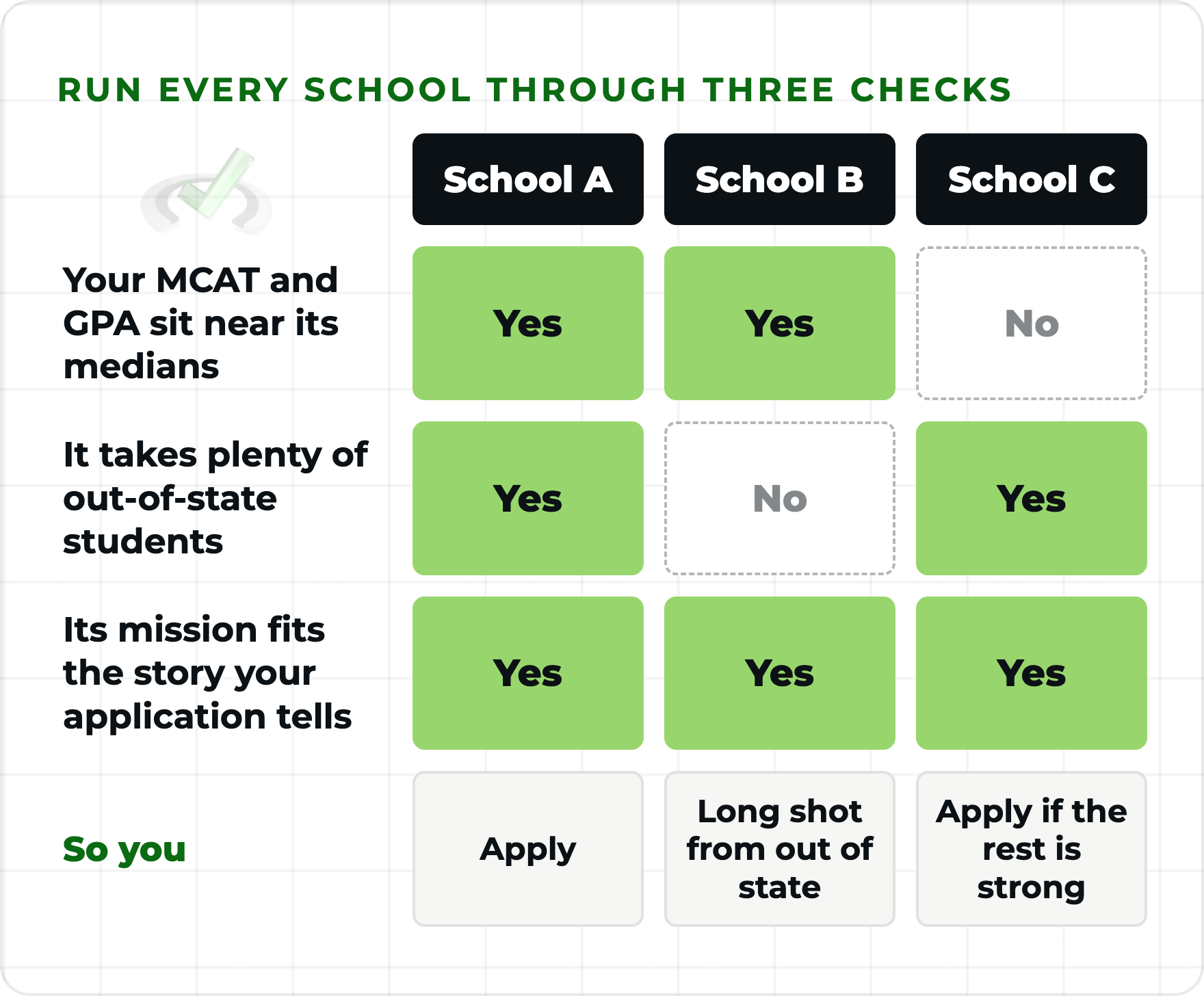
Say you're from Ohio and considering several California public schools. Many of them heavily favor California residents, so think about whether each one earns a spot on your list, given the time, money and energy it takes.
The MSAR from AAMC is one of the best tools for this. For each school, it shows details like:
- How many students apply
- How many are interviewed
- How many matriculate
- In-state versus out-of-state patterns
- Tuition differences
- Curriculum and school details
If the MCAT side of your timeline still needs planning before you finalize your list, our guide on when to start MCAT tutoring can help you think it through.
3. Align Your Strengths With Each School's Strengths
By the time a school sends you a secondary, and especially once it invites you to interview, it's already interested. At that stage your job is to show why you belong there!
Strong applicants make the case that:
- The school’s mission fits their values
- The school’s programs fit their interests
- The school’s culture fits their personality and goals
- Their background and priorities would add something meaningful to that community
That alignment should shape your secondary essays and your interviews. If a school emphasizes research, service to underserved communities, urban health, primary care or a specific educational model, you'll want to understand it well enough to explain where you fit.
That research helps in every essay!
How to Research School Fit Beyond the Website
School websites tell you what a school wants to present. For a sense of what the place feels like day to day, talk to people who know it firsthand:
- Current medical students
- Recent alumni
- Applicants or contacts from your undergraduate network
I found it especially helpful to reach out to people with some kind of existing connection. Maybe they attended my undergraduate institution and were now at a medical school I was targeting. That made the outreach feel more natural.
Srikar, MedLife mentor and Columbia med student
Your message can be short, respectful and specific, and that's plenty! Here's a sample you can adapt, based on the one Srikar shows in the video.
Sample outreach messageHello!
I’m [Your Name] and I’m a current applicant for [School Name].
I would love to chat for like 5 to 10 minutes and gain insights from your experiences as a student here.
Your perspective would be invaluable to me as I navigate the application process.
Looking forward to hearing from you!
You'll get ignored sometimes, and that's normal, since med students and alumni are busy. Even a handful of conversations can give you insight that improves your essays and interviews!
Your coach can also help you research each school and shape your secondaries and interview answers around what you find. You've got this!
A T20 application is the same cycle, run earlier and tighter. Here is the cycle.
On its way.
Check your inbox in the next minute.
Keep Your Stats in Perspective and Lean on Support
Aim to be as competitive as you can for any T20 medical school on your list. Take your GPA seriously and prepare well for the MCAT!
Stats help decide whether your application gets a careful read, and the rest of it decides whether you earn a yes.
Whatever your stats are, the rest of your application still gets the final say.
If the MCAT is holding you back, one-on-one MCAT tutoring can help you study with more direction, and these online MCAT resources can help you strengthen that part of your profile.
Applying can feel isolating, especially when everyone around you seems to have a different opinion about what matters most. You don't have to do it alone. Lean on people you trust:
- Friends
- Family
- Professors
- Mentors
- Advisors
This process is a marathon. Support helps you think clearly, recover from setbacks and stay grounded when applications start to take up too much of your headspace.
If you're in a heavy MCAT season at the same time, our guides to avoiding MCAT burnout and MCAT stress and anxiety can help you protect your energy.
Our MCAT success stories are a good reminder that the path is rarely perfect. You'll get there too :)
FAQs About Getting Into a T20 Medical School
What Is a T20 Medical School?
It's one of the 20 top-ranked schools in U.S. News's medical school research rankings. U.S. News switched to tiers in 2024, so the label now comes from its older numbered lists.
What MCAT Score Do You Need for a T20 Medical School?
For the 2026-27 cycle, the median MCAT at the 20 schools in our table runs from 511 to 523, and most sit at 519 or higher.
A median means about half the class scored below it, so a score under the median can still get in!
Do You Need Perfect Stats for a T20 Medical School?
No! Strong stats help, and a T20 medical school also weighs fit, the depth of your activities, how you communicate and how clear your reasons for medicine are.
Do Publications Matter for T20 Medical School Admissions?
They can help, and they aren't required. Committees care most about whether you can discuss your research with insight and interest, so a project you can talk about well counts for a lot!
Is It Bad if Not All of Your Activities Are Medical?
Not at all! A T20 medical school doesn't expect every part of your life to revolve around medicine, and meaningful nonmedical experiences can make your application more memorable.
How Important Is School Fit for a T20 Medical School?
Very! Once you reach the secondary or interview stage, showing that your goals and values match the school's mission can make a major difference.
What's the Best Way to Research a Medical School Before Secondaries and Interviews?
Start with official sources like the MSAR and the school's own website. Then talk to current students or alumni for the clearest picture of its culture, priorities and day-to-day environment.
Should Geography Affect Where You Apply?
Yes! It matters for your quality of life and for your strategy, since some public schools strongly prefer in-state applicants.
Get Help Applying to T20 Medical Schools
Getting into a T20 medical school comes down to a strong academic foundation, meaningful experiences, a story you understand and a clear case for why you fit each school. That's a very human process, and that's good news!
If you'd like support with how to get into a top medical school, our 1:1 med school application coaching pairs you with a mentor who's been accepted to med school and is in med school now!
Your coach can help with your personal statement, AMCAS activities, secondaries and interview prep.
If you'd rather focus on planning, you can use your sessions for strategic advising, like building your school list or making a concrete action plan for the whole application. A plan can make the whole cycle feel lighter!
For more planning tools, our free med school admission resources are a great place to start, and you can browse independent reviews on Trustpilot. We'd love to help you get there :)