
Why most students start too late
"I wish I started working with a tutor earlier!" We hear this so often.
Below are just a few examples of students who met with us when they were panicking with a close test date, and then later realized how much of a higher score increase they would have had if they had just started working with us at the beginning of their prep.
We're meeting too many premeds planning to get a mentor "when they need it", not realizing that when they 'need' an MCAT mentor, they'll already be too late.
Which is why, if you're thinking of working with an MCAT Mentor to get to your score goal by your 2027 test date, here are 3 reasons not to wait until later this year to meet with one of us.
1. The Optimal MCAT Prep Schedule
When you work with a MedLife MCAT Mentor, you'll have an optimal MCAT prep schedule created for you from the very beginning, that will be regularly updated. Creating an MCAT study schedule that:
- Has the right balance of content and practice
- Uses your available content and practice resources in the smartest way possible
- Takes into account your work, school and life schedule, your study habits, your strengths and weaknesses, your score goal, and starting scores
- And adapts on the fly as practice scores change and life happens
Is not easy to do on your own, or get right on the first or second try. How do we know? We've all tried. You can use templates, and watch videos on the optimal way to create your own study schedule.
But nothing will be as convenient, and as reliable, as having a top MCAT scorer who's made all the mistakes and succeeded do it for you.
What a mentor does with that schedule
Some detail is due here, because "a study schedule" sounds like something a spreadsheet could produce. The work is in the judgment calls, and those are the calls students get wrong alone.
- Sequencing. Which sections to attack first given your starting scores, and when to stop content and switch to practice.
- Diagnosing weakness correctly. A low section score can come from a content gap, a timing problem or a review habit, and the fix is different for each.
- Rationing the good resources. The official AAMC material is finite. Burning it early is one of the most common and least recoverable mistakes in MCAT prep.
- Rebuilding when life happens. Every plan survives until the first bad week. What matters is what replaces it.
Those decisions compound. Made well in week one, they save you weeks later. Made badly, you rarely find out until a full-length tells you.
2. Unlocking The Highest MCAT Score Possible, For You Personally
When you work with a MedLife MCAT Mentor, you'll maximize your chances of getting the highest score you're capable of.
Many students meet a tutor 4 to 6 weeks before their test day and don't get as much of a score increase as they would have if they had met at the start of MCAT prep.
You'll increase your score at any point you get a mentor, no doubt. But you'll come in having wasted so much time trying to reinvent the wheel, second-guessing your approach, and making avoidable mistakes like:
- Wasting high-yield content and practice resources
- Diagnosing your weaknesses incorrectly
- Following a sub-par schedule
- Not interpreting passages, question stems, and answer choices the way AAMC expects you to
These are just a few but there are so many more emotionally and mentally draining moments that can be avoided. If it gets too late, you're not left with enough time to hit your highest score that we all know you're capable of.
You can even meet with a mentor for only one or two sessions in the beginning, and save the rest for when you think you need it.
But the early sessions will be extremely beneficial to make sure you're planning and approaching your prep in the right way.
Being honest about what tutoring will not do
We would rather you buy this for the right reason, so here is the other side.
It will not make you study. A mentor adds accountability, and the hours between sessions are still yours to work.
It will not replace the official AAMC material. Nothing does. Coaching changes how you use it.
It closes a large content gap only over a long time. It also costs more than a course would. If there are whole topics you have never learned, spend on content first and bring the coaching in once you have something to diagnose.
It will not guarantee a score. Guarantees exist across this market, ours included, and they all carry conditions. Read them as risk-sharing rather than as a promise.
Free quiz
The Unbiased MCAT Prep Course Decision Quiz
Three different problems stall an MCAT score, and buying the wrong fix costs months. Six questions sort out which one is yours and what to spend on it. We name competitors and free resources when they beat us, and say so when the answer is spend nothing.
No email required. Your plan appears on screen.
Transparency, before you start. We sell MCAT tutoring and courses, so here are the rules this quiz follows.
- Zero budget, no purchases. Free resources only, and we say so.
- Content gap, buy content first. From whoever does it best, which is usually not us. Our tutoring comes up only as an optional add-on for a big gap.
- Strategy gap, we recommend our own course first. We would put our name against it, and we name a lower-priced alternative beside it so you can price us against it.
- Competitors named and linked when they beat us: UWorld, Kaplan, Blueprint, ExamKrackers, Khan Academy.
- We appear only where we fit, with the budget to match, and always beside a lower-priced option.
- Our free MCAT resources show up wherever they fit, and they ask for nothing.
3. Maximize Motivation, Minimize Procrastination
When you meet with a MedLife MCAT Mentor, you won't procrastinate or lose motivation for your far test date.
As premeds, we've never had to study for such a foreign exam that's months into the future. For some, you're doing it again for a second or third time. It's so easy to get demotivated halfway through and feel tempted to procrastinate.
This inevitable 'low' you're going to feel is where a huge percentage of premeds drop off. It's a slippery slope and we want to see you make it, because once you get a strong MCAT score, med-school admission gets a lot easier.
In fact, if you let us, we'll be by your side holding you accountable, keeping you motivated, reminding you of your dream when you forget it, and ensuring your scores improve with a strategy-focused approach, so you naturally feel more confident.
Basically, we'll be holding your hand all the way until your test date.
There are so many more reasons to work with an MCAT mentor that you can find out here.
So when should you start? A timeline
Counting backwards from test day is more useful than counting forward, because the exam date is the fixed point.
- Six months out. The ideal moment to have your schedule built, per reason one above. One or two sessions here shape everything that follows.
- Three to four months out. Still excellent. You have score data, a visible pattern, and runway for a change in approach to show up in practice tests.
- Two months out. The work narrows. Aim at the two or three habits costing the most points rather than at everything.
- One month out. Strategy, timing and triage only. Do not start a content program now.
- Two weeks out. A small number of sessions on passage approach and test-day process can still help. Keep expectations specific.
The one case for waiting is if you have not taken a full-length yet, take one first. Without score data there is nothing to diagnose, and a session in that state turns into a content lesson, which is the most expensive way to buy content.
How your test date should shape the decision
Two things about the exam itself feed back into when you start.
The MCAT has testing limits. You can sit it three times in one testing year, four times across two consecutive years, and seven times in a lifetime.
Attempts are a finite resource, which is an argument for getting the first one right rather than treating it as a practice run.
Schools see every score. Most medical schools view your full testing history rather than only your best result.
A retake that goes well still sits next to the one that did not, so a weak attempt costs more than the time it takes to redo.
Both push in the same direction as reason two above. The earlier the help arrives, the fewer attempts you are likely to need.
One practical trap
Most prep access windows start at purchase, not when you start studying. ExamKrackers gives 90 days from purchase. Blueprint fixes its window at checkout. MCAT test dates slip constantly, and if yours moves you can end up buying twice.
Our tutoring sessions never expire, and unused ones transfer to med-school application coaching, so buying early carries no penalty if your date changes.
A live-course seat can move to the next cohort at no cost for the same reason. If you are comparing us against something with a clock, factor that in.
You got this
But at the end of the day, when you're not going at it alone, when you have a coach and a friend by your side through this journey, you'll know. You got this.
The MedLife Mastery Team
Your MCAT Success Mentors
PS. We love helping students get to their MCAT score goal without the stress that we went through.
And we can really minimize that stress if they just came to us earlier. That way they would save so much time and energy by not making all the mistakes trying to figure it out on their own first.
If you're thinking of having one of us be with you on this journey, we're here for you.
See the 6-Week Live MCAT Accelerator
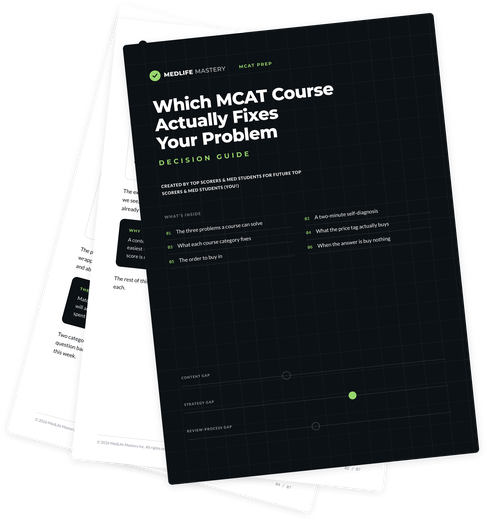
Get the free Decision Guide
On its way.
Check your inbox in the next minute.