MCAT anxiety is one of the most common emotions to feel when you’re about to take the longest and the most challenging exam of your life. We know because nearly all of us at MedLife Mastery felt it when we were studying for the MCAT.
So we know that while it’s true that experiencing feelings of anxiety is common for MCAT takers, it is also one of the most significant barriers to test-day preparation.
Feelings of anxiety can manifest as fidgeting, rapid heart rate, and sweaty palms. Others also develop difficulties in breathing. These symptoms drain your energy and take your focus away from studying, which makes it even harder to recover when empty unproductive days start to pile up and the test date is near!
In this article, we will highlight nine effective strategies that we used to keep MCAT anxiety at bay. We hope this helps you focus more on what truly matters at the moment—making the most out of your MCAT test prep!
Why MCAT anxiety costs you points
The instinct, when you are behind, is to let the fear do the work. You are worried about the score, so you study longer, and the worry feels like fuel. Plenty of students run on it for months.
That works right up until it doesn't. Anxiety is expensive on this particular test, and the cost lands on the exact skill the MCAT was built to measure.
Your brain solves problems better when it isn't scared
There is a chain running from how you feel to how well you reason. Feeling good widens what you notice. Noticing more makes you more attentive. Attention is what lets you think creatively. Creative thinking is what lets you solve a problem you have not seen before.
The MCAT is a problem-solving test. Very little of it rewards recall on its own. Nearly all of it hands you a passage you have never read and asks what you can do with it. That ability is the first thing to narrow when you are afraid.
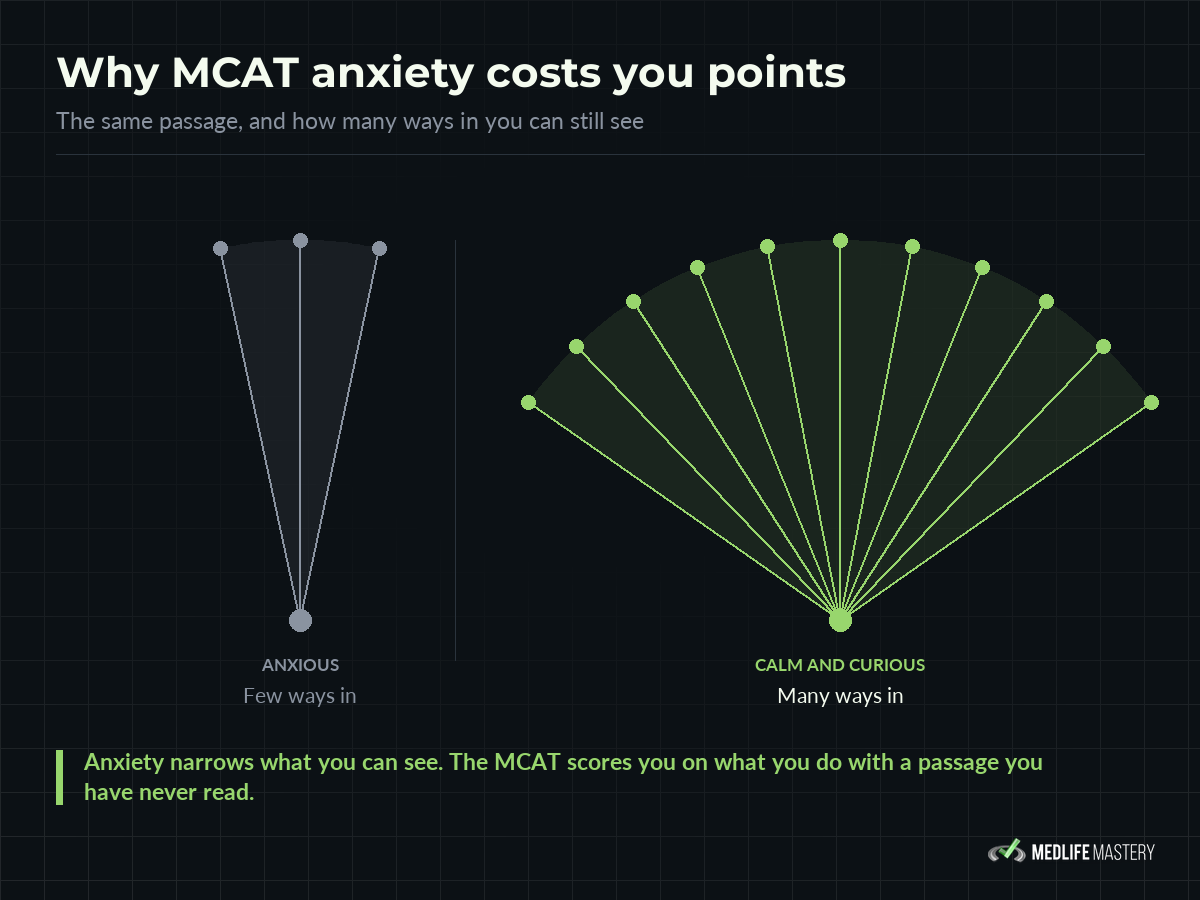
Barbara Fredrickson's broaden-and-build theory describes the mechanism: negative emotions narrow your options down toward a single escape, while positive emotions widen them and let you build skills that stay with you. Don Norman, who spent years studying how people learn, puts the learning half of it directly:
"It's only in the last couple of years that people have studied the positive emotions. And the positive emotions are essential for learning. It turns out those are what drive curiosity and exploration, which is how we learn about the world."
Check that against your own prep. The days you learned the most were probably not the days you were most afraid.
The thought arrives before the feeling
Worry does not appear from nowhere. A thought comes first, and the feeling follows it. You think about your test date, and then you feel the drop in your stomach.
This is useful, because a thought is something you can catch. Most students try to argue with the feeling once it has already arrived, which is the hardest possible moment to do anything about it. The thought that produced it is easier to work with, and it comes earlier.
Negative emotions live in the past and the future
Sort the feelings you have had during prep by where in time they point.
Anger, sadness, guilt and regret all point backward. You are angry about a score you already got. You regret the months you did not use well. Worry, anxiety and dread point forward. You are afraid of a test you have not sat yet.
Now sort the good ones. Joy, calm, absorption, the feeling of a session that went well. Those all sit in the present. When you are out with friends and laughing, you are not running the percentile tables. When a passage finally clicks, you are not thinking about test day.
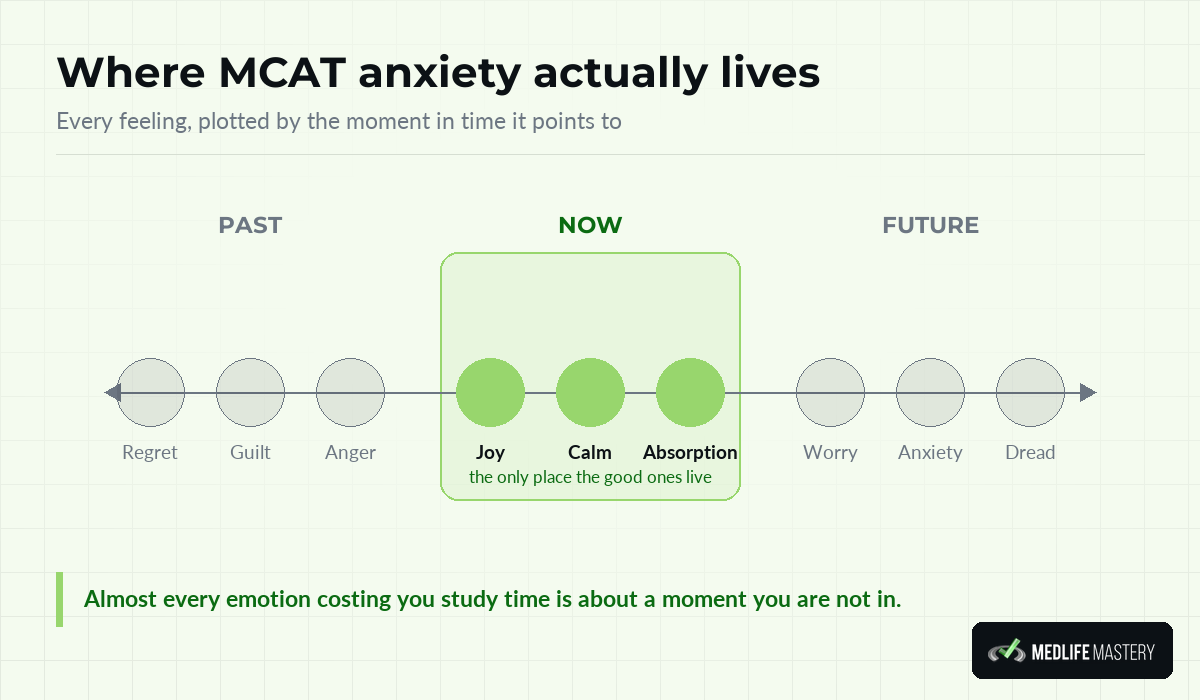
Almost every emotion costing you study time is about a moment you are not currently in. That is what makes presence worth training. It is not a mood you have to manufacture. It is the place where the useful emotions already live.
Presence is not the same as escape
Worth separating these two, because they can look alike from the outside.
Scrolling for an hour also stops you thinking about the past and the future. So does eating when you are not hungry. The relief is real, and it lasts until the moment you stop, at which point the thing you were avoiding is still there and usually slightly larger.
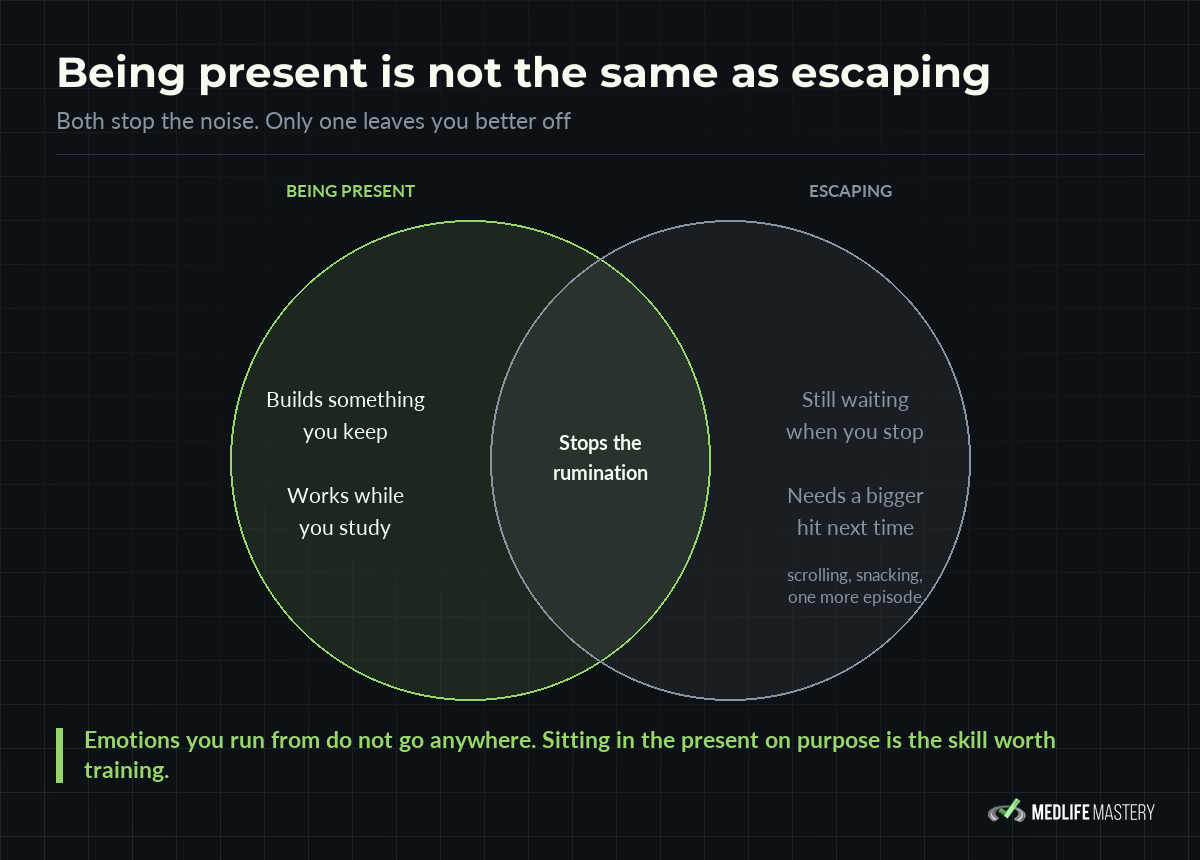
The goal is not to get away from what you feel. Emotions you run from do not go anywhere. The goal is to be able to sit in the present on purpose, which is a skill, and which is what the rest of this article is about.
This is a skill medicine selects for
You would be right to want a source before rearranging your prep around any of this.
Julia E. Connelly, of the Program for the Humanities in Medicine at the University of Virginia School of Medicine, wrote about it in Academic Medicine, the AAMC's own journal. Her subject was practicing physicians, not premeds:
"Medical practice is beset by interruptions, contests for the attention of the physician, and urgent demands that diminish the attentiveness required for the humanistic care of patients. This essay discusses skills for being in the present moment that can help doctors to overcome distractedness. Applying these skills in everyday practice rewards the physician with renewed energy, a fresh perspective, and increased strength while preventing the stress and harm caused by a distracted or inattentive practice."
That reframes what you are doing. The MCAT was designed to find out who can think clearly under pressure, because medical school and residency will apply far more of it than a single exam ever could. Learning to stay clear-headed while something important is on the line is not a trick for one Saturday morning. It is the beginning of the job.
Ariana walks through the research and all three strategies in full:
Even Future Doctors Need This Reminder!
If you are extremely anxious to the point of it getting in the way of your normal everyday functioning, then it might be time to consider seeking a medical professional for help. No volume of self-help tips and advice can amount to the help that a professional counseling or help might give you.
1. You're On The Same Path As Most Top MCAT Scorers
Making the commitment to take the MCAT is already a feat in itself. Pat yourself on the back for that. The next thing to acknowledge before you dive deep into your MCAT test preparations is to know that everyone who has been on this journey (and reached their goals) started off a little bit scared.
But only at the start! We can’t let fear or anxiety over the MCAT throw us off balance, taking us off the focus of truly achieving the goal of getting into a good medical school. The MCAT is only ONE of the stepping stones towards realizing that dream; it can be scary and anxiety-inducing and daunting and overwhelming. But just like everything else so far, we can learn to get through it!
The MCAT is one of the most stressful exams in the world and the AAMC knows this; you don’t have to bear the pressure of it alone.
Reframe your thinking about MCAT prep and test day by putting your stress and MCAT anxiety in context. Think of the hundreds of other aspiring med-school students who might be feeling or experiencing the same way at this moment. It’s a minor thing to recognize, but sometimes the knowing that we are not alone during a difficult or stressful time is like a salve for the wound.
We're Here If You Need Us!
If you think you could use the guidance of a top MCAT scorer holding your hand through the MCAT journey, we're here if you need us! Learn more about working with a MedLife Mastery Mentor here.
2. Practice The Art of the Reframe When Feeling MCAT Stress
One of the biggest reasons why the MCAT is so burdensome and stressful is because most students think of it as such! Our brains are powerful this way, in that whatever we conceive in our minds as real ultimately becomes the reality we’re experiencing.
If you’re already thinking of the MCAT as a burden or a chore before you even start wading deep into its waters, you are setting yourself up for hard, anxiety-ridden days. And these are unproductive days that could be spent preparing for the test day.
3. Go Through The MCAT Journey With Others Who Can Relate
Nothing eases an anxious mind better than a support group and people who can relate. Good thing for aspiring physicians, there are a lot of support groups, forums and newsletters online that provide guidance on your medical school journey.
For example, if you sign up to our emails, you’ll get near-daily top scorer case studies of students who were extremely stressed, with low scores, who made it out with a really competitive score. They’re incredibly encouraging emails many of us wish we had when studying for the MCAT.
It is one thing to go through this alone. Maybe you will survive, if you have the mental fortitude and emotional strength, but most people, even top MCAT scorers, needed to rekindle the fire every once in a while with a good and trustworthy study buddy (or buddies!).
Be careful with this one though. You don't want to catch the MCAT anxiety of others - and a lot of forums are filled with premeds venting their frustrations, or bragging about their accomplishments. Any one of which can make you feel worse than if you hadn't gone there.
Forming your own group of positive, strategic thinkers is the best thing you can do for your MCAT and med-school journey.
The most strategic thing you can do is form a relationship with someone who is one step ahead of you. Who's been through it. Kind of like an older sibling who wants to see you succeed but has to go through the difficulties first so you can get all the good stuff 
Of course, that's what we're here for. Again, use our resources on the site! They're for you! If you want us to meet you once a week, once a day, or even once a month during your MCAT prep, you know where to find us as well!
When you learn from someone who's been in your shoes and done well, you get clarity on how best to study for the MCAT rather than trying out random study methods and techniques, that you hope will work.
Being able to set up a definitive MCAT study plan and the strategies that are right for you, will help you tone down your anxieties about the MCAT and help you gain more confidence in acing on test day.
4. Implement Daily Science-Backed MCAT Anxiety-Reducing Practices
Most of the time, our days are filled with the buzz of trying to memorize and absorb information, so we recommend taking a bit of time off to sit and quiet down your mind.
It’s the part of your body you use the most when studying for the MCAT so it might be best to nourish it also with a good ten or 20 minutes of meditation.
A lot of top MCAT scorers swear by the meditation app, Headspace, where you can personalize how long you want a meditation session to be. It doesn’t have to be an outright perfect practice, but as long as you know that you’re sincere in quieting down the mind, you will feel the benefits of that habit in a few weeks.
You can also learn from a 515 scorer and MS, Ariana, as she shares a few tips in this video on how she practiced mindfulness during her MCAT prep which warded away MCAT anxieties and helped her achieve a competitive score.
The top MCAT scorers who’ve tried meditation claim that having a meditative or mindfulness practice started up way before test day helped them remain calm, collected, and focused during the actual MCAT test day.
However, if you’re not one for quieting down and meditating, sign up for a gym membership! Try cardio or a HIIT workout, or sign up for your gym’s yoga or pilates class.
Find out which physical exercise works best to clear your mind, gives you more focus, and keeps your energy levelled. Most sports are also "fun exercise".
A boost of serotonin might be good for calming down your test day nerves and MCAT anxieties. It also helps you get out of your study area, take your mind off your study materials, and have a little time off on your own!
MCAT Tutor Tips: Action Steps to Reduce Testing Anxiety
We all felt the testing anxiety at some point during our MCAT prep.
It's a vicious cycle and this is why Savannah Runge, 517 scorer and MCAT mentor, has created a really valuable video for you on how to lessen MCAT anxiety in just minutes!
Savannah often felt defeated, exhausted, and super burnt out during her MCAT prep...
This is the advice she wishes someone told her earlier!
In this video, she covers:
→ 3 questions to ask yourself whenever you finish a subject or a section, that instantly put you in a more calm state.
→ A 5 second action to do every single time you transition to a new subject or section on an exam, that prevents build up of stress and anxiety.
→ A key action step to take after every long study session to help you listen to your body and your mind, so you can improve your efficiency with each study session.
→ 4 questions to feel more at ease and bring back your motivation when you're feeling excess stress, panic, or anxiety (for those really bad times!).
Remember, sometimes feeling unmotivated is more about not having clarity than it is about motivation itself.
When you have clarity on how to improve your MCAT score and the exact steps to take, the motivation usually shows up automatically.
We've poured a lot of energy into creating these MCAT Strategy Courses, and are working with students one-on-one everyday...
Guiding them with clear direction on what to do to hit their score goal and get into med-school!
We know you have what it takes too.
5. Take Back Your Emotional Control With This One Question
Think about this:
What's the only thing that's in your control?
The answer:
All you can do is study to the BEST of your ability.
That's it.
So ask yourself now:
Am I giving my MCAT prep all that I possibly can? Am I doing my absolute best?
If the answer is yes, then you have nothing to worry about. Why? Because what more CAN you do? That's all that's in your control, now you can relax because no matter what happens on test day, you gave it your all.
If the answer is no, then crank it up a notch. Ask yourself why you're not feeling like you're doing the best you can...
Are you not studying hard enough? What's causing you to not study hard enough?
Do you have distractions? Change your environment. Do you not know how to study for the MCAT? Learn about it on our blog/emails or work with a mentor.
Whatever is holding you back, you can find the answer. And you can keep finding answers until you can go back to the initial question of "Are you studying to the best of your abilities?" and give a wholehearted YES.
Therefore, you don't need to worry. You always have the power. We feel anxious because we disempower ourselves. We feel a lack of control. But you always have control. You always have control over how you study, how much you study, how much effort you put into your prep.
As long as you can be honest with yourself that you're doing your absolute best during the process, the outcome (and your MCAT anxiety) will take care of itself.
6. Try A Simple Visualization Technique To Get Pumped For Test Day
We get it - this is one of the biggest days of your life that will ultimately define where you’ll be for the next four or so years of your life, as well as your future, so being anxious or stressed out about it is understandable.
Which means whenever you think about test day, you get anxious. You're loathing it more each day it gets closer.
The problem here is that you're looking at test day in the wrong light. Here's a visualization technique that might help:
Imagine yourself waking up on the day of your test day and ask yourself how you’d want to feel in that moment. As you visualize, become familiar with the actual flow of your test day (as if you’re simulating test day) and ask yourself again, “What’s the most ideal and positive thing to feel right now?”
Jot down those feelings you want to feel on test day; the morning of, when you walk into testing centre, when you're in the middle of the exam.
Now when you visualize, feel those feelings.
Your prescription for MCAT anxiety: Visualize regularly.
This will help you look forward to test day. Why? Because you'll be convincing yourself that you'll be THAT prepared and you'll be feeling pumped when the actual day comes.
You'll start looking forward to test day while your MCAT anxiety will fade into the background.
7. Savor the time you are not studying
Stephen Schueller, a psychologist at the University of Pennsylvania, ran a study where participants took something they normally rush through and paid full attention to it instead. Not a meditation practice. Breakfast. A walk. The ordinary parts of a day that usually pass while you are thinking about something else.
Participants reported more joy and calm and less anxiety. Schueller's description of why is worth keeping:
"Being present-minded takes away some of that self-evaluation and getting lost in your mind, and in the mind is where we make the evaluations that beat us up."
That last part is what matters during MCAT prep. The running commentary about whether you are studying enough, fast enough, well enough, does not happen while you are absorbed in something. It happens in the gaps.
What to do this week. Pick one thing you already do daily and stop multitasking through it. Eat breakfast and pay attention to the food. Take a shower without planning the day. Walk somewhere with no headphones.
Then add breathing. Not a technique, not an app, just your attention on your own breath for however long you can hold it there. Do it now, before you keep reading.
Give this a week or two before you judge it. The first few days feel like nothing. The change shows up as a day that goes better than it should have, and then another one.
8. Set goals small enough to pull you into flow
You have been in flow before. You were so far into something that you lost track of the hour, and the phone rang and you ignored it. It happens with puzzles, with sport, with a piece of work you actually wanted to do.
Psychologists have studied the state for decades, and it is a good one to study in. Attention stops leaking. The effort of staying on task disappears, because staying on task is no longer something you are doing on purpose.
Two things get you there.
Enjoy the material, where you can. Not every subject will cooperate. But you are learning how a body works so that you can eventually treat one, and there are days when it is possible to hold that in mind while you read. Those are the days that turn into flow.
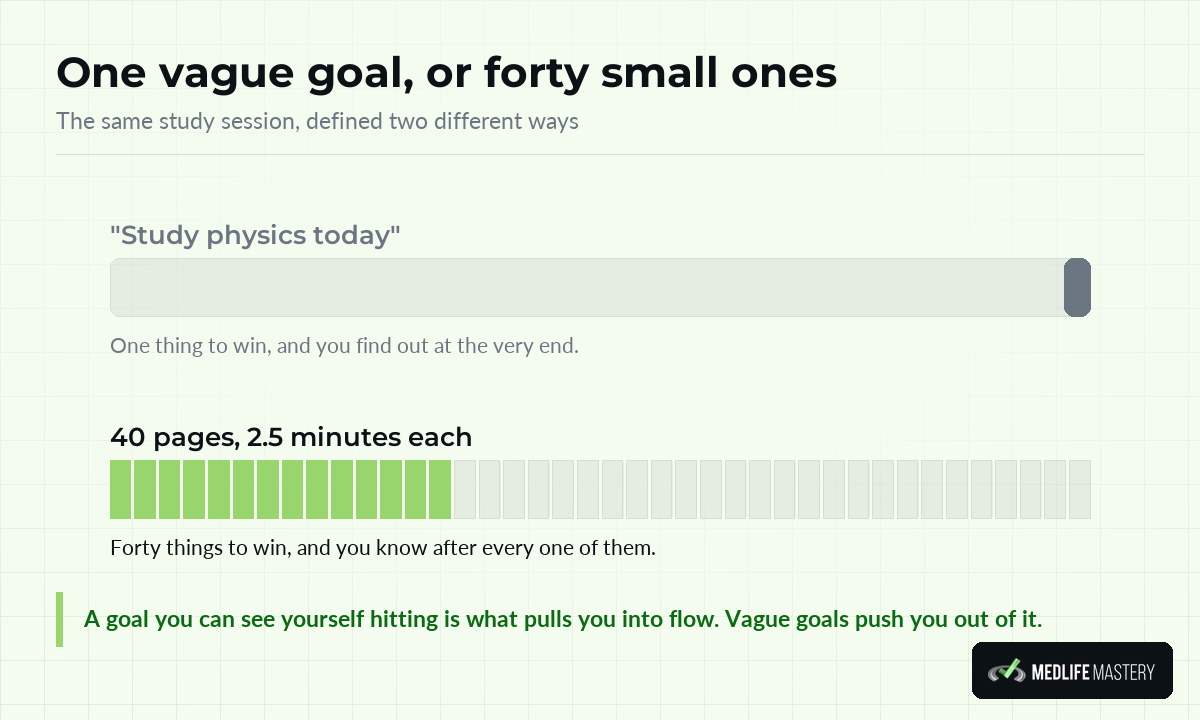
Define the next step small enough to see. Mihaly Csikszentmihalyi, who first described flow, gave the examples of playing the next bar on a scroll of music, finding the next foothold if you are a rock climber, or turning the page of a good novel. Every one of those is small, immediate, and obviously achievable.
Compare that to "study physics today," which is none of those things. You cannot tell whether you are winning, so you check the clock instead.
A worked example. Say you have a 40-page chapter and two hours, with a 20-minute break in it. That leaves 100 minutes of reading, which is about 2.5 minutes a page. Now every page you finish inside 2.5 minutes is a small, visible win, and there are 40 of them in the session instead of one vague goal you either hit or miss at the end.
Run the same logic at the other scale. Across a whole prep timeline, the goal is to take the MCAT one day at a time. That only works once you have done the background work of building a schedule, so you know what today is supposed to contain.
If the math itself stresses you out, and for some people it does, use time instead of pages. Read for 50 minutes, break for 10, read for another 50. The point is a target you can see yourself hitting, not a particular way of counting.
Most weeks you will pass the goal you set. Five things put away turns into eight, because starting was the hard part and you already did it.
9. Cut the stress by getting clear on what you are doing
Most MCAT stress is not about the material. It is about not knowing whether you are studying the right things in the right way. Am I using the right resources? Should I be reviewing like this? Is any of this working?
That is building IKEA furniture with no instructions. It is possible. You will get there. And you will spend the whole build frustrated, take far longer than you needed to, and never quite trust that the thing is square.
The MCAT has an instruction manual. It is written by people who have already sat it and scored well, and it is the difference between working hard and working hard in the right direction. Clarity is the cheapest stress reduction available to you, because it removes the doubt underneath most of the anxiety rather than managing the anxiety itself. If you want that guidance directly, you can work one-on-one with a top scorer who has been through it.
Final Message
When it comes to MCAT test day anxiety, sometimes a dash of confidence and faith in yourself is necessary. Know that on test day, you’ll actually do really well because you’ve worked so hard all these months in preparation.
In this article, we identified nine ways to get over MCAT anxiety, highlighting the techniques which worked for many top scorers as well as practical hacks in general.
We understand the difficulty of the everyday as you prepare for the biggest exam of your life. That’s why we’re here by your side to guide and inspire you into achieving your maximum potential!
As mentioned above, having clarity on how best to study and prepare for the MCAT will curb your anxiety a lot since you’ll know you're using tried-and-tested strategies to help you with whatever your score goal is.
We also encouraged practicing mindfulness to help with any MCAT test-day anxieties. Having a grasp on your emotions and mental being (and practicing this earlier on) will help you power through on exam day to the fullest of your potential. Just know that making MCAT anxiety go away is a day-to-day effort on your end. But worry not; we’re right here with you.
If you’re still feeling a little anxious, read our success stories, learn more about the top scorer mindset, learn exactly how to study for the MCAT.
We've created this site to help you own test day and become the doctor you ARE meant to be!
You got this,
The MedLife Mastery Team
Your "MCAT Success" Mentors
Sources
- Currin, L. (2004). "Feelin' Groovy." eLearn Magazine, 2004(1). ACM.
- Fredrickson, B. L. (2001). "The role of positive emotions in positive psychology: The broaden-and-build theory of positive emotions." American Psychologist, 56(3), 218-226.
- Connelly, J. E. (1999). "Being in the present moment: Developing the capacity for mindfulness in medicine." Academic Medicine, 74(4), 420-424.
- Schueller, S. M. (2010). "Preferences for positive psychology exercises." The Journal of Positive Psychology, 5(3), 192-203.
- Csikszentmihalyi, M. (1990). Flow: The Psychology of Optimal Experience. Harper & Row.