
USMLE Pass Rates, All Three Steps
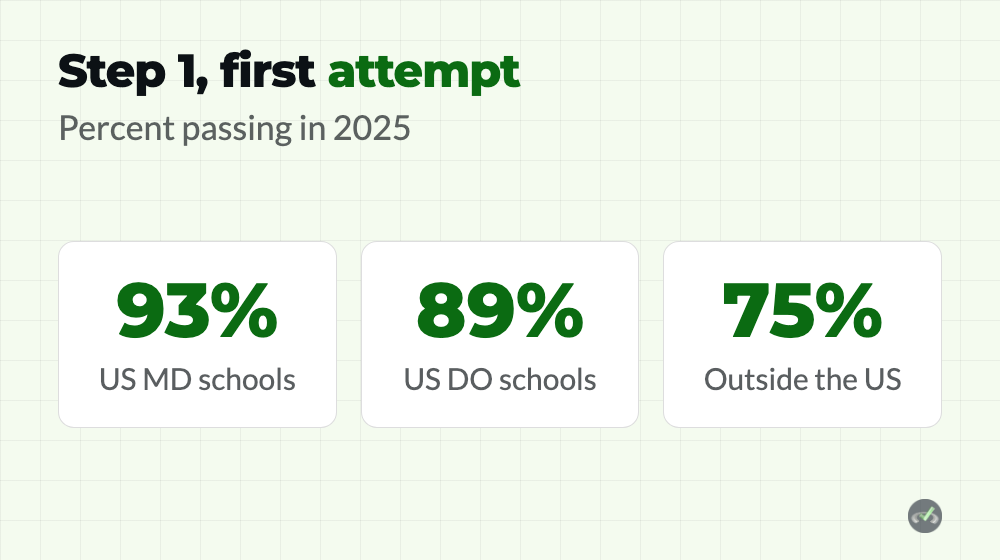
Roughly nine in ten first-time takers from US medical schools pass Step 1. Three in four from schools outside the US do. The gap between those two numbers is the most useful thing on this page.
Everything below comes from the tables the USMLE program publishes each year, most recently for 2025. Read your own group's row rather than the headline, because they say different things!
- The USMLE pass rate for each Step
- What the USMLE pass rate looks like on a retake
- The four-year trend
- What a USMLE pass rate does and does not tell you
- Step 1 in detail
- Step 2 CK in detail
- Step 3 in detail
- Why people fail Step 1
- What counts as a failed attempt
- Moving yourself into the passing group
- USMLE pass rate, common questions
- Related reading
The USMLE pass rate for each Step
2025 figures, first attempts, by where the examinee trained.
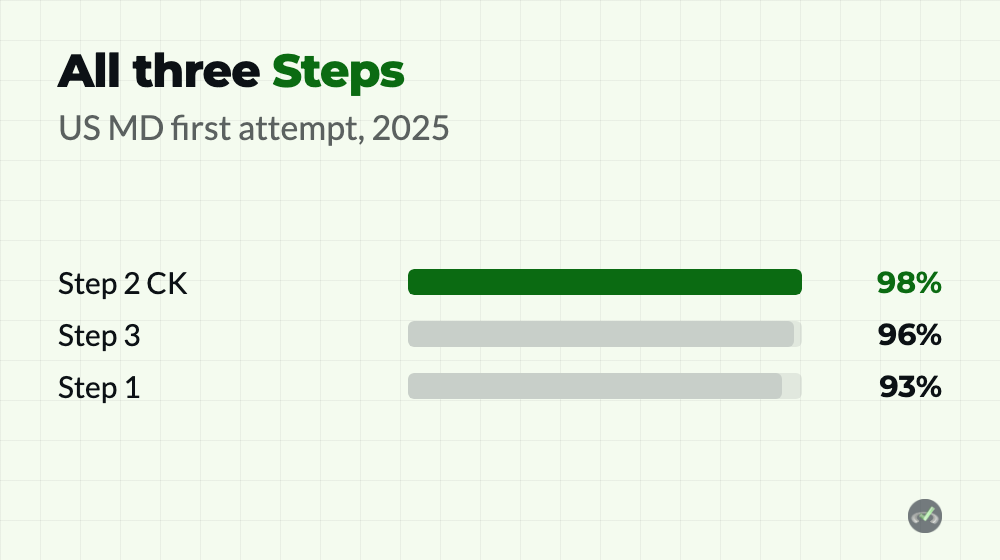
Step 1 is where people fail. By Step 2 CK the same cohorts are passing at 96 to 98%, which is good news if Step 1 is the one in front of you 🙂
The other reading of that table is that a USMLE pass rate tells you about a cohort and not about you, so treat it as background rather than as a forecast.
Step 3's DO figure rests on only 129 examinees, since COMLEX Level 3 is the osteopathic route, so read that one as a small sample rather than a finding!
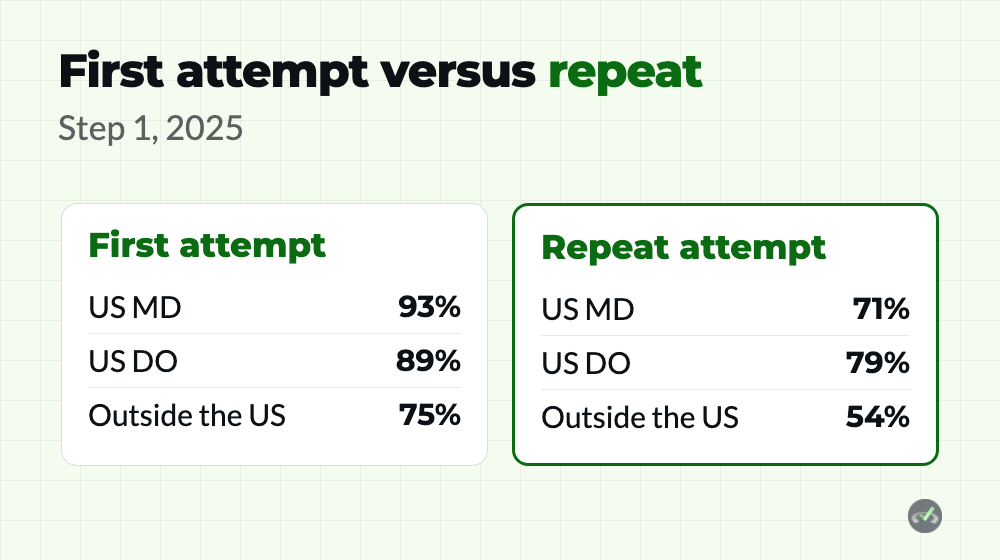
A first attempt is worth far more than a second one. Every group passes at a much lower rate on a retake.
What the USMLE pass rate looks like on a retake
The USMLE pass rate on a repeat attempt drops in the same shape everywhere, and it is steep.
Part of that is selection. The people retaking are the people who found it hardest the first time, so a lower rate is expected and it is not a verdict on you!
The rest is method. A second attempt built on the same preparation as the first tends to produce the same result, which is why the honest question after a fail is what specifically went wrong 🙂
The four-year trend
Step 1 first-attempt pass rates since the exam went pass/fail.
The USMLE pass rate has held inside a three-point band, with 2025 back at the 2022 level. Nobody should read a one-point change as a trend!
One caveat on comparing the ends of that table. Canadian schools were counted with the US group through 2024 and with the non-US group from 2025, so the two columns shifted slightly underneath the numbers!
What a USMLE pass rate does and does not tell you
A USMLE pass rate is an outcome rather than a target. The passing standard is set against the content, not against the other people sitting that day, so in principle everybody could pass, or nobody could.
- It is not a curve. Your result does not depend on how the person next to you did.
- Around 60% correct. The USMLE program says examinees typically need to answer about that share of questions correctly, varying by Step and by exam form.
- School-level rates vary a lot. A national figure hides a wide spread between individual schools.
- Your own practice scores predict better. A national pass rate tells you nothing about you. An NBME self-assessment tells you plenty!
Step 1 in detail
Step 1 has been reported as pass or fail, with no number, since 26 January 2022. It is the Step where the USMLE pass rate is lowest for every group.
Nearly 56,000 people sat Step 1 in 2025, and around 8,000 of them did not pass. If you are one of them, you are in a very large group and almost all of them go on to pass 🙂
Our complete Step 1 guide covers what the exam tests, and the Step 1 study schedule covers how to prepare for it at any length!
Step 2 CK in detail
Step 2 CK reports a three-digit score, and the minimum passing score rose to 218 on 1 July 2025. The USMLE pass rate here is the highest of the three Steps for US graduates.
Step 2 CK reporting runs July to June rather than by calendar year, so the label covers a period rather than a year!
With Step 1 now pass/fail, this is the score residency programs look at. A pass here is the floor and the number is what gets read!
Step 3 in detail
Step 3 is a two-day exam, scored on the three-digit scale, with a minimum passing score of 200 since 1 January 2024. Most people sit it during residency.
The people sitting Step 3 have already cleared two Steps, which is most of the reason the USMLE pass rate holds up here. By this point you know how to sit one of these 🙂
The scoring rules for all three Steps are published at usmle.org.
Why people fail Step 1
The USMLE pass rate says how many, and not why. From what students tell us and from what score report breakdowns show, four reasons come up over and over.
- Sitting before the practice scores say so. A date booked around a school calendar rather than around an NBME result is the single most common story.
- Coverage without retention. A finished content pass that was never revisited leaves month-one material gone by test day.
- Review that only checks the answer. Reading the explanation teaches the fact. Working out where your reasoning went wrong teaches the next twenty questions.
- Stamina. An 8-hour day is its own skill, and full-length practice under timed conditions is the only way to build it!
Not one of those shows up in a national USMLE pass rate, and every one of them is visible in your own data before test day 🙂
A national pass rate describes tens of thousands of people, most of whom prepared nothing like you did.
Your own NBME trend, sat under timed conditions, predicts your result far better than any figure on this page.
What counts as a failed attempt
Three things land on your transcript, and only one of them is the obvious one.
- A fail. Recorded permanently, visible to residency programs.
- An incomplete. Leave a block unopened and the attempt may not be scored at all, and it is reported as incomplete.
- An invalidated score. Rare, and it follows a review of irregular behavior or an unusual score pattern.
All three count against your four attempts, which catches people out. Walking out of an exam that feels like it is going badly does not undo it, so finish the day if you can!
Moving yourself into the passing group
The national figures are a backdrop. What changes your own odds is narrower than they are.
- Sit a full-length NBME early. It converts a vague worry into a number you can work on.
- Practice in the current format. Step 1 moved to fourteen 30-minute blocks of up to 20 questions on 14 May 2026, and Step 2 CK to sixteen such blocks a week earlier.
- Fix the reason you missed, not the fact. Reviewing for the reason is slower per question and worth several times as much.
- Get a second reading of your score report. A breakdown you interpret alone at midnight is not the same document you read with somebody who has seen a hundred of them 🙂
USMLE pass rate, common questions
What is the USMLE pass rate for Step 1?
93% for first-time takers from US MD schools in 2025, 89% from US DO schools and 75% from schools outside the US.
What is the USMLE pass rate for Step 2 CK?
98% for first-time takers from US MD schools, 96% from US DO schools and 90% from schools outside the US, on the 2024 to 2025 reporting year.
What is the Step 3 pass rate?
96% for first-time takers from US MD schools and 88% from schools outside the US in 2025.
Why is the pass rate lower for international graduates?
The group is far more varied, spanning many different curricula, languages of instruction and levels of access to US-style question banks. The exam is written around a US curriculum.
Does a low national pass rate mean the exam is getting harder?
No. The standard is set against content rather than against the cohort, so the rate reflects who sat it rather than how the exam was built.
How many times can you fail before you are out?
Four attempts at each Step in total, no more than three in any 12 months, and no appeal. Our USMLE overview sets out the full rules!
Related reading
- What is the USMLE, the three Steps, costs and attempt limits
- The complete USMLE Step 1 guide, what it tests and what passing takes
- USMLE Step 1 study schedule, 3 weeks to 6 months
- 8 best USMLE Step 1 tutors, and when to skip tutoring
- USMLE vs COMLEX, which one you sit and whether you sit both
- The USMLE exam guide, all three Steps