
USMLE Scores: How Each Step Is Reported
Step 1 gives you one word. Step 2 CK and Step 3 give you a three-digit number. That split is the single most important thing to understand about how the USMLE is scored today!
Every threshold below changed inside the last four years, so a guide written before 2025 is describing a different set of numbers. Everything here was checked against usmle.org this month 🙂
- Every USMLE score, at a glance
- Step 1, pass or fail
- Step 2 CK, and the USMLE score programs read
- Step 3
- When your USMLE score arrives
- Three ways a USMLE score goes wrong
- Rechecks, and what they are not
- What predicts your USMLE score
- Percentiles beside your USMLE score
- What the transcript shows
- USMLE score, common questions
- Related reading
Every USMLE score, at a glance
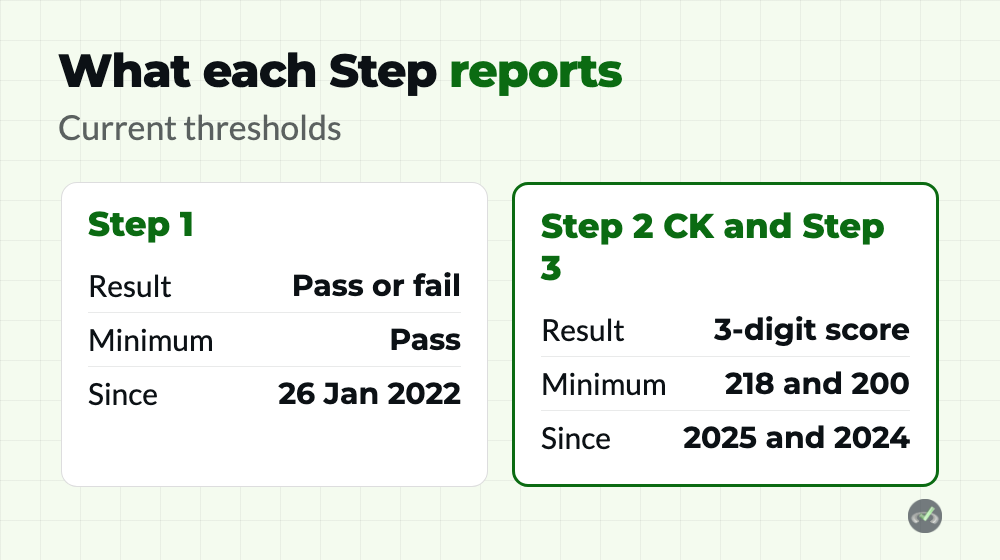
Current for exams sat today, and easier to hold in your head than it looks!
That ~60% comes from the USMLE program's own wording. Examinees typically need to answer about that share of questions correctly, and the exact proportion varies by Step and by exam form.
The standard is set against the content, not against the people sitting that day. It is not a curve.
Step 1, pass or fail
Every Step 1 exam sat on or after 26 January 2022 is reported as pass or fail with no number attached. A year of work resolves into one word.
A three-digit passing threshold of 196 still sits underneath the decision, and it is not disclosed to you. There is no near miss and no credit for a strong fail 🙂
What changed for applicants is where the weight went. Programs lost their favorite numeric filter and most of it landed on Step 2 CK, which is why people now sit that one more carefully.
Step 2 CK, and the USMLE score programs read
Reported on a three-digit scale, with a minimum passing score of 218 since 1 July 2025. Before that date the minimum was lower, so an older guide will quote a different number.
- This is the number on your application. With Step 1 pass/fail, Step 2 CK is the only USMLE score a program sees.
- The scale is not a percentage. A 240 does not mean 240 out of anything.
- Passing is the floor. Competitive specialties read the number well above it, which is a different target from passing!
Step 3
Also on the three-digit scale, minimum 200 since 1 January 2024. Most people sit it during residency, and by then you have done two of these already 🙂
It is the only Step scored across two days, combining multiple-choice blocks with computer-based case simulations where you manage a patient in real time.
When your USMLE score arrives
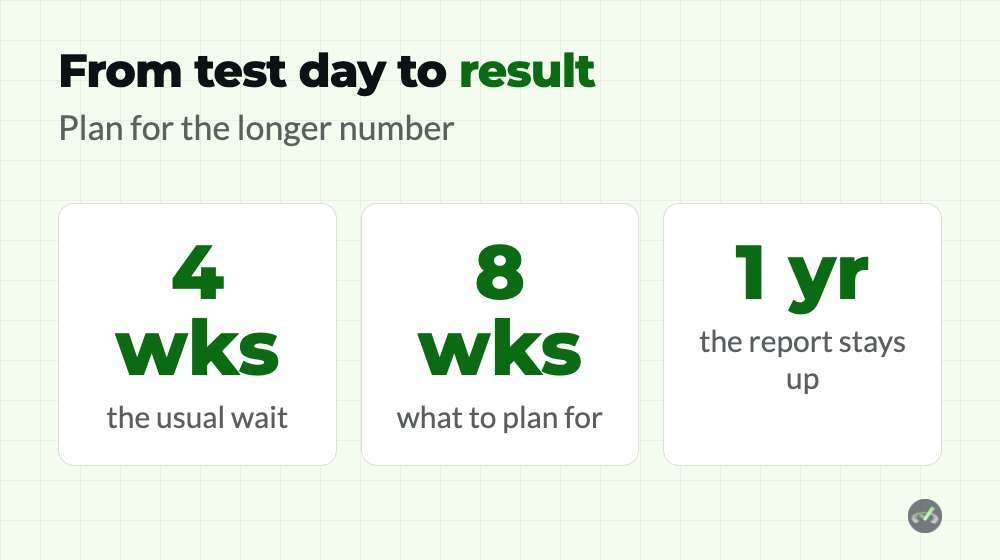
Usually within four weeks of your test date. The USMLE program advises allowing at least eight when you are planning around it, so build your application timeline on eight!
- Reports are released on a schedule, published in advance, rather than individually as each exam is marked.
- The report stays available on your registering organization's site for about a year from notification.
- Delays happen, and a delayed result is not a bad one. A form under review can push a result past the usual window for reasons that have nothing to do with you!
The current schedule is published at usmle.org.
Three ways a USMLE score goes wrong
Only one of the three is failing, and the other two surprise people.
- A fail. Recorded permanently on your transcript and visible to programs.
- An incomplete. If you do not open every block, the exam may not be scored at all, and the attempt is reported as incomplete.
- An invalidated score. Rare, following a review of irregular behavior or an unusual answer pattern.
All three count against your four attempts at that Step, which catches people out. Walking out of an exam that feels like it is going badly does not undo it, so finish the day if you can!
Even a block you have no time left for. An unopened block can cost you the whole scored attempt, and there is no partial credit for the ones you did finish.
The clock is unforgiving and the rule is not 🙂
Rechecks, and what they are not
You can request a score recheck. Here is what it does, before you spend on one 🙂
- It re-runs the scoring. The answer key is reapplied to your responses.
- It is not a re-read. Nobody reviews the questions or your reasoning.
- Changes are very rare. The process is a safeguard rather than an appeal!
If the result is not what your practice scores predicted, the more useful next step is usually looking at what happened on the day 🙂
What predicts your USMLE score
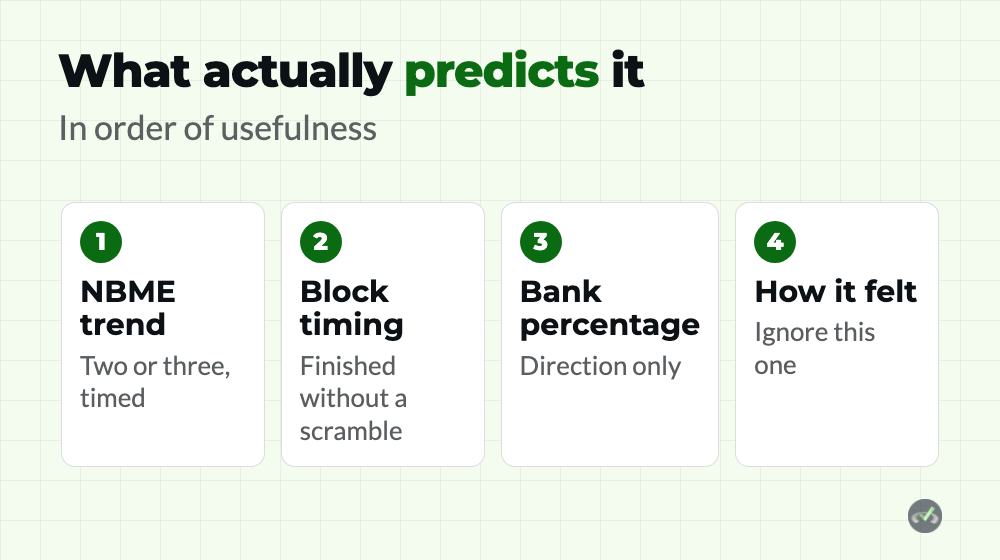
Your own NBME self-assessments, sat under timed conditions. Nothing else comes close, and they start at $62 🙂
- A trend beats a reading. Two or three across a run tells you far more than one good score.
- Question bank percentages are not calibrated to the passing standard, so use them for direction rather than for a prediction.
- Timing is separate from knowledge. A good score that collapses under the clock is a different problem, and it has a different fix.
- A dip in the final fortnight is noise until the trend agrees with it!
Our pass rate page has the national picture, and our study schedule covers where the checkpoints go.
Percentiles beside your USMLE score
Step 2 CK and Step 3 report a percentile alongside your USMLE score, and the percentile shifts even when the score does not.
- The score is fixed to the content. A 240 means the same thing in 2026 as it did in 2024.
- The percentile is relative. It compares you to a recent cohort, so it drifts as cohorts change.
- Programs read the score. The percentile is context, and a good one does not rescue a low number.
Since Step 1 went pass/fail, cohorts have shifted how they prepare for Step 2 CK, which is part of why percentiles have been unstable. Read the score first!
What the transcript shows
Programs and state boards see a full USMLE transcript rather than one USMLE score, and it holds more than the number.
- Every attempt, passed, failed or incomplete, with its date.
- Pass or fail for Step 1, with no number, on every attempt since January 2022.
- The three-digit score for Step 2 CK and Step 3.
- Nothing is removable. There is no cancel, no retake-and-replace, and no expiry on a recorded attempt!
That permanence is the argument for sitting when your practice scores say so rather than when the calendar does 🙂
USMLE score, common questions
Is there still a USMLE score for Step 1?
No. Every Step 1 exam sat on or after 26 January 2022 is reported as pass or fail, with no number released to you or to programs.
What is a good USMLE score on Step 2 CK?
Passing is 218. What counts as good depends entirely on the specialty you are applying to, and the honest answer is to look at that specialty's own published data.
What percentage do you need to pass?
Around 60% of questions correct, by the USMLE program's own wording, varying by Step and by exam form.
How long until my USMLE score arrives?
Usually within four weeks, and the program advises planning for eight.
Can I cancel a score I do not like?
No. Every attempt appears on your transcript, including incompletes.
Does a failed attempt stay on the record forever?
Yes, and plenty of practicing doctors have one. Our USMLE overview covers the attempt limits that follow it!
Related reading
- Build your Step 1 study plan, a free tool that sizes the phases below to your own weeks and practice scores
- USMLE pass rates, all three Steps by examinee group
- What is the USMLE, the three Steps and how they fit together
- The complete USMLE Step 1 guide, what it tests and what passing takes
- How long is USMLE Step 1, the eight-hour day block by block
- USMLE Step 1 study schedule, 3 weeks to 6 months
- 8 best USMLE Step 1 tutors, and when to skip tutoring
- The USMLE exam guide, all three Steps