
The USMLE Step 1 Content Outline, Explained
The Step 1 content outline is the only published statement of what the exam contains. Everything else you will read about high-yield topics is somebody's inference from it!
All three weighting tables are below, current for 2026, with what each one is useful for. They are ranges rather than fixed percentages, because forms vary 🙂
- Disciplines, and what the Step 1 content outline weights most
- Systems, and why they matter more for planning
- Competencies, the part of the Step 1 content outline people skip
- How to turn the Step 1 content outline into a study order
- The outline changes, and so does the exam around it
- "High yield" and what the outline supports
- Step 1 content outline, common questions
- Related reading
Disciplines, and what the Step 1 content outline weights most
The subject split, and the table people mean when they say high yield!
They add to well over 100% because a single question can be counted under several disciplines. A vignette about a drug acting on a diseased kidney is pharmacology, pathology and physiology at once.
Read the table as weight rather than as a timetable. Pathology at 45 to 55% and physiology at 30 to 40% mean a gap in either costs you across the whole paper!
Pathology and physiology together touch most of the exam. Nothing else on this page changes that.
Systems, and why they matter more for planning
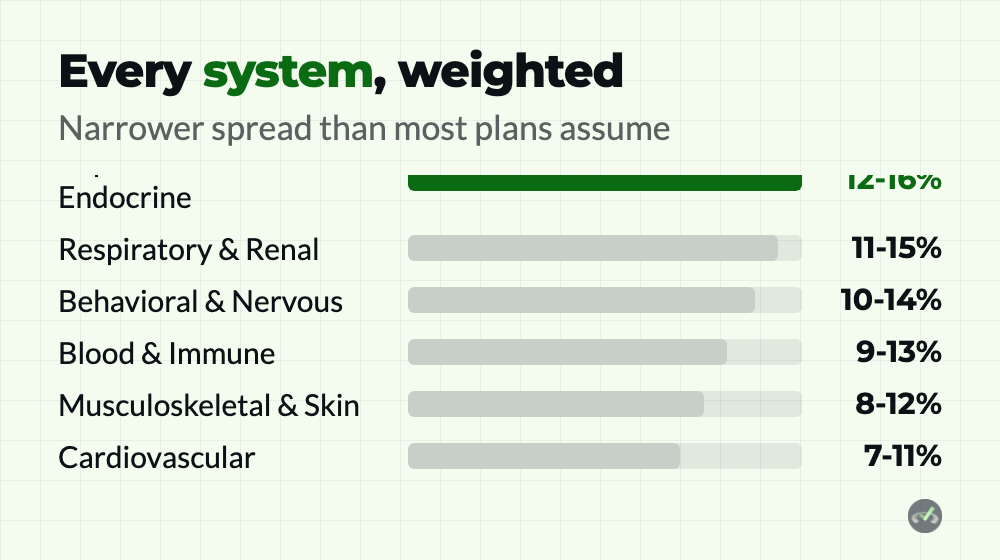
Step 1 is built along systems first and disciplines second, so this is the better table to plan a study order from. Good news, because it is the friendlier one!
The spread here is narrower than the discipline table, which tells you something. No system is skippable, and the difference between the top and the bottom is smaller than most study plans assume.
Cross this table with your own NBME breakdown and you have your study order. A weak system near the top earns more days than a weak system near the bottom!
Competencies, the part of the Step 1 content outline people skip
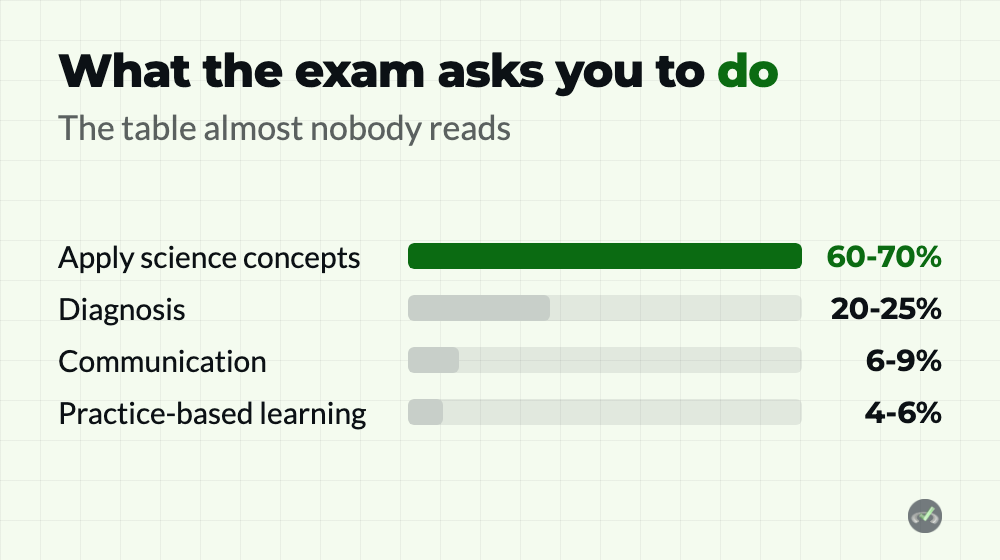
The third table in the Step 1 content outline describes what the exam asks you to do with the content, and it repays a read 🙂
Two thirds of Step 1 is applying a concept rather than retrieving a fact. That single number is the strongest argument in the whole outline against memorisation-first preparation.
A fifth is diagnosis, which is reasoning from a presentation to an answer, and roughly a tenth is communication and self-improvement content!
A deck teaches retrieval. Sixty to seventy percent of the exam wants application, and those are different skills that feel identical while you are studying.
Which is why a bank percentage that will not climb usually means the method needs changing rather than the hours 🙂
How to turn the Step 1 content outline into a study order
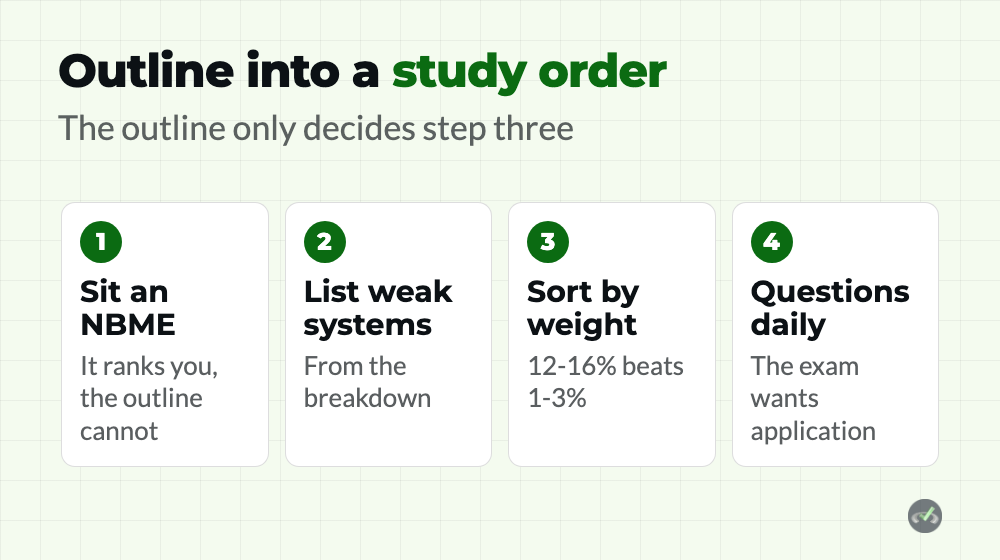
Four steps, and the Step 1 content outline only decides the third one!
- Sit a full-length NBME. It tells you where you are weak, which the outline cannot.
- List your weak systems from that breakdown, not from how a subject feels.
- Sort them by the system table. A weak system at 12-16% earns more days than one at 1-3%.
- Study each with questions from day one, because the competency table says the exam wants application.
Our Step 1 study schedule builds that into phases at any length from three weeks to six months!
The outline changes, and so does the exam around it
Two things shift under this page, at different speeds.
- The weightings are revised periodically and the program publishes them without much fanfare. Check the source before you build a plan on a number you read elsewhere.
- The format changed on 14 May 2026. Step 1 now runs as fourteen 30-minute blocks of up to 20 questions in the same 8-hour day, and the outline says nothing about that.
The current tables are at usmle.org. Our exam-day breakdown covers the format side!
"High yield" and what the outline supports
The phrase means one of two things, and only one of them is checkable 🙂
- Weighted heavily in the outline. Pathology, physiology, the reproductive and endocrine systems. Published, checkable, safe to plan around.
- Somebody's recollection of their own exam. Unpublished, unverifiable, and different for every form.
Only the first survives contact with the tables above. A list of topics circulating in a forum is a sample of one person's form, and forms vary by design 🙂
Step 1 content outline, common questions
What is the Step 1 content outline?
The published specification of what the exam covers, broken into discipline, system and competency weightings, each given as a range.
Which subject is weighted highest?
Pathology, at 45 to 55%, followed by physiology at 30 to 40%.
Why do the percentages add to more than 100?
A single question can count under several disciplines at once, so the ranges overlap by design.
Can I skip a low-weighted system?
We would not. The system table in the Step 1 content outline runs from 1-3% up to 12-16%, and even the smallest slices appear on every form!
Does the outline tell me what to study first?
Only in part. It ranks the content; your NBME breakdown ranks you. The order comes from crossing the two, which our study schedule does.
How often does it change?
Periodically, without a fixed schedule, so the source is the only safe place to read it 🙂
Related reading
- Build your Step 1 study plan, a free tool that sizes the phases below to your own weeks and practice scores
- The complete USMLE Step 1 guide, what it tests and what passing takes
- USMLE Step 1 study schedule, 3 weeks to 6 months
- Step 1 practice questions, where to get them and how to review them
- Best Step 1 prep course, seven compared
- How long is USMLE Step 1, the eight-hour day block by block
- USMLE pass rates, all three Steps by examinee group
- The USMLE exam guide, all three Steps