
USMLE Step 1 Practice Questions
Step 1 practice questions are how you learn the material, and only secondarily how you check that you have learned it. That distinction decides almost everything about how you use them!
Below is where the official ones live, what to use alongside them, and the review method that turns a 30-minute block into something you still have in six weeks!
- The official Step 1 practice questions
- Question banks, and picking one
- Practice Step 1 practice questions in the current format
- How to review a block
- Step 1 practice questions versus practice exams
- How many Step 1 practice questions you need
- The Prometric practice session
- When to start doing Step 1 practice questions
- When your questions feel too hard
- Six ways people waste their practice
- Step 1 practice questions, common questions
- Related reading
The official Step 1 practice questions
The USMLE program publishes its own Step 1 practice questions. Nothing else you can buy is written by the people who write the exam 🙂
- Sample test questions, free, inside the interactive testing experience. Same software, same navigation, same look as test day.
- The content outline and specifications, which tell you the discipline and system weightings the exam is built to.
- Test question format guidance, covering how single-best-answer items are constructed and how to approach them.
- NBME self-assessments, from $62 each, and the closest thing there is to a scored sitting.
Start with the free set at usmle.org before buying anything, because it costs nothing and it calibrates everything after it!
Official questions are written by the exam's own authors. Nothing else on this page can say that.
Question banks, and picking one
Most people run a commercial question bank as the spine of their preparation, and the choice between them matters far less than finishing one. Good news, because people agonise over that decision for weeks 🙂
- Pick before day one and stay. Half of two banks is worse than all of one, and switching mid-run costs you a week to no benefit.
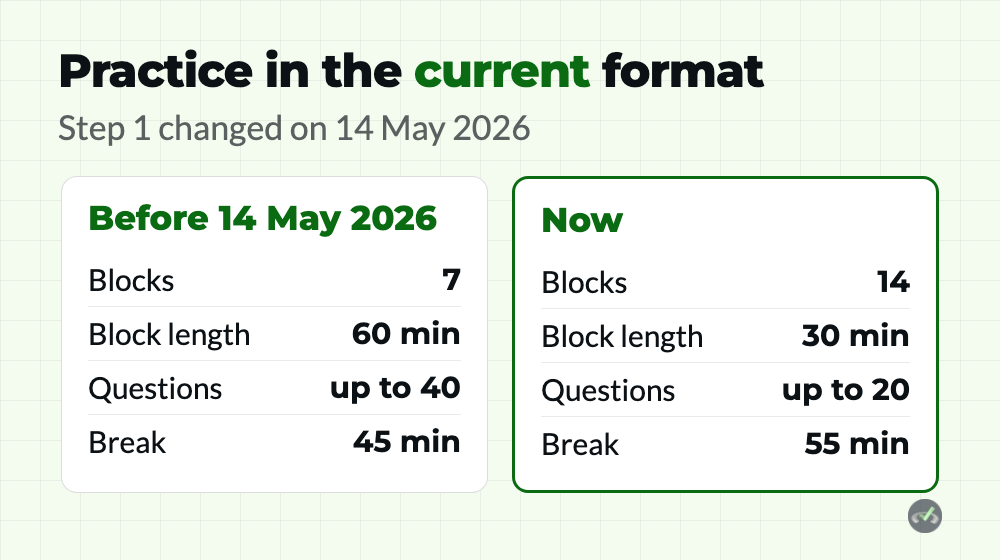
- Match the exam's format. Since 14 May 2026 Step 1 runs in 30-minute blocks of up to 20 questions, so build your sets that way.
- Explanation quality is what you are buying. The questions teach less than the explanations do.
- Subscription windows cost money. A longer preparation run needs a longer window, which is a line in your USMLE budget.
Whichever you choose, the plan in our Step 1 study schedule works with it 🙂
Practice Step 1 practice questions in the current format
Step 1 changed on 14 May 2026, and plenty of people are still practicing for the old day. Fix it this week and you never think about it again 🙂
The pace per question is identical. What changed is the recovery room inside a block, so your Step 1 practice questions should come in sets of 20 rather than 40 from here on.
- Sets of 20 at 30 minutes, timed, from the first week.
- Random and mixed once your content pass is done, because subject-sorted blocks tell you the answer's category before you read it.
- A check of the clock at question 10. Half the block, half the time!
How to review a block
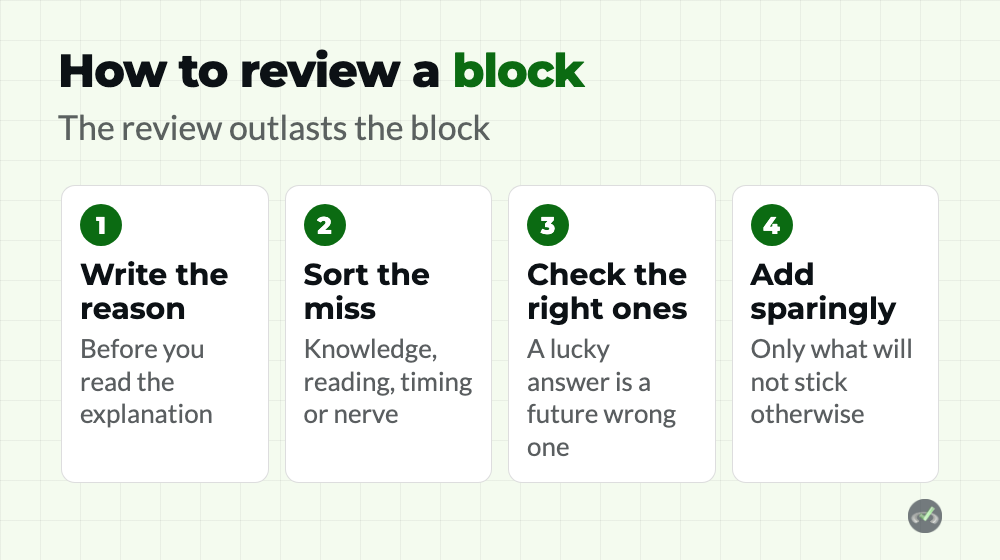
The block takes 30 minutes. Because the learning happens in the review, the review should take longer than the block did!
- Before reading the explanation, write down why you picked what you picked. One line. Your reasoning is what you are trying to correct.
- Sort every miss into a reason. Did you not know it, misread the stem, run out of time, or talk yourself out of the right answer? Four different problems, four different fixes.
- Read the explanations for the ones you got right too, at least where you were unsure. A lucky right answer is a future wrong one.
- Add only what will not stick otherwise to spaced repetition. A deck that grows faster than you review it becomes a second job!
Reviewing for the reason rather than the fact. Learning the fact fixes one question. Learning why your reasoning went where it did fixes the next twenty.
It is slower per question and it is the difference between a bank that teaches and a bank that tests 🙂
Step 1 practice questions versus practice exams
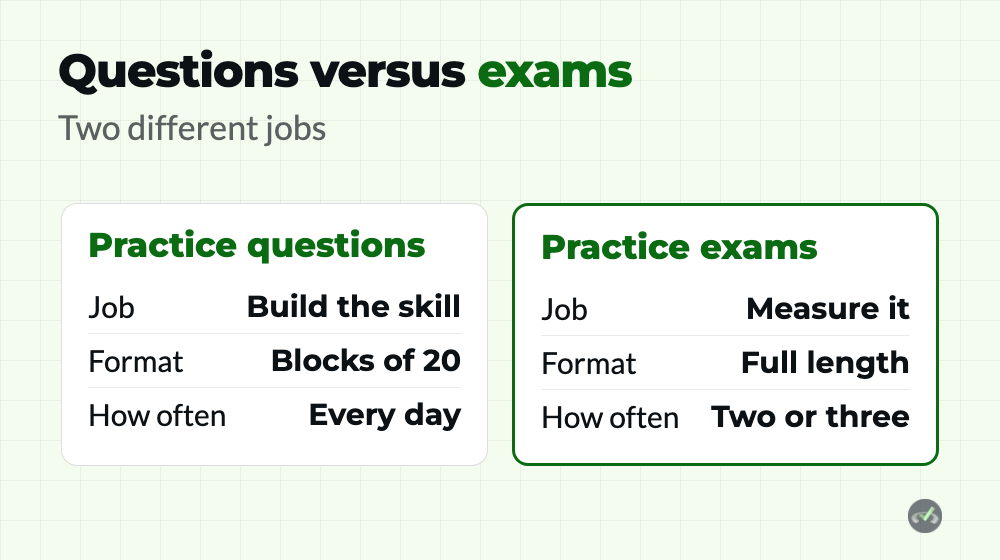
Two different jobs, and using one for the other is the most common planning error we see 🙂
NBME self-assessments are the measuring stick because they come from the same organization that writes the exam. A commercial bank's predicted score is an estimate built on somebody else's data.
Space them so each one can change what you do next. Two at a minimum, three if the picture is unclear, monthly on a run of three months or more!
How many Step 1 practice questions you need
There is no published number, and anybody quoting one is quoting a forum. That is oddly freeing!
What is true is that a bank of Step 1 practice questions finished and reviewed properly beats two banks half done, and that a second pass through your own misses beats a first pass through anything new.
- Volume matters less than review depth. Forty questions reviewed well beats a hundred reviewed by reading explanations.
- Coverage matters more than volume. A system you have never seen questions on is a hole, however many questions you have done elsewhere.
- Your percentage is not a score. Bank percentages are not calibrated to the exam's passing standard, so treat a rising trend as the signal 🙂
The Prometric practice session
Once you hold a scheduling permit, you can book a practice session at a Prometric center for a fee. It is the only way to rehearse the building rather than the exam!
- One per exam registration, in the same testing region as your Step exam.
- A permit is issued within a few business days of registering for it.
- It uses the same software you will sit the exam in, in the same room, with the same check-in.
Whether the fee earns its keep depends on how much of your anxiety is about the day rather than the content. For some people that is most of it, and this removes it 🙂
Registration details are at usmle.org.
When to start doing Step 1 practice questions
Day one, and earlier than most plans allow for.
The instinct is to finish learning the content first and then test yourself on it. That order feels sensible and it costs you weeks, because questions teach the shape of the exam and nothing else does.
- During a content phase, one timed block of Step 1 practice questions a day, on what you covered that morning.
- During full coverage, a timed block daily, mixing in what came before.
- During mixed practice, random blocks across every system, reviewed for the reason you missed.
- In the final week, short sets at exam rhythm and nothing new!
Our Step 1 study schedule sets out those phases at every length from three weeks to six months.
When your questions feel too hard
Almost everyone hits a stretch where a block feels unrecognisable. Three explanations, and they need different responses.
- The content is not there yet. Percentages in the thirties early in a run are normal, and they are not a forecast.
- The format is unfamiliar. Long stems and five near-identical options are a reading skill before they are a knowledge one, and reading gets faster with volume.
- The bank is harder than the exam. Several commercial banks are deliberately pitched above test difficulty, so a bank percentage is not a passing standard!
What tells the three apart is your NBME trend rather than how a block felt. Feelings after a bad block are famously unreliable 🙂
Six ways people waste their practice
- Untimed Step 1 practice questions all the way through. Timing is a skill and it is only built under time.
- Reading the explanation before writing down the reasoning. The explanation overwrites what you were about to learn about yourself.
- Saving questions for the end. A bank started in the last fortnight is a diagnostic, not a teacher.
- Subject-sorted blocks after the content pass. Knowing the topic before you read the stem is a hint the exam will not give you.
- Two banks at once. Twice the money, half of each, no more learning.
- Treating a bank percentage as a predicted score. It is not calibrated to the passing standard, and NBME self-assessments are!
Step 1 practice questions, common questions
Where can I get free Step 1 practice questions?
The USMLE program publishes free sample test questions inside its interactive testing experience, in the same software you sit the exam in.
How many Step 1 practice questions should I do a day?
At least one timed block, from day one, even during a content phase. More than that only helps if you can review all of it properly.
Should I buy NBME self-assessments?
They are the only scored practice written by the organization that writes the exam, and they start at $62. Two or three across a preparation run.
Should I practice in 40-question blocks?
No. Step 1 has run in 30-minute blocks of up to 20 questions since 14 May 2026, and our exam day breakdown covers what that day looks like now.
Do question bank percentages predict my result?
Not directly. They are not calibrated to the passing standard, so use the trend rather than the number, and use NBME self-assessments for the number.
What if my percentage stops improving?
Look at the reasons you are missing rather than the count. A plateau in the number usually means the review method needs changing, not the volume 🙂
Related reading
- Build your Step 1 study plan, a free tool that sizes the phases below to your own weeks and practice scores
- USMLE Step 1 study schedule, 3 weeks to 6 months
- The complete USMLE Step 1 guide, what it tests and what passing takes
- How long is USMLE Step 1, the eight-hour day block by block
- USMLE pass rates, all three Steps by examinee group
- 8 best USMLE Step 1 tutors, and when to skip tutoring
- What is the USMLE, the three Steps and how they fit together
- The USMLE exam guide, all three Steps