
USMLE Step 3: The Complete Guide
USMLE Step 3 is the last exam in the sequence and the only one sat across two days. Passing it is what lets you practice medicine in the United States without supervision!
Most people sit it during residency, and by then you have cleared two of these already. Everything below is current for 2026, checked against usmle.org this month 🙂
What USMLE Step 3 tests
Whether you can manage a patient on your own. The emphasis is on ambulatory care, and the exam is built from a model of what a general, as-yet undifferentiated physician meets in practice.
Three encounter frames run through it. Initial workup, continuing care and urgent intervention, each emphasizing different tasks, from data gathering through long-term management to rapid decisions under pressure.
Our USMLE overview covers how the three Steps build on each other, and our Step 2 CK guide covers the one before this.
Step 3 is the only Step with computer-based case simulations, where you manage a patient in real time rather than pick an option.
The USMLE Step 3 format, day by day
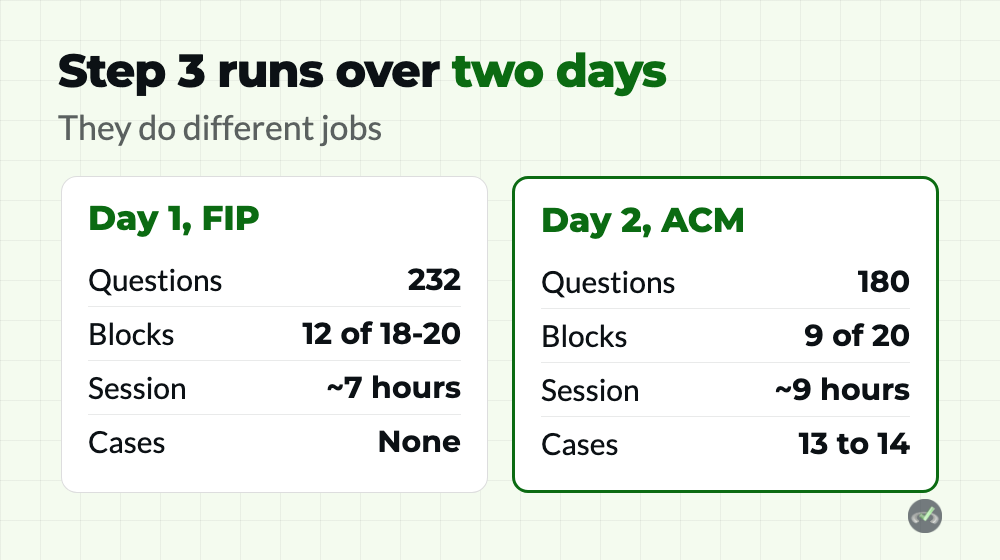
Two days, roughly 16 hours of testing between them, and they do different jobs!
412 multiple-choice items across the two days, plus the case simulations. That is more questions than Step 1 and Step 2 CK combined!
Day 1 leans on foundational science, biostatistics and interpreting the literature. Day 2 is management, and the CCS cases stop resembling any exam you have sat before!
The CCS cases, which nothing else prepares you for
Computer-based case simulations put a patient in front of you and let you act. You order tests, start treatments, move the patient between settings and advance the clock, and the case responds. It is the most interesting hour of the whole sequence 🙂
- Real time matters. Each case is allotted 10 or 20 minutes of real time, and the simulated clock moves as you order things.
- There is no option list. You type what you want, which is a different skill from picking a right answer out of five.
- Over-ordering costs you, and so does missing something. The case is graded against what a reasonable physician would do.
- The free practice software is the whole preparation. The USMLE program publishes it, and nothing else simulates the interface!
A 6-minute CCS tutorial runs on day two before the cases start, and it is shorter than the practice software, so do the practice software first.
What is on USMLE Step 3
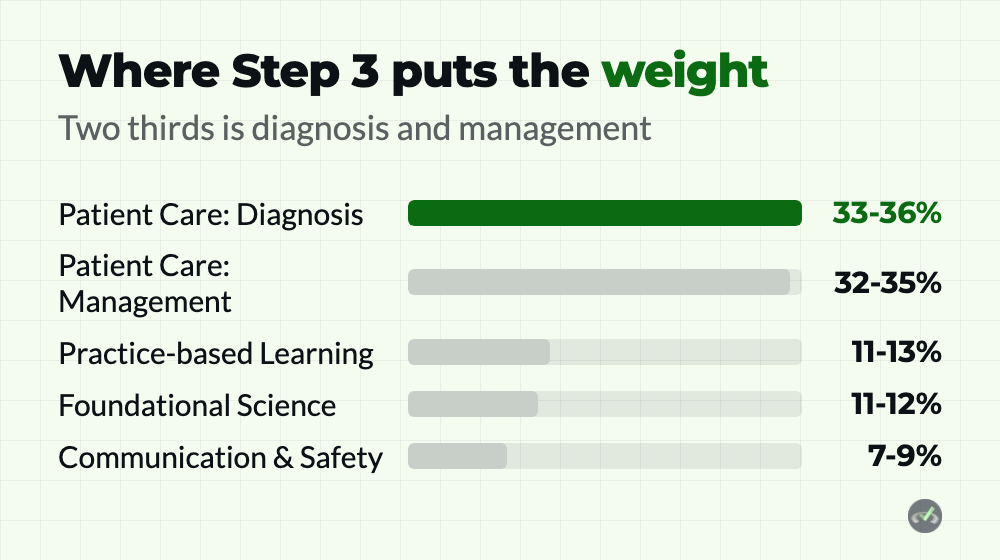
Two published tables, and the system split comes first!
Biostatistics at 11 to 13% is the number that catches people. A bigger slice here than on either earlier Step, and most residents have not touched it in years!
The competency table shows where the weight sits.
Two thirds of Step 3 is diagnosis and management. Foundational science is 11 to 12%, down from 60 to 70% on Step 1. The sequence has come a long way by this point 🙂
USMLE Step 3 scoring and pass rates
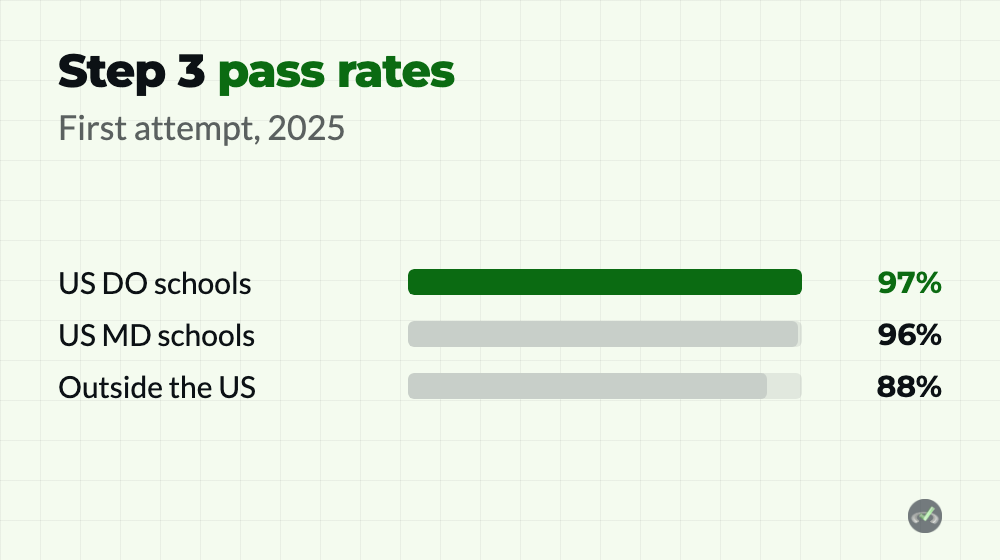
A three-digit score, minimum 200 since 1 January 2024, and the rates below are the friendliest in the sequence 🙂
The DO figure rests on 129 examinees, because COMLEX Level 3 is the osteopathic route. Read it as a small sample rather than a finding.
Full tables by year are published at usmle.org, and the format specification is at usmle.org.
People sitting Step 3 have already cleared two Steps, which is most of why the rates hold up here!
Eligibility, cost and timing
Step 3 asks for more than the earlier Steps, and it is administered only in the United States. The requirements are all things you will already have by then!
The fee attaches to a three-month eligibility period and does not transfer if you miss it. Many residency programs require Step 3 before promotion, which sets the timing for most people.
Our eligibility page has the full rules and our cost page has every fee!
Three months, chosen at application, non-refundable and non-transferable. Residency schedules move around, and a period chosen optimistically in February is a $955 lesson by May.
Book early inside the period rather than late, so there is room to move without extending 🙂
How to prepare for USMLE Step 3
Less than for the earlier Steps, and differently. Most people give it weeks rather than months, which is the best news on this page 🙂
- Do the free CCS practice software first. It is the only thing that prepares you for the case simulations, and it is published by the USMLE program.
- Refresh biostatistics. At 11 to 13% it is weighted higher here than anywhere else in the sequence, and residency does not keep it sharp!
- Practice in 30-minute blocks, which is the format on both days.
- Plan the two days as one event. They can be scheduled apart, and the second day is the longer one.
Our Step 1 guide and Step 2 CK guide cover the exams before this one.
USMLE Step 3, common questions
How long is USMLE Step 3?
Two days. About 7 hours on day one and about 9 on day two, with 412 multiple-choice items between them plus 13 to 14 case simulations.
What is a passing Step 3 score?
200, on the three-digit scale, since 1 January 2024.
When do you take Step 3?
Usually during residency, often in the first or second year, and many programs require it before promotion.
What are CCS cases?
Computer-based case simulations on day two, where you manage a patient in real time by typing orders rather than choosing from options.
Can I take Step 3 outside the United States?
No. Step 3 is administered only at US Prometric centers.
How hard is Step 3?
96% of first-time takers from US MD schools passed in 2025 and 88% from schools outside the US. Our pass rate page compares all three Steps 🙂
Related reading
- USMLE Step 2 CK, the exam before this one
- What is the USMLE, the three Steps and how they fit together
- USMLE scoring, how each Step is reported
- USMLE pass rates, all three Steps by examinee group
- USMLE cost, every fee for all three Steps
- USMLE eligibility, who can sit each Step
- The USMLE exam guide, all three Steps