
How Hard Is the USMLE, in Numbers
Hard enough that one in fourteen first-time takers from US MD schools failed Step 1 in 2025, and one in four from schools outside the US. Easy enough that the great majority of people who prepare properly pass on the first attempt!
USMLE difficulty is an opinion unless it is anchored to something. Everything below is anchored, and most of it is friendlier than the reputation 🙂
USMLE difficulty, in published numbers
Four figures answer the question better than any adjective.
That ~60% comes from the USMLE program's own wording, and it surprises people. Step 1 is an exam you have to clear rather than one you have to ace 🙂
The pass rates behind these figures are published at usmle.org, and the scoring rules at usmle.org!
A first attempt passes at 93% for US MD candidates. A repeat passes at 71%. The difficulty is concentrated in getting it right once.
What drives USMLE difficulty, specifically
Four things drive USMLE difficulty, and only one of them is the content.
- Volume. Two years of basic science, weighted across eleven disciplines and eleven systems. Our content outline page has the full split.
- Application, not recall. 60 to 70% of Step 1 is applying a concept rather than retrieving a fact, which is a different skill from the one flashcards build.
- Stamina. Eight hours, fourteen blocks, and hours six to eight are a different exam because you are a different person by then.
- One shot that counts. Every attempt is permanent on your transcript, so the pressure is structural rather than imagined!
Which Step is hardest
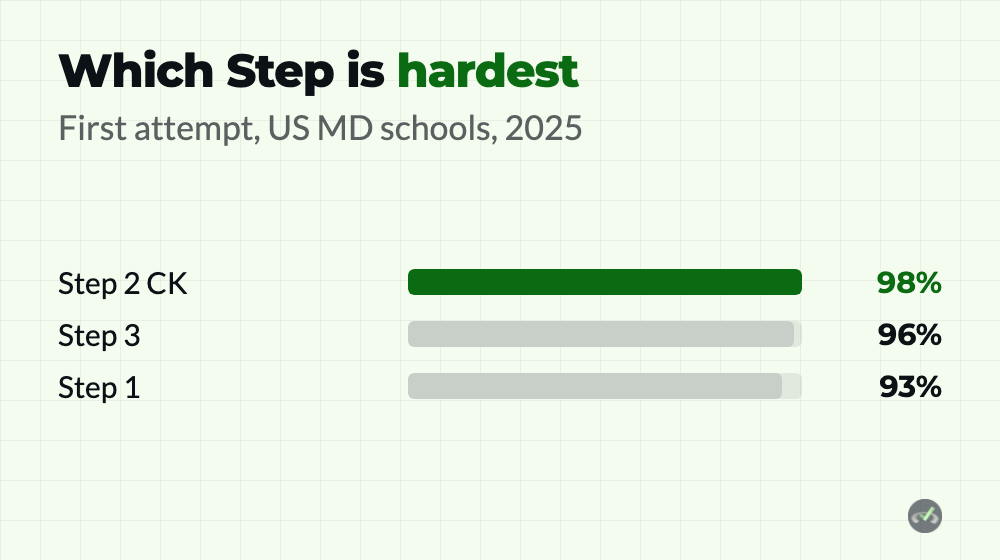
Step 1, on every published measure of USMLE difficulty, and it is not close.
Step 1 is where people fail. By Step 2 CK the same cohorts are passing at 96 to 98%, partly because the students who were going to struggle have already met Step 1.
So if Step 1 is the one in front of you, USMLE difficulty drops sharply after it 🙂
Is the USMLE harder than the MCAT
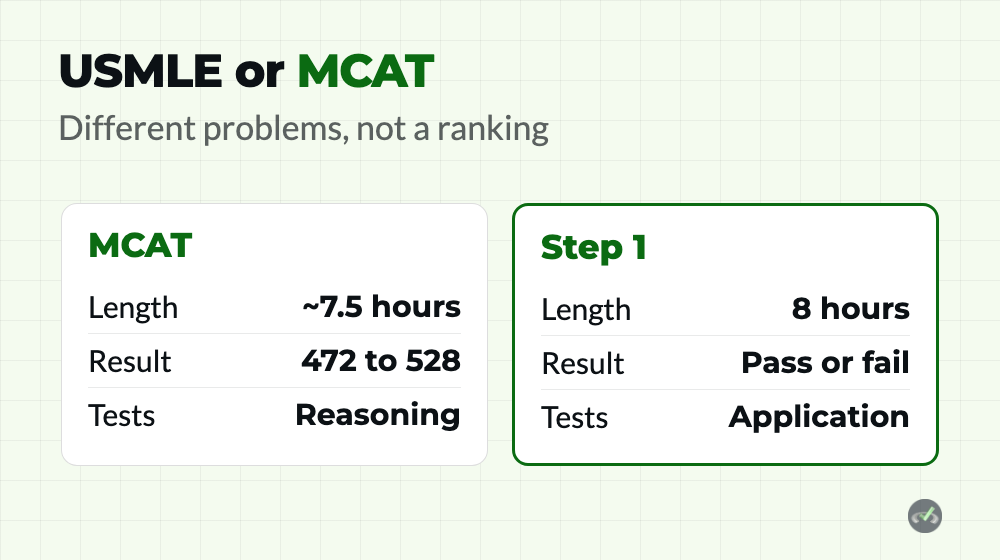
They are different enough that ranking USMLE difficulty against the MCAT tells you less than the side-by-side does.
The MCAT is a reasoning test you sit against a broad science background. Step 1 is a knowledge and application test you sit against a curriculum you have just finished.
Most people who have sat both say Step 1 is heavier and the MCAT is trickier, which is a description of two different problems rather than a ranking!
Whether doing well on the MCAT predicts doing well on Step 1. There is some relationship, and it is far weaker than the worry around it suggests.
Your NBME self-assessments predict your Step 1 result. An MCAT score from three years ago does not 🙂
Who finds it hardest, and why
USMLE difficulty varies more between groups than it does between exams.
In 2025, 93% of first-time takers from US MD schools passed Step 1 against 75% from schools outside the US. That is an 18-point spread on the same exam.
The reasons are structural rather than about ability. A curriculum built to a different specification, a different language of instruction, less access to US-style question banks, and often less protected time for a dedicated period!
Our pass rate page breaks it down by group and by attempt!
What cuts USMLE difficulty measurably
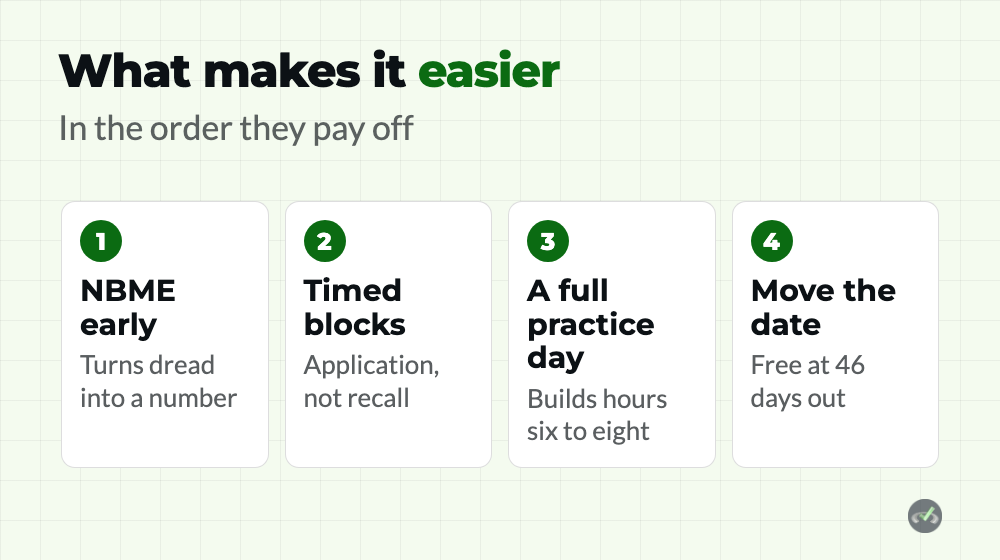
Four things cut USMLE difficulty, in the order they earn their keep.
- Sit a full-length NBME early. It converts a vague dread into a number, and a number can be worked on.
- Practice application rather than recall. Timed question blocks from week one, reviewed for the reason you missed rather than the fact.
- Build the stamina. A full-length practice day is the only thing that prepares you for hours six to eight.
- Do not sit before the scores say so. Moving the date at 46 days out is free; sitting unready costs an attempt you cannot get back!
Our Step 1 study schedule builds all four in, at any length.
USMLE difficulty, common questions
How hard is USMLE Step 1?
93% of first-time takers from US MD schools passed in 2025, and 75% from schools outside the US. You need roughly 60% of questions correct.
Is the USMLE harder than the MCAT?
Heavier on volume, lighter on abstract reasoning, and sat against a different preparation. Most people who have done both call them different rather than ranking them.
Which Step is the hardest?
Step 1, by pass rate, on every examinee group. Step 2 CK and Step 3 both pass at 88% or better.
Can you fail the USMLE?
Yes, and thousands do each year. Four failed attempts at any Step ends your eligibility for the whole sequence, which our eligibility page sets out.
How much do you need to get right?
Around 60%, by the USMLE program's own wording, varying by Step and by exam form.
Does it get easier after Step 1?
By the numbers, yes. The same cohorts pass Step 2 CK at 96 to 98% and Step 3 at 96 to 97% 🙂
Related reading
- USMLE pass rates, all three Steps by examinee group
- The complete USMLE Step 1 guide, what it tests
- Step 1 content outline, every published weighting
- How long is USMLE Step 1, the eight-hour day block by block
- USMLE Step 1 study schedule, 3 weeks to 6 months
- What is the USMLE, the three Steps and how they fit together
- The USMLE exam guide, all three Steps