
USMLE Score Invalidation and Irregular Behavior
A USMLE score can be withheld, canceled or annotated after you have sat the exam. It is rare, it is permanent, and almost nobody reads the rules until they need to!
Below is what triggers it, how the process runs, and what ends up on your transcript.
What USMLE score invalidation means
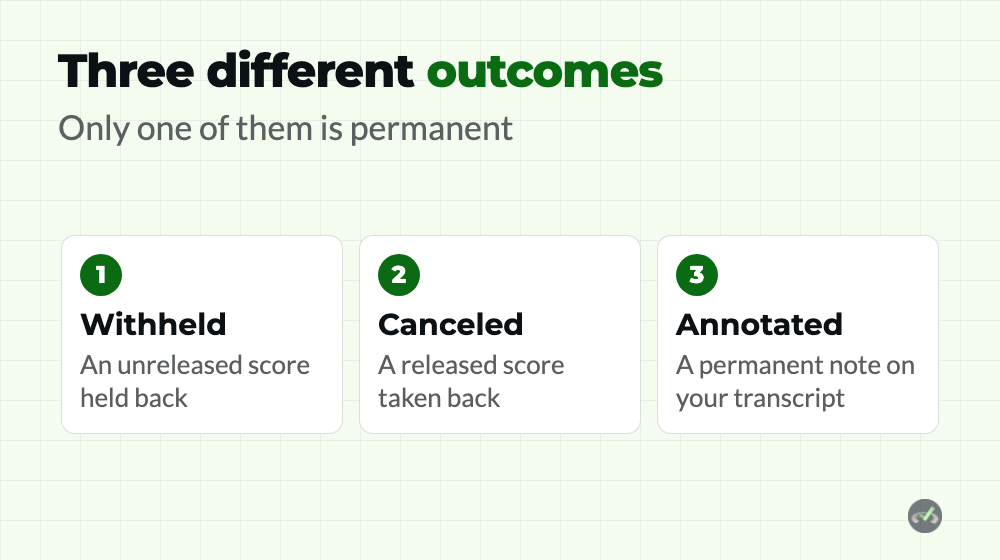
Three different outcomes get called USMLE score invalidation, and they are not the same thing 🙂
The annotation lasts. It becomes part of your permanent USMLE history and appears on your score report and transcript, where every program and state board sees it.
An annotation is permanent. A canceled score can be re-sat; a note on your record cannot be removed.
What triggers USMLE score invalidation
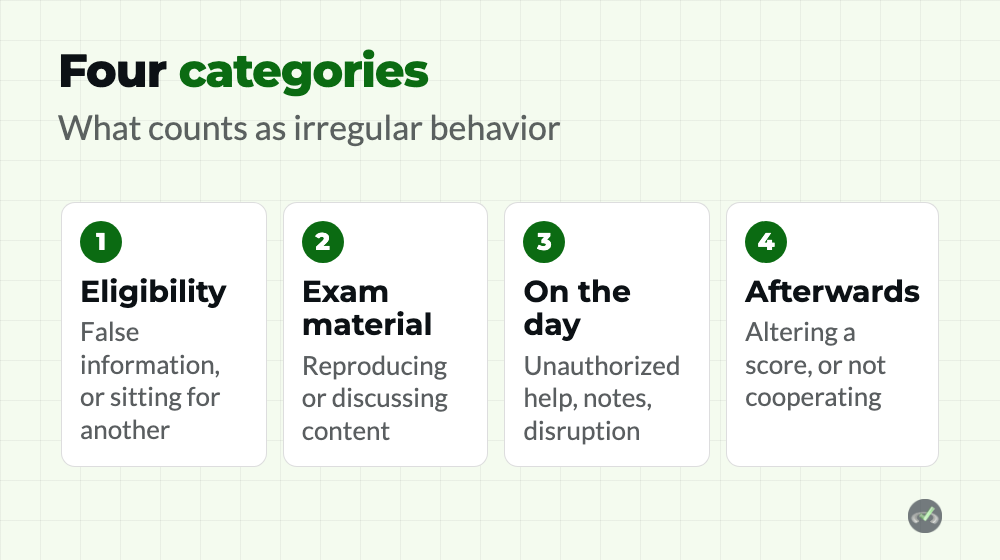
USMLE score invalidation follows a finding of irregular behavior, which the program defines broadly as any action that could compromise the validity, integrity or security of the process. It falls into four groups.
- Eligibility and identity. Registering while ineligible, giving false information on an application, or sitting an exam for somebody else.
- Exam material. Seeking unauthorized access to content, reproducing it including by reconstruction from memory or posting it online, or discussing questions before, during or after the exam.
- Conduct on the day. Seeking unauthorized assistance, making unauthorized notes, failing to follow the rules, or harassing or disrupting test center staff.
- Afterward. Altering a score, or failing to cooperate fully in an investigation.
Two of those catch people who never intended anything. Discussing questions after the exam is a violation, and so is posting a recalled question in a study group!
Writing down what you remember and sharing it is named explicitly as unauthorized reproduction. So is reading somebody else's recollection.
Every "recalls" document circulating in a forum sits on the wrong side of this line, whichever end of it you are on 🙂
How an investigation runs
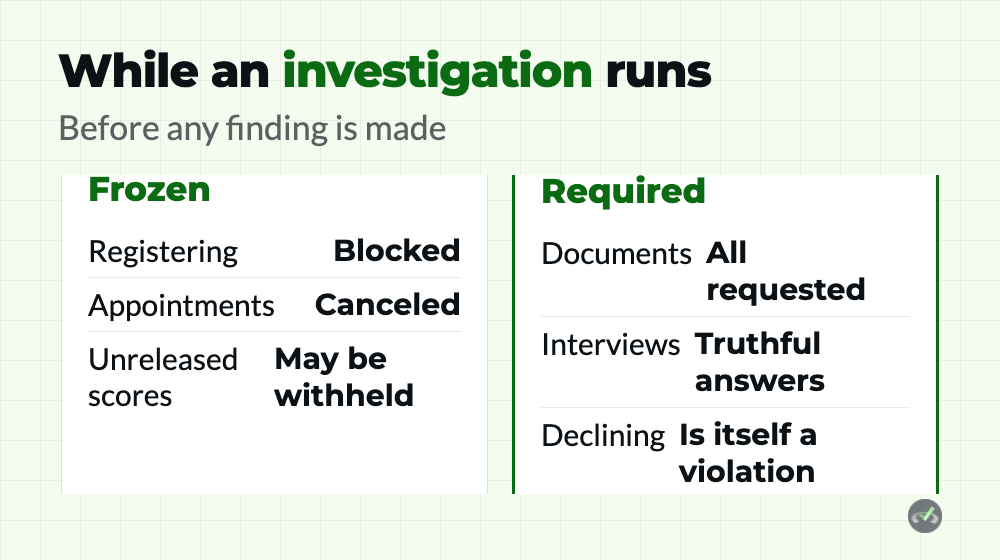
Four things happen at once when a report is received, before any finding of USMLE score invalidation is made!
- You cannot register for further exams while the investigation is open.
- Unreleased scores may be withheld.
- Pending appointments are canceled.
- You are required to cooperate fully, providing documentation and answering questions truthfully in interviews.
Failing to cooperate is itself irregular behavior, so declining to engage makes the position worse rather than safer.
If you are in this position, the Bulletin of Information is the document that governs it, and a professional adviser rather than a study forum is the right place to go next!
Anomalous performance, which is separate
The USMLE program also monitors results for unusual score patterns, and that is a different process from irregular behavior.
Examinees flagged by that analysis may be asked to explain their testing behavior. A large, unexplained jump between attempts is the pattern most often described.
Treat it as a request for information rather than a verdict. Sit the exam straight and the analysis stays somebody else's problem 🙂
Our USMLE scoring page covers how results are reported normally.
How to stay well clear of it
Five habits keep USMLE score invalidation off your horizon, and none of them cost anything 🙂
- Use published material only. Official practice, commercial banks and books. Nothing described as recalls, remembered questions or leaked content.
- Do not discuss questions. Not before, not during, not after, not in a group chat.
- Report an eligibility change promptly to whoever registered you. Silence there is itself a violation.
- Follow the test center rules to the letter. No notes, no devices, no shortcuts at check-in.
- Read the Bulletin once. You agree to it at registration, and it takes half an hour!
Who this reaches in practice
Very few people, and the ones it reaches are rarely the ones who set out to cheat.
- Study groups that swap remembered questions. The most common route in, and it usually starts as generosity!
- Anyone posting or reading "recalls". Both ends of that exchange are named in the rules.
- Students whose status changed and who did not report it, because an appeal felt like the status was unresolved.
- People who stopped replying once an investigation opened, which converts a question into a second violation.
Not one of those four needs any intent to game the exam, which is why the rules repay a read before you need them 🙂
How long it takes, and what it holds up
The USMLE program does not publish a fixed timetable, and the practical effect is what matters.
- Your sequence stops. No new registrations while it runs.
- Your application cycle can slip. A held score at the wrong moment costs you a year rather than a result.
- Cooperation shortens it. Documents and interviews answered promptly are the only lever you control.
Which is the argument for staying well clear of the whole thing, and acting on it costs you nothing 🙂
USMLE score invalidation, common questions
Can USMLE score invalidation happen after a score is released?
Yes. A released score may be canceled where a finding of irregular behavior affects its validity.
What is an annotation?
A permanent note of a finding of irregular behavior on your score report and USMLE transcript. It does not expire.
Is discussing questions after the exam a violation?
Yes. Disclosing or discussing test content before, during or after the exam is named in the Bulletin as irregular behavior.
What happens while a USMLE score invalidation case is open?
You cannot register for further exams, pending appointments are canceled, and unreleased scores may be withheld.
Does a big score jump get flagged?
Unusual patterns are monitored, and examinees may be asked to explain their testing behavior. That review is separate from irregular behavior.
Does an annotation end my eligibility?
Not by itself. Attempt limits are a separate rule, and our eligibility page sets those out 🙂
Related reading
- USMLE scoring, how each Step is reported
- USMLE eligibility, who can sit each Step and the attempt limits
- USMLE pass rates, all three Steps by examinee group
- What is the USMLE, the three Steps and how they fit together
- The complete USMLE Step 1 guide, what it tests
- USMLE Step 1 study schedule, 3 weeks to 6 months
- The USMLE exam guide, all three Steps