MCAT Retake Calculator
Getting a score back that misses is a rough week, and every retaker we work with has had one. The question underneath it is whether another three months buys you the points.
In about thirty seconds, this free MCAT retake calculator gives you an answer you can act on.
- Whether the retake makes sense at all
- How many study weeks the jump needs at the pace you can keep
- Whether the date you are eyeing can hold them
- How many more medical schools the new score opens
Nothing to sign up for. Put your four section scores in and see where you land.
On this page
How the MCAT retake calculator works
The MCAT retake calculator asks for four section scores rather than a total, because which section is dragging changes the answer far more than the total does. A 506 built from 124/125/129/128 and a 506 built from four flat 126s are different problems, and they need different retakes.
Then it asks what went wrong last time. That single answer splits the calculation in two.
- You ran out of time to study. The gap is content you never got to. The calculator prices it in study weeks at your pace and checks the date against it.
- You studied hard and stalled. You have already run the more-content experiment and watched it come back flat, so the calculator stops pricing content and switches to what a plateau needs instead.
- Your practice scores beat your real score. You already own the points. Something between practice conditions and test day is taking them.
- One section dragged it down. The cheapest points on the whole exam are sitting in one place instead of spread across four, which is the fastest retake there is.
- You do not know yet. The calculator refuses to price it and tells you to diagnose first, which is the first thing our mentors tell every retaker.
What moving your score costs in weeks
A retake is bought in weeks, so the MCAT retake calculator counts weeks at the hours you can realistically give it, measured against the date you picked. Our 515+ scoring mentors put about two weeks off in front of that, because nobody should start studying the week their score lands.
Our mentors put the reset first every time. It is what separates a retake aimed at something from a retake that repeats the year. If your date cannot hold the weeks, the calculator names the first date that can, instead of encouraging you to squeeze.
It also runs both scores against the median MCAT of 219 US and Canadian MD and DO programs, so you retake shows up as schools rather than as points. How many your current score clears, and how many the target would.
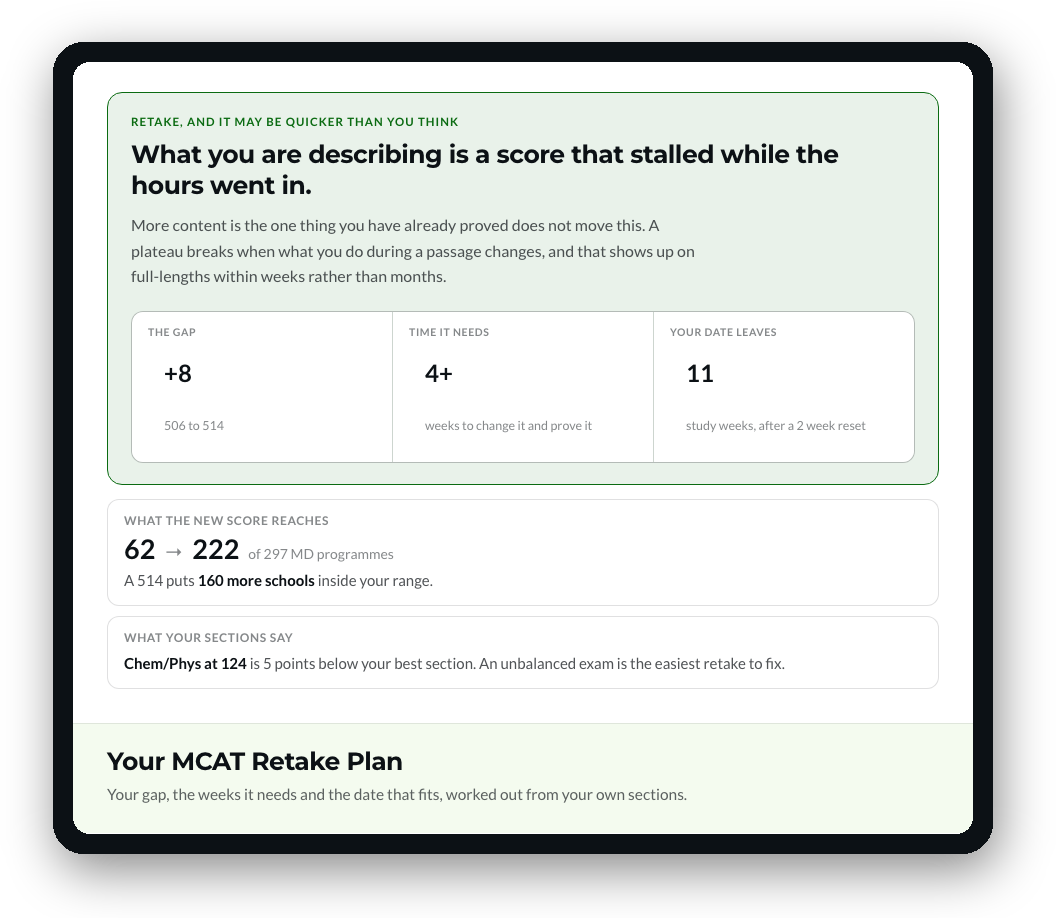
The read-out the MCAT retake calculator sends you, with the verdict, the weeks it needs, and every school the new score opens.
What is a good MCAT score?
No single number works for everyone, so the MCAT retake calculator asks for your target instead of assuming one. The scale runs from 472 to 528 with each of the four sections scored 118 to 132, and AAMC publishes percentile ranks for every scaled score, updated each year, along with a full explanation of how the exam is scored. A percentile tells you where you sit against everyone who took it. It does not tell you whether you get in.
Your school list decides it. A score that clears one program by its median misses another by four points, so the calculator measures both your current score and your target against the median MCAT of 219 US and Canadian MD and DO programs and shows you the difference in schools rather than in percentiles.
Balance matters as much as the total. A 508 built from 124/125/129/130 and a 508 built from four flat 127s read the same on an application and need different retakes. So it asks for four.
How many times can you retake the MCAT?
Before the MCAT retake calculator can price anything, it needs to know how many attempts you have left. AAMC caps how often you can sit the exam, and the limits count in ways that catch people out. You may attempt the MCAT no more than three times in a single testing year, no more than four times across two consecutive testing years, and no more than seven times in your lifetime, counting from the April 2015 test dates onward.
Voided exams and no-shows count against those limits precisely like a scored sitting. So count every sitting, including the ones you walked away from. That is why we ask how many times you have already taken it. At a fourth or fifth attempt a rushed date costs three months and one of a shrinking number of chances. You can read the current rules on the AAMC testing attempt limits page, and check available sittings on the official MCAT calendar.
If you are still deciding whether to submit or void on the day itself, that is a separate call with its own rules, and we cover it in should you void your MCAT.
When the calculator tells you not to retake
A calculator that always says yes is a sales page. This MCAT retake calculator says no in three situations, and they are so you know before you put your numbers in.
- Your score already meets your target. A second score sits on your record beside the first, and it can go down as easily as up.
- The gap is one or two points. That is inside what a single test day moves on its own. If a programme on your list has a hard cutoff you sit under by a point or two.
- Your AAMC full-length average is well below your target. Top scorers treat that average as the readiness test. The real exam almost never rescues a number your practice is not already showing.
If the answer comes back as no, the months you were about to spend studying are better spent on the rest of the application. When the MCAT retake calculator does say yes, the full MCAT retake guide walks through the prep itself.
What top scorers do differently on a retake
We have interviewed hundreds of 515+ scorers, and a striking number of them are retakers. The same handful of moves comes up every time, and they are built into the MCAT retake calculator rather than bolted on as advice.
- They take the reset first. Days off and out of the house, before a page of content.
- They work out what went wrong before buying anything. Content gaps, timing and test-day nerves each need a completely different retake.
- They set a date, and they do not set it too close. A retake with no endpoint turns into a year of studying; one booked too soon turns into a third score.
- They adjust for inflated practice scores. Sitting a full-length you have already seen makes you look readier than you are.
- They would rather delay the application a cycle than sit underprepared. That one is close to unanimous.
You can read how that played out for individual students in our 500 to 514 retake story and our 516 scorer retake tips. If you have not scored yet and want to convert a practice raw score first, use the MCAT score calculator, then come back here.
Every MCAT score, 472 to 528
We have written up every score on the scale, covering where it lands in percentile terms, which schools it reaches, and whether a retake usually makes sense at that number. Find yours, then bring it back to the MCAT retake calculator above.
Free video
Still deciding? Watch what top scorers did after a score that missed
Ten minutes on the reset they took before restarting, how they got honest about their schedule, and the two decisions about the retake date…
On its way.
Check your inbox in the next minute.
MCAT retake calculator FAQ
Is this MCAT retake calculator free?
Yes, and it needs nothing from you to use. Put your numbers in and the verdict appears. Emailing yourself the full week by week plan is the only part that asks for an address.
How accurate is an MCAT retake calculator?
No calculator can promise a score. What this MCAT retake calculator does is make the arithmetic explicit, showing the weeks the jump needs at your pace, the weeks your date leaves, and whether those two numbers agree. When a retake goes wrong, that subtraction is usually the step nobody ran.
Does retaking the MCAT look bad to medical schools?
Schools handle multiple scores differently. Some take the highest, some average, some weigh the most recent most heavily. A retake reads badly mainly when the score does not move, which is the case the MCAT retake calculator is designed to help you avoid.
How long should I study for an MCAT retake?
It depends far more on what went wrong than on the size of the gap. A genuine content gap is measured in months. A timing or reasoning problem often moves within weeks, because you already know the material. The calculator splits those two cases apart and gives you a number for yours. The AAMC also publishes what it considers a reasonable preparation timeline, which sits usefully beside your own number.
Can I use the MCAT retake calculator before I get my score?
You can plan with the MCAT retake calculator, but the section scores are what make the answer specific. If you are waiting on a score, the should I retake the MCAT guide is the better read while you wait.