Whether your score just came back or you’re setting a goal, it helps to see where a number ranks. We’ve got you!
The MCAT is scored from 472 to 528, and your MCAT percentile is the share of test takers who scored at or below you.
The MCAT percentile calculator, the chart and the full table below use the AAMC ranks in effect for 2026 to 2027, so a good MCAT score can be read straight off them.
Find Your MCAT Percentile
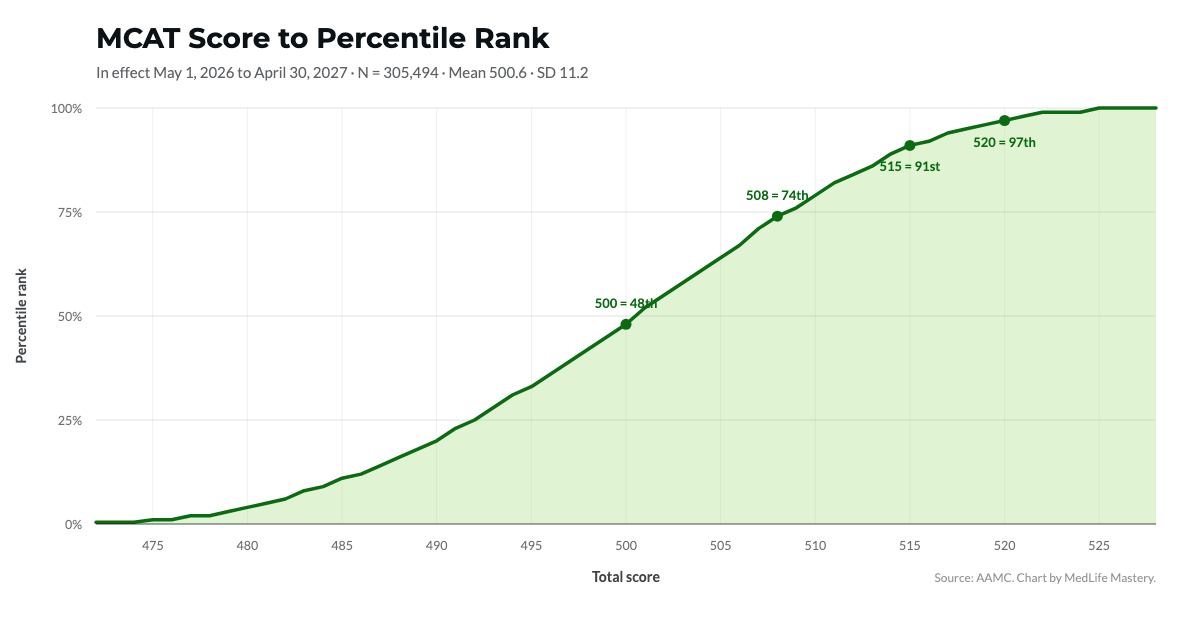
A 500 is the 48th percentile, a 508 is the 74th and a 515 is the 91st.
The mean score is 500.6, and a 501 is the 52nd percentile, so anything from 501 upwards puts you in the top half of everyone who sat the exam.
The MCAT percentile calculator at the top of this page gives the percentile for any total or section score, and it works backward from a percentile too!
What MCAT Score Is the 80th, 90th or 95th Percentile?
Many of you search for a percentile first and the score second, so here’s the lowest total score that reaches each common MCAT percentile in the 2026 to 2027 table :)
The 90th percentile MCAT score is a 515, which ranks 91st, since a 514 ranks 89th. The 80th percentile takes a 511, because a 510 ranks 79th and a 511 ranks 82nd.
At the very top, a 525 through 528 all show as 100 in the AAMC table, since the ranks are rounded to whole numbers. That’s a lovely spot to land in!
The AAMC table goes up in whole score points, so some percentiles never appear. When yours is missing, take the lowest score whose rank reaches it. For the 80th, that’s a 511.
How Is the MCAT Scored?
The MCAT exam has four sections.
- Chemical and Physical Foundations of Biological Systems (Chem/Phys)
- Critical Analysis and Reasoning Skills (CARS)
- Biological and Biochemical Foundations of Living Systems (Bio/Biochem)
- Psychological, Social, and Biological Foundations of Behavior (Psych/Soc)
The AAMC first counts how many questions you answered correctly in each section. That number is your raw score, and it’s converted into a scaled score from 118 (lowest) to 132 (highest).
The four scaled scores add up to your total, so the MCAT score range runs from 472 to 528, with a midpoint of 500. You get a percentile for the total and for each section!
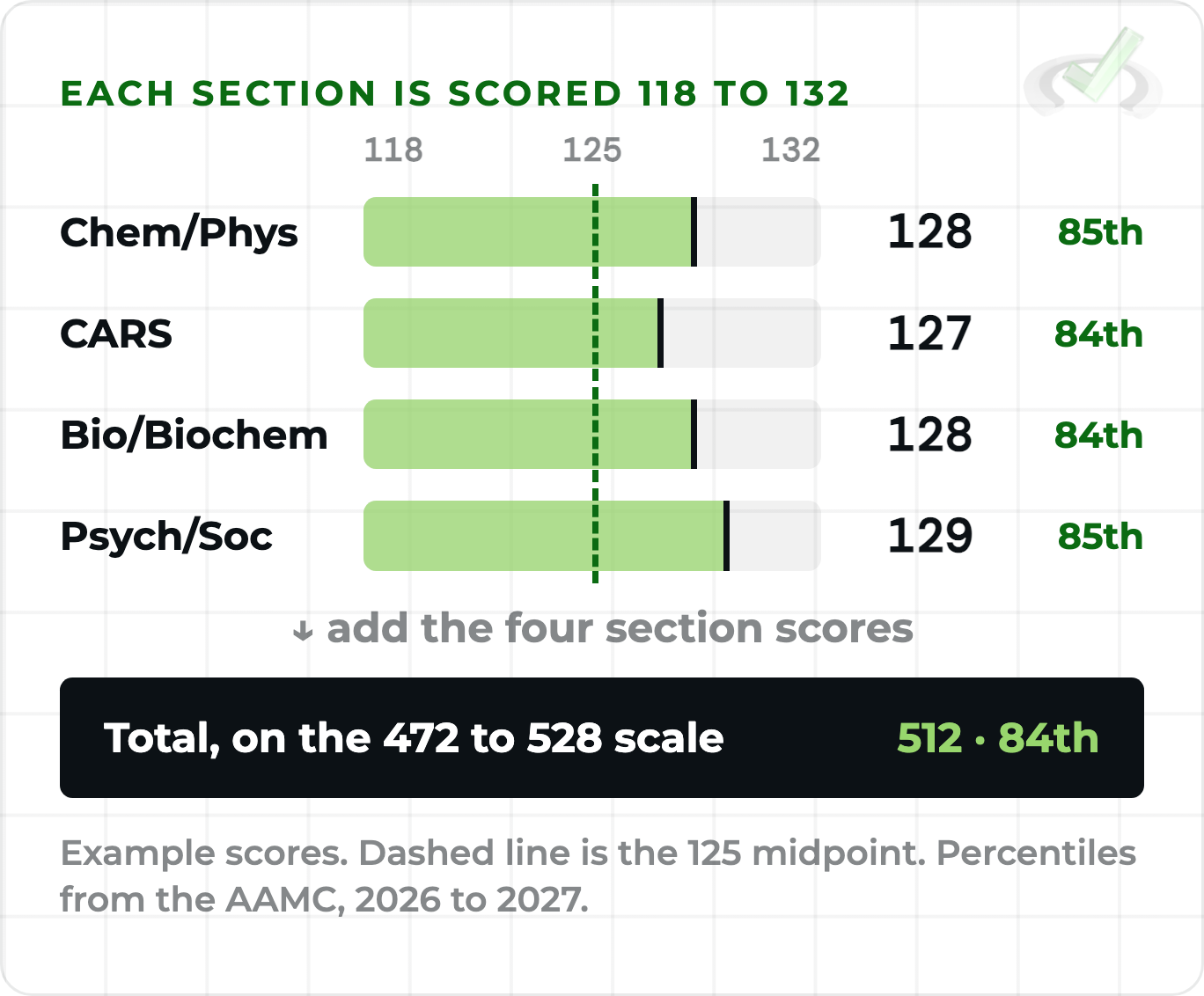
Our MCAT score calculator does that conversion for you, section by section, and returns your MCAT percentile alongside it!
It works from your raw scores on the free AAMC unscored sample test, and links you to that test if you haven’t taken it.
On test day, the MCAT has 6 hours 15 minutes of testing and runs about 7 hours 30 minutes with breaks, according to the AAMC’s MCAT Essentials. Pack good snacks!
For more detail, see how the MCAT is scored, what MCAT score confidence bands are and how score profiles work.
Why Does the MCAT Use Scaled Scores?
Every MCAT tests the same concepts and skills, but each exam uses its own set of questions. That means one form can be a little harder than another, and comparing raw scores across test dates wouldn’t be fair.
Scaled scores even out those small differences in exam difficulty. The AAMC calls this process equating, and it lets schools compare applicants who took different forms.
So the same raw score won’t always give the same scaled score. Two students with the same scaled score may have answered a different number of questions correctly, because their forms differed. It all evens out!
The MCAT isn’t graded on a curve. Your scaled score doesn’t depend on how the other people in your testing room did, or on which date you picked. Breathe easy on that one :)
What Does Your MCAT Percentile Mean?
Your MCAT percentile shows the share of test takers who scored the same as you or lower. You get one for your total score and one for each of the four sections.
If your MCAT percentile is 88, then 88% of test takers scored the same as you or lower. The higher your MCAT percentile, the better!
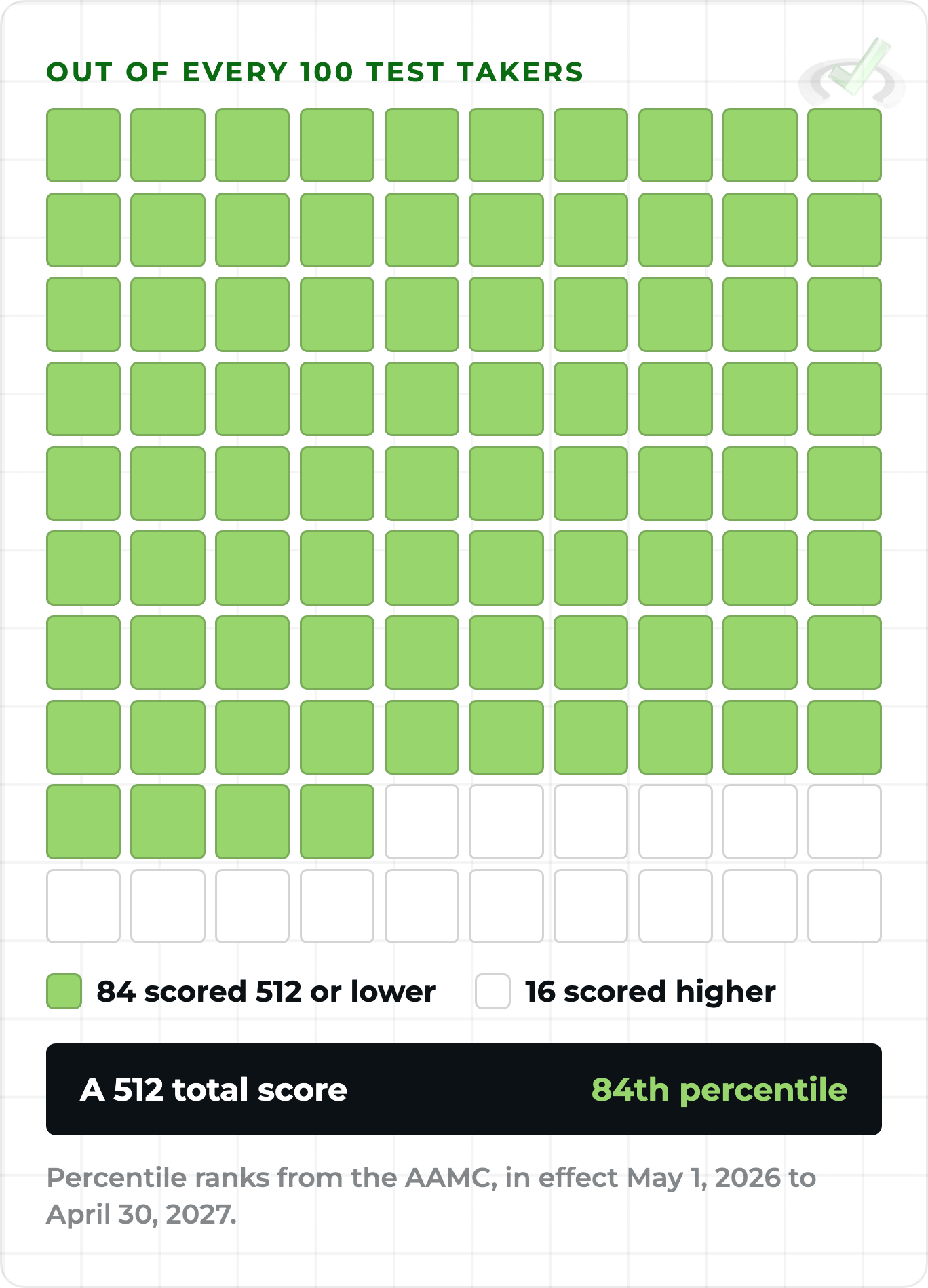
A percentile isn’t a grade out of 100. A 512 doesn’t mean you got 84% of questions right. It means 84 out of every 100 scores in the AAMC’s data were a 512 or lower. That’s a great result!
Each table covers every MCAT taken in the three testing years before it. The 2026 to 2027 ranks use scores from 2023, 2024 and 2025. Handy to know!
MCAT Section Percentiles for 2026 to 2027
Each section has its own MCAT percentile table. A 125 is the midpoint of the section scale, and here’s where every section score ranks this year. Each number is the percentile rank, and C/P is Chem/Phys, B/B is Bio/Biochem and P/S is Psych/Soc.
The same score can rank differently by section. A 125 is the 62nd percentile in CARS and the 44th in Psych/Soc, so check the column for your section! A strong section can lift your whole profile :)
MCAT Scores and Percentiles for 2026 to 2027
The AAMC revises MCAT percentile ranks every May 1. The table in effect from May 1, 2026 to April 30, 2027 is built from 305,494 scores across the 2023, 2024 and 2025 testing years.
Across those scores, the mean total is 500.6 and the standard deviation is 11.2. Most scores sit near the middle of the scale, and fewer sit at each end. A curve you’ve probably seen in stats class!
Source: AAMC Summary of MCAT Total and Section Scores, percentile ranks in effect May 1, 2026 to April 30, 2027.
What MCAT Percentile Should I Aim For?
The average MCAT score of students who matriculated into medical school in the 2025-2026 cycle was 512.1, according to AAMC FACTS data. A 512 is the 84th percentile.
The percentile that’s good for you depends on your goals and the rest of your application. Your target should line up with the MCAT scores of students admitted to the schools at the top of your list.
Our list of median MCAT scores at every US medical school shows where each school sits, and our free MCAT Target Score Tool works out your target from your school list!
(Optional) If you’re aiming several points above where you are now, our 6-Week Live MCAT Accelerator works live passages in every section and includes seven 1:1 sessions with a 515+ scorer. We’d love to help!
Pick your target score first, then read its MCAT percentile. A target built from the schools you want gives you a number you can plan weeks against.
Will My MCAT Score Guarantee Admission?
No MCAT score guarantees an acceptance. Medical schools also weigh your GPA, letters of recommendation, extracurricular activities and more.
A 515 puts you in the 91st percentile, and a 517 is the 94th. Scores in that range make you a more competitive applicant at many schools!
The MCAT is one part of your whole application. A lower MCAT score can be easier to overcome if you’ve faced great difficulties, or if you bring strong letters, a high GPA and achievements you show in your personal statement and AMCAS activities.
If you’re working toward one of those higher percentiles, 1:1 MCAT tutoring pairs you with a 515+ scorer who can find the patterns in your misses with you. You don’t have to do it alone!
Admissions committees read the whole application. A strong MCAT percentile opens doors, and the rest of your story walks you through them!
Is Your MCAT Score Good? Pick Your Score
We wrote a short guide for every MCAT score, with its percentile and what it means for your school list. Tap your score below, or start with our guide to what makes a good MCAT score.
MCAT Percentile FAQs
What is a good MCAT percentile?
A good MCAT percentile depends on your goals and the schools you want to attend. Some schools are far more selective than others. At the most selective ones, an 82nd percentile score (511) may sit below most of the students they admit.
What MCAT percentile is a 500?
Under the AAMC ranks in effect May 1, 2026 to April 30, 2027, a 500 is the 48th percentile. About half of test takers scored higher, and our guide to increasing your MCAT score can help you climb from there!
What score is the 95th percentile on the MCAT?
A 518 is the 95th percentile under the AAMC’s 2026 to 2027 ranks. That puts you in the top 5% of test takers, and it’s a strong score for medical school applications.
What MCAT percentile is a 510?
A 510 is the 79th percentile for 2026 to 2027. One more point, a 511, reaches the 82nd. So close!
Do MCAT percentiles change every year?
Yes. The AAMC updates the ranks every May 1, using the three most recent testing years. The same score can rank a point or two differently from one year to the next.
Final Thoughts on MCAT Percentiles
Your MCAT percentile tells you where a score sits today. Your target tells you where you’re headed, and the gap between them is something you can plan for!
If you’d like mentors beside you for that climb, our 6-Week Live MCAT Accelerator teaches the strategy behind AAMC passages, live, with 1:1 sessions included.
If the cohort dates don’t line up, 1:1 MCAT tutoring pairs you with a 515+ scorer on your schedule. Retaking? Our MCAT Retake Calculator shows how many study weeks your goal needs.
Wherever your score lands, we’re rooting for you, and our MCAT practice test guide is a great next read :)

 To help you achieve your goal MCAT score, we take turns hosting these