
You log in to your AAMC account, click into your scores, and your eyes jump to the total at the bottom. It isn't anywhere near what you were scoring on your practice exams. What happened?
Ali has been there twice! She took the MCAT three times, finished on a 513, and learned something new about how she studies on every attempt.
In the video above, she walks through the MCAT retake study plan she wishes she'd followed the first time around. Here's the written version, and please be kind to yourself while you read it 🙂
Free download
If you are retaking, 515+ is on the table. This is what changes between attempt one and two.
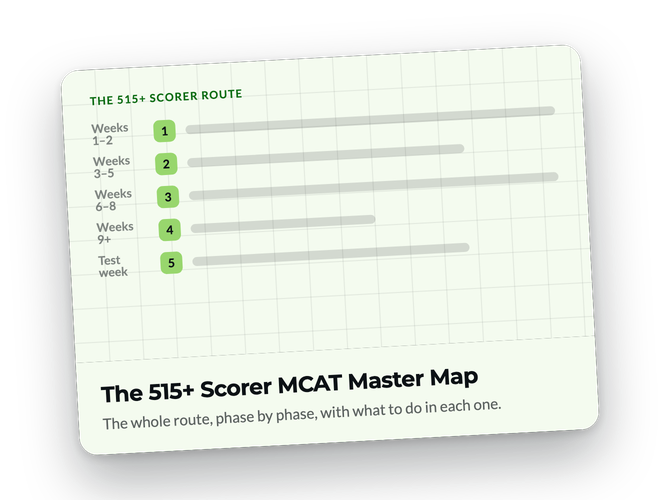
The 515+ Scorer MCAT Master Map is the route those scorers followed, and most of them were retakers.
On its way.
Check your inbox in the next minute.
Before Your MCAT Retake Study Plan: Sit With How You Feel
Getting a score below what you expected is discouraging, and you're allowed to feel that! Give yourself some time with it before you start planning anything.
During that stretch, look for outlets that help with the negative thoughts. Encouraging resources help here, and they'll keep helping for the rest of your prep. Lean on family and friends who'll support you through it, too.
Most of all, remember that this exam doesn't define you as a person. The work you put into the score you want, and what you learn about yourself along the way, says far more about you :)
Step 1: Review Everything That Went Into Your Last Attempt
Sit down with your whole study process, your resources, your tactics and your schedule, and be critical. Ali calls this one of the most important steps of an MCAT retake study plan, and it comes before you open a single book.
Here are some reflection questions to start with:
- Were you taking practice test after practice test without reviewing your answers?
- Were some sections hard to manage the whole way through?
- How did you split your study time across the sections, and does that need to change?
- Did you need more flashcards? Were there terms on the exam you didn't know?
- Did it feel like you choked on test day?
Go deeper than these. The more thorough you are, the less likely you'll repeat a mistake!
A new test date won't fix the same habits on its own, either. The AAMC scales and equates every MCAT form, so there's no curve to hope for and your score means the same thing whenever you test.
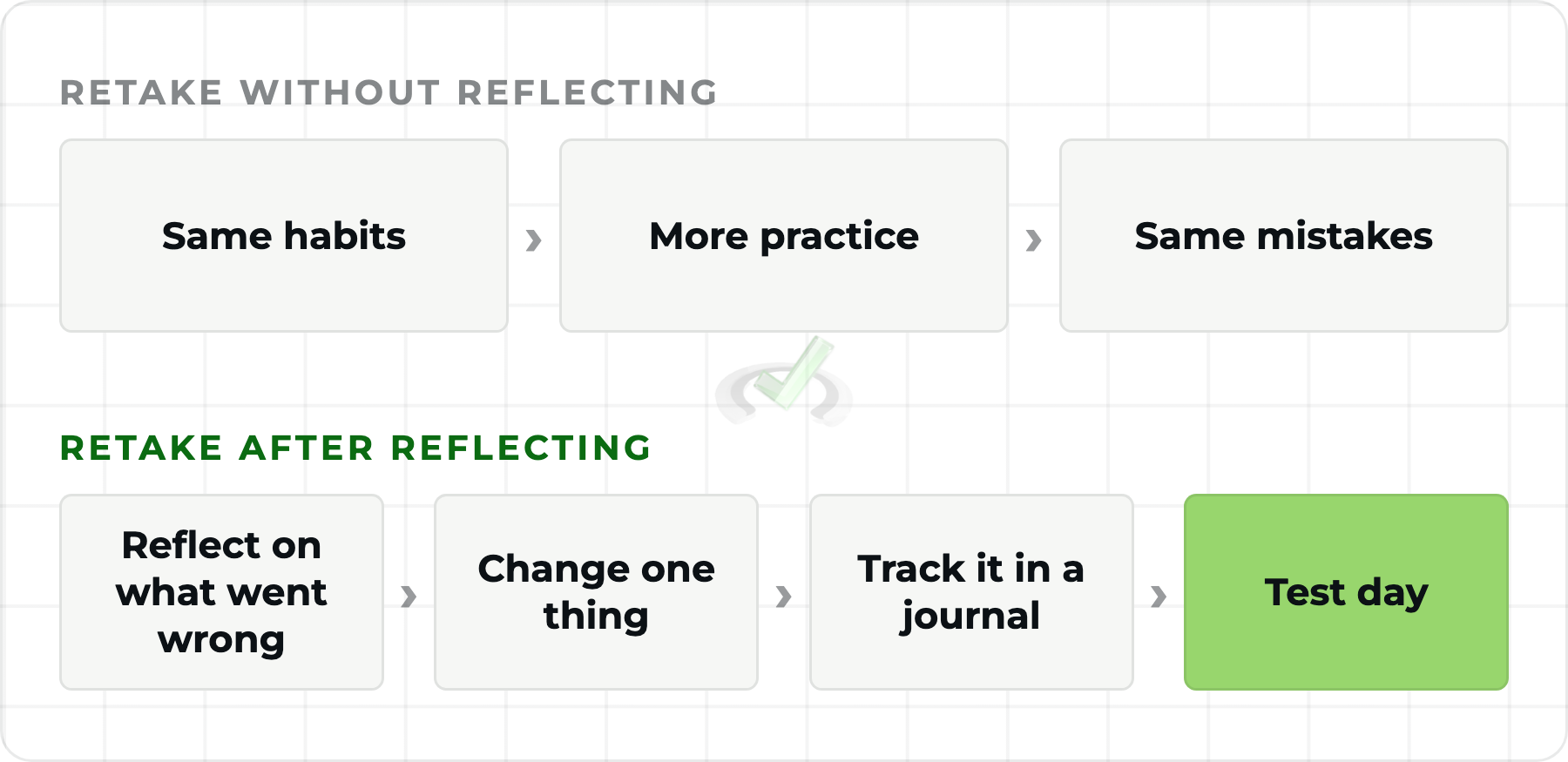
Before her third attempt, she spent a long time asking what she needed to improve and how. That's the attempt that worked, and it's why reflection comes first in any MCAT retake study plan!
Reviewing your own last attempt is hard to do objectively. If you'd like a second pair of eyes, a mentor in 1:1 MCAT tutoring can go through your practice tests and score report with you and point out the patterns you're too close to see.
Step 2: Rebuild Your Motivation
Getting motivated to study again can be one of the biggest barriers to a retake. Ali felt it too, and she found that hearing from people who'd been through the same thing helped the most.
Knowing you aren't alone is comforting. Our MCAT success stories are full of students who retook, including one who went from a 500 to a 514 on a retake.
Motivation is what keeps an MCAT retake study plan going past the first week. It also helps to see the MCAT as one hurdle on the way to becoming a physician. You've cleared hurdles before, and you can clear this one too :)
Step 3: Change One Thing, and Track What Happens
Once you know a few areas to improve, pick one and build your MCAT retake study plan around it, then look for resources that support it.
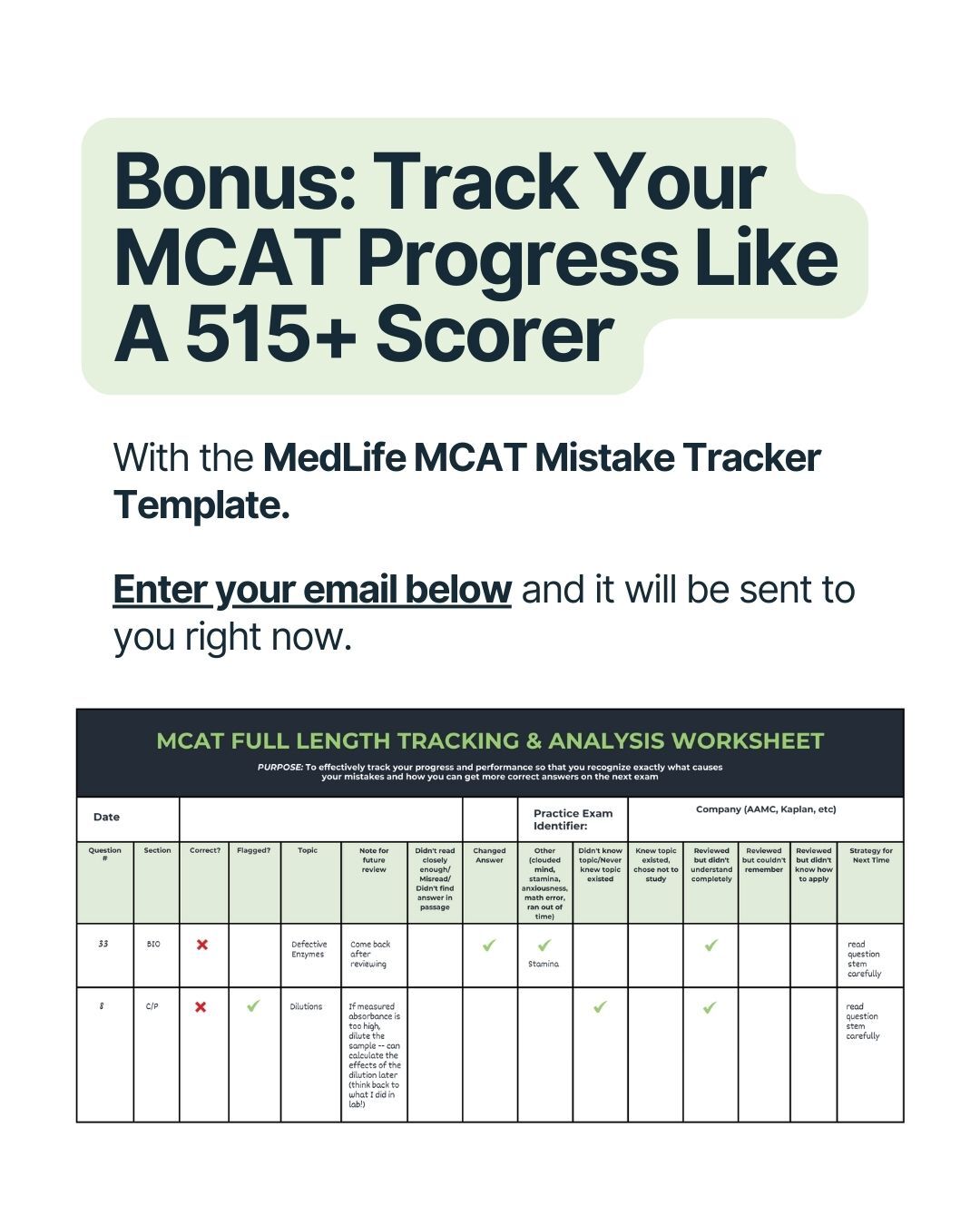
Expect some trial and error, which is why you'll want to track everything, whether that's in a journal, an Excel sheet or a Google Doc.
Read how different resources suggest approaching a section or a topic, then decide for yourself. You're a unique learner, and nothing says you have to use one method everywhere.
Ali found that her brain worked differently for different sections, so she used different strategies across them. Even within Chem/Phys, she'd approach a chemistry question a little differently from a physics one!
If you'd like a structure to test changes in, our 6-Week Live MCAT Accelerator includes seven 1:1 sessions with a 515+ scorer, and you can start them before classes begin. That's a good window to plan what you'll change before the course starts!
Step 4: Keep a Mood and Productivity Journal
Add a journal to your MCAT retake study plan from day one!
Alongside your score tracking, use it to note how you feel going into a study session, during it and after it. You'll be surprised by the trends you find in your mood, your mindset, and how you did on practice questions and exams.
Here are a few questions to ask yourself:
- Are you most productive after dinner, or do you feel sluggish and tired then?
- Do flashcards go well in the morning before work?
- Did something at work or school put you in a mood before a session, and was that session productive?
- How did you score on the days that felt good, compared with the days that didn't?
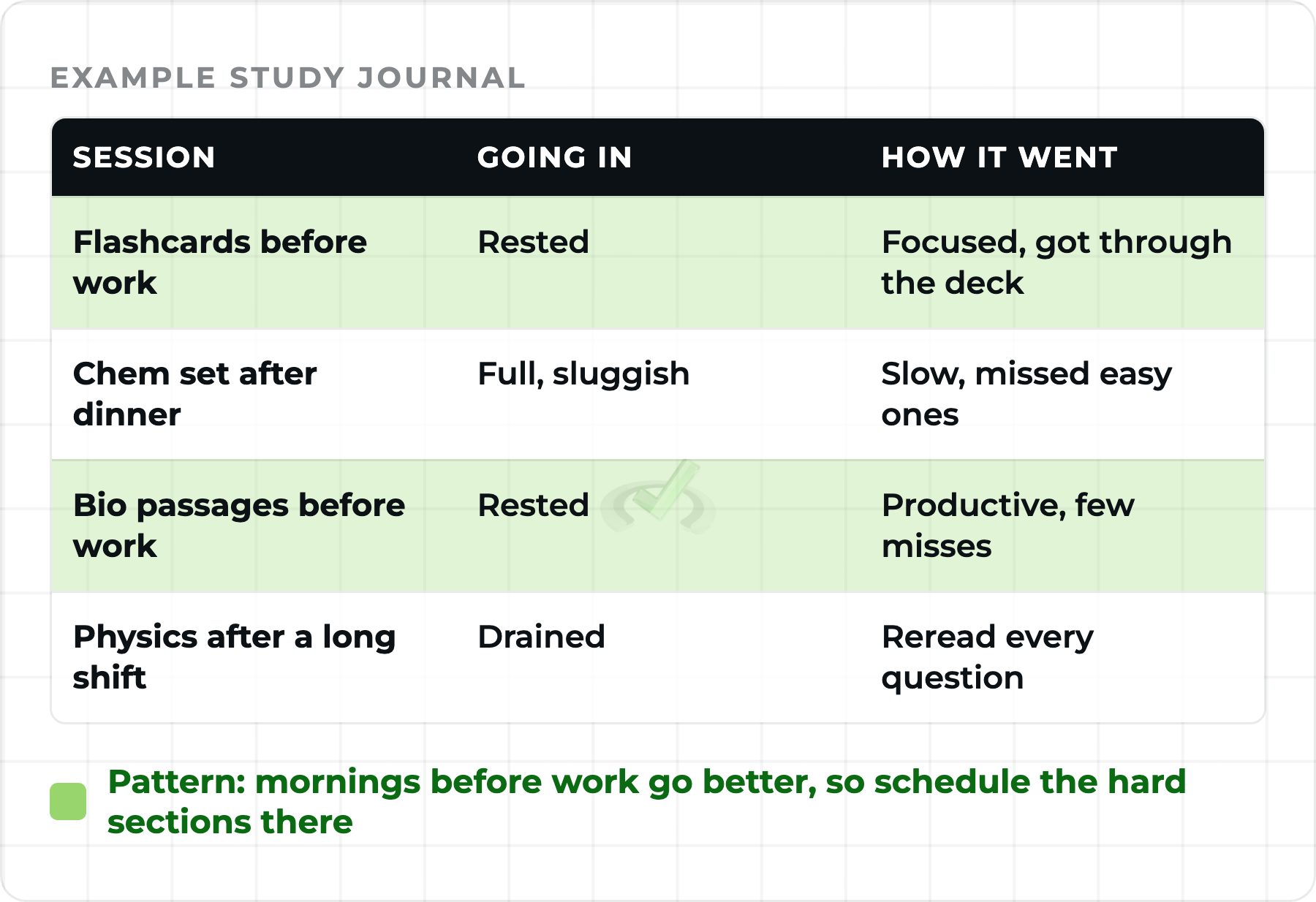
The journal builds a focused self-awareness, and that pays off on test day. If you show up tired, in a mood or not feeling well physically, chances are you'll have run into it during your prep and found a way through it.
You've overcome that barrier before, so you know you can do it again on exam day :)
Step 5: Build Stamina Into Your MCAT Retake Study Plan
You wouldn't run a marathon with no training, and you shouldn't jump into eight-hour study days on your first day back either!
Start small, with one to three hours a day, and build up as the days and weeks go on. Easing in keeps your motivation up and stops the restart from overwhelming you.
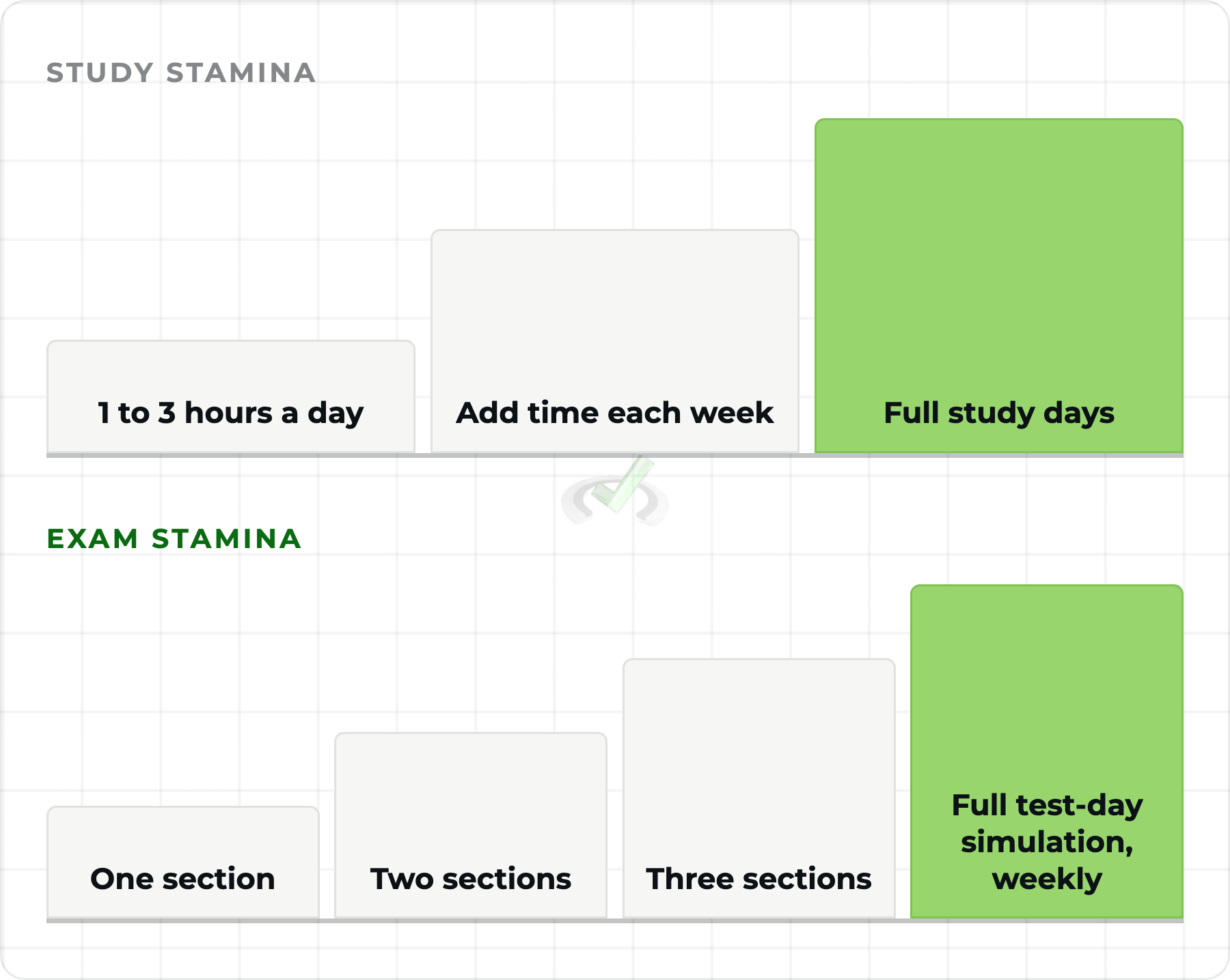
Exam stamina matters just as much on a test this long, so put it on your schedule. At first that might mean getting through a single section. Then add another.
About one to two months out, aim to simulate test day for several weeks in a row. That's what builds the stamina you'll need for the full exam!
If you're wondering how long a full plan should run, our MCAT retake guide covers timelines and what to change for each section.
MCAT Retake Study Plan Dos and Don'ts
- Don't force hours of studying that aren't productive. An unfocused hour doesn't count for much.
- Do take meaningful breaks. No MCAT videos, podcasts or notes during them. Go for a walk, stretch or do some yoga so your mind can reset. Your brain works like any other muscle, and training it around the clock won't get you the results you want.
- Don't jump in too early. Take time to decide whether and when a retake makes sense. Ali had to retake a second time, and she'd like to spare you that! The AAMC also limits attempts to three in a testing year, four over two consecutive years and seven in your lifetime, so each one counts. Our MCAT retake calculator takes your section scores, target and test date and helps you decide.
- Do take nights or days off. Plan time with friends or other activities that recharge you. Ali overlooked this before her second attempt and calls it one of the most important habits.
- Do be realistic and kind with yourself. More on both below.
Be Realistic and Kind With Yourself
Being realistic means looking hard at everything on your plate. If you're doing research, working and in school, ask whether you can give all of them, and the MCAT, the mental and physical energy they need.
Ali likes to think she can do just about everything at once, and between her second and third attempts she had to be tough with herself about it.
Being kind means remembering how much this process takes out of you. Give yourself breaks, go for walks and treat yourself to your favorite snacks!
Check in with yourself often, and if your energy is slipping, find people or activities to help you along the way :)
For more from students who've been through it, see these MCAT retake tips from a 516 scorer.
MCAT Retake Study Plan FAQ
How should I study for an MCAT retake?
Start your MCAT retake study plan by reviewing everything that went into your last attempt, before you study anything.
Then change one thing at a time, track how it goes, keep a mood and productivity journal, and build your study and exam stamina back up gradually.
What should an MCAT retake study plan include?
A good MCAT retake study plan includes a review of your last attempt, one change at a time with a way to track it, a mood and productivity journal, a schedule that builds stamina, and planned days off. Each one is covered above :)
How many hours a day should I study for an MCAT retake?
Ali suggests starting with one to three hours a day and building up over the following weeks. Hours that aren't productive don't help, so let your focus set the pace!
When should I start full-length practice tests for a retake?
Build up from single sections first. About one to two months before test day, aim to simulate a full test day for several weeks in a row.
Should I retake the MCAT right away?
Not before you've reflected on your last attempt and decided whether and when a retake is realistic. Our guide on whether you should retake the MCAT walks through the decision.
Plan Your Retake With a 515+ Scorer
If you'd like support on this attempt, our 6-Week Live MCAT Accelerator pairs live strategy classes with weekly office hours and seven private 1:1 sessions with a 515+ scorer, so you aren't working out what to change on your own.
If you'd rather focus on one-on-one help, MCAT tutoring matches you with a mentor who can review your last attempt with you and build your MCAT retake study plan around it. We'd love to help!
It's okay to be taking the MCAT again, and it's okay to feel discouraged at first. Ali stood where you are twice!
There are clear steps you can take to do well this time, and an MCAT retake study plan built on them is a great start. Take it one day at a time. You've got this :)
Get The 515+ Scorer MCAT Master Map
On its way.
Check your inbox in the next minute.
The MedLife Mastery Team

 To help you achieve your goal MCAT score, we take turns hosting these