
There are about 188 MCAT equations worth knowing
The exam will hand you exactly none of them. No MCAT formula or MCAT equation sheet, no calculator, nothing but what you carry in your head and the reasoning you have practiced.
That sounds brutal until you understand how the test actually uses math. Most questions are not asking you to grind through a calculation. They are asking whether you know what happens to one variable when another one moves.
Below is every equation worth your time, sorted by how likely you are to genuinely need it, searchable by variable, with flashcards and a rapid-fire quiz built in.
Underneath the tool, we break down what the exam expects, which MCAT equations matter most, and the memorization approach our 515+ scorers actually use.
Priority:
Must know: expect math
Know relationships: trends only
Speculative: may not appear
Are Equations Given on the MCAT?
No. The AAMC does not provide an equation sheet, a formula reference, or a calculator at any point during the exam. The only reference material you get in the Chemical and Physical Foundations section is a periodic table.
This is a deliberate design choice, not an oversight. The AAMC is not testing whether you can look up a formula. It is testing whether you understand the relationship the formula describes well enough to reason with it under time pressure.
Practically, that means two things. You need the high-yield MCAT equations genuinely memorized, not merely recognized. And you need to be comfortable manipulating them, because a question will rarely hand you the variables in the order the equation lists them.
How Many MCAT Equations Do You Actually Need to Memorize?
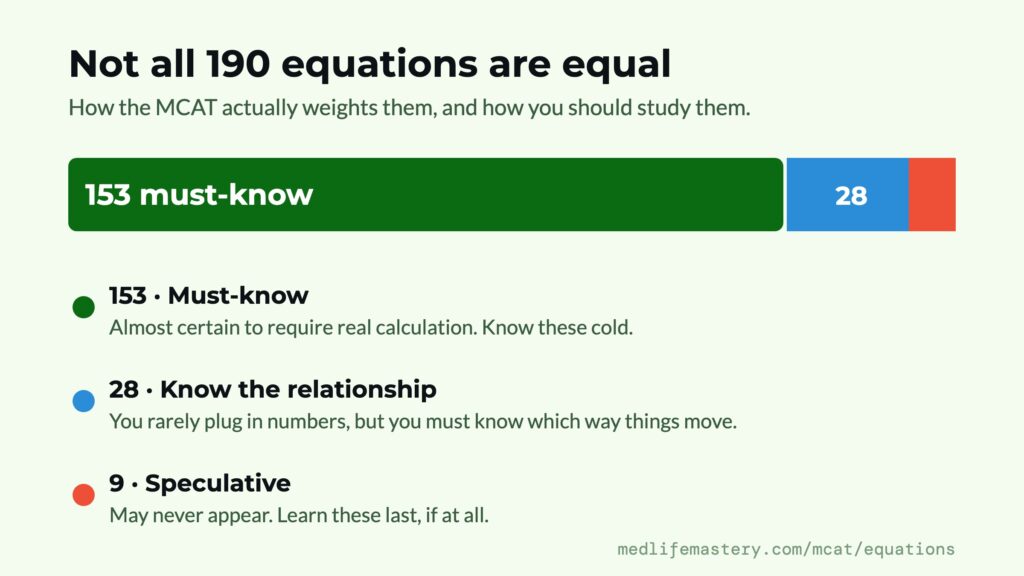
Our list runs to 188, but treating all 188 as equally important is the single most common way students waste study time. They are not equal, and the exam does not treat them equally.
Sorted by how they actually show up on test day:
- 150 must-know MCAT equations. These are almost certain to require real calculation. Molarity, the kinematic equations, Ohm's law, Henderson-Hasselbalch, Michaelis-Menten. If you know nothing else, know these cold.
- 29 know-the-relationship MCAT equations. You are unlikely to plug numbers into these, but you absolutely need to know which way things move. Poiseuille's law is the classic case: nobody is asking you to compute flow rate, but plenty of questions ask what happens to flow when a vessel narrows.
- 9 speculative MCAT equations. These may never appear. Learn them last, if at all, and only once everything above is secure.
Put differently, roughly 80 percent of the list carries most of the weight. Getting the tiering right is worth more than adding another twenty obscure formulas to your deck.
Must-Know Versus Know-the-Relationship
The tool above colour-codes every equation by those three tiers, and you can filter to just one at a time. That filter is the most useful thing on the page during a time crunch.
Two weeks out from your test date, filtering to must-know only and running the flashcards is a far better use of an hour than scrolling the full list. It removes the MCAT equations that are quietly stealing your attention without earning it.
The tiers came from a mix of AAMC content outlines, our tutors' experience with real exams, and how frequently each equation appears in official practice material. Where our mentors disagreed, we deliberately kept the leaner call, because a shorter list you actually know beats a longer list you half-remember.
The MCAT Is a No-Calculator Exam by Design
This is the insight that reframes the whole topic. Because there is no calculator, the test cannot ask for arithmetic-heavy computation. So it asks for something else instead.
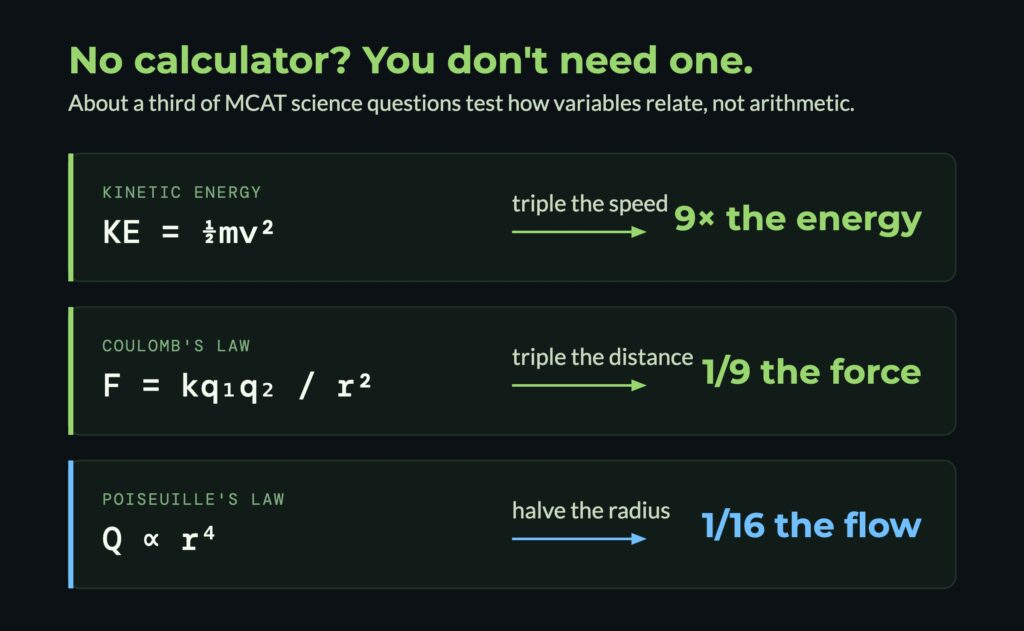
Roughly a third of the science questions come down to proportional reasoning: if this variable changes, what happens to that one? You are not calculating. You are reading the relationship straight out of the equation and tracing the change through.
A few worked examples of what that looks like:
- Kinetic energy is one half m v squared, so tripling speed increases kinetic energy ninefold, not threefold.
- Coulomb's law goes as one over r squared, so moving two charges three times further apart cuts the force to one ninth.
- Poiseuille's law goes as radius to the fourth, so halving a vessel's radius drops flow to one sixteenth.
None of those need a calculator. They need you to spot the exponent and apply it. The quiz built into the tool drills exactly this pattern, because it is the pattern the exam rewards.
When a question does require real arithmetic, the numbers are almost always clean enough to handle by hand. For the estimation and rounding techniques that make that fast, our MCAT chem and physics math strategies guide walks through the approach a 98th percentile scorer used.
Dimensional Analysis: Solving MCAT Equations You Have Not Memorized
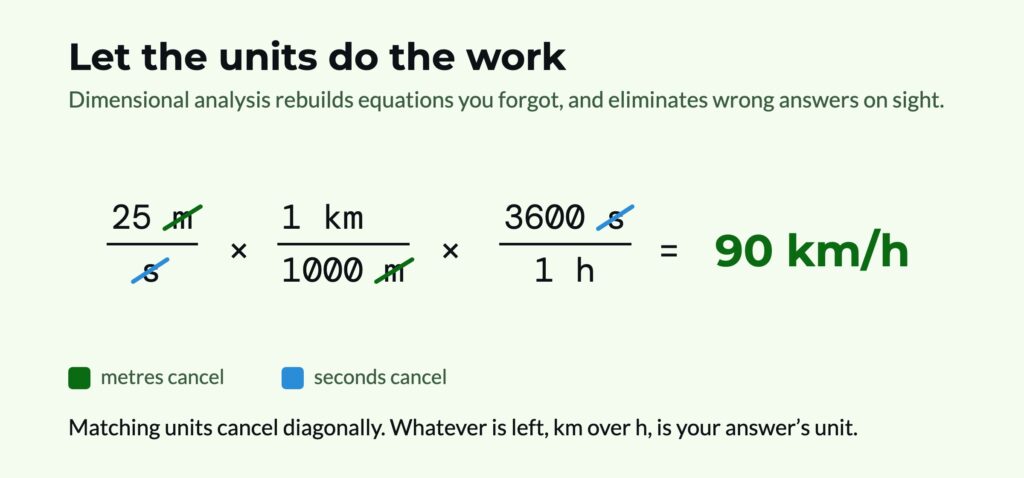
Dimensional analysis is the closest thing the MCAT has to a cheat code, and it is badly underused. The core idea is that units are not decoration. They are a map of how the quantities relate.
If a question gives you a value in newtons and asks for something in joules, the units themselves tell you a distance has to be involved, because a joule is a newton metre. You can often reconstruct a relationship you never memorized, or catch that you have flipped an equation upside down, purely by checking whether the units resolve.
It is also the fastest way to eliminate wrong answer choices. If three options have the wrong units, you are done before you calculate anything.
We have a full walkthrough in MCAT dimensional analysis: master chem and physics MCAT equations faster, and a video version in The Ultimate MCAT C/P Cheat Code if you prefer to watch it worked through.
The Units and Constants Worth Memorizing
Equations are useless if you cannot convert into the units they expect. This is where a surprising number of otherwise correct answers fall apart: the physics was right, the conversion was not.
The non-negotiables are the SI prefixes from nano through giga, the standard units for each quantity you will meet, and a small handful of constants such as Avogadro's number, the gas constant, and the speed of light. The Units and Constants tab in the tool above collects all of them in one place.
For the underlying detail, see units and dimensional analysis on the MCAT and our reference on standard metric units.
MCAT Physics Equations
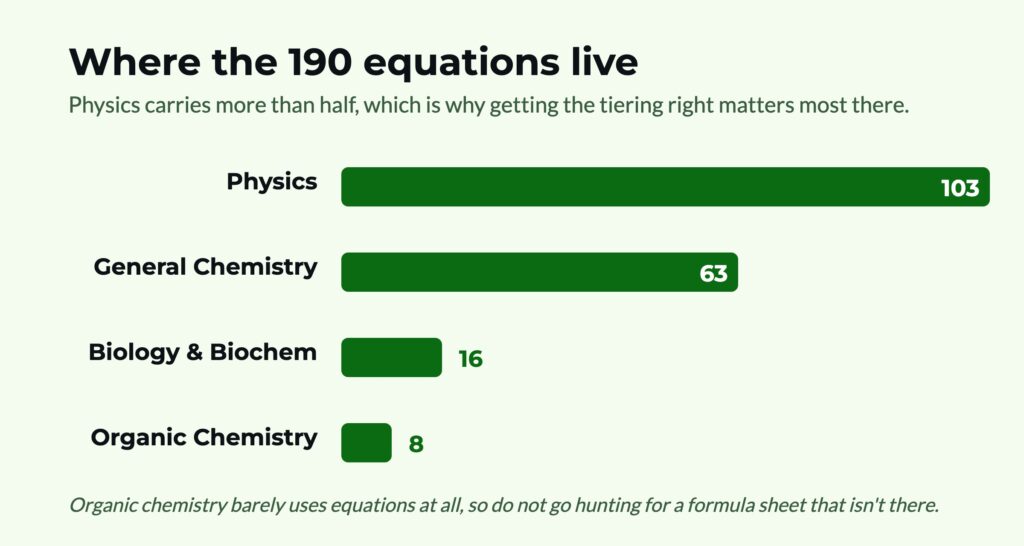
Physics is by far the most equation-dense subject on the exam, which is why it makes up more than half of our list. It is also the area where the tiering matters most, because physics is where the speculative MCAT equations tend to pile up.
The clusters worth prioritising:
- Kinematics. The core motion equations, and knowing which one to reach for when time is not given. More in our MCAT kinematics guide.
- Fluids. Continuity, Bernoulli, buoyancy and Poiseuille, heavily favoured because they map onto physiology. See fluid laws, equations and effects.
- Electrostatics and circuits. Coulomb's law, electric fields, and series versus parallel behaviour. Start with electric fields and MCAT circuits.
- Waves and sound. Wave speed, intensity, decibels and the Doppler effect, which is worth knowing conceptually as well as algebraically. See the Doppler effect.
- Thermodynamics. Internal energy, work and heat. More in our thermodynamics guide.
For the physics-only view with fuller explanations of each formula, our MCAT physics equations page goes subject by subject.
MCAT General Chemistry Equations
General chemistry equations tend to be shorter than the physics ones but appear more often, and they are unusually punishing when half-remembered. Getting a sign backwards in a thermodynamics question changes the answer completely.
The highest-yield areas are acid and base calculations, thermodynamics and equilibrium, gas laws, and solution chemistry. Henderson-Hasselbalch in particular earns its keep, and it is one of the few equations the exam tests both computationally and conceptually, which is why it appears in both tiers in our tool.
Go deeper on buffers and the Henderson-Hasselbalch equation, colligative properties, and calculations of chemical equations.
MCAT Biochemistry Equations
Biochemistry carries fewer equations than the chemistry and physics sections, but the ones it does carry are close to guaranteed. Enzyme kinetics is the clearest example: Michaelis-Menten, the Lineweaver-Burk plot, turnover number and catalytic efficiency all appear regularly, and the inhibition questions that follow depend on you knowing what each variable actually represents.
Beyond enzymes, expect Hardy-Weinberg for population genetics, cardiac output in physiology, and Beer-Lambert for anything spectroscopy-flavoured. Our enzyme kinetics guide covers the first group in depth.
What About Organic Chemistry?
Organic chemistry is the outlier, and it is worth saying plainly: there is very little to memorize in the way of equations. Our list contains only a handful, and most of them are decision frameworks rather than formulas, such as choosing between substitution and elimination mechanisms.
If you have been hunting for an organic chemistry equation sheet and coming up short, that is not you missing something. The section genuinely rewards pattern recognition over calculation.
How to Memorize MCAT Equations So They Actually Stick
Knowing which MCAT equations to learn is the easy half. Retaining them through months of studying is the part that decides your score.
What works, in rough order of impact:
- Understand before you memorize. An equation you understand is one fact. An equation you have only memorized is a string of symbols that decays within days. If you know why intensity falls with the square of distance, you never need to memorize that one.
- Practice retrieval, not recognition. Reading a formula sheet feels productive and does very little. Being asked a question and having to produce the equation from memory is what builds recall. That is the reason the tool above defaults to flashcards and a quiz rather than a static list.
- Use spaced repetition. A small number of MCAT equations reviewed daily beats the entire list reviewed occasionally. Our guide to the best MCAT Anki decks covers the setup, and our memorization strategies hub covers the technique.
- Drill the relationships, not just the formulas. Given how much of the exam is proportional reasoning, practising "what happens to Y if X doubles" is closer to the real thing than reciting the equation.
For the specific tactics one of our students used to turn formulas from a weak point into a strength, "these MCAT formula hacks got me a 517" is worth the read, and includes a free MCAT equations Anki deck.
Frequently Asked Questions About MCAT Equations
Are you given an equation sheet on the MCAT?
No. There is no equation sheet and no calculator. The only reference provided is a periodic table in the Chemical and Physical Foundations section.
How many equations do I need to know for the MCAT?
Around 188 are worth knowing, but only about 150 are genuinely must-know. The remainder are worth understanding directionally rather than memorizing for calculation.
Can I use a calculator on the MCAT?
No. The exam is deliberately calculator-free, which is why the arithmetic is kept manageable and most quantitative questions test relationships rather than computation.
What are the most important MCAT equations?
The highest-yield ones cluster in kinematics, fluids, electrostatics and circuits, acid and base chemistry, thermodynamics, and enzyme kinetics. Filter the tool above to must-know to see the full set.
Do I need to memorize organic chemistry equations?
Barely. Organic chemistry contributes very few equations, and most of what looks like a formula is really a decision framework for predicting reaction pathways.
How should I study MCAT equations in the last two weeks?
Filter to must-know only, run the flashcards daily, and use the quiz to test relationships under time pressure. Do not spend late-stage study time on the speculative tier.
----
Bookmark this page and come back to it. The tool is free, works on your phone, and lets you flag the equations you keep forgetting so you can drill just those!

We're a team of 70+ future doctors who scored 515 (up to 527) on the MCAT. Over 10+ years, we've distilled strategies from hundreds of 90th+ percentile scorers into systems built for fast results - with mental health woven in, because the MCAT, just like medicine, tests the whole person.
Our goal is to help as many students as possible, not the same student for as long as possible. It's worked; hundreds of our students have gone on to score 511+ and get into medical school.
Free Resources
Mentorship Options
Connect With Us
Copyright © 2026 by MedLife Mastery Inc. All Rights Reserved.
*MCAT®, AAMC® and AAMC PREview™ are trademarks registered and/or owned by the Association of American Medical Colleges, which is not affiliated with MedLife Mastery and was not involved in the production of, and does not endorse, this website or product.