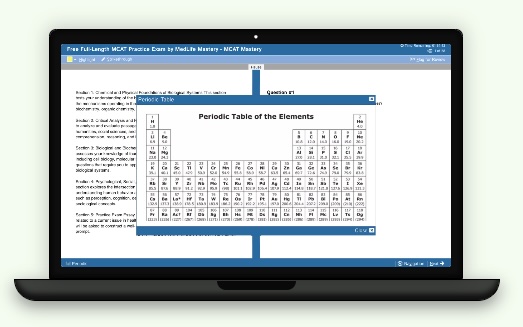

“Wait, what? We’re taking an exam to get into medical school. Why do I have to go back to learning math? Plus, I thought math was just numbers. Why are there letters?!”  We know…, we were thinking the exact same thing when studying for the MCAT.
Unfortunately, to our dismay, we sometimes still have to get the dirty stuff done just to make ends meet. While not exactly MCAT content material, understanding some of the basics of MCAT math will be undoubtedly beneficial as you’ll undoubtedly encounter a fair amount of calculation questions!
Hopefully, after reading through this article, you’ll have a superficial understanding of units and dimensional analysis before diving further into the individual articles. Let’s go!
Work Backwards From the Units to the Equation
Most people carry one route to a chem/phys answer: remember the equation. If that route closes, the question is gone. There is a second route, and it does not depend on recall; read the units in the answer choices and work backwards to the formula you need.
Sarah Beel, one of our MCAT strategy instructors, scored a 526 (132/130/132/132). Three months before her exam she was in the 503 range and stuck, and more content review was not moving it. This method is one of the things that did. She walks through it below, then works it on two real questions.
The 6-Step Unit Strategy
This is what to run when you recognize the quantity a question is asking for but cannot recall the equation that gets you there.
- Identify the known values and their units. Read the passage for numbers, and write the unit next to every one of them.
- Convert everything to SI units. Anything in feet, grams, liters or nanometers gets converted before it touches a formula.
- Identify the units of the answer choices. This is your target. You are trying to build these units out of the ones you were given.
- Rewrite any derived units in base SI units. A newton becomes kg·m/s², a joule becomes kg·m²/s². Now everything is in the same currency.
- Think of any relevant constants. If you cannot get there with what the passage gave you, a constant is usually supplying the missing unit — the speed of light, acceleration due to gravity, the ideal gas constant, Planck’s constant.
- Manipulate the units until they match the answer choices. Whatever you did to the units is the equation.
Two rules make the algebra fall out on its own: if you are multiplying quantities, you multiply the units, and if you are dividing quantities, you divide the units. Any unit that ends up in both the numerator and the denominator cancels.
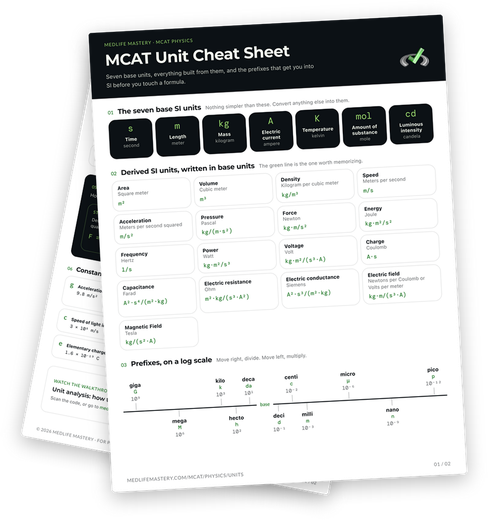
Free download · MCAT physics
The MCAT Unit Cheat Sheet
Two pages: every SI unit the MCAT expects, plus the 6-step method for working backwards to a formula you forgot.
On its way.
Check your inbox in the next minute.
Units and Dimensional Analysis on the MCAT: What You Need to Know
Topics on units and dimensional analysis will be realistically tested in all the MCAT sections except for the CARS section!
While we cannot give you a good probability of the number of unit and dimensional analysis questions, know that they’ll most likely be asked in the context of general chemistry and physics topics.
Introductory physics accounts for 25% of the content covered in the Chemical and Physical Foundations of Biological Systems.
Important Sub-Topics: Units and Dimensional Analysis
As cliche as it sounds, your practice and amount of exposure are your best weapons to becoming more comfortable with these questions! Start slow, jot down your mistakes, and progressively build confidence!
1. Standard Metric Units
The SI units are the primary calculation units used and tested by the MCAT! These include units like meters, kilograms, kelvin, etc. (think that we’re in Europe y’all!). We’ll list just a couple down in the table below as you’ll become much more familiar as you go through different physics and chemistry MCAT topics!
Within the SI system, there are 2 main types of units: basic and derived units. Basic units are the units that the system is centered on, while derived units (as their name implies) are derived from the basic units. Note that derived units are still within the SI system! The full base unit and derived unit tables, plus every metric prefix you need, are on our MCAT SI units page.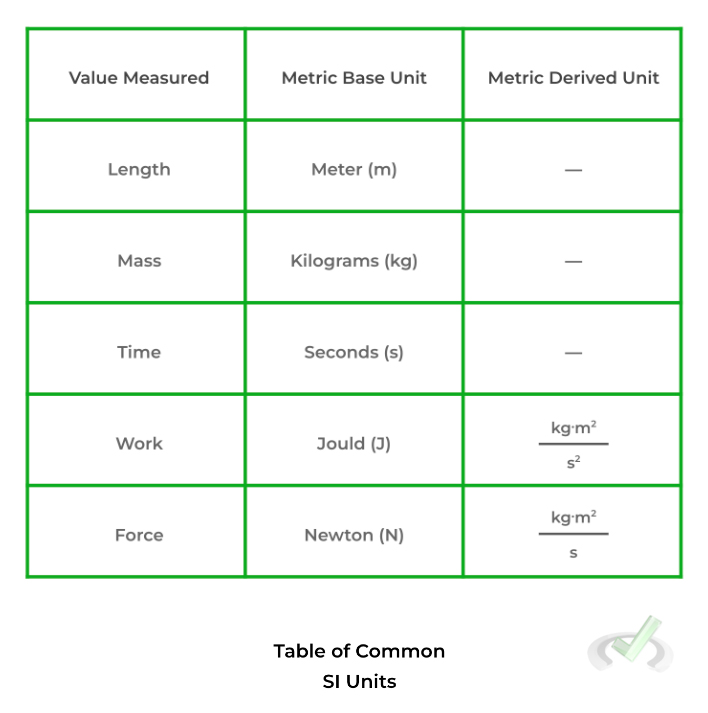
A big part and must know in regards to solving MCAT calculation problems is understanding base 10 conversion factors. Not only will you have to memorize various equations and variables, but you’ll also be expected to convert between units adding another element of difficulty!
Unfortunately, one of the only ways around this is through memorization, but as you solve lots of problems, you’ll slowly but surely become more familiar and comfortable with these conversions.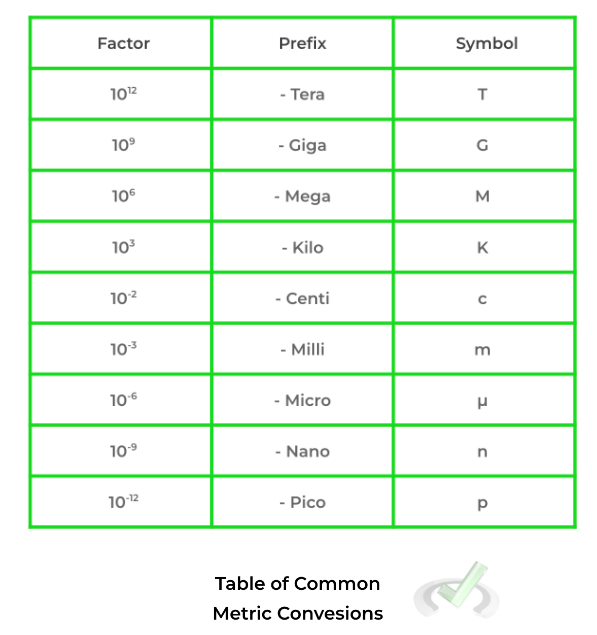
Full Study Notes : Standard Metric Units on the MCAT
For more in-depth content review on the standard metric units, check out these detailed lesson notes created by top MCAT scorers.
2. Basics of Dimensional Analysis
If you’ve studied stoichiometry in general chemistry, you may be familiar with this concept already! In its simplest terms, dimensional analysis are mathematical calculations that allow you to convert between different units and metric factors.
The key to solving dimensional analysis problems is to make sure all your unwanted units cancel so that you’re left with the correct units! Look at the example below!
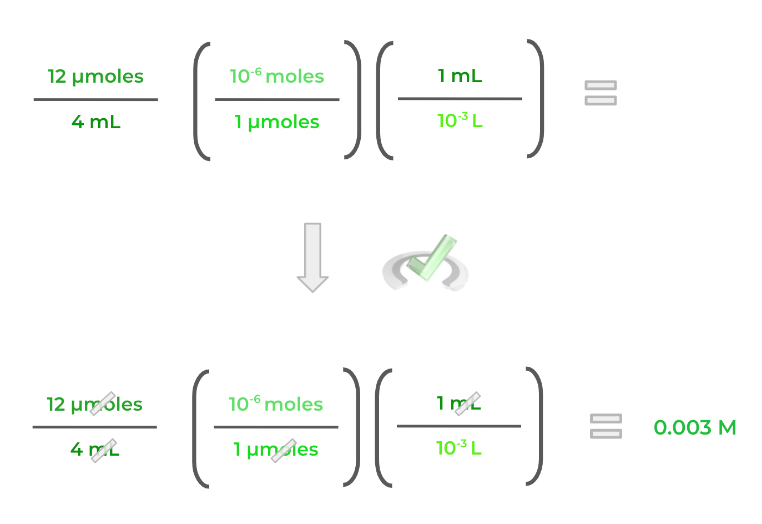
Notice how in this molarity example, everything crosses out except the desired units: moles divided by liters which gives molarity. This example shows the importance of committing the base 10 conversion factors to memory!
Apart from this common example, you’ll see a lot of dimensional analysis in topics such as stoichiometry, emission spectrums, etc.!
Learn more about dimensional analysis in this article!Must-Watch MCAT Dimensional Analysis Video by a 525 Scorer

Click to go to video!
Full Study Notes : Basics of Dimensional Analysis on the MCAT
For more in-depth content review on dimensional analysis, check out these detailed lesson notes created by top MCAT scorers.
3. Mathematical Functions of Exponents and Logarithms
Probably after seeing the base 10 conversion factors above, it may be beneficial to go over some basics of exponents and logarithms. As indicated by the topic title, we’ll focus more on the mathematical functions of the 2 rather than a basic overview.
The 2 mathematical functions of exponents most helpful for the MCAT are the multiplication and division of exponents. Remember: the base of both exponents must be the same or else the below rules cannot apply!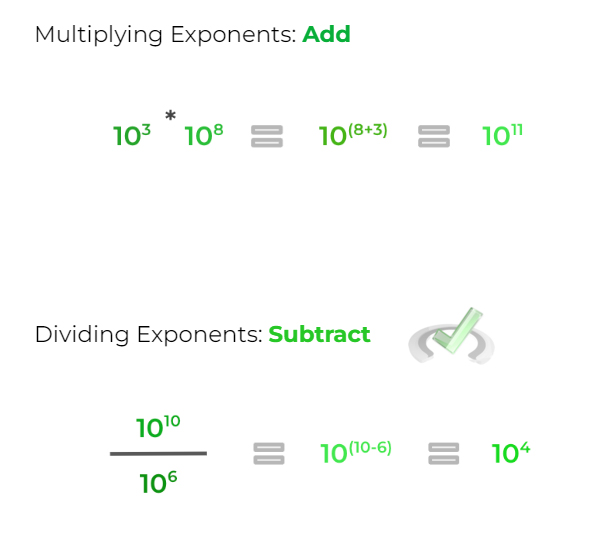
Note that both the exponents are the same: base 10. This allows us to apply the rules mentioned above!
These 2 exponential mathematical functions are the basis for solving mathematical calculations dealing with scientific notation which we’ll discuss more in the upcoming section!
Additionally, 2 important exponential rules to remember before going into the MCAT are the zero exponent and negative exponent rules.
The zero exponent rule states that any base raised to the power of 0 is always equal to 1. The negative exponent rule states that we can write negative exponent as a fraction reciprocal as shown below.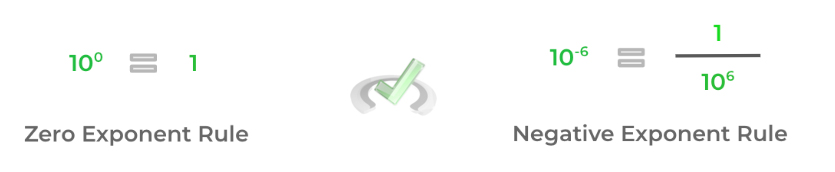
Logarithms might need a little background explanation before getting into some of the common mathematical functions. By their formal definition, logarithms are the inverse of exponents. But let’s try to explain it in a different way!
In exponents, we’re trying to find a value (y) given the base (b) raised to the power of (x). In logarithms, however, we’re now trying to find the value of the exponent (x) as we have (y) and (b).
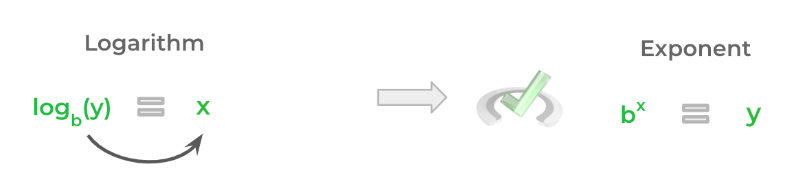
Most logarithmic expressions you’ll encounter on the MCAT are base 10 logs (i.e. b = 10). However, there is another special type of logarithm called a natural log where the base is Euler's number, e.
Luckily, you most likely won’t have to calculate any values with the natural log. You’ll see natural logs mostly in the context of equations and really only have to memorize the following relationships!
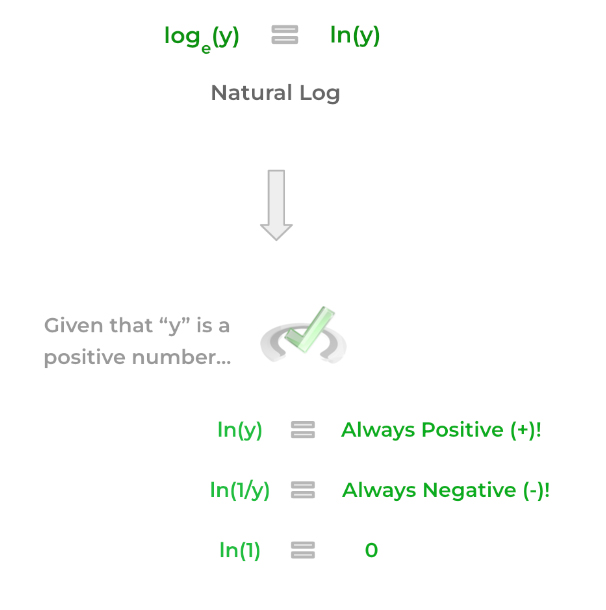
Just as a preview, the above relationships will be really useful when dealing with Gibbs free energy and reaction spontaneity!
Full Study Notes : Mathematical Functions of Exponents and Logarithms on the MCAT
For more in-depth content review on the mathematical functions of exponents and logarithms, check out these detailed lesson notes created by top MCAT scorers.
4. Fundamentals of Scientific Notation
After covering the above topics, we now have a better foundation to get into scientific notation. Simply put, you’re basically multiplying a number by a base 10 conversion which is another way of formatting a really big or small number!
The trick to getting comfortable with scientific notation is knowing 1) which direction you’re moving the decimal and 2) counting the number of decimal places you’re moving. Look at the following rules below!
>> Making a “Big Number Smaller”
Move the decimal place FROM THE RIGHT TO LEFT until you reach the desired decimal place. The number of decimal places moved will be the POSITIVE value of the exponent.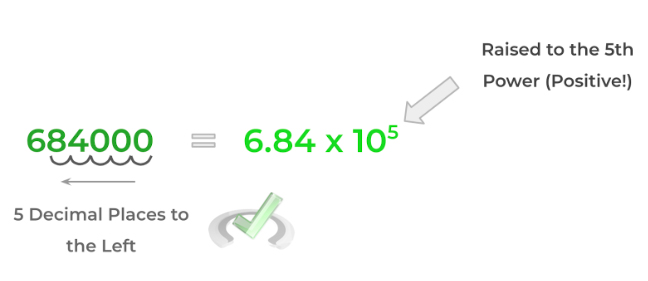
>> Making a “Small Number Bigger”
Move the decimal place FROM THE LEFT TO RIGHT until you reach the desired decimal place. The number of decimal places moved will be the NEGATIVE value of the exponent.
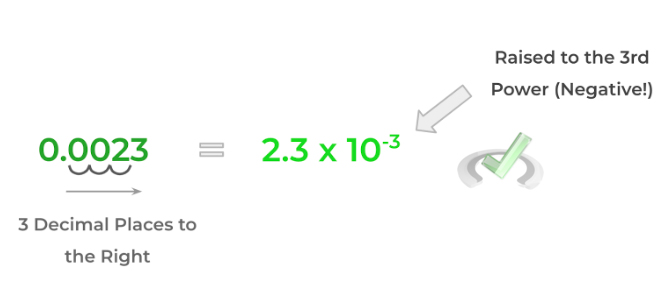
Luckily, a trick to memorizing the rules of scientific notation is that the rules are essentially opposites of one another!
Full Study Notes : Fundamentals of Scientific Notation on the MCAT
For more in-depth content review on scientific notation, check out these detailed lesson notes created by top MCAT scorers.
Worked Examples: Turning Units Into Equations
The method is easier to trust once you have watched it produce an answer. Here are four cases, from the simplest to a full exam-style question.
Example 1: How Far Did the Car Drive?
A passage tells you a car is moving at 30 m/s and drives for 4 s. It asks how far the car traveled, and every answer choice is in meters. Suppose you have blanked on d = vt entirely.
Look only at the units. You have m/s and you have s. Multiply them, and the seconds sit in both the numerator (from the time) and the denominator (from the velocity), so they cancel and leave meters — which is a distance. The only thing you can be doing is multiplying velocity by time, so d = vt, and 30 × 4 = 120 m. You just derived the equation from the units instead of recalling it.
Example 2: Why You Convert to SI First
Say you are asked for a force, and you know F = ma. The passage gives you a mass of 5 kg and an acceleration of 3 ft/s². Multiply them and you get 15 — so the answer is 15 newtons, right?
No. A newton is a kilogram times meters per second squared. What you actually calculated is 15 kg·ft/s², which is not a newton and does not match any answer choice. Feet are not an SI unit, so the moment they entered the formula the result stopped being the quantity you thought it was.
This is why step 2 exists. Any formula with a constant in it — the speed of light, Planck’s constant, the ideal gas constant — has that constant expressed in SI units, so a non-SI value will not cancel against it properly. Unless a question specifically calls for something else, convert to SI before you touch an equation.
Example 3: Writing a Derived Unit in Base Units
Step 4 asks you to rewrite derived units in base units, and the way to do that is to work from a formula you already know.
The newton. Force is mass times acceleration. Mass is measured in kilograms and acceleration in meters per second squared, so a newton must be kg·m/s². That single line now gives you two ways to answer any force question: recall F = ma, or manipulate the given quantities until the units simplify to kg·m/s².
The watt. Power is energy over time, so a watt is joules per second — but a joule is itself a derived unit, so derive that first. Take any formula that produces joules; potential energy, PE = mgh, is the easiest. That is kilograms times meters per second squared times meters, which gives kg·m²/s². Divide by one more second and a watt is kg·m²/s³.
You do not have to memorise that column cold. You have to be able to rebuild it from a formula you know, which is a much smaller thing to carry into the exam.
Example 4: A Full Question, Start to Finish
A laser emits light with a wavelength of 560 nm. What is the frequency of the light? The answer choices are in hertz.
- Knowns: the only number given is the wavelength, 560 nm.
- Answer units: hertz.
- Rewrite in base units: hertz is not one of the seven base units. Frequency is per second, so hertz is 1/s.
- Find the missing constant: you have nanometers and you need seconds, and nothing in the passage bridges them. The question is about light, so the constant is the speed of light, c = 3 × 10⁸ m/s. It brings both meters and seconds with it.
- Manipulate: convert 560 nm to 5.6 × 10⁻⁷ m. Now take m/s and divide by m — the meters cancel, leaving 1/s, exactly what the answer choices want. Dividing the speed of light by the wavelength is the operation, so f = c/λ.
- Do the arithmetic: (3 × 10⁸) ÷ (5.6 × 10⁻⁷) ≈ 5 × 10¹⁴ Hz.
You could have answered that by recalling c = λf. The point is that you did not have to.
Important Definitions and Key Terms
Term | Definition |
|---|---|
Basic Units | The seven units the SI system is built from, including the meter, kilogram, second and kelvin |
Derived Units | SI units are derived from basic units; Including newtons, joules, etc. |
Dimensional Analysis | Mathematical calculations that allow you to convert between different units based on a set conversion factor/ratio |
Natural Logarithm | Logarithmic function where the base is Euler’s number (e) |
Scientific Notation | Method to format very large and small numbers via multiplying a number by a base 10 conversion factor |
Additional FAQs - Units and Dimensional Analysis on the MCAT
How Do You Convert Units on MCAT?
What Units Do You Need to Know for the MCAT?
Do Dimensional Analysis Use Units – MCAT?
Do We Need to Know Unit Conversions for the MCAT?
Do I Still Need to Memorize Equations if I Know Unit Analysis?
Yes. Recalling an equation outright is always faster than deriving it, and speed matters on a timed exam. Unit analysis is a second way in, not a replacement — it is what you use on the day you blank, and most people blank on something. It also tends to make the equations stick, because once you can write a newton as kg·m/s² you have encoded F = ma twice.What Are the Seven Base SI Units on the MCAT?
Seconds, meters, kilograms, amperes, kelvins, moles and candela. Every other unit on the exam is built from those seven, which is why any derived unit can always be rewritten in base units. Full base unit, derived unit and metric prefix tables are here.How Do I Know Which Constant a Question Wants?
Work it out from the units you are missing. If your knowns cannot reach the units of the answer choices, something has to supply the gap, and the constant that does it is usually obvious from the topic: light points to the speed of light, anything falling points to g, gases point to the ideal gas constant, and photons or energy levels point to Planck’s constant. Check the constant is appropriate for the situation before you use it.Additional Reading: Physics Topics on the MCAT:
- Circuits on the MCAT
- Electrostatics on the MCAT
- Fluids on the MCAT
- Kinematics on the MCAT
- Light and Optics on the MCAT
- Magnetism on the MCAT
- Thermodynamics on the MCAT
- Atomic and Nuclear Phenomena on the MCAT
- Waves and Sound on the MCAT
- Work and Energy on the MCAT
Supplemental Resources
Want to go deeper on this topic? Here's where to read, watch and practice it next.
Read
- Kaplan MCAT Physics and Math Review 2026-2027, Chapter 1 and Chapter 10
Get the MCAT Unit cheat sheet
On its way.
Check your inbox in the next minute.





 To help you achieve your goal MCAT score, we take turns hosting these