
MCAT CARS timing is one of the biggest frustrations premeds bring to us, and if you've ever finished a practice section with two passages still left, you know the feeling!
Most students blame a slow reading speed. One of our mentors sees it the other way around!
In the video above, she explains why a slow reader can have the advantage in CARS, once they know where to spend their time.
This is the written version, with the AAMC numbers you're working against and a way to practice pacing that doesn't involve staring at the clock 🙂
Free videos
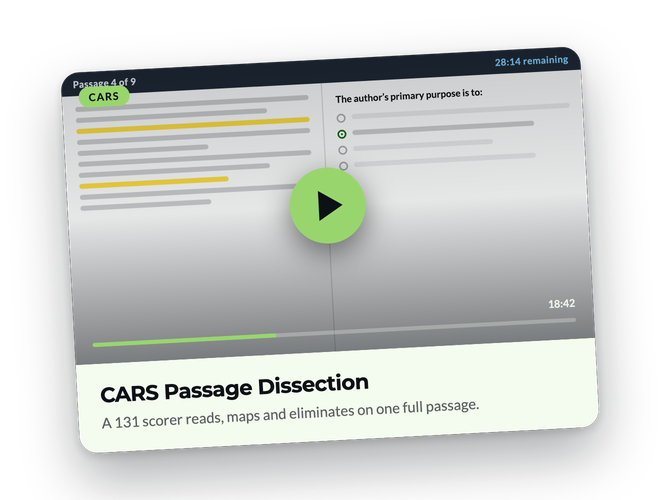
A 130+ in CARS starts with the method. Watch a 99th percentile scorer work a passage.
Free videos: the read, the eliminations and the commit, on a real CARS passage.
On its way.
Check your inbox in the next minute.
MCAT CARS Timing: How Much Time You Get
The AAMC gives you 90 minutes for the CARS section and 53 questions, and every one of them is tied to a passage (AAMC CARS section overview). The passages are short, typically 500 to 600 words, and dense. The AAMC content outline describes them as humanities and social sciences passages, roughly half each.
A test usually carries nine passages, so most top scorers budget about 10 minutes per passage, questions included.
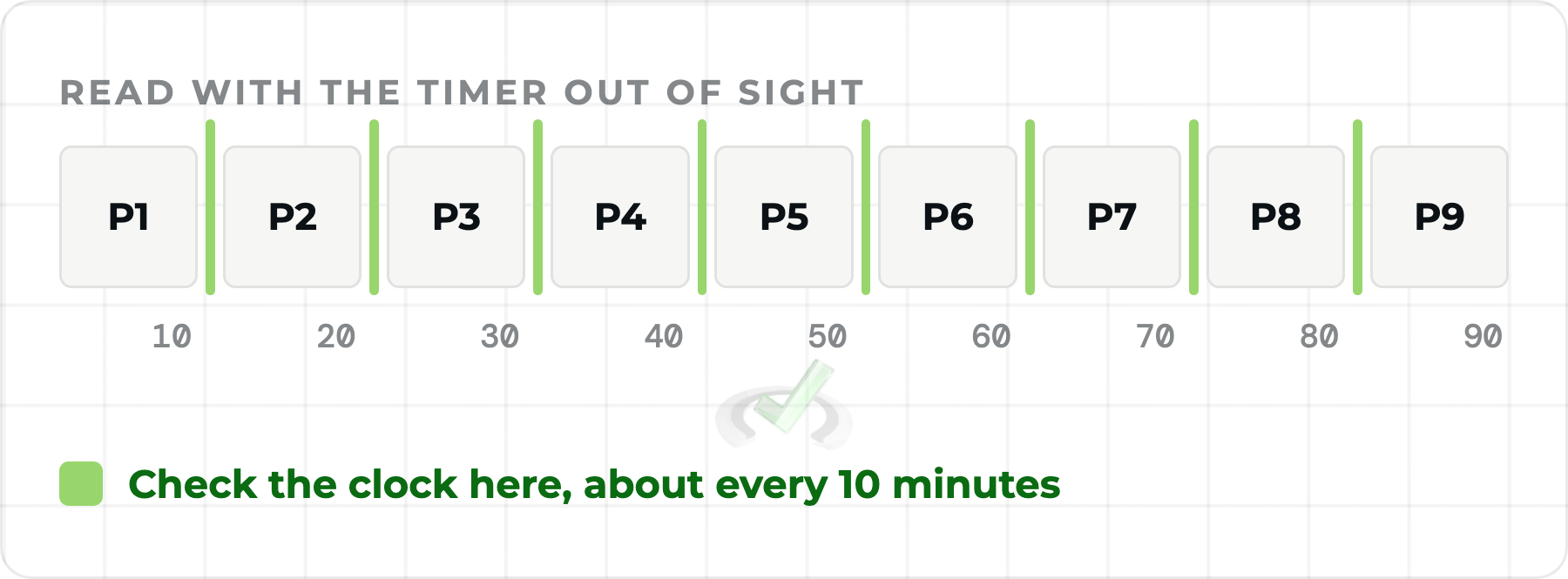
Use that 10 minutes as a check you make between passages. While you're reading, leave the timer alone. That one habit is the biggest fix for your MCAT CARS timing, and the rest of this guide shows why!
Why Being a Slow Reader Can Help Your MCAT CARS Timing
A lot of students feel like a slow reading speed puts them at a disadvantage. If that's you, you're in good company, and you can still do very well in CARS!
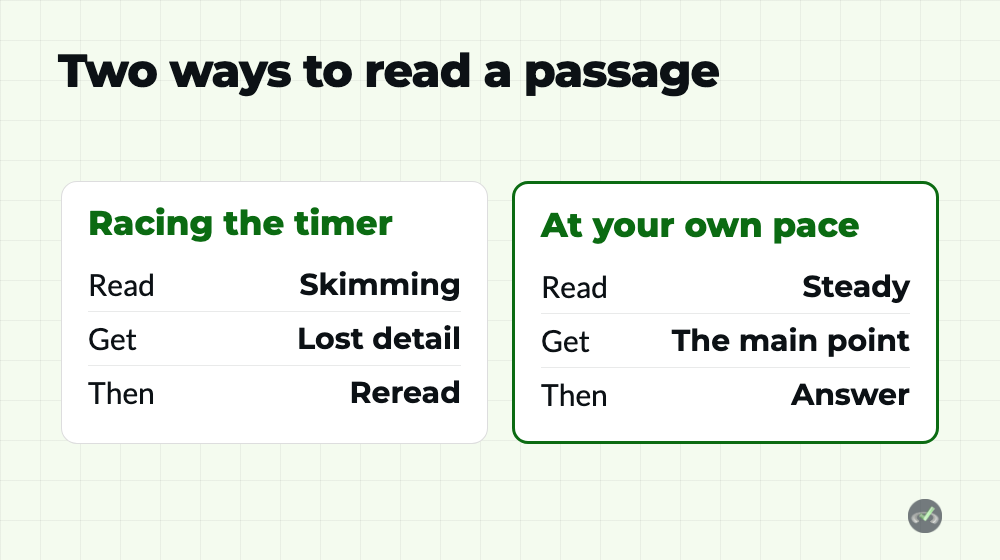
The section comes down to working out what the author is trying to tell you. When the timer pushes you past your natural pace, you start skimming to get through, and the author's point slips by.
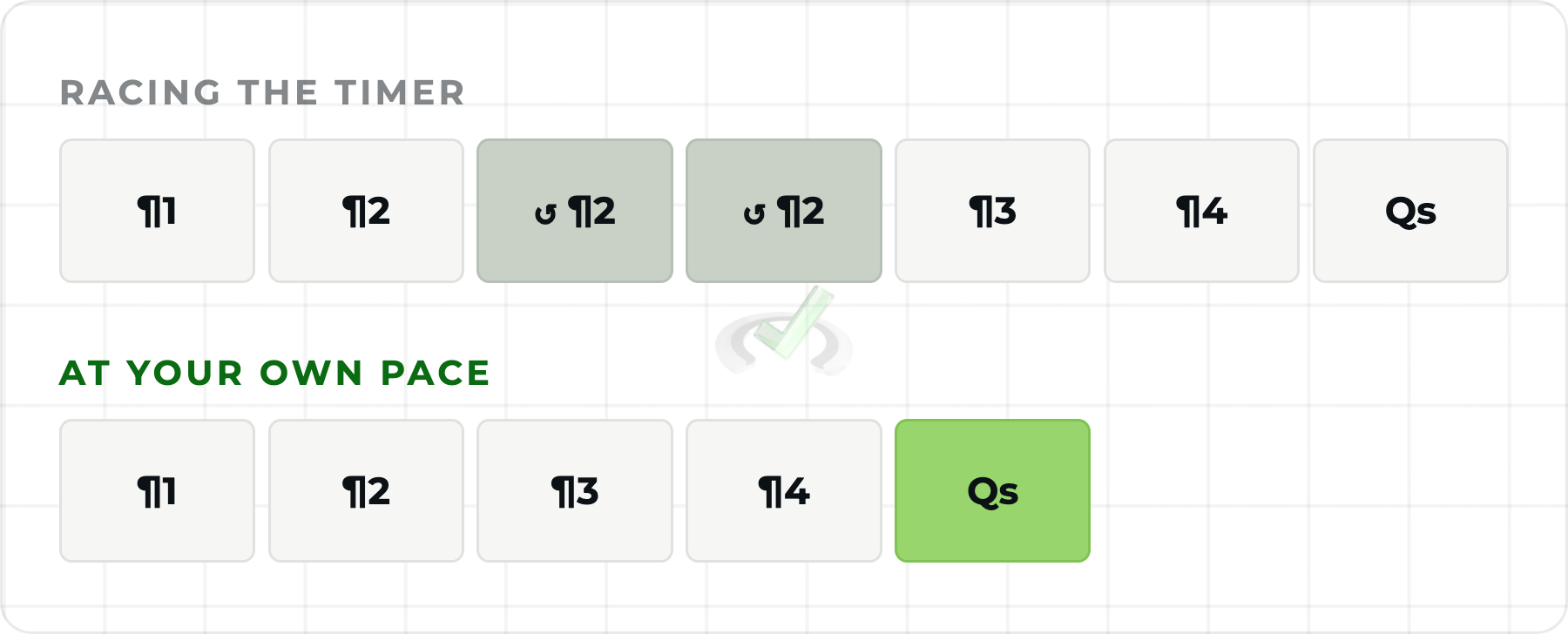
Then the questions feel impossible, so you go back and reread, which costs more time than reading it well the first time. That's how most MCAT CARS timing problems start.
At your own pace, you notice what the author is arguing and which details carry that argument. Those are what the questions ask about, so you answer them faster and second-guess yourself less :)
If you've always been a slower reader, our CARS strategy guide from 130+ scorers shows how to build a full method around it.
Read the Passage the Way a Doctor Listens to a Patient
CARS can feel like it has nothing to do with medicine. Our mentor's analogy changes that.
Picture yourself as a physician with a 15-minute appointment. Your patient starts telling you how they've been feeling, and the whole time you're glancing at your watch. Ten minutes left. Five minutes. Three minutes and 30 seconds. Then you start packing up your laptop.
Your patient walks out feeling unheard, and you've missed half of what they told you!
Checking the timer every few lines of a CARS passage works the same way, and you'll miss what the author is trying to say.
It hurts your MCAT CARS timing too, since you end up rereading what you missed!
So give the author the courtesy you'd want from your own doctor, the same one you'll give your patients one day, and listen to the whole thing :)
Stop Rereading the Parts You Don't Understand
Even at a comfortable pace, you'll hit sentences that don't make sense. That's normal! CARS passages are written to be roundabout and confusing in places, and the confusion is part of the test.
We've all been there. You read the sentence again. Then a third time. Sometimes it gets more confusing with every pass.
Top scorers handle it differently. They read a confusing section once, maybe a second time, and if it still isn't clear, they move on!
In our mentors' experience, you usually need about 20 to 30 percent of a passage's information to answer its questions.
That should take some pressure off. You don't have to understand every detail to get the questions right, and your MCAT CARS timing gets a lot easier once you stop trying :)
Telling the argument apart from the decoration is hard to learn from an answer key alone. In a 1:1 session, a 130+ CARS scorer can read a passage next to you and show you where they slow down and where they let go.
The Three Things to Look For in Every CARS Passage
Once you stop trying to understand every line, the next question is where to spend your attention. Our mentors break it into three things.

1. What information matters
Some sentences carry the author's argument, and some are decoration. Your first job is telling them apart, so you know what's worth a second read and what you can let go.
2. Where to find it
The important details tend to sit where the author states a view, pushes back on another one or changes direction. Knowing where to look saves you from searching the whole passage every time a question asks about it.
3. How to use it
The last step is bringing what you found to the questions. When you know what matters and where it lives, you can go straight to the line a question depends on and answer from it.
For a step-by-step version, see how 130+ scorers approach CARS passages.
Our CARS Mastery Course is built on these three questions, with 130+ scorers showing what they pull from each paragraph of a passage.
How to Practice MCAT CARS Timing Without Staring at the Clock
Build up to full timed sections in four steps, and keep the clock out of your reading the whole way!
- Start untimed. Do a few passages at your natural pace and note how long each one takes. That's your baseline, and it's fine if it's slow!
- Add the 10-minute check. Time full sections to test your MCAT CARS timing, and look at the clock only when you finish a passage. (Optional) If you'd rather practice pacing with a group, our 6-Week Live MCAT Accelerator works live passages in every section to build pacing endurance.
- Review every missed question. Find the sentence that held the answer and ask whether you'd flagged it as important. Our guide on how to review CARS walks through it.
- Watch a top scorer work a passage. Seeing where they slow down and where they move on teaches pacing faster than reading about it. Start with this step-by-step CARS passage dissection.
If your timing struggles go beyond CARS, our guide to MCAT timing covers the science sections too, and these ways to increase your CARS score pair well with it.
MCAT CARS Timing FAQ
How much time should I spend on each CARS passage?
About 10 minutes, questions included. The section gives you 90 minutes for 53 questions, and a test usually has nine passages.
What is a good MCAT CARS timing strategy?
A good MCAT CARS timing strategy is to budget about 10 minutes per passage, check the clock only between passages, and stop rereading sentences that won't come clear. Most of the time you save comes from that last one!
Is it bad to be a slow reader on the MCAT?
Reading at your natural pace helps you follow the author's argument, and that's what CARS questions test. Your pacing comes from knowing what to let go of, so you can keep your natural speed.
Should I reread confusing parts of a CARS passage?
Once, maybe twice. If it still isn't clear, move on. You usually need only part of a passage to answer its questions, and rereading eats the time you need for the rest.
How do I get faster at CARS?
Spend less time on the parts that don't matter, and your MCAT CARS timing improves without reading faster. Read at your natural pace, stop rereading what won't come clear, and focus on what the author is arguing and where they say it.
Get Help With Your MCAT CARS Timing
There's a limited supply of good CARS practice passages, and going through them without a plan burns them fast. You can finish the whole stack with your score still stuck in the low 120s and no idea why.
Our 6-Week Live MCAT Accelerator gives you that plan, with live strategy classes across every section and seven 1:1 sessions with a 515+ scorer built in.
If the cohort dates don't line up with your test, a few 1:1 tutoring sessions on their own can fix your MCAT CARS timing too. We'd love to help :)
CARS can feel frustrating and stressful, and the process won't always be smooth. You've got this, and you do have what it takes to become a doctor :)
Watch the CARS passage dissection
On its way.
Check your inbox in the next minute.
The MedLife Mastery Team

 To help you achieve your goal MCAT score, we take turns hosting these