Is your Bio/Biochem score holding you back on the MCAT? Maybe a practice exam surprised you, and you’d like to raise it as soon as you can. You’re in the right place!
Before you can raise a score you need a reliable baseline. The MCAT score calculator converts your raw answers on the free AAMC unscored sample test into a scaled score and percentile, and links you to the test if you have not taken it.
We interview top scorers all the time, and we single out the ones who scored 130 or higher on a section to learn what they did there.
Below are the strategies our 130+ B/B scorers used, written so you can start on them today. Each one is a way to increase B/B score and get past the 130 mark yourself!
First, a quick look at what the section tests, so you know where the points are 🙂
Free videos
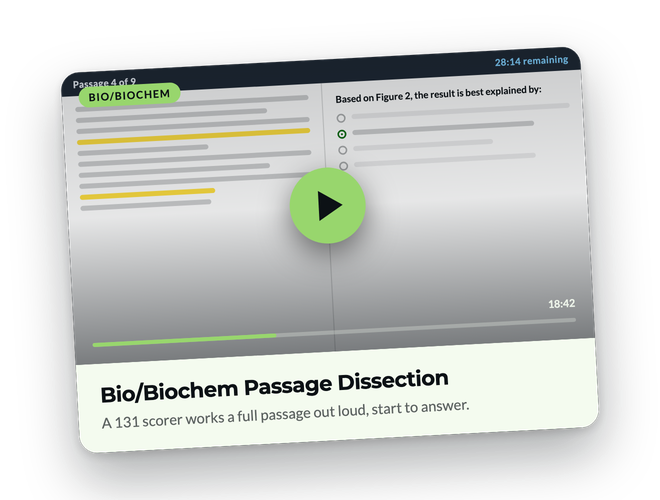
A 130+ in Bio/Biochem starts with the method. Watch a 99th percentile scorer work a passage.
Free videos: the read, the eliminations and the commit, on a real Bio/Biochem passage.
On its way.
Check your inbox in the next minute.
What Is the B/B Section of the MCAT?
B/B is short for Biological and Biochemical Foundations of Living Systems. It’s the third of the four MCAT sections, and it tests how cells, organ systems and biomolecules keep living things running. Our B/B section format guide goes deeper on the layout.
Those numbers come from the AAMC’s B/B section overview and its score scale page. The AAMC also publishes where the questions come from, and biology leads by a wide margin.
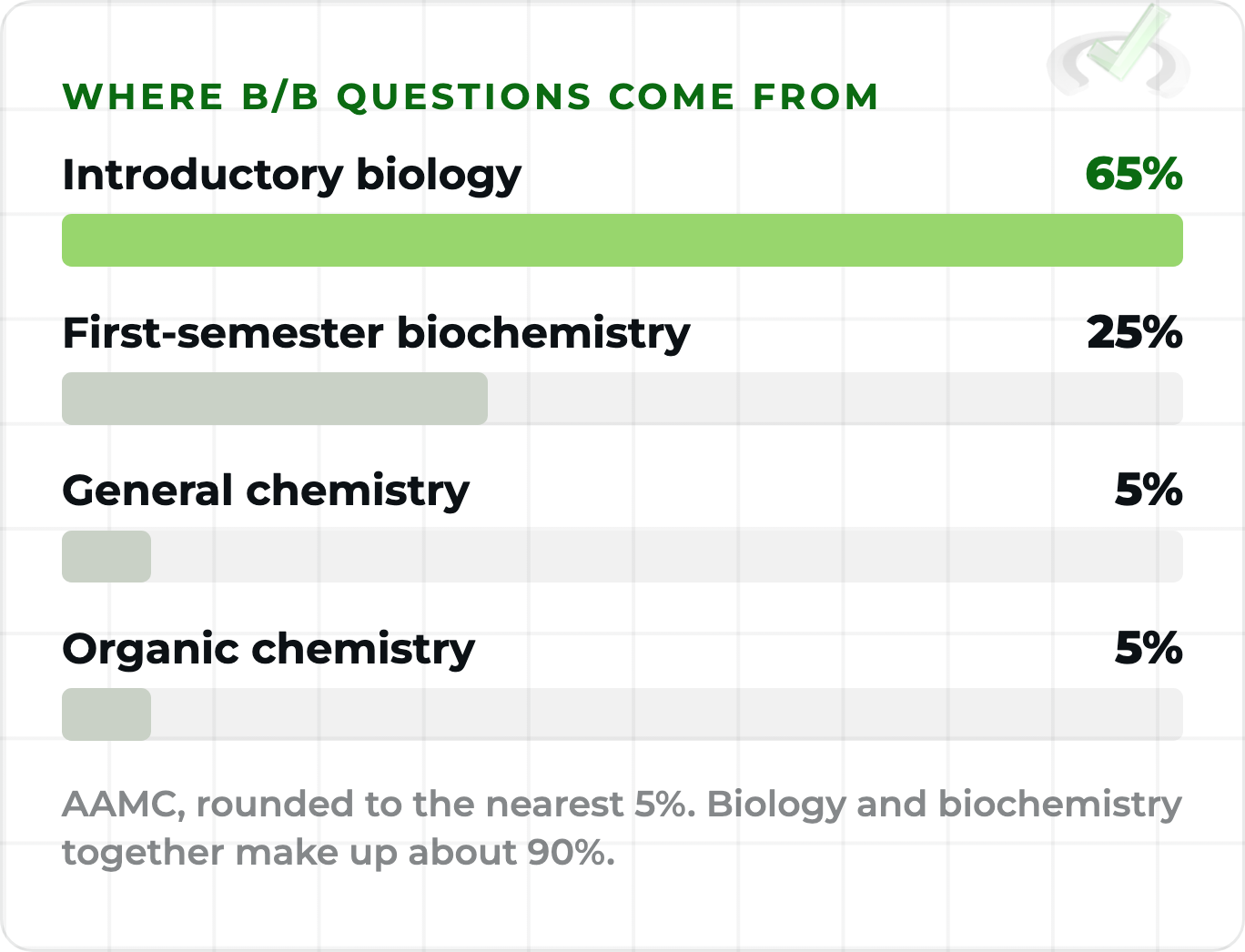
The full topic list lives in the AAMC content outline, and it’s a great checklist for your review!
First-semester biochemistry makes up about 25% of B/B and about 25% of Chem/Phys. Every hour you put into biochem helps two sections, so our Chem/Phys guide pairs well with this one!
Why B/B Scores Stall
Maybe you know your amino acids and most of the content, but something isn’t connecting. Maybe every piece of advice you get is to do more practice passages. Maybe you haven’t taken a biochemistry course yet, and you’re worried about this section.
We’ve heard all of it, and we’ve been there ourselves. You’ll get through it!
The 130+ B/B scorers we’ve interviewed changed how they read passages, drew pathways and reviewed their misses. The eight strategies below are the changes they made to increase B/B score, and you can use every one of them!
Strategy 1: Keep a Notebook of Your Weak Spots
A notebook of your weak spots turns every practice set into a study list, and it’s one of the easiest ways to increase B/B score! When you go through practice questions, write down the general topics you got wrong.
Look each topic up that same day, and make a flashcard as you go. Over time you’ll build a stack of flashcards made from your weakest topics, ready to drill as often as you like!
Add your pathways to the notebook too, and learn them early in your prep.
Martin scored a 132 in Bio/Biochem and a 519 overall, and his lowest practice score was a 501. His notebook tracked his reasoning, question by question.
I have this little notebook right here next to me that is full of notes. It's really my thought process behind each question, how I approached it, and where in that thought process I went wrong.
Martin K. 132 Bio/Biochem
In your last month or two, go over the whole notebook about once a week. A few pages each morning gets you through it by the end of the week, and it’s a nice way to warm up your brain :)
Here’s a tip from a 132 B/B scorer for notebook review. Use your notes as cue cards and teach each concept out loud, as if you’re giving a lecture. If you can teach it, you know it!
Strategy 2: Think Big Picture and Draw the Pathways
The MCAT tests the big picture, so study like a professor who has to explain a topic. Pretend you have a whiteboard and draw diagrams that connect pathways and amino acids.
On test day, sketch a quick flow chart on your noteboard as you read a dense pathway passage. When you reach the questions, check your chart before you go back to the passage.
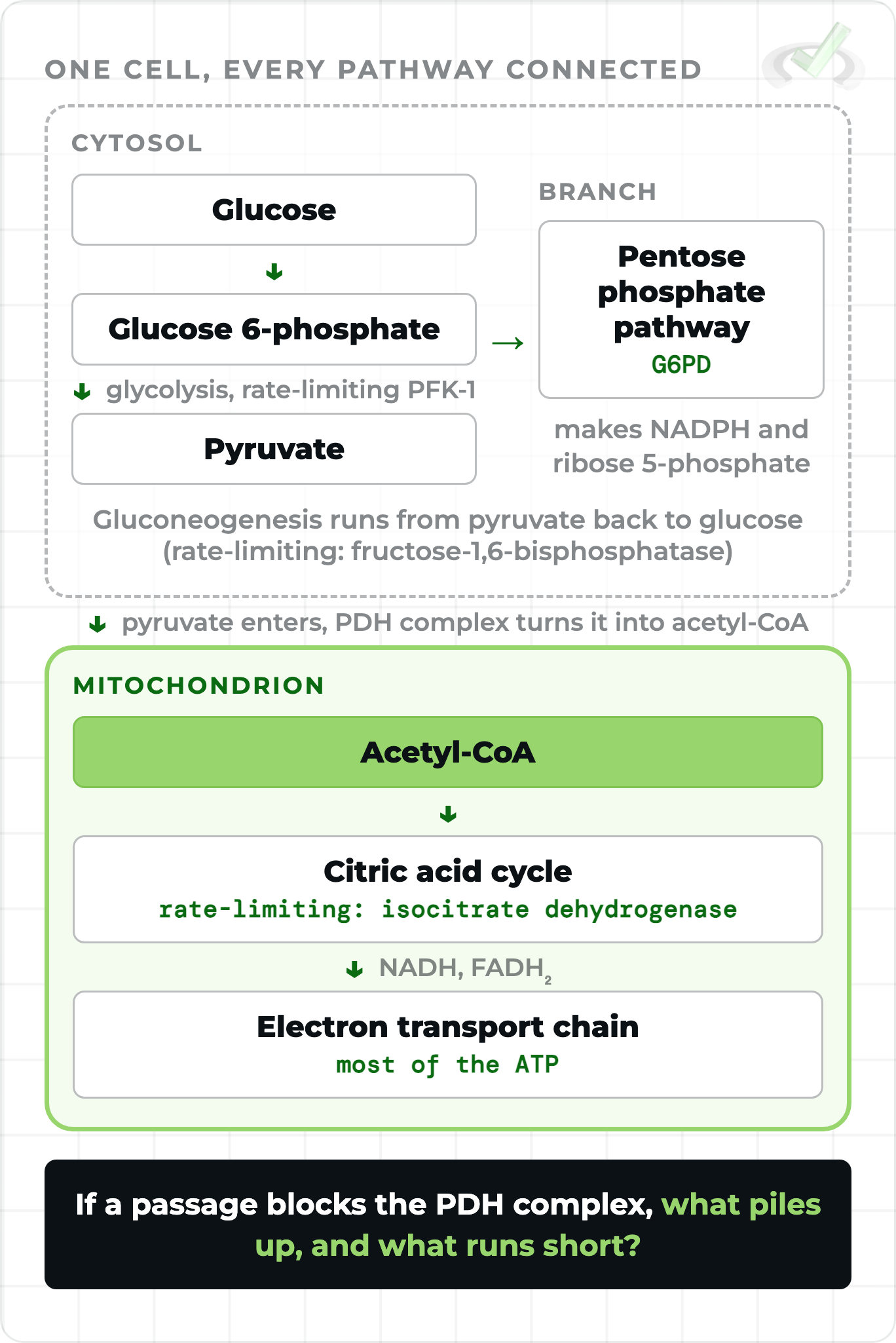
Aly, who scored a 131 in Bio/Biochem, practiced this on a whiteboard. She drew a huge cell, put glycolysis in the cytosol and followed pyruvate to the PDH complex.
Then she asked how it linked to gluconeogenesis and the pentose phosphate pathway. Once one topic connects to the next, a passage on any of them feels familiar.
Visualizing works for organ systems too. Picture food moving down the esophagus to the stomach, the pancreas releasing its enzymes, and a monosaccharide traveling all the way to glycolysis. It’s a fun way to study!
When you’ve hit this stage of being able to teach and visualize for this section, we can guarantee you’ll have already seen a substantial increase in your B/B score and you’re hitting 130+ levels.
Some top scorers draw a pathway from memory every day. Mark the rate-limiting enzyme and the points of regulation each time, and the pathways start to feel like old friends!
Strategy 3: Highlight and Decode What the Passage Tests
B/B passages pack in genes, proteins and acronyms, and plenty of that detail is there to distract you. Highlight the terms a question is likely to test, like a competitive inhibitor or a knockout, and stay with the basic science underneath.
With practice you’ll start to sense which questions are coming, and the right answer choice often stands out.
Passages also use shorthand that looks strange until you’ve seen it a few times. Aly’s example is a mutation written as E127A.
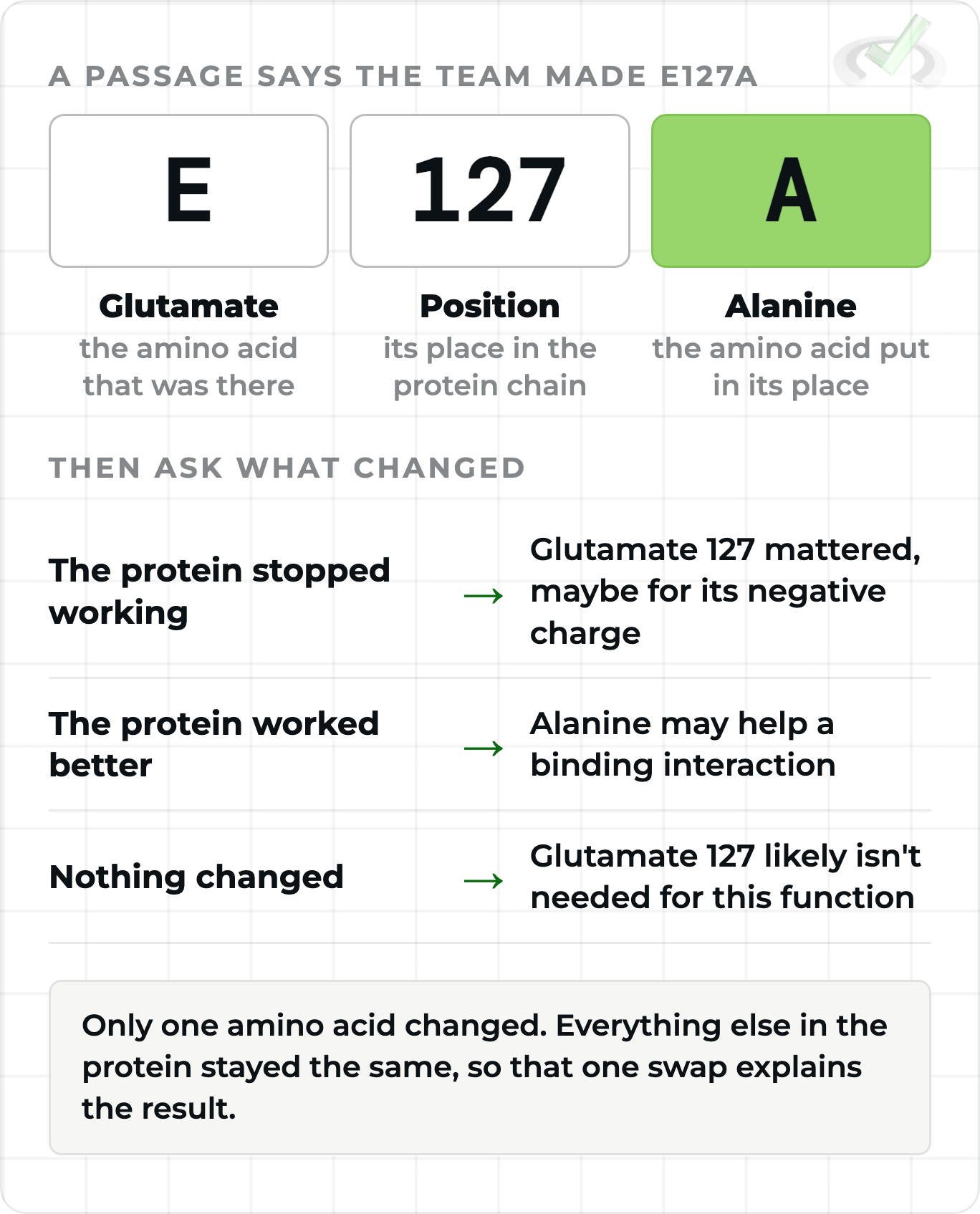
Glutamate sat at position 127, and the researchers swapped in alanine. Ask what that one swap did to the protein, and the questions get much easier to reason through! Decoding shorthand like this helps you increase B/B score on experiment passages.
Learn the one-letter amino acid codes so this shorthand reads at a glance. When a format keeps confusing you, look it up before you move on!
Strategy 4: Read Every Graph From the Axes In
B/B is full of graphs and tables. Before you look at the data, read the x-axis and the y-axis. Then check the passage text just above or below the figure for an explanation.
Next, read the graph as a whole. What’s the overall trend, and what changed between the groups? The details make sense once you know what the graph shows.
Tanmay scored a 130 in Bio/Biochem and a 514 overall after three months of prep, and graphs were one of his top tips.
Another important tip is to practice how to interpret graphs and diagrams. Many questions will require you to channel your abilities to interpret graphs that may be odd looking or unique, or very complex.
Tanmay P. 130 Bio/Biochem
Top scorers split on whether to look at figures before reading the passage. Some scan the tables, figures and italicized terms first. Others go to a figure only when a question sends them there.
Try each way for a couple of weeks of practice, then keep the one that gives you better results. Trust your gut, and let your scores decide!
If graphs keep tripping you up, spend extra review time on them and work out why each one confused you. The AAMC tests data reasoning in all three science sections, so this practice carries over! It’s a steady way to increase B/B score.
Strategy 5: Pace B/B One Passage at a Time
A lot of low B/B scores start with one dense passage that eats ten minutes or more. A plan for each passage protects the rest of the section, and pacing practice helps you increase B/B score too.
With 59 questions in 95 minutes, you’ve got about 1.6 minutes per question.
If you’ve spent a minute on a question and you’re still setting it up, treat that as a red flag. Guess, flag it and come back if time allows.
Our guide to MCAT passage timing covers clock checks for every section. (Optional) If you’d like to build pacing with a group, our 6-Week Live MCAT Accelerator works live passages in every section to build pacing endurance. It’s a fun way to practice!
Strategy 6: Predict, Then Answer From the Passage
Pick answers that tie back to the passage and what it says. A choice can be true in your textbook and still miss what this passage is testing.
Make a prediction before you read the answer choices, then pick the choice closest to it. When a question needs the choices first, like an all-except question, go to them right away.
When no choice matches your prediction, eliminate. Martin put it this way.
If you know the three wrong answers, then you also know the right answer.
Martin K. 132 Bio/Biochem
Strategy 7: Know Your Enzymes and Their Regulation
Know the common enzymes, what each one does and where it sits in its pathway. In the citric acid cycle, for example, isocitrate comes right after citrate.
Learn the rate-limiting enzymes and the points of regulation. Then learn what inhibits or activates each enzyme, and why. The why keeps you in big-picture mode, and our enzyme kinetics guide covers how those changes show up on a graph.
Enzyme names give you clues too. A dehydrogenase removes hydrogens, often passing them to NAD+ to make NADH. A kinase moves a phosphate group, usually from ATP.
Our biochemistry mnemonics have more like this one.
Strategy 8: Review Every B/B Miss by Its Cause
Practice pays off fast in B/B when you review every question, right or wrong. For each one, work out why you got it right or wrong, and read the explanation even when you were right.
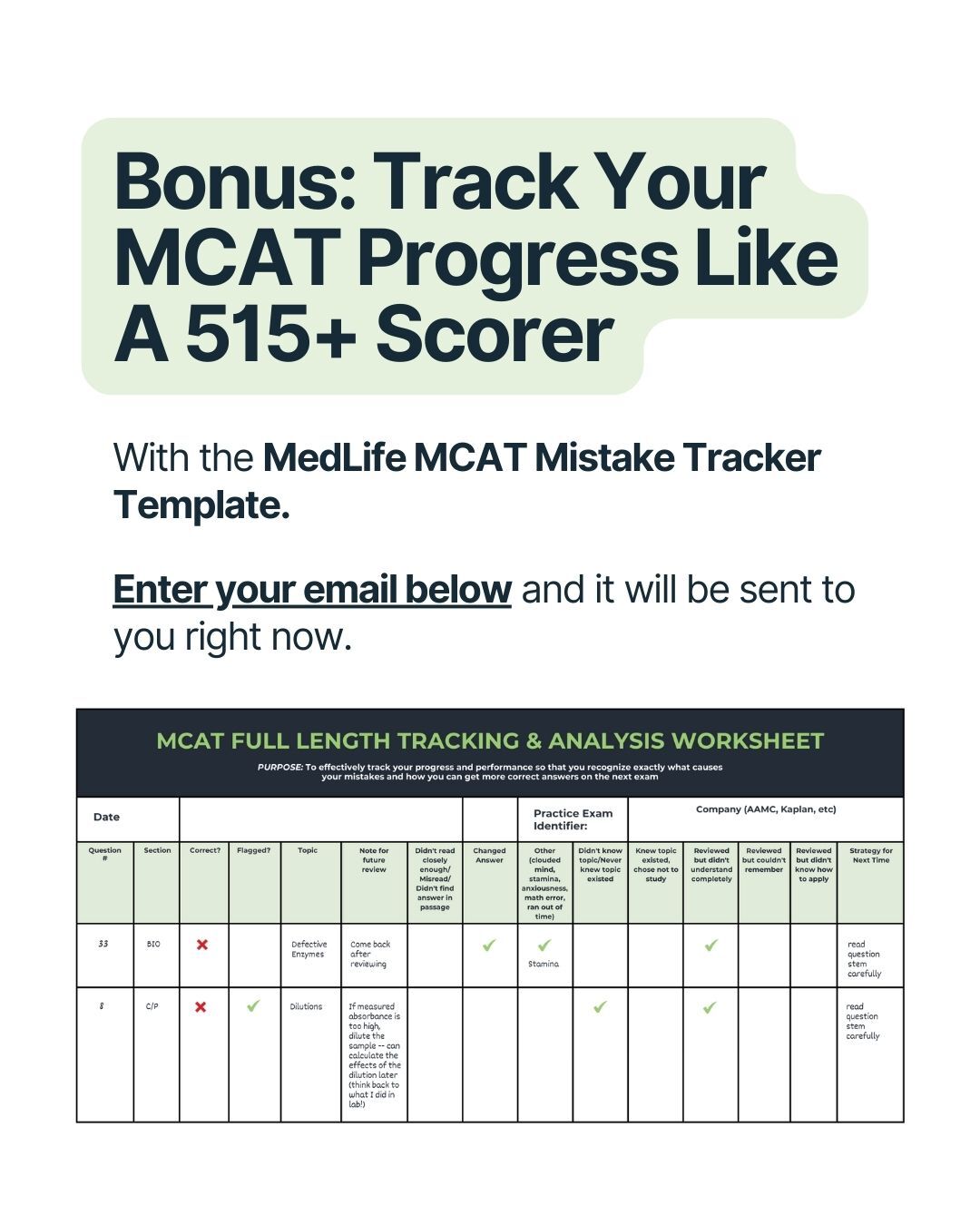
Tanmay tracked his mistakes on what he called “Why I Missed It Sheets,” and he credits them with helping him do well. Sort each miss by its cause, like this.
Track the causes for a week or two. A pattern shows you where your next points are.
If your misses don’t fit a pattern, a few 1:1 tutoring sessions with a 515+ scorer can help. Your tutor reviews your missed questions with you and spots what you can’t see yourself. That’s what we’re here for!
Give review as much time as the questions took. You’ll see the patterns sooner, and every miss turns into a lesson!
The Best AAMC Practice for B/B
The AAMC writes the exam, so its official practice products are the closest you’ll get to test-day questions. Tanmay leaned on one of them in particular!
For this section I would really focus on the AAMC section bank. Those questions are difficult and will prepare you well for the difficulty of the questions you will see on test day.
Tanmay P. 130 Bio/Biochem
These are the AAMC products with B/B questions in them.
- Biology Question Pack, Volumes 1 and 2. 120 passage-based and independent biology questions in each.
- Section Bank, Volumes 1 and 2. 100 questions from each science section in each volume, with an emphasis on biochemistry.
- Independent Question Bank. 150 questions, including 25 each in biochemistry and biology.
- Full-length practice exams. Practice Exam 1 and the Unscored Sample Test are free, and Practice Exams 2 to 6 cost extra.
For more questions, try our free MCAT biology practice questions and MCAT biochemistry practice questions.
For content review, Tanmay used the Kaplan books. When a concept won’t stick, Khan Academy’s MCAT videos are a free place to relearn it.
Keep at least two AAMC full-lengths for your last few weeks. Fresh, test-like questions near the end tell you how ready you are! Our MCAT practice test guide shows how to space them.
How to Increase B/B Score: Quick Answers
What is B/B on the MCAT?
B/B is Biological and Biochemical Foundations of Living Systems, the third section of the MCAT. It has 59 questions in 95 minutes and covers introductory biology, first-semester biochemistry and a little general and organic chemistry.
How much biochemistry is on the MCAT?
The AAMC puts first-semester biochemistry at about 25% of the B/B section and about 25% of the Chem/Phys section. That’s roughly 15 questions in each of those two sections.
Do I need a biochemistry course before the MCAT?
The AAMC tests biochemistry at the level of a first-semester college course. If you haven’t taken one, plan extra content review time for biochem, since it shows up in two sections.
How long does it take to increase B/B score?
It depends on where you start and how many hours a week you have. Tanmay prepared for three months and scored a 130 in B/B. Steady practice and review add up, and our guide to a good MCAT score helps you set a target!
Final Thoughts on How to Increase B/B Score
Bio/Biochem can feel like a wall of acronyms, and plenty of students who now score 130+ felt that way once. You can increase B/B score with steady habits.
Keep a notebook, draw your pathways, read every graph from the axes in, and review every miss by its cause. We’re cheering you on!
Do you believe that 90% of those who will be writing the MCAT with you soon, will be aware of these strategies for B/B? They won't, but since you now are, and if you apply them, that automatically will place you in the top 10%.
Get and apply the MCAT prep strategies others have used to increase their scores by 10, 12, even 15+ points to achieve competitive scores and gain admission into the med-school of their dreams, so you can do the same.
Our Chem/Phys & Bio/Biochem Mastery Course teaches these strategies step by step, with a 130+ B/B scorer walking through AAMC B/B passages line by line.
If you’d rather have someone look at your misses with you, 1:1 MCAT tutoring pairs you with a 515+ scorer. We’d love to help you get there :)
Working on more than one section? Our guides to raising your Chem/Phys, CARS and Psych/Soc scores, and our complete guide to increasing your MCAT score, pair well with this one. You’ve got this!
Watch the Bio/Biochem passage dissection
On its way.
Check your inbox in the next minute.

 To help you achieve your goal MCAT score, we take turns hosting these