Learning how to study MCAT Psych/Soc can feel like learning a new language. There are hundreds of terms to memorize, and so many of them sound the same!
If you never took psychology or sociology in college, it can feel like you’re teaching yourself the psychology/sociology section of the MCAT from scratch. Lots of students start there 🙂
Aly felt the same way at first. She spent hours trying to cram every term, then built a few flashcard habits that took her to a 132 in Psych/Soc (100th percentile) and a 520 overall.
She walks through how to study MCAT Psych/Soc with flashcards in the short video below, and we’ve written them out underneath with her own notes. We hope it helps!
Enjoy!
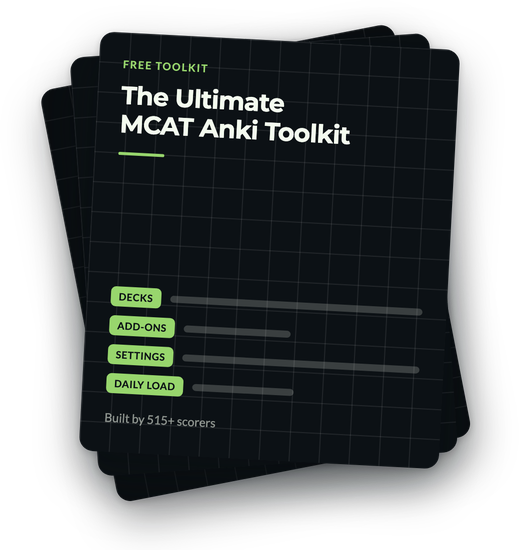
Free download
A 130+ in Psych/Soc rewards recall. Here is the deck and the settings that make 300 terms stick.
The Ultimate MCAT Anki Toolkit carries the deck, the extensions and a survivable daily load.
On its way.
Check your inbox in the next minute.
How to Study MCAT Psych/Soc: Start With What It Tests
Psych/Soc is the fourth and last section of the exam. The AAMC says it tests first-semester psychology and sociology, the biology behind behavior, and basic research methods and statistics.
The AAMC rounds those content shares to the nearest 5%, and they vary a little from one test to the next.
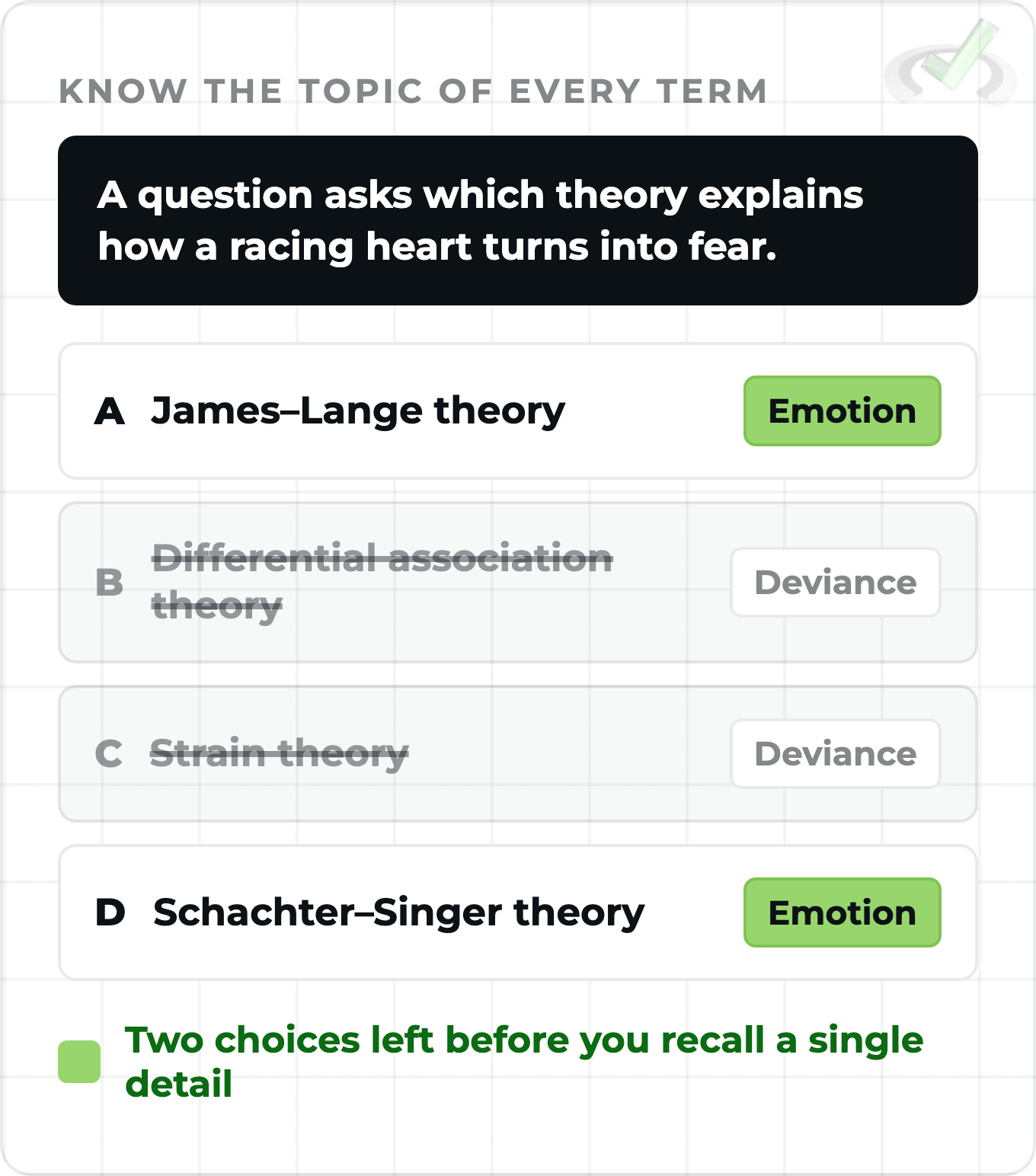
Most questions come down to a term. If you know all four terms in the answer choices well, you can work through the process of elimination fast and pick the one that fits.
For Aly and many of our top scorers, flashcards (usually Anki) are what make the terms stick. She also learned how each term gets applied, since a passage rarely uses the textbook definition word for word.
Her fix was to make flashcards out of the questions she saw, mostly from AAMC and UWorld, because she found those two closest to test day!
Psych/Soc mostly asks whether you know a term and can spot it in a passage. Learn the terms well, and every question gets faster!
Strategy 1: Put Related Terms and Theories on One Card
Psych/Soc is full of terms that sound alike. Aly kept mixing up the parts of a theory, and terms that share a word. She once had flashcards for about 12 different terms that start with social!
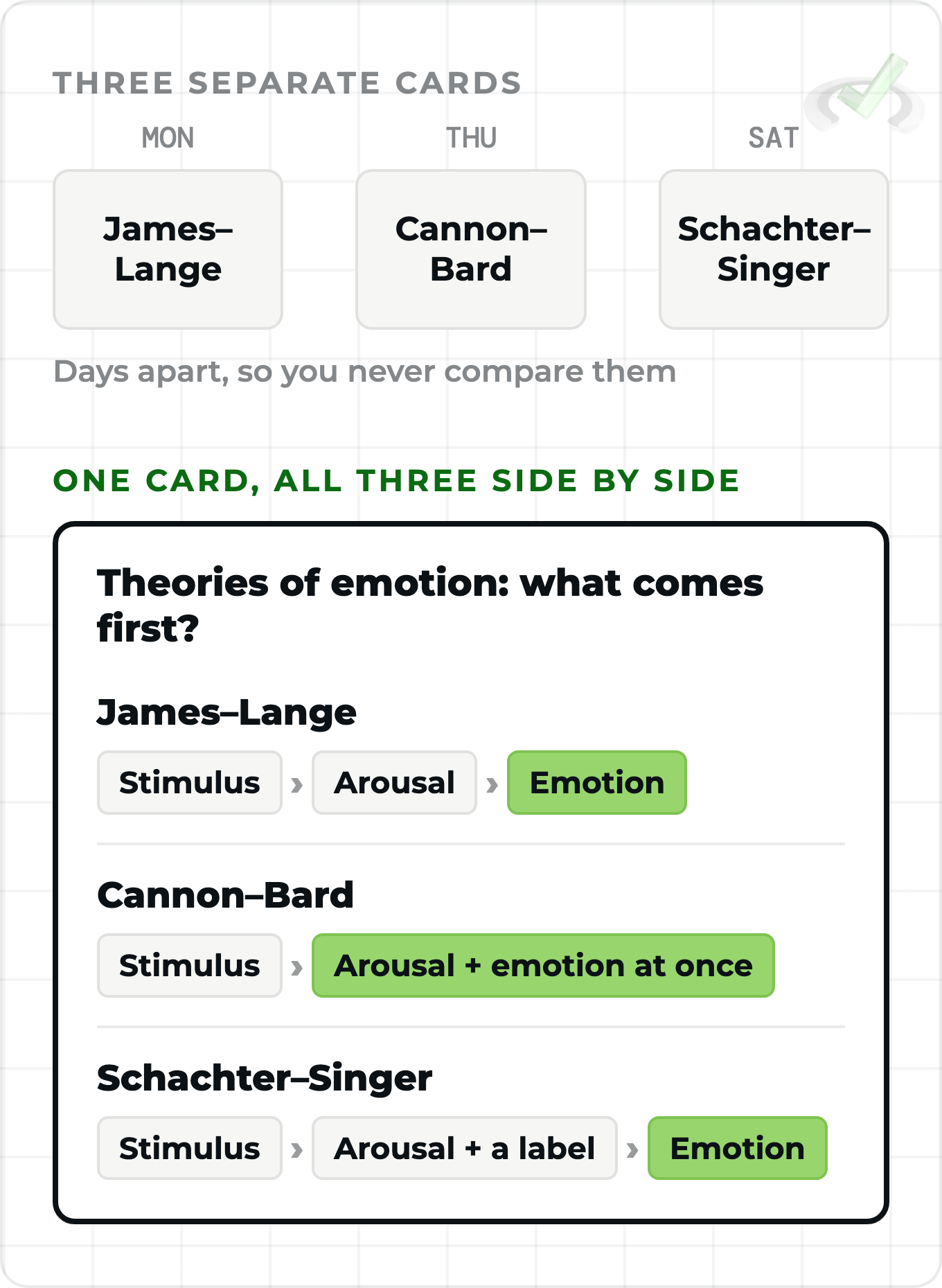
On test day, related terms often show up together as answer choices, or you get one and have to work out which it is. A grouped card makes you tell them apart the same way. Groups that work well on one card:
- Theories of emotion. James-Lange, Cannon-Bard and Schachter-Singer, with what comes first in each.
- Theories of deviance. Differential association, labeling theory and strain theory.
- Piaget’s stages. Sensorimotor, preoperational, concrete operational and formal operational, in order.
- Freud’s psychosexual stages. Oral, anal, phallic, latency and genital, in order.
- The social terms. Social facilitation, social loafing, social support, social mobility and the rest, each with a one-line meaning.
Stages belong on one card for a second reason. If Piaget’s stages sit on four cards, you can learn every stage and still get the order wrong.
(Optional) Our Psych/Soc Mastery course has four lessons on mastering P/S concepts with flashcards, including one for when the terms still won’t stick.
If two terms could show up as answer choices to the same question, put them on the same card!
Strategy 2: Aim for Recognition Before Memorization
If you’re short on time, this is how to study MCAT Psych/Soc. Make it your goal to recognize every concept and know its general topic. Go deeper where you have time, and it’s okay to stop at recognition for the rest!
Too much detail can work against you, too. With a long definition on every card, similar terms start to blur together.
To find the terms you don’t recognize yet, Aly suggests the 300-page Psych/Soc document that students pass around on Reddit. It’s a long set of student-made notes titled Khan Academy Behavioral Sciences Review.
Skim it, flag every term that looks unfamiliar, then research those and make cards. Some top scorers save it for the last couple of weeks before their test.
Strategy 3: Research Each Term Until You Can Teach It
Aly calls this her favorite strategy. She used to copy down the first definition she found on Google or in an explanation and move on. Those terms often didn’t stick.
When a term feels even a little fuzzy, look it up in two, three or four places before you make the card. Watch a video, read another explanation or check a thread, until one analogy clicks for you!
Then put the term in your own words and tie it to your own life. Something linked to you is easier to pull back up on test day.
Aly checks herself by teaching the term to someone. If they ask a fair follow-up question she can’t answer, she goes back and researches it again.
A 1:1 MCAT tutor who scored 515+ makes a great person to teach. They’ll ask the follow-up questions and show you where a definition is still thin.
If you can explain a card without getting stuck on a follow-up question, it’s ready to drill. If you can’t, give it one more round of research!
Strategy 4: Turn Practice Questions Into Flashcards
Many of our top scorers build their P/S deck from practice. Do a passage or two and go over the answers. Make an Anki card for every term you missed, then find each term in your MCAT review book and read the paragraph around it.
That takes you through the parts of your P/S book that get tested, without reading it cover to cover! Aly didn’t spend long on niche terms that never came up in practice.
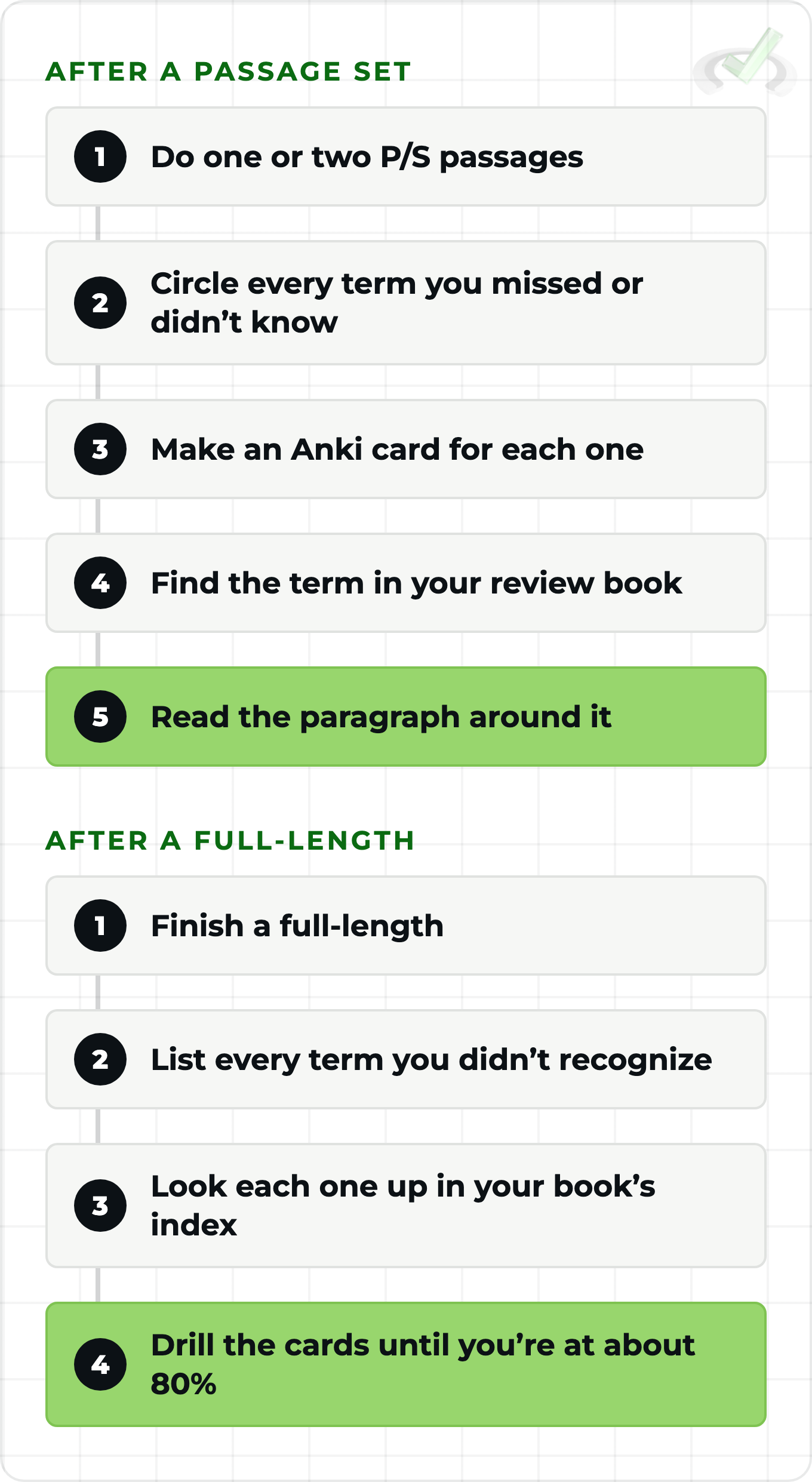
After a full-length, write down every term or answer choice you didn’t recognize. Look each one up in your book’s index, make a card, and drill the set until you’re at about 80%. Aly aimed to review them every night.
For P/S practice, each of the AAMC’s Section Bank volumes carries 100 questions per science section and leans on psychology and sociology. Its Independent Question Bank adds 25 psychology and 25 sociology questions, and UWorld’s MCAT QBank covers behavioral sciences too.
If you’d like help applying the terms to passages, our 6-Week Live MCAT Accelerator includes our Psych/Soc Mastery course, with 40+ strategy video lessons by 130+ P/S scorers and 10+ AAMC passage walkthroughs.
Get The Ultimate MCAT Anki Toolkit
On its way.
Check your inbox in the next minute.
MCAT Psych/Soc Flashcards and Resources
If you’re still deciding how to study MCAT Psych/Soc day to day, here’s where to start:
- Premade decks. Our best MCAT Anki decks list compares the P/S-only decks, with card counts and links.
- Your own cards. Our guide to using Anki for the MCAT comes from a 517 scorer, and our MCAT flashcards guide compares the other options.
- Content review. Our MCAT Psychology and Sociology hub collects our P/S strategy and content guides.
- Official practice. The AAMC’s official prep practice exams use questions from past MCATs.
- More from top scorers. Kayla scored 131 in Psych/Soc and shares her approach, and our guide to increasing your Psych/Soc score gathers advice from 130+ scorers.
Choose one premade deck or your own cards, then add a card for every term you miss in practice. One deck you review every day beats three you dip into!
How to Study MCAT Psych/Soc: FAQs
What’s the best way to study for Psych/Soc on the MCAT?
Learn the terms with flashcards, put the ones you mix up on the same card, and make new cards from every practice question you miss. Then check that you can apply each term in a passage!
How do you get a 132 on Psych/Soc?
A 132 is the top P/S score, at the 100th percentile in the AAMC’s current ranks. Aly got there by knowing the terms well enough to eliminate fast and by drilling every term she missed in practice. You can get there too!
Is UWorld good for Psych/Soc?
Aly made many of her P/S cards from UWorld and AAMC questions, because she found those two closest to test day. We’d start with the AAMC’s own material, since the test developers write it!
What’s the 300-page Psych/Soc document?
It’s a long set of student-made notes titled Khan Academy Behavioral Sciences Review that circulates on Reddit, and Aly mentions a shorter 86-page version too. Use it to find terms you don’t recognize, then make cards for those :)
When should I start studying Psych/Soc?
Early, alongside the science sections, so your flashcard reviews have weeks to build up. Our guide on when to take the MCAT can help you set your date first!
Start Your Psych/Soc Flashcards Today
You don’t need every term by the end of the week! Pick one group you keep mixing up, put it on one card, and add a card for every term you miss in your next practice passage.
If you’d like live help, our 6-Week Live MCAT Accelerator includes 12 live strategy classes with a 520+ scorer, seven 1:1 sessions with a 515+ scorer, and our Psych/Soc Mastery course.
If the cohort dates don’t line up with your test, 1:1 MCAT tutoring with a 515+ scorer fits around your schedule.
Now you know how to study MCAT Psych/Soc the way Aly did. We remember spending hours in coffee shops and libraries trying to fit all of this in. It gets easier, and you’ve got this. We’re rooting for you :)

 To help you achieve your goal MCAT score, we take turns hosting these