If your MCAT diagnostic score came back lower than you hoped, take a breath. That sinking feeling after a first practice test is hard, and most of us on our team felt it too.
You might hear the MCAT is hard, and you feel it for the first time on the first MCAT practice test. A low number on day one is your starting line. You are not stuck, and we’ll help you plan from here!
Below, we cover what a good and average MCAT diagnostic score look like, why first scores run low, and the steps our mentors took after theirs.
Mehul Nimpal, one of our mentors, scored a 524 on the MCAT. One of his early practice tests came in far below his goal.
In this video, he shares how he got his mindset back on track and used that test to start boosting his MCAT score 🙂
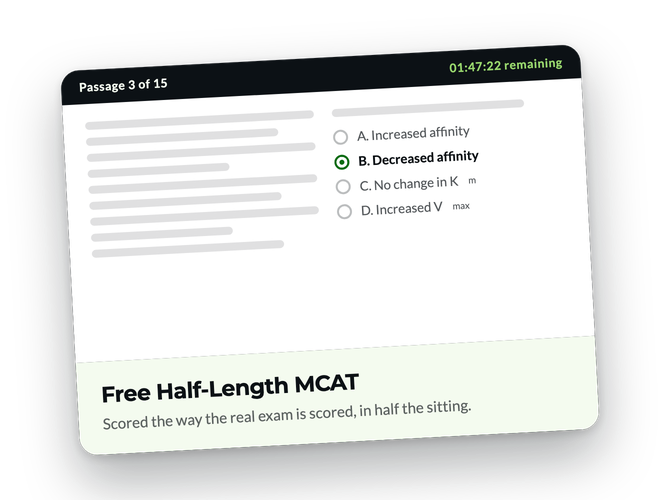
MCAT Practice Test (Half-Length) · Free, all 4 sections
Find Your Exact Gap to 515+ With a Free Half-Length, Then Close It Section by Section
Timed like test day, with a score report for every section.
Join 12,000+ students using our free resources
On its way.
Check your inbox in the next minute.
What Is an MCAT Diagnostic Test?
An MCAT diagnostic test is the first practice exam you take, usually before you start studying. Some students call it a baseline test. It shows you three things.
- Your starting score, overall and in each of the four sections
- Which sections need the most work
- How your focus holds up over a long sitting
You can use any full or half-length practice test as your MCAT diagnostic. These are the common choices.
The AAMC lists every practice exam it sells or gives away on its official practice products page. If you’d like to save the scored AAMC exams for later in your prep, the Unscored Sample Test plus our calculator makes a great first diagnostic!
Take your MCAT diagnostic timed, in one sitting, in the same section order as test day. An open-book run gives you a number you can’t plan against.
When to Take Your MCAT Diagnostic Test
Ideally, you’ll take it at the very start, before content review. You’ll know where you stand and which sections to study first!
If you take a full-length two weeks or a month into content review, you probably won’t score where you hope yet. That’s normal at that stage!
On test day, the MCAT has 6 hours 15 minutes of testing and runs about 7 hours 30 minutes with breaks, according to the AAMC’s MCAT Essentials. A full-length diagnostic asks the same of you, so set aside the whole day!
Haven’t started studying? Take your diagnostic this week. Partway through content review? Finish the content review first, then sit your next full-length.
What Is a Good MCAT Diagnostic Score?
Any MCAT diagnostic score is a good one when it’s honest, because it gives you a true starting point!
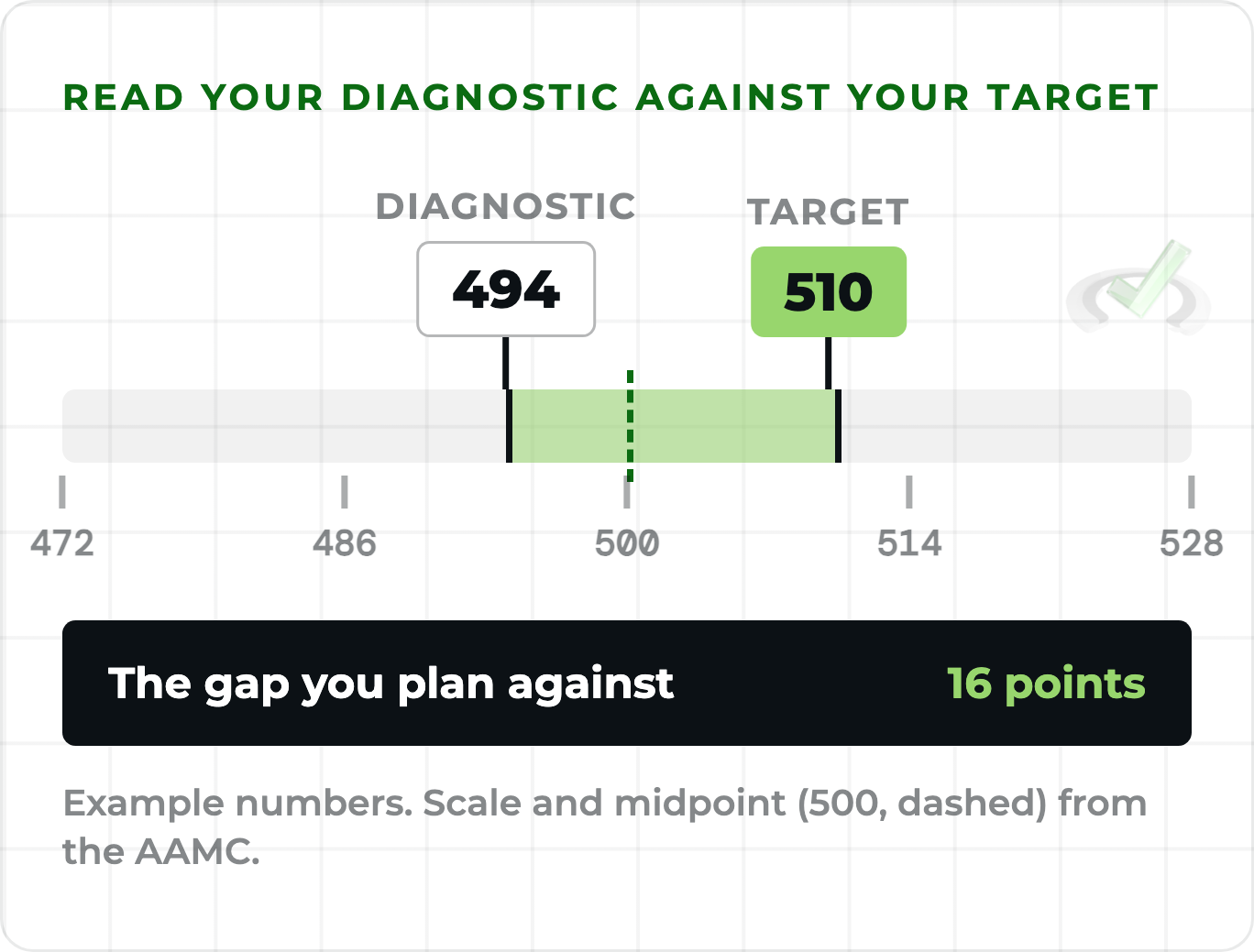
Read your MCAT diagnostic against your target score. The gap between them tells you how many weeks to plan and what kind of work to put in.
Our MCAT percentile chart shows where every score ranks for 2026 to 2027 test dates. Not sure what your target should be? Our free MCAT Target Score Tool works it out from your school list!
Want the bigger picture? Our guide to what makes a good MCAT score goes into more detail!
What Is the Average MCAT Diagnostic Score?
There’s no official average MCAT diagnostic score. The AAMC publishes percentile ranks for the official exam, and students take diagnostics on their own, from different companies, at different points in their prep.
Any average you see online mixes different tests and different starting points. Because a diagnostic comes before you’ve studied, it usually lands below where you’ll score after months of prep.
So set the averages aside and measure your diagnostic against your own target. That’s the comparison you can plan with!
Why Your First MCAT Practice Test Score Runs Low
A low first score can feel like proof you’re not cut out for this. We hope you won’t read it that way!
The first MCAT practice test was a rude awakening for most of us on our team. It was the first time we’d sat the whole exam. Here’s what usually pulls a first score down.
- You haven’t finished content review. Topics you haven’t studied yet still show up.
- You haven’t learned the strategy yet. AAMC-style passages reward a way of reading that takes practice.
- The length wears you down. Over six hours of testing is tiring the first time.
- Other companies use their own scales. Only the AAMC writes the MCAT, so treat AAMC full-lengths as your benchmark.
- You had a bad day. Sleep, nerves and a long week all show up in one sitting.
Even a low score on an AAMC practice test is useful. The whole point of a practice test is to learn from it, and our guide to low MCAT scores goes deeper. You’ve got a full test’s worth of lessons now!
How Students Climbed From a Low MCAT Diagnostic
If you’re looking at a number in the 480s or 490s right now, these two stories started right where you are!
Melissa took her MCAT diagnostic in January and scored a 489, much lower than she expected. Her test was in May, and she finished with a 512!
I think it was the belief that even if my scores were low at the time I kept telling myself that I WILL do well.
I did get discouraged while taking my practice exams because my scores weren’t increasing like I wanted them to.
Melissa M. 512 MCAT
Hanes scored a 500 on his first diagnostic while taking physiology and biochemistry. He spent two months reading, watching videos and taking notes, and his full-length scores barely went up.
In his last month, he switched to practice questions, full-length review and flashcards. He scored a 520, and he’s now one of our MedLife mentors!
…it did not help that when took my first diagnostic exam, I scored a 500. This was definitely not the score I wanted to start off at.
I was studying my full-length exams, trying to learn where I went wrong, and using a lot of flashcards.
Hanes G. 520 MCAT
Every journey is different, and nobody can promise you a number. Both of them started by being honest about their diagnostic and changing how they studied! You’ll find more in our MCAT success stories!
What to Do After a Low MCAT Diagnostic Score
Here’s the plan we’d follow, one step at a time :)
- Give yourself a day. Feel what you feel, then come back with fresh eyes.
- Review every question. Read the explanation for every answer choice, even on questions you got right.
- Sort each miss by its cause. Content, reasoning or timing, as in the graphic below.
- Set your target. Use the Target Score Tool to see the gap you’re planning against.
- Build your schedule. Our MCAT study schedule guide shows how 515+ scorers laid out their weeks.
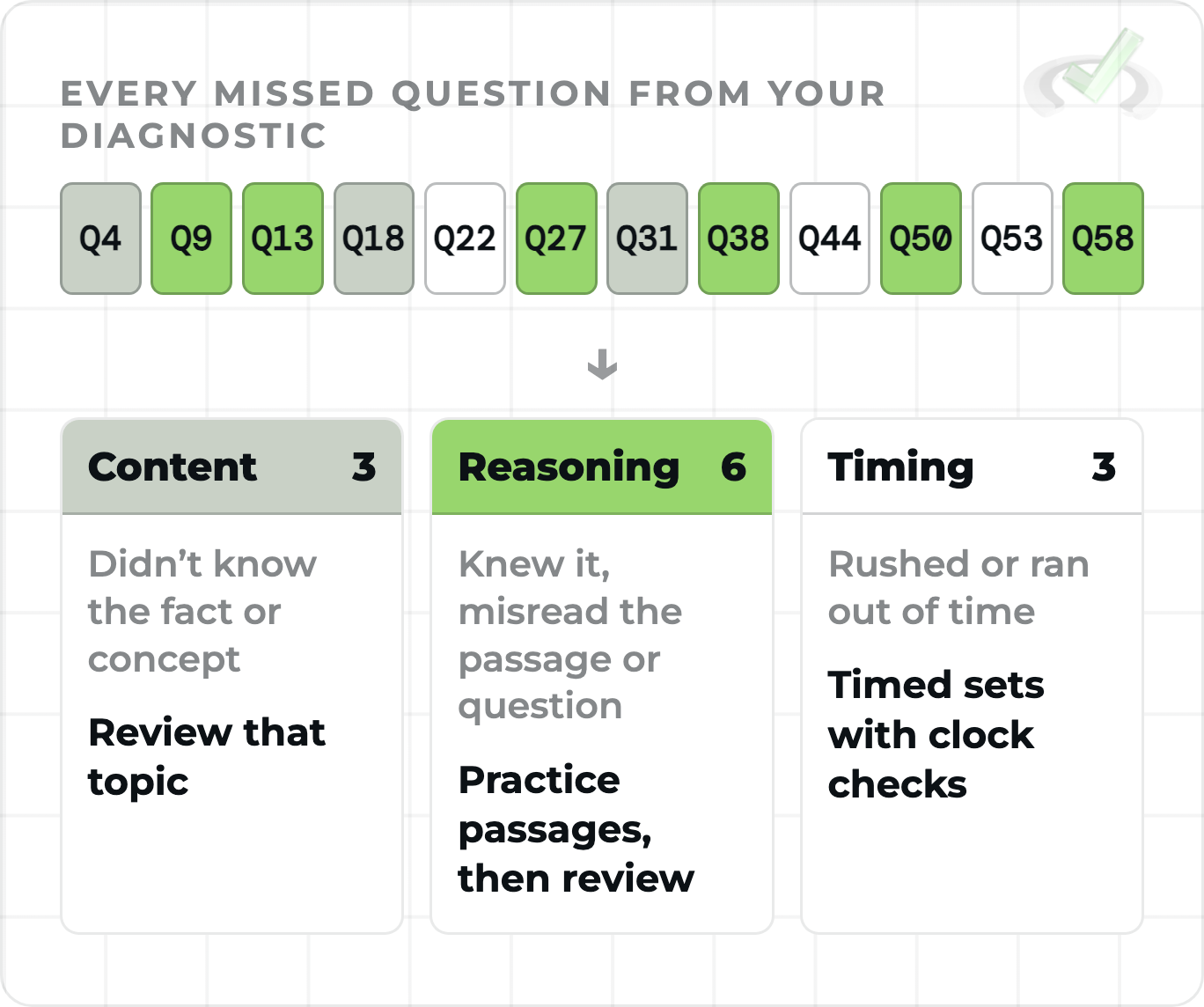
Content misses point you to topics for review. Reasoning misses get better with passage practice and careful review, which our guide to reviewing MCAT mistakes walks through. Timing misses need timed sets with clock checks.
(Optional) If you’d like mentors to guide you through the reasoning and timing work, our 6-Week Live MCAT Accelerator works live passages in every section and includes seven 1:1 sessions with a 515+ scorer.
Plan to spend as long reviewing your MCAT diagnostic as you spent taking it. Your misses are the most useful part of the whole test!
Your Next MCAT Practice Score Increase Depends on Two Factors
Whether you’re on your first practice test or your fifth, or retaking the actual MCAT, your next score increase depends on two factors.
- Did you identify the lessons and weaknesses from your last attempt?
- Did you find the right approach to improve on them?
Neither one is easy to do alone. A few 1:1 MCAT tutoring sessions with a 515+ scorer can spot the patterns in your misses and match an approach to each one. That’s what we’re here for!
Retaking the MCAT itself? Our MCAT Retake Calculator shows how many study weeks your goal needs and whether your date can hold them.
MCAT Diagnostic Test: Quick Answers
How long does an MCAT diagnostic test take?
A full-length MCAT diagnostic runs about 7 hours 30 minutes with breaks, the same as test day. Our free half-length has about three hours of questions across all four sections, plus breaks.
Is 500 a good diagnostic MCAT score?
A 500 sits at the midpoint of the 472 to 528 scale. As a score before you’ve studied, it gives you a solid base to build from, and Hanes started at a 500 on his way to a 520!
Should my MCAT diagnostic be a full-length or a half-length?
A full-length shows your stamina as well as your score, so it’s the closer match to test day. A half-length gets you a section-by-section read in less time, which helps when a full day is hard to find.
When should I take my next full-length after the diagnostic?
Finish your content review first, then take your next full-length. Our MCAT practice test guide shows how to space the rest of them!
Final Thoughts on Your MCAT Diagnostic Score
A low MCAT diagnostic score stings, and it’s okay to feel that. It’s also the most honest map you’ll get of where to start, and you’re already reading it the right way!
If you’d like a plan with mentors beside you, our 6-Week Live MCAT Accelerator teaches the strategy behind AAMC passages, live, with 1:1 sessions included.
If the cohort dates don’t line up, 1:1 MCAT tutoring pairs you with a 515+ scorer on your schedule. Either way, we’d love to help you reach your MCAT score goal and, after that, your med-school dream!
For more on the mental side of prep, our MCAT mindset guides and our guide to MCAT prep are great next reads. You’ve got this :)
Take the Free Half-Length MCAT
On its way.
Check your inbox in the next minute.