Is the CARS section of the MCAT turning out to be one of your biggest challenges? Maybe you finish a passage with no idea which answer to pick, or the clock runs out before the last passage.
You’re in good company, and you can fix it!
We interview top scorers all the time, and we single out the ones who scored 130 or higher in CARS to learn what they did there. Below are the strategies they shared, written so you can start on them today.
Each one is a way to increase your CARS score, and you don’t have to use all of them. Try each one and keep what works for you 🙂
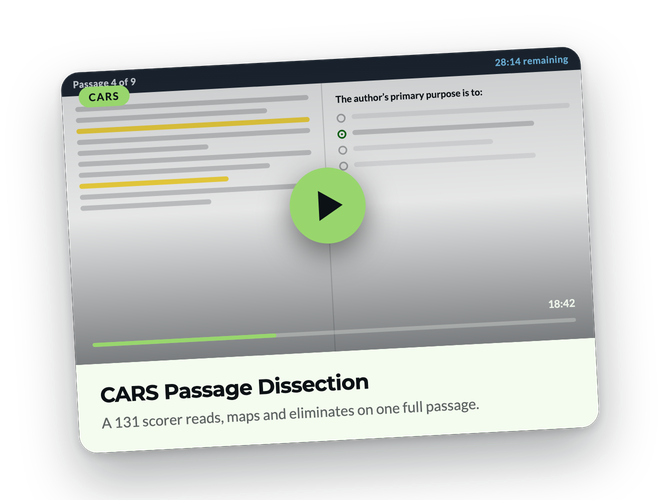
CARS Passage Dissection · Free, 19-minute video
Hear Why a 131 CARS Scorer Keeps or Cuts Every Answer Choice, and Stop Losing CARS Points Between the Last Two
A 19-minute walkthrough of one full passage from a 522 MCAT scorer, reasoning out loud.
Join 12,000+ students using our free resources
On its way.
Check your inbox in the next minute.
What Is the CARS Section of the MCAT?
CARS stands for Critical Analysis and Reasoning Skills. It’s the second of the four MCAT sections, right after Chem/Phys and a 10-minute break, and it tests how you read and reason through an argument.
Those numbers come from the AAMC’s CARS section overview and its score scale page. The passages cover subjects like ethics, philosophy, cultural studies and population health, and you don’t need any background in them to do well!
CARS comes second, after a full science section. Sit some of your practice CARS sections after a science set, so reading on a tired brain feels familiar by test day.
What Your CARS Score Means Right Now
It helps to know where you’re starting. The AAMC publishes percentile ranks for every section score, and here’s where each CARS score sits today.
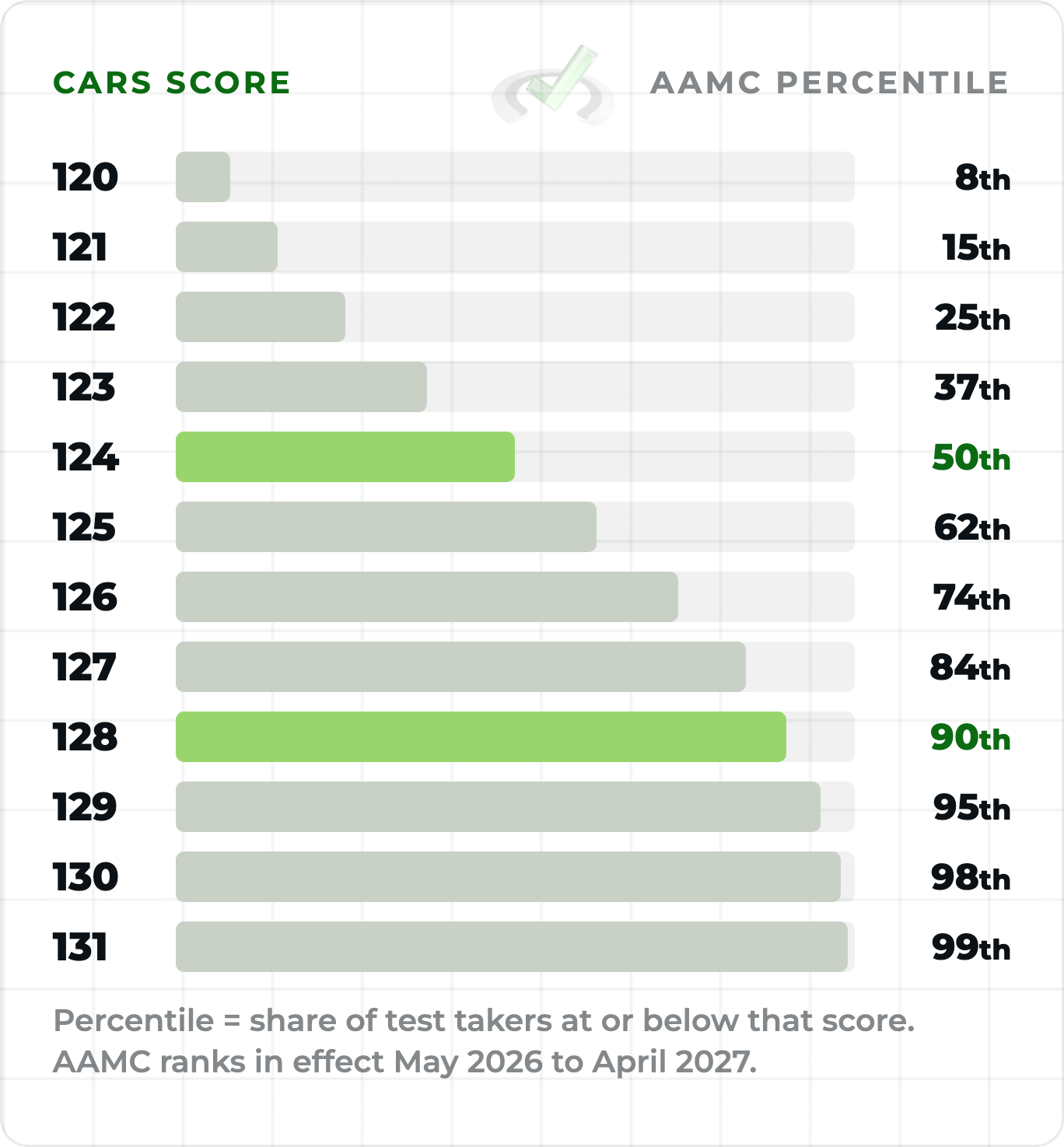
A 124 sits at the 50th percentile, and a 128 puts you at the 90th. If you’re at a 122 or 123 right now, you’re at the 25th or 37th percentile, with plenty of room to climb!
Before you can raise a score you need a reliable baseline. The MCAT score calculator converts your raw answers on the free AAMC unscored sample test into a scaled score and percentile, and links you to the test if you have not taken it.
Our MCAT percentile ranks guide has the full table for every section.
Why Your CARS Score Is Stuck or Going Down
Doing passage after passage and reviewing your mistakes is good advice, once your process works. If you’re already doing that and your score won’t climb, the process itself needs fixing.
More passages on the same habits give you the same results. So fix the process first, then practice as much as you can until test day. That’s the order our 130+ CARS scorers recommend!
A dip can happen while you change habits, too. Ariana, one of our CARS instructors, went from about a 127 on her diagnostic to a 125 three months before her test. She scored a 130 on test day!
If your whole score has stalled, our guide to why your MCAT score is not improving covers the other sections. The eight strategies below come from our 130+ CARS scorers, and each one can help you increase your CARS score!
Strategy 1: Find the Core Concept of Every Passage
The core concept is the main idea underneath the passage, the point the author wants you to accept. Almost every CARS question circles back to it, so give yourself a moment to pin it down.
Top scorers suggest writing it in one or two sentences while you practice. Here’s how they find it:
- Make a quick list of possible core concepts, each in as few words as you can.
- Narrow it down to the ones that matter most.
- Work out how those top concepts connect. Usually the link is easy to spot.
- Write one to three sentences that tie them to the passage and to the author. That’s your core concept!
On the questions, choose the answer that matches the core concept and has no detail that contradicts the passage.
It also helps to read the author as someone trying to convince you, and to check whether each argument holds up. CARS questions ask you to judge those arguments, so you’ll be ready.
For more, see how 130+ CARS scorers analyze sentences and our in-depth guide to finding the main idea.
Top CARS scorers aim to stop writing things down by test day. Writing is fine if you need it, and the more you practice this process, the faster it runs in your head!
Strategy 2: Stay in the Passage and Pace Each One
You get 90 minutes for 53 questions, usually across nine passages. One top scorer recommendation is to give each passage 9 minutes and keep the last 9 minutes as a cushion.
Staying focused matters as much as the clock. Rereading a passage when you reach its questions costs time, so aim to follow it the first time through.
Many of our top scorers stay focused by writing a quick note after each paragraph about what it said. At the end, they jot one or two sentences with the main idea.

The highlight tool helps a lot of top scorers stay in the passage too. Try it and see if it works for you!
When you finish a passage’s questions, close your eyes for a few seconds and take a couple of deep breaths. Start each passage with a clear head, so the last argument doesn’t blur into the new one.
Our guide to MCAT CARS timing shows how slow readers finish on time, and our step-by-step CARS passage dissection lets you follow a 130+ scorer through an AAMC passage.
(Optional) If you’d like to build pacing with a group, our 6-Week Live MCAT Accelerator works live passages in every section to build pacing endurance. It’s a fun way to practice :)
Strategy 3: Spot the Trap Answer
In a lot of CARS questions, two answers are clearly wrong and two look good. One of those two is a trap, and the other is correct.
The trap sounds great until you notice one small detail that’s a little off. It isn’t obviously wrong, and the rest of the answer is so appealing that you want to pick it anyway. Don’t!
The correct answer often sounds less exciting, so you start second-guessing yourself. That’s on purpose, and once you expect it, it loses its grip on you.

Stuck between the last two? Our 519 scorer’s tips for choosing between two answers and our guide to how 130+ scorers approach CARS passages go deeper.
Spotting traps on every question helps you increase your CARS score one passage at a time.
Our CARS Mastery Course also has a full lesson on the tricks and traps CARS question writers use. You’ll start spotting them everywhere!
Strategy 4: Leave Outside Knowledge Outside
Have you ever picked an answer you were sure was right, and it turned out wrong? Or dismissed one you were sure was wrong? It’s so frustrating!
CARS questions are written so the correct answer isn’t obvious, because that’s how they test critical thinking. Often the culprit is outside knowledge.
An answer sounds right because it matches something you believe or learned elsewhere. A correct answer sounds wrong because it clashes with what you know. On CARS, only the passage counts.
130+ CARS scorers train themselves to care about one thing, whether an answer links to the passage. Whether it’s true in general doesn’t matter here.
- You’ll overlook right answers if you go with whichever one sounds correct.
- Pick the answer that’s consistent with the passage, even if it sounds odd, surprising or false.
Answers that sound “true” are a classic trap for lower-scoring test takers. Training yourself out of it with practice is a steady way to increase your CARS score.
In its own words, “Everything you need to know to answer test questions is in the passages and the questions themselves.” If you can’t point to the line that supports your answer, look again!
Strategy 5: Read Like a Skeptic Outside of CARS
Everyone’s reading can improve, whatever your starting point. If English isn’t your first language, our guide for ESL students on the MCAT has more help for you!
If you have time before your MCAT, many top scorers recommend reading outside your prep:
- Opinion essays and opinion-based articles
- The New Yorker
- The Wall Street Journal
- News magazines that analyze the news more than they report it
While you read, form counter-arguments in your head and follow the debate the author is part of.
Bonus points if you pick the one you find least interesting. If you can read it with some interest, you’re on your way to CARS success!
This also trains you to take in a lot of text at once and follow the author faster. Top scorers focus on thinking critically about what they read and applying it to a new situation, since CARS questions ask for both.
Starting early gives this habit time to build, and our guide on how to prepare for CARS lays out a plan.
Strategy 6: Read Every Passage Like It’s Your New Major
A lot of premeds dread CARS, and some passages are dry. Accept that a few will bore you, and decide how you’ll handle it before test day.
A negative mindset costs you. Some people lose reading speed when they’re frustrated, and others take in less of what they read. Why take that chance?
Top scorers make the passage interesting on purpose. For the next few minutes, the topic is your new major and you can’t wait to learn about it, even if it’s art history and you’re a biology major!
Your mind stays active, and the section goes by more smoothly. Frustration and stress lead to brain fog, and brain fog costs points.
Ariana’s CARS mindset shift took her from a 125 to a 130 in CARS, and her story walks through the change she made.
Before each practice section, decide you’ll find one interesting idea in every passage. It feels silly at first, and it gets easier every time!
Strategy 7: Let Go of the Details You Don’t Need
Taylor raised her MCAT from 499 to 511 in two and a half months and scored a 131 in CARS. We asked her how she handled CARS.
Regarding CARS, I found it helpful to read through the passages without focusing too much on understanding every detail. Doing this allowed me to save on time and I still understood the main concepts by the end of the passages.
Previously I would get too caught up on a sentence that I did not understand and would end up wasting time and losing focus.
Taylor E. 131 CARS
Details in the question are a different story. Read the question stem closely, since a detail there often decides between your last two answers.
When a sentence in the passage won’t come clear, note where it is and keep going. Come back only if a question sends you there :)
Strategy 8: Practice and Review to Increase Your CARS Score
Once your process is in place, practice as much as you can until your exam. Nothing beats practice in CARS!
Review every passage, right answers included. For each miss, find the line in the passage that held the answer, then sort the miss by its cause.
Our guide on how to review CARS walks through it step by step.
The AAMC’s own passages are the closest you’ll get to test day. The old Question Packs now live in the AAMC CARS Question Bank, and our guide shows where every passage went. For more practice, try our free CARS practice questions.
If your misses don’t fit a pattern, a few 1:1 tutoring sessions with a 515+ scorer can help. We’ll match you with a tutor who’s strongest where you’re struggling, and they prepare before every session. That’s what we’re here for!
Seeing a 130+ scorer reason through an AAMC passage shows you where they slow down and what they let go. The free video near the top of this page and our 131 scorer’s passage walkthrough are great places to start!
How to Increase Your CARS Score: Quick Answers
What is a good CARS score?
A 124 sits at the 50th percentile and a 128 at the 90th, on the AAMC’s current percentile ranks. What’s good for you depends on your total target and your schools, and our guide to what makes a good MCAT score helps you set one.
Is a 122 or 123 in CARS bad?
A 122 is at the 25th percentile and a 123 at the 37th. It’s a starting point, and every strategy on this page is built for climbing from there!
Can you increase your CARS score in a week or two?
A week or two gives you time to start fixing habits, like answering from outside knowledge or falling for trap answers. Reading speed and comprehension take longer to build. Our guide to raising your MCAT score in 2 weeks has a short-runway plan.
Why is my CARS score going down?
Scores can dip while you change habits, and they can stall when you practice without fixing your process. Sort your misses by cause, and if the same cause keeps showing up, fix that one first.
Final Thoughts on How to Increase Your CARS Score
CARS can feel like the hardest section to improve, and some of our 130+ CARS instructors started in the low 120s. You can increase your CARS score with steady habits.
Find the core concept, pace each passage, check every detail and answer only from the passage. We’re cheering you on!
Our CARS Mastery Course teaches these strategies step by step, with video lessons from 130+ CARS scorers and full walkthroughs of AAMC passages.
If you’d rather have someone work through passages with you, 1:1 MCAT tutoring pairs you with a 515+ scorer. We’d love to help you get there :)
Working on more than one section? Our guides to raising your Chem/Phys, Bio/Biochem and Psych/Soc scores, and our complete guide to increasing your MCAT score, pair well with this one. You’ve got this!
Watch the CARS Passage Dissection
On its way.
Check your inbox in the next minute.

 To help you achieve your goal MCAT score, we take turns hosting these