Olivia Paraschos, one of our MCAT strategy instructors, scored a 523. For the first stretch of her prep, she was in content review, reading books and watching YouTube videos. Her first practice exam showed her it hadn't prepared her to answer MCAT questions.
So she changed how she studied. She switched to practice questions and kept a spreadsheet of the ones she missed.
Before long she was reading questions the way the people who write them do, and on test day she scored a 523, right around her last few practice exams.
If you're weighing content review vs practice questions right now, her story is for you 🙂 Watch the video, or read her story below.

Olivia's own prep and result, in her words. Scores vary with your starting point, your timeline and how you prep.
- Content review vs practice questions, where her prep started
- The practice exam that showed her the gap
- Switching from content review to practice questions
- How Olivia reviewed every practice question she missed
- Thinking like the people who write MCAT questions
- Why passage-based questions got easier for her
- Her last practice exams, and a 523 on test day
- Why these skills outlast the MCAT
- What Olivia's story says about content review vs practice questions
- What Olivia covers in the live course
- Common questions about content review vs practice questions
Content review vs practice questions, where her prep started
Olivia started, in her words, “probably similar to a lot of you,” with a lot of content review.
Topic by topic, she read through a bunch of MCAT prep books and watched a lot of YouTube videos, trying to hit every major topic the exam covers.
It was overwhelming. There's a huge amount the MCAT expects you to know, and making sure all of it was sticking was hard.
Knowing a topic, and answering a question on it
The harder problem was that she couldn't see how the exam would ask about any of it.
“I think it's one thing to know the topics, and it's totally another thing to be able to answer somewhat related questions on the MCAT.”
That gap is hard to see while you're reading. A chapter can feel finished, and a passage can still ask you to use it in a way the chapter never did.
If you'd like to test it on yourself, pick a topic you'd call finished and try ten practice questions on it.
If the questions feel harder than the chapter did, you've found the same gap she found. That's good news, because now you know where to work!
The practice exam that showed her the gap
Not feeling great about her prep, Olivia knew she should probably take a practice exam to see where she was falling. She didn't expect it to go well.
It didn't. The score wasn't a surprise, and it was still a little frustrating, because of what it told her.
“All of the work that I had done in terms of learning the content hadn't really prepared me at all to take the exam.”
She still credits that content review with giving her a baseline and a framework to build on.
What she decided after that exam
After getting that score back, she sat and reflected on how she'd been approaching her studying. Then she came up with a different way to study, one aimed at the MCAT itself.
“I wasn't just learning the content, but I was actually studying for the exam itself.”
Why a first practice exam helps, even when it goes badly
- It shows you where you stand while there's still time to change course.
- It tells you whether your content review is turning into points.
- It puts you in front of passage-based questions, the kind she hadn't come across in content review.
- It gives you a baseline to measure every later exam against.
If you haven't taken one yet, our free MCAT practice test is a low-stakes place to start, and our guide to the best MCAT practice exams covers the rest. The official practice material comes from the AAMC, which writes the exam.
Her rough first score came before her 523. Yours is a starting point too!
Switching from content review to practice questions
Looking back at that exam, Olivia realized she hadn't been doing nearly enough practice questions. Before it, she hadn't done any.
Questions, she figured, were where her score would start to climb, so she started running through a lot of them.
Third-party questions first, AAMC toward the end
Her answer to content review vs practice questions was to lead with questions. First came third-party resources like UWorld, and toward the end of her studying she did some of the AAMC's own questions.
The AAMC writes the MCAT, and there's a limited amount of official practice material, so we'd keep some of it for your last few weeks. That's where it landed in her prep too.
You can start questions today, even with content review still going!
If UWorld is part of your plan, our guide to using UWorld for MCAT prep covers a daily question count and how to review them.
When things started to click
Things started to click a little better after the switch, and it came down to what she did once each question was answered.
How Olivia reviewed every practice question she missed
When Olivia got a question wrong, she sat with it and asked herself why. Then she kept track of it in a spreadsheet.
“It was that organization and running through question after question that I think really started to help things click for me.”
What went into her spreadsheet
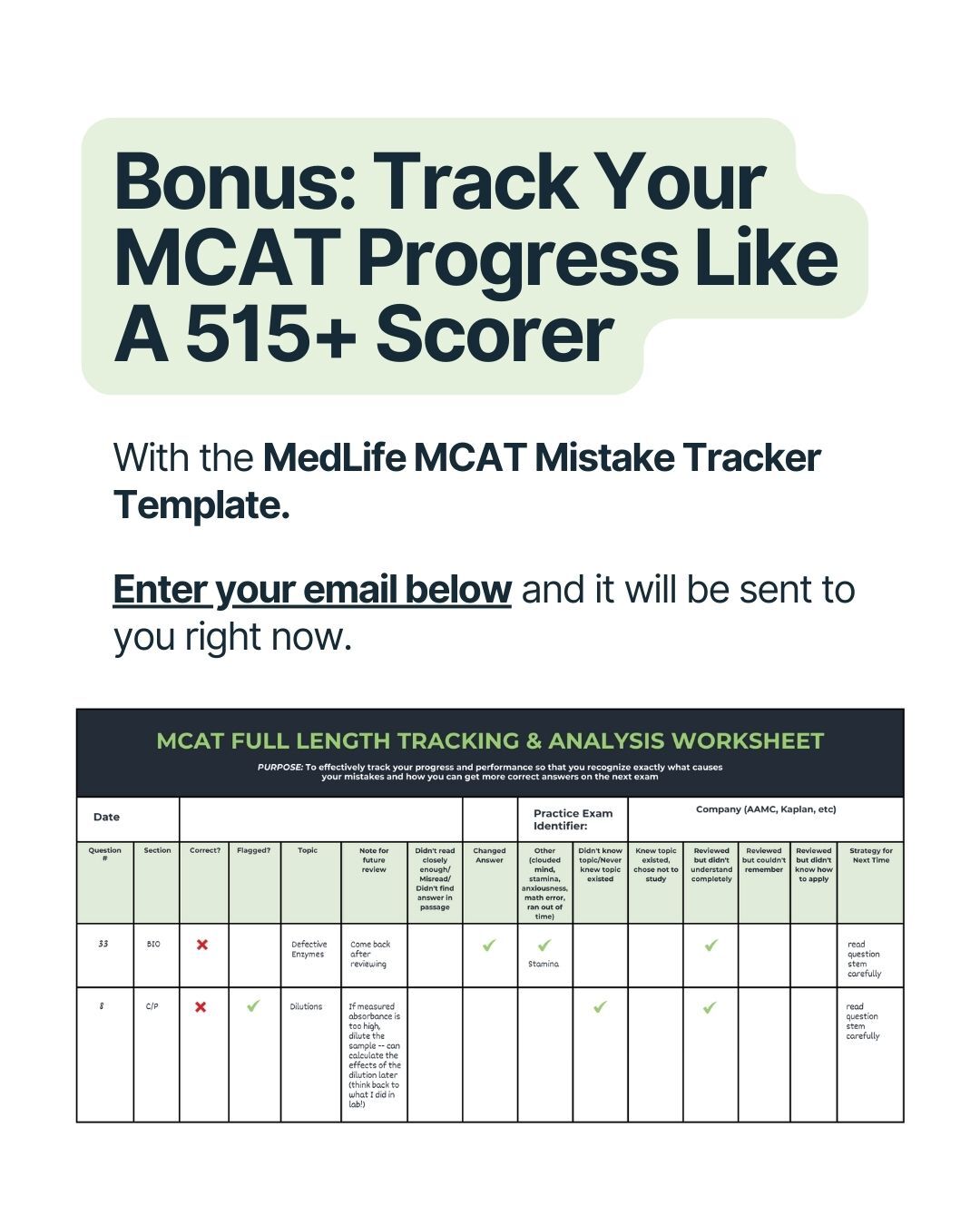
She used it to see where she could work on things, and which things were going well. Since she doesn't list her columns in the video, these are the ones we'd track for every question you miss:
- The section and the topic, so you can see which areas keep coming up
- The type of question, passage-based or standalone
- Why you missed it, whether it was a content gap, a misread, timing or reasoning that went sideways
- How confident you felt when you picked your answer
- What you'll do differently next time
- What went well, which she tracked too
Question by question and day by day, our guide to reviewing MCAT mistakes walks through a full version of this. It's slower than moving on, and it's the habit she credits with things clicking!
Free download
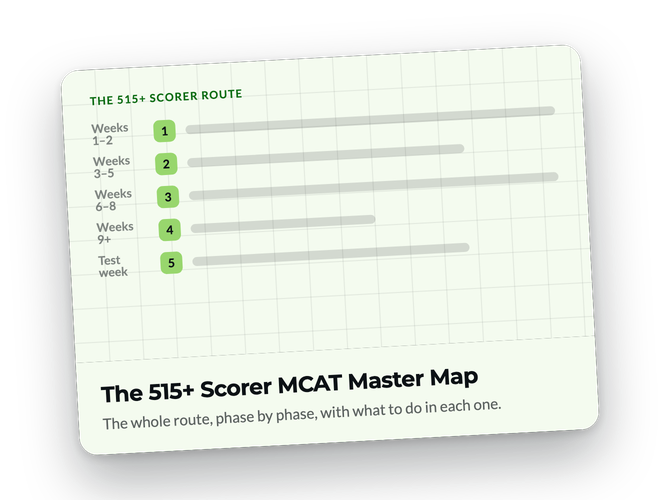
Olivia logged her misses on the way to a 523. Here is a tracker to start logging yours.
The 515+ Scorer MCAT Master Map includes question-level mistake trackers for all four sections, ready to fill in.
On its way.
Check your inbox in the next minute.
When a miss turns out to be a content gap
That's when content review earns its place again. Our advice is to review that one topic, make an Anki flashcard for the piece you missed, and head back to questions.
The same review works on a full practice exam, on a bigger scale. Our practice test strategies page covers how 515+ scorers approach and review a full-length.
Thinking like the people who write MCAT questions
Question after question, Olivia started to pick up on patterns in the types of questions the exam asks, and in the way it explains the correct answers.
“As I was going through these questions, I was starting to think almost like the people who are writing the questions, which I think is a great approach for the exam.”
That habit carried her on questions where her content wasn't solid, and it grows with every question you review. You can build it too :)
“Even if you're not 100% sure on the content for certain things, sometimes you can just figure out which answers sound like wrong answers and which ones sound like right answers based on what questions you've already seen.”
Olivia says it helped her performance on the exam “tremendously.”
Questions to ask yourself when you review
Our process of elimination guide, written by a 524 scorer, suggests a few questions to ask after each miss. They help you see the patterns sooner:
- Did I pick an answer that's true but doesn't answer this question?
- Did I eliminate answers too early?
- Did I reread the question before choosing?
- Did I cross out the right answer at any point?
Our guide to getting stuck between two choices shows what to compare when two options both look right.
Why passage-based questions got easier for her
At the beginning, the questions that were heavily passage-based were difficult for Olivia. The passages covered things she hadn't come across in content review, and those questions stressed her out.
After practice question after practice question, she noticed that the passage-based questions test the same skills, whatever the passage is about.
“Regardless of what passage they're actually attached to, they're all testing kind of the same skills.”
Once she'd built those skills, they became some of the easier questions on the exam for her. In the moment, she didn't have to remember some small fact.
“Everything you need is right there on the screen next to the question.”
A lot of reassurance. In Olivia's words, “maybe you don't need to know every single fact, but you want to feel good about the questions that you know that you can get right.”
The skills the AAMC says it tests
In the video she doesn't name them. The AAMC does, in its official outline of the exam. The three science sections test four reasoning skills:
- Knowledge of scientific concepts and principles
- Scientific reasoning and problem-solving
- Reasoning about the design and execution of research
- Data-based and statistical reasoning
CARS tests three of its own:
- Foundations of comprehension
- Reasoning within the text
- Reasoning beyond the text
Every passage you practice is another rep on that short list. Our guides to science passage strategies and what the MCAT tests go deeper, and our timing guide helps once the skills are there.
That's good news if content review has you worried you'll never know every fact!
Her last practice exams, and a 523 on test day
A little later in her studying, Olivia took more practice exams. Her score had gone up a long way from where she started, and from where she'd been struggling.
On a few practice exams in a row, she hit around her goal score, a score that made her competitive for the medical schools she was interested in. Then she sat for the MCAT and scored right around where those practice exams fell.
“It felt like all of the hard work that I had put in had eventually paid off.”
It took a while, and she puts a lot of it down to “shifting the way that I was approaching and thinking about the exam.”
Our guide to whether 523 is a good MCAT score covers what it means for a school list, and our MCAT percentile table shows every score.
Using your practice exams to judge readiness
Her test day score landed right around her last few practice exams. So when you're deciding if you're ready, we'd look at your recent practice scores together, and check them against a good MCAT score for the medical schools on your list.
Your own practice exams can show you when you're close too!
Why these skills outlast the MCAT
A lot of the skills Olivia built during MCAT prep came with her into medical school.
“The exams aren't going to be over once you finish the MCAT.”
Medical school brings its own, and she lists them:
- Preclinical exams
- Exams on clinical rotations
- All of the USMLE exams, the licensing exams we cover in our USMLE guides
In Olivia's words, “they all require a similar level of critical thinking.” The review habits you build now come with you to med school :)
Our article on the lifelong skills the MCAT teaches, from a 517 scorer and career changer, makes the same point.
What Olivia's story says about content review vs practice questions
Since the video doesn't give week counts, read these as the order Olivia worked in for content review vs practice questions. Each one comes from what she did.
- A practice exam before you feel ready. Hers showed her what content review alone hadn't done.
- Practice questions alongside your content review. She'd done none before her first practice exam, and that was what was missing.
- Third-party questions first. She ran through a lot of them, UWorld included.
- AAMC questions toward the end. That's where they landed in her prep, and the official material is limited.
- Every miss reviewed. She sat with each question she got wrong.
- A spreadsheet for the misses. It showed her where to work and what was going well.
- An eye on the patterns. The types of questions, and how the explanations justify the right answer.
- Passages treated as skill practice. The same skills show up whatever the passage is about.
- A run of practice exams near your goal. Her test day landed right around hers.
Signs you've leaned on content review for too long
- You've done few or no practice questions so far
- You can explain a topic and still miss questions that use it
- Your first practice exam surprised you
- Passage-based questions stress you out because the material looks new
- The amount there is to know feels overwhelming
If a few of these sound familiar, you're right where she was, and she went on to score a 523!
Where content review still fits
She credits content review with her baseline and framework. Once you're doing questions, a miss that shows a content gap sends you back to that one topic, and our study notes by subject work well for that.
What Olivia covers in the live course
Olivia recorded this video to introduce herself to students joining one of our live course cohorts. She's from the Chicago area, and outside of academics she likes to cook and bake, read, and do yoga and running.
Because studying for an exam this big is stressful, she relates to students on their MCAT journey.
“There's about a million pieces of advice out there and resources that you could potentially use.”
Her goal is to help students with the questions that come with that, like which route to take, how to approach it and how to make the most of their time. She wants them walking into test day prepped and confident.
In the course, she sees her job as giving you:
- A little push when you need one
- Advice on what she thinks is high yield to know going into the exam
- Answers to the questions that come up along the way
- Some encouragement
If the next cohort doesn't fit your test date, 1:1 MCAT tutoring works around your timeline instead. You can also meet our mentors or read more MCAT success stories.
Common questions about content review vs practice questions
When should I stop content review for the MCAT?
The video doesn't give a date. Her signal was a practice exam that showed her content review hadn't prepared her to answer questions. We'd start practice questions well before content review feels finished, and keep reviewing the topics your misses point to.
Should I do practice questions during content review?
Before her first practice exam she hadn't done any, and that was the gap. Our UWorld guide covers starting questions early.
How do I review MCAT practice questions?
We'd sit with every miss, ask why, and log it with the topic, the question type and the reason, the way she did. The 515+ Scorer MCAT Master Map has a tracker for each section, and you can download it free.
Can I get questions right without knowing all the content?
Sometimes, in Olivia's experience. After enough questions she could tell which answers sounded wrong and which sounded right, and on passage-based questions she found everything she needed on the screen.
What did Olivia score?
A 523 on test day, right around her last few practice exams.
You've been putting in the work, and in Olivia's words, “I'm sure it'll pay off.” We're rooting for you :)
Get The 515+ Scorer MCAT Master Map and its mistake trackers
On its way.
Check your inbox in the next minute.

 To help you achieve your goal MCAT score, we take turns hosting these