
We reviewed six MCAT book sets against the same rubric and checked every edition and list price in August 2026.
Editions matter more here than in any other category: Kaplan revises annually and released a substantially rebuilt 2027-2028 set in July 2026, while other publishers on this page have not kept pace.
One framing before the rankings. Every set here is a content resource.
They are ranked against each other on how well they teach content and how well they read, not against coaching, which solves a different problem. The section after the rankings explains where books stop being the answer.
How we scored these sets
Each set is scored out of ten on five weighted criteria, value for money (25%), strategy versus content (25%), explanation quality (20%), practice material (15%), and how current the edition and its extras are (15%).
We do not score marketing claims about score improvements, because no publisher provides outcome data that can be compared.
The six sets, ranked
Each entry is a summary. Follow the link for the full review, the edition detail and a set-by-set comparison.
1 ExamKrackers 8.0/10
The best-written set on this page and the only one that seriously teaches approach rather than only content. Deliberately leaner than Kaplan, which is a feature for most students and a limitation for a few.
Strengths
- The clearest explanations in MCAT print, by a wide margin
- 44 mini-MCATs alongside 3 full-length exams, far more practice than the alternatives
- The CARS book is the long-standing favorite in this market
- Deliberately leaner, which cuts low-yield material rather than padding
Drawbacks
- Less exhaustive than Kaplan or Princeton Review, so a genuine gap in an obscure topic may need another source
- Retail pricing varies by seller and is less consistent than the big two
- The conversational voice does not suit every reader
- Production values are plainer than the big publishers
2 AAMC Official Guide 7.8/10
Written by the organization that writes the exam, which makes it the only source here with no interpretation layer. It is a guide and a question set, not a content review, and buying it expecting otherwise is the usual disappointment.
Strengths
- Written by the AAMC, so it reflects the exam rather than a guess at it
- Official practice questions are the closest thing to the exam itself
- Explains the structure, scoring and logic of the exam authoritatively
- Inexpensive relative to every third-party set
Drawbacks
- It is not a content review book and will not teach you biology or physics
- Question volume is small next to any third-party set
- Currently the Fifth Edition, revised infrequently
- Most of the value sits in the separate AAMC online bundle, not the book
3 Kaplan 7.2/10
The most complete content set in MCAT prep, and freshly rebuilt. It teaches every topic on the outline well. What it cannot do is change how you take the exam.
Strengths
- The 2027-2028 edition adds 500+ new full-color science images and an entirely rebuilt CARS book
- Covers every topic on the AAMC outline to a consistent standard
- Three practice tests and online resources come with the set
- Revised annually, so the content tracks the current exam
Drawbacks
- Around $300 list makes it the most expensive set on this page
- Sheer volume is intimidating and encourages passive reading
- Content-heavy by design, with little on passage strategy
- Annual revisions mean a set dates quickly if you buy ahead
4 The Princeton Review 7.0/10
A thorough, well-presented content set that does the same job as Kaplan for a little less money. Which of the two suits you is mostly a question of how you like to read.
Strengths
- Seven books covering every section, plus three online practice tests
- Lists below Kaplan at $259.99 and sells well under list
- Layout is cleaner and less dense than the main alternative
- Strong diagrams, particularly in the science volumes
Drawbacks
- Content-led throughout, with limited coverage of passage strategy
- The CARS volume is the weakest book in the set
- Revised less frequently than Kaplan, so check the edition date
- Practice questions run easier than the exam itself
5 Barron's 4.5/10
A single volume trying to cover an exam that the major publishers need seven books for. Inexpensive, and the arithmetic on that is not as good as it looks, because the gap has to be filled from somewhere.
Strengths
- Inexpensive, and lower still second-hand
- One volume is less intimidating than a seven-book set
- Includes online practice tests
- Reasonable as a first orientation to the exam’s shape
Drawbacks
- One book cannot cover what the exam tests, and the compression shows
- Has not kept pace with the current exam the way annually-revised sets have
- Very little on passage strategy or CARS approach
- Practice material is thin and does not reflect current difficulty
6 Mometrix 4.0/10
A general test-prep publisher’s take on the MCAT rather than a dedicated MCAT resource, and the difference shows. Inexpensive, current in edition number, and thin against what this exam demands.
Strengths
- Inexpensive next to the dedicated MCAT sets
- Currently on its 9th edition, so the edition number is current
- Includes practice tests
- Compact enough to work through quickly
Drawbacks
- Mometrix is a general test-prep publisher, not an MCAT specialist, and the depth reflects that
- A single guide against an exam the specialists cover in seven volumes
- Very little on passage strategy, which is where MCAT points are won
- Practice material does not reflect the difficulty of the exam itself
Free quiz
The Unbiased MCAT Prep Course Decision Quiz
Three different problems stall an MCAT score, and buying the wrong fix costs months. Six questions sort out which one is yours and what to spend on it. We name competitors and free resources when they beat us, and say so when the answer is spend nothing.
No email required. Your plan appears on screen.
Transparency, before you start. We sell MCAT tutoring and courses, so here are the rules this quiz follows.
- Zero budget, no purchases. Free resources only, and we say so.
- Content gap, buy content first. From whoever does it best, which is usually not us. Our tutoring comes up only as an optional add-on for a big gap.
- Strategy gap, we recommend our own course first. We would put our name against it, and we name a lower-priced alternative beside it so you can price us against ours.
- Competitors named and linked when they beat us: UWorld, Kaplan, Blueprint, ExamKrackers, Khan Academy.
- We appear only where we fit, with the budget to match, and always beside a lower-priced option.
- Our free MCAT resources show up wherever they fit, and they ask for nothing.
Where books fit, and where they do not
Every set on this page is a content resource, and that decides whether buying one is a good use of your money.
Books are excellent at closing content gaps. If there are topics you have never properly learned, a well-written set will teach them, at your pace, for a fraction of what a course charges.
This is the case books are built for and they do it well.
Books cannot watch you work. They cannot see that you commit to an answer before finishing the passage, or that you lose four minutes on the first CARS passage every time.
The most common thing students write to us about is finishing a full content resource, retaining it, and sitting at the same practice score. No book fixes that, because the problem is not knowledge.
What we would recommend. Buy the official AAMC material first, because nothing substitutes for questions written by the people who write the exam. Add one book set if you have content gaps to close.
Add a question bank. Only then consider investing in hours with a person, and only if your score has stalled while you already know the material.
We sell coaching, so read that ordering knowing what we sell. It is also the order we would give a friend who was never going to buy anything from us.
How to choose between them
If you need content taught thoroughly, Kaplan or Princeton Review. They cover the same ground and either will close a gap. Kaplan is fresher and its CARS book has just been rebuilt; Princeton Review lists for less.
If you want to understand rather than memorize, ExamKrackers. It is the best-written set here and the only one that teaches approach alongside content, and it ships far more practice.
If you are buying one thing only, buy the official AAMC material instead of any of these. It teaches no content, and its questions are the only ones written by the people who write the exam.
If budget is the binding constraint, buy a previous edition of a good set second-hand rather than a current edition of a weak one. A year-old Kaplan beats a new single-volume guide.
Skip the single-volume options as a primary resource. One book cannot carry an exam that the specialists need seven for, and most students who start there buy a proper set anyway.
See the 6-Week Live MCAT Accelerator
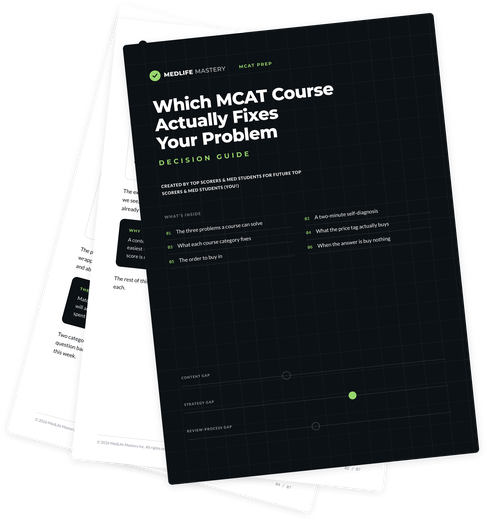
Get the free Decision Guide
On its way.
Check your inbox in the next minute.