As MCAT tutors, one of the most common questions we get from students is "what high yield MCAT topics do I actually need to know?" The answer should be personalized to your specific strengths, academic background, and comfort with different subjects.
But there are general principles every student can use to find the topics that matter most for their score goals. Identifying the content areas you need to study early in your MCAT prep helps you score higher, study less, and stress less.
Here's what content you actually need to know to ace this test.
Start With the High Yield MCAT Topics List
Not all topics on the MCAT are tested equally. Depending on where you are in your prep, you've probably already noticed certain topics show up over and over, whether on official AAMC questions or third-party resources.
Early in your studying, get your hands on a list of MCAT high yield topics so you can master these concepts before test day. We built a checklist of the highest-yield MCAT topics based on what our mentors, all 90th-percentile-plus scorers, have seen tested most.
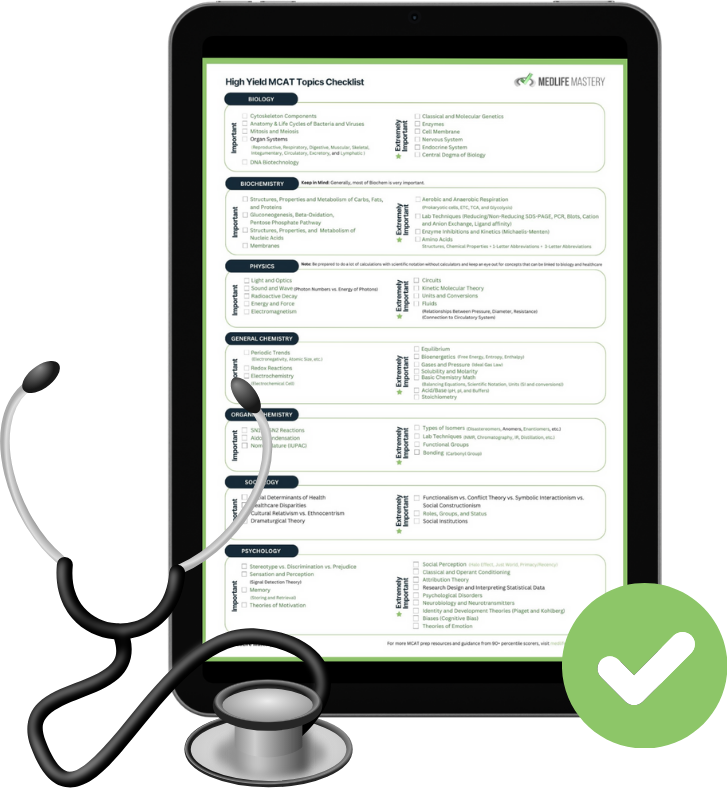
Want it as a printable PDF?
Download the free high yield MCAT Topics Checklist and the rest of our free MCAT resources here →
Here's the full list, organized by subject, with a link to our study notes on each one.
High Yield MCAT Topics List - Sortable Table
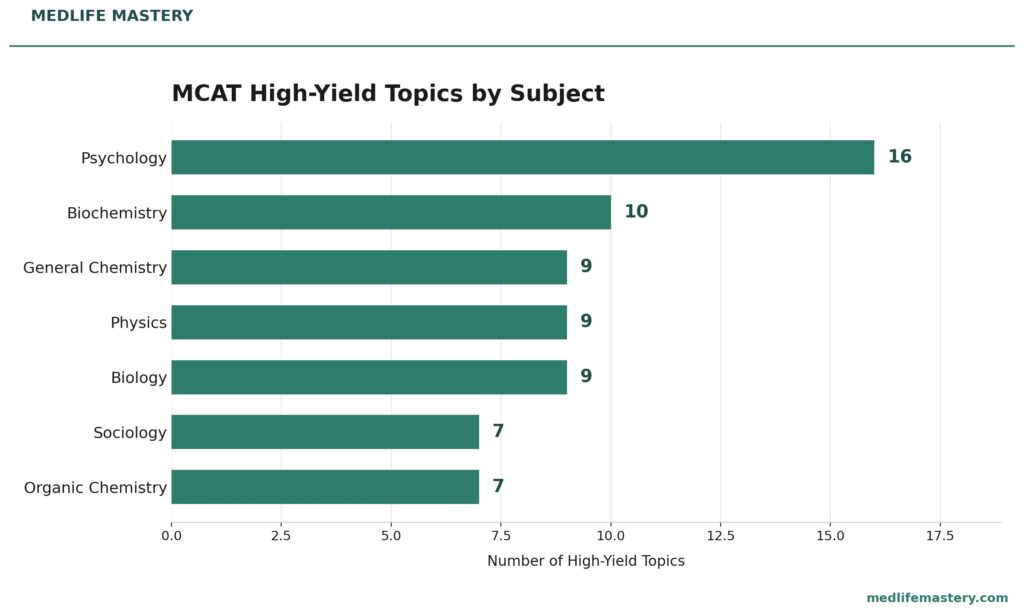
MCAT High-Yield Topics by Subject
Click any column header to sort. On mobile, tap a subject to expand it.
| Section | Subject | Topic |
|---|---|---|
| Bio/Biochem | Biology | Cytoskeleton Components |
| Bio/Biochem | Biology | Anatomy and Life Cycles of Bacteria and Viruses |
| Bio/Biochem | Biology | Mitosis and Meiosis |
| Bio/Biochem | Biology | Organ Systems: Reproductive, Respiratory, Digestive, Musculoskeletal, Integumentary, Circulatory, Excretory, and Lymphatic |
| Bio/Biochem | Biology | DNA Biotechnology |
| Bio/Biochem | Biology | Classical and Molecular Genetics |
| Bio/Biochem | Biology | Nervous System |
| Bio/Biochem | Biology | Endocrine System |
| Bio/Biochem | Biology | RNA, DNA, and the Central Dogma of Biology |
| Bio/Biochem | Biochemistry | Structures, Properties, and Metabolism of Carbohydrates, Fats, and Proteins |
| Bio/Biochem | Biochemistry | Gluconeogenesis, Beta-Oxidation, and the Pentose Phosphate Pathway |
| Bio/Biochem | Biochemistry | Structures, Properties, and Metabolism of Nucleic Acids |
| Bio/Biochem | Biochemistry | Aerobic and Anaerobic Respiration (Prokaryotic Cells, ETC, TCA, Glycolysis) |
| Bio/Biochem | Biochemistry | Lab Techniques |
| Bio/Biochem | Biochemistry | Enzyme Inhibition and Kinetics (Michaelis-Menten) |
| Bio/Biochem | Biochemistry | Amino Acids |
| Bio/Biochem | Biochemistry | Membranes: Transport and Dynamics |
| Bio/Biochem | Biochemistry | Enzymes |
| Bio/Biochem | Biochemistry | Bioenergetics (Free Energy, Entropy, Enthalpy) |
| Chem/Phys | Physics | Light and Optics |
| Chem/Phys | Physics | Sound and Waves |
| Chem/Phys | Physics | Radioactive Decay |
| Chem/Phys | Physics | Energy and Force |
| Chem/Phys | Physics | Electrostatics and Magnetism |
| Chem/Phys | Physics | Circuits |
| Chem/Phys | Physics | Kinematics |
| Chem/Phys | Physics | Units and Conversions |
| Chem/Phys | Physics | Fluids (Pressure, Diameter, Resistance, and the Circulatory System connection) |
| Chem/Phys | General Chemistry | Periodic Trends (Electronegativity, Atomic Size) |
| Chem/Phys | General Chemistry | Redox Reactions |
| Chem/Phys | General Chemistry | Electrochemistry (Electrochemical Cells) |
| Chem/Phys | General Chemistry | Equilibrium |
| Chem/Phys | General Chemistry | Gases and Pressure (Ideal Gas Law) |
| Chem/Phys | General Chemistry | Acid/Base Chemistry (pH, pI, Buffers) |
| Chem/Phys | General Chemistry | Stoichiometry |
| Chem/Phys | General Chemistry | Solubility and Molarity |
| Chem/Phys | General Chemistry | Basic Chemistry Math |
| Chem/Phys | Organic Chemistry | Nucleophiles, Electrophiles, and Reactions |
| Chem/Phys | Organic Chemistry | Aldol Condensation (Carbonyl Group) |
| Chem/Phys | Organic Chemistry | Nomenclature (IUPAC) |
| Chem/Phys | Organic Chemistry | Types of Isomers (Diastereomers, Anomers, Enantiomers) |
| Chem/Phys | Organic Chemistry | Lab Techniques (including Spectroscopy for NMR and IR) |
| Chem/Phys | Organic Chemistry | Functional Groups: Alcohols and Ethers, Aldehydes and Ketones, Carboxylic Acids and Derivatives, and Nitrogen-Containing Compounds |
| Chem/Phys | Organic Chemistry | Bonding |
| Psych/Soc | Psychology | Sensation and Perception (Signal Detection Theory) |
| Psych/Soc | Psychology | Memory: Storing and Retrieval |
| Psych/Soc | Psychology | Theories of Motivation |
| Psych/Soc | Psychology | Language and Development |
| Psych/Soc | Psychology | Cognition and Consciousness |
| Psych/Soc | Psychology | Social Processes and Behavior in Groups |
| Psych/Soc | Psychology | Social Perception |
| Psych/Soc | Psychology | Classical and Operant Conditioning |
| Psych/Soc | Psychology | Attribution Theory (Halo Effect, Just World Hypothesis, Primacy/Recency) |
| Psych/Soc | Psychology | Research Design and Interpreting Statistical Data |
| Psych/Soc | Psychology | Psychological Disorders |
| Psych/Soc | Psychology | Neurobiology and Neurotransmitters |
| Psych/Soc | Psychology | Identity and Development Theories (Piaget, Kohlberg) |
| Psych/Soc | Psychology | Cognitive Biases |
| Psych/Soc | Psychology | Theories of Emotion |
| Psych/Soc | Psychology | Stereotype vs. Discrimination vs. Prejudice |
| Psych/Soc | Sociology | Social Determinants of Health |
| Psych/Soc | Sociology | Healthcare Disparities |
| Psych/Soc | Sociology | Cultural Relativism vs. Ethnocentrism |
| Psych/Soc | Sociology | Dramaturgical Theory |
| Psych/Soc | Sociology | Functionalism vs. Conflict Theory vs. Symbolic Interactionism vs. Social Constructionism |
| Psych/Soc | Sociology | Roles, Groups, and Status |
| Psych/Soc | Sociology | Social Institutions |
Biology
- Cytoskeleton Components
- Anatomy and Life Cycles of Bacteria and Viruses
- Mitosis and Meiosis
- Organ Systems: Reproductive, Respiratory, Digestive, Musculoskeletal, Integumentary, Circulatory, Excretory, and Lymphatic
- DNA Biotechnology
- Classical and Molecular Genetics
- Nervous System
- Endocrine System
- RNA, DNA, and the Central Dogma of Biology
Biochemistry
- Structures, Properties, and Metabolism of Carbohydrates, Fats, and Proteins
- Gluconeogenesis, Beta-Oxidation, and the Pentose Phosphate Pathway
- Structures, Properties, and Metabolism of Nucleic Acids
- Aerobic and Anaerobic Respiration (Prokaryotic Cells, ETC, TCA, Glycolysis)
- Lab Techniques
- Enzyme Inhibition and Kinetics (Michaelis-Menten)
- Amino Acids
- Membranes: Transport and Dynamics
- Enzymes
- Bioenergetics (Free Energy, Entropy, Enthalpy)
Physics
- Light and Optics
- Sound and Waves
- Radioactive Decay
- Energy and Force
- Electrostatics and Magnetism
- Circuits
- Kinematics
- Units and Conversions
- Fluids (Pressure, Diameter, Resistance, and the Circulatory System connection)
General Chemistry
- Periodic Trends (Electronegativity, Atomic Size)
- Redox Reactions
- Electrochemistry (Electrochemical Cells)
- Equilibrium
- Gases and Pressure (Ideal Gas Law)
- Acid/Base Chemistry (pH, pI, Buffers)
- Stoichiometry
- Solubility and Molarity
- Basic Chemistry Math
Organic Chemistry
- Nucleophiles, Electrophiles, and Reactions
- Aldol Condensation (Carbonyl Group)
- Nomenclature (IUPAC)
- Types of Isomers (Diastereomers, Anomers, Enantiomers)
- Lab Techniques (including Spectroscopy for NMR and IR)
- Functional Groups: Alcohols and Ethers, Aldehydes and Ketones, Carboxylic Acids and Derivatives, and Nitrogen-Containing Compounds
- Bonding
Psychology
- Sensation and Perception (Signal Detection Theory)
- Memory: Storing and Retrieval
- Theories of Motivation
- Language and Development
- Cognition and Consciousness
- Social Processes and Behavior in Groups
- Social Perception
- Classical and Operant Conditioning
- Attribution Theory (Halo Effect, Just World Hypothesis, Primacy/Recency)
- Research Design and Interpreting Statistical Data
- Psychological Disorders
- Neurobiology and Neurotransmitters
- Identity and Development Theories (Piaget, Kohlberg)
- Cognitive Biases
- Theories of Emotion
- Stereotype vs. Discrimination vs. Prejudice
High Yield MCAT Topics List - In Text Form
Biology
- Cytoskeleton Components
- Anatomy and Life Cycles of Bacteria and Viruses
- Mitosis and Meiosis
- Organ Systems: Reproductive, Respiratory, Digestive, Musculoskeletal, Integumentary, Circulatory, Excretory, and Lymphatic
- DNA Biotechnology
- Classical and Molecular Genetics
- Nervous System
- Endocrine System
- RNA, DNA, and the Central Dogma of Biology
Biochemistry
Most of biochem carries real weight on test day, so treat this section as close to mandatory:
- Structures, Properties, and Metabolism of Carbohydrates, Fats, and Proteins
- Gluconeogenesis, Beta-Oxidation, and the Pentose Phosphate Pathway
- Structures, Properties, and Metabolism of Nucleic Acids
- Aerobic and Anaerobic Respiration (Prokaryotic Cells, ETC, TCA, Glycolysis)
- Lab Techniques
- Enzyme Inhibition and Kinetics (Michaelis-Menten)
- Amino Acids
- Membranes: Transport and Dynamics
- Enzymes
- Bioenergetics (Free Energy, Entropy, Enthalpy)
Physics
- Light and Optics
- Sound and Waves
- Radioactive Decay
- Energy and Force
- Electrostatics and Magnetism
- Circuits
- Kinematics
- Units and Conversions
- Fluids (Pressure, Diameter, Resistance, and the Circulatory System connection)
General Chemistry
Electrochemistry and redox reactions deserve extra attention here, since they're some of the most heavily tested concepts on the exam:
- Periodic Trends (Electronegativity, Atomic Size)
- Redox Reactions
- Electrochemistry (Electrochemical Cells)
- Equilibrium
- Gases and Pressure (Ideal Gas Law)
- Acid/Base Chemistry (pH, pI, Buffers)
- Stoichiometry
- Solubility and Molarity
- Basic Chemistry Math
Organic Chemistry
- Nucleophiles, Electrophiles, and Reactions
- Aldol Condensation (Carbonyl Group)
- Nomenclature (IUPAC)
- Types of Isomers (Diastereomers, Anomers, Enantiomers)
- Lab Techniques (including Spectroscopy for NMR and IR)
- Functional Groups: Alcohols and Ethers, Aldehydes and Ketones, Carboxylic Acids and Derivatives, and Nitrogen-Containing Compounds
- Bonding
Psychology
- Sensation and Perception (Signal Detection Theory)
- Memory: Storing and Retrieval
- Theories of Motivation
- Language and Development
- Cognition and Consciousness
- Social Processes and Behavior in Groups
- Social Perception
- Classical and Operant Conditioning
- Attribution Theory (Halo Effect, Just World Hypothesis, Primacy/Recency)
- Research Design and Interpreting Statistical Data
- Psychological Disorders
- Neurobiology and Neurotransmitters
- Identity and Development Theories (Piaget, Kohlberg)
- Cognitive Biases
- Theories of Emotion
- Stereotype vs. Discrimination vs. Prejudice
Sociology
- Social Determinants of Health
- Healthcare Disparities
- Cultural Relativism vs. Ethnocentrism
- Dramaturgical Theory
- Functionalism vs. Conflict Theory vs. Symbolic Interactionism vs. Social Constructionism
- Roles, Groups, and Status
- Social Institutions
Save this high yield MCAT topics list, grab the PDF, screenshot it, print it out, whatever gets it in front of you regularly. The goal is knowing every item on it cold before your first full-length exam.
How Should You Study These high yield MCAT Topics?
Before you start on official MCAT questions (practice tests, the Section Bank, and so on), make sure you've reviewed the high yield MCAT topics first. As you work through practice questions, you'll get more exposure to these same concepts.
If you have access to UWorld or a similar QBank, use it to generate topic-specific question sets around the high yield MCAT list. When you review your answers, mark any question that touches a high yield MCAT topic (a screenshot folder works fine if a spreadsheet feels like overkill). Then, before your test, block off real time to go back through everything you flagged.
We built a free tool for exactly this: the MCAT Master Map. Every high yield MCAT topic in the content tracker is clickable, and clicking one pulls up a quick explainer on why it's high yield, a cheat sheet PDF, and a spot to log your comfort level.
Once you've rated a batch of topics, you can filter down to the exact list of what to study next: high yield MCAT topics where your comfort is still weak, or anything sitting at 0 percent progress. It turns the flag-and-review system above into something you don't have to build from scratch.
One of our mentors who scored 521 told us her biggest lever wasn't more content review. It was setting aside time the day after every practice test to review every single question, including the ones she got right, and letting that review shape what she studied next.
Another mentor put it a different way: burning through Anki cards taught her the vocabulary, but it didn't teach her how to use it under passage conditions. The real gains started once she asked, for every question she missed, whether she didn't know the content or didn't know what to do with it.
That distinction matters more than almost anything else in this guide, and it's not something a checklist alone can fix. If building a study plan around your specific gaps sounds like more than you want to take on solo, our 1:1 MCAT Tutoring pairs you with a 515+ scorer who builds that plan with you and adjusts it as your practice scores come in.
Besides high yield MCAT Topics, What Else Do You Need to Study?
Studying high yield MCAT topics is necessary for doing well on the MCAT. It isn't sufficient on its own. So how do you find the rest? Start here: the AAMC, the organization that writes the MCAT, publishes the full content outline of everything fair game on test day. We've also mirrored it in a cleaner format on our AAMC Outline page if the official layout is hard to navigate.
The AAMC's format is long and not built for skimming, but if you open the "Section Content" document for each section, you'll find every testable concept bolded in the right-hand column. Block off a couple of hours early in your prep to go through it once. Circle anything you feel shaky on and prioritize those first.
Keep updating this list as you study, folding in topics tied to questions you missed. Maybe you thought you had electrochemistry down cold, but you keep missing questions on it anyway. If so, it goes back on your list.
The AAMC also partners with Khan Academy on a free MCAT collection mapped to this same content outline, over 1,000 videos and thousands of practice questions. It's a solid, no-cost way to fill gaps once you know exactly where they are.
Keep a copy of the high yield MCAT checklist on hand while you work through the AAMC outline. Grab it, plus the rest of our free MCAT resources, here →
Let Your Practice Questions Build the Rest of Your List
The goal of your studying is to get actual MCAT questions right. Use your questions, whether you get them right or wrong, to decide where your remaining time goes.
If you miss two or more questions on the same topic, add it to your list, even if it isn't officially high yield. If you're unsure whether something belongs on the list, add it anyway. On something as important as the MCAT, you'd rather over-prepare than under-prepare.
If you're using the Master Map, this is what its full-length error tracker is built for. Log each missed question by topic, and the same filtering system that helped you prioritize content review now shows you exactly which topics keep costing you points across multiple full-lengths.
Planning out what to study can feel like a distraction from actually studying, especially when your test date is close and the to-do list feels endless. But taking the time to map this out early saves you time, saves you stress, and moves your score more than jumping straight into content review ever will.
It's also where most students hit a wall that content review alone can't solve. In our student intake forms, this shows up constantly: students whose content review feels solid, who still lose themselves in the wording of a passage on full-length exams.
Students who know the material and don't know what to do with it. Content knowledge gets you to the point where you understand what a passage is asking. Strategy is what gets you to the correct answer, quickly, under pressure, on a question phrased in a way you've never seen before.
That gap is what our Live 6-Week MCAT Strategy Course is built to close. It's not another content review course. It's built by mentors who scored 515 to 527 themselves, focused on teaching you how the AAMC actually thinks, so the content you already know starts showing up in your score.
And if you haven't grabbed the checklist and the rest of our free resources yet, now's a good time.
The content is the floor, not the ceiling. What you do with it on test day is what separates a 500 from a 515.
You got this,
Your MedLife Mentors

 To help you achieve your goal MCAT score, we take turns hosting these