Organic chemistry nomenclature is the set of IUPAC rules that turns a structure into a name, and a name back into a structure. On the MCAT, it usually shows up inside other questions. A passage names a compound and expects you to picture it, or shows a structure and names the answer choices, so you'll lean on these rules in both science sections!
If organic chemistry I and II left you with mixed memories, you're in good company 🙂 Like the rest of your journey to medical school, everyone starts somewhere. Nomenclature is also the base for most of organic chemistry, and it overlaps with plenty of other sections and subtopics tested on the MCAT, from sugar names to amino acid side chains!
This overview covers how to find the parent chain, number it, name the substituents and pick the suffix. The full rulebook lives in the IUPAC nomenclature recommendations, and we'll pull out everything the MCAT needs!
Organic Chemistry Nomenclature on the MCAT: What You Need to Know
Topics on organic chemistry will be tested on the Chem/Phys and the Bio/Biochem section of the MCAT and can appear both as passage based and fundamental discrete questions.
While this section is important, it’s not so much about the number of questions you’ll be asked; rather, it’ll be your job to identify a molecule via the nomenclature when it comes up on passage content!
Introductory organic chemistry accounts for 15% of the content covered in the Chemical and Physical Foundations of Biological Systems and 5% of the content covered in the Biological and Biochemical Foundations of Living Systems, according to the AAMC content outline.
Free cheat sheet
The IUPAC Nomenclature Cheat Sheet
Prefix, parent and suffix in order, the lowest locant rule, and naming alkanes, alkenes and alkynes. Four pages.
On its way.
Check your inbox in the next minute.
Important Sub-Topics: Organic Chemistry Nomenclature
As mentioned before, there is some overlap between this chapter overview and other MCAT topics. This is especially true for biochemistry topics as some of the basics covered in this chapter overview will appear in topics like carbohydrate structure, amino acids and proteins, etc.
1. Naming Fundamentals of Organic Molecules
Before getting into the rules of naming organic molecules, let’s define what these molecules are. Organic molecules are built on a carbon backbone. The most basic organic molecules are alkanes composed of a straight chain of hydrogen and carbon atoms covalently linked by single bonds.
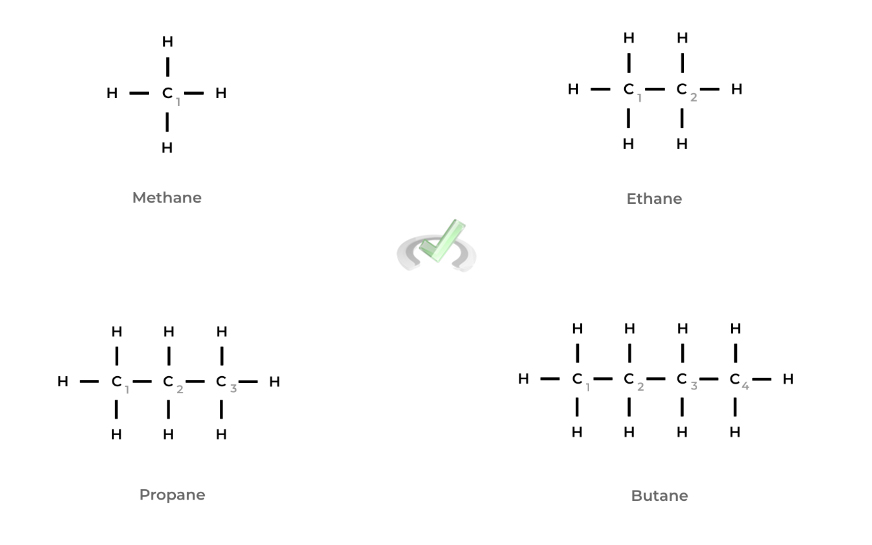
In addition, instead of being drawn out with each atom and bond, organic chemists often use the “stick” format to represent organic molecules where each point represents a carbon atom while the bonded hydrogen atoms are implied, as shown below!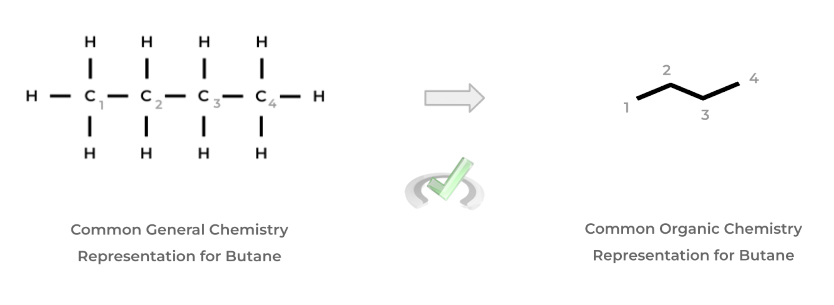
Knowing the names of common alkanes will help when the MCAT tests them directly and when more complex structures get built from alkanes such as alkenes, alkynes, and when adding more substituents.
Luckily, the first 4 alkanes are the only ones with unique names, while the rest follow common sense. The first and simplest alkane is methane which only contains 1 carbon bonded to 4 hydrogens. It’s then followed by ethane, propane, and butane.
The following alkanes are named with the usual number roots. A 5 carbon alkane is pentane, a 6 carbon alkane is hexane, a 7 carbon alkane is heptane, and so on.
If a double or triple bond is added to the alkane, the molecule becomes an alkene or alkyne, respectively. Luckily, the prefixes from the alkane names remain the same, and the suffix “-ane” changes to “-ene” or “-yne” as shown below!
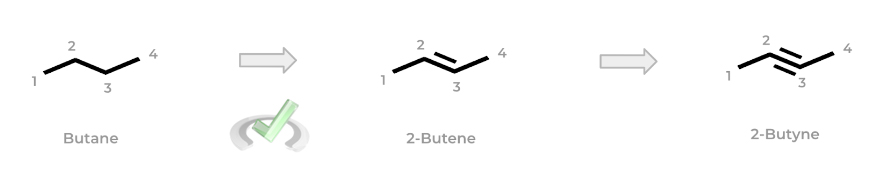
Note also how the number in front indicates the lowest number carbon where the double/triple bond is located! You’ll see this “lowest numbered carbon” motif come up a lot when getting into the specific steps of naming more complex organic chemistry molecules which we’ll introduce in a bit, so keep this in mind for now!
Finally, let’s get into the steps of naming these molecules! Every IUPAC name comes out of the same five steps:
- Find the parent chain, the longest continuous carbon chain that contains the highest-priority functional group.
- Number the chain so the highest-priority group gets the lowest number, then the substituents.
- Name the substituents as prefixes (methyl-, chloro-, hydroxy-), adding di-, tri- or tetra- for repeats.
- Give each substituent a number, even when two sit on the same carbon.
- Assemble the name with the prefixes in alphabetical order, then the parent chain, then the suffix from the highest-priority group.
To find the parent chain, we have to find the longest chain of carbon atoms that contains the highest-priority functional group. It’s kinda like drawing a line and seeing how many carbons we can include with just one try. Start off at one free end and try to include as many carbons as possible!
This might take a little getting used to! You’ll have to look at the molecule from different angles and will engage in a lot of trial and error. However, if you remain patient and diligent, you’ll without a doubt see improvement in no time!
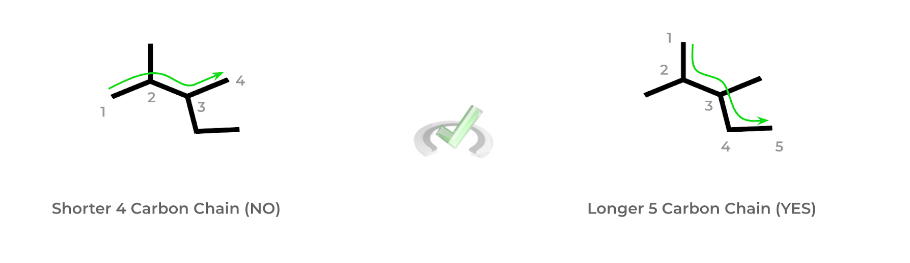
Next, from the longest carbon chain, identify any major substituents. We’ll learn about many different substituents and you’ll see that some substituents have “priority” in their naming.
This means that the alkane suffix of “-ane” can be changed depending on the priority of the substituents. For example, if a 5 carbon chain contains a carboxylic acid, the suffix changes to “-oic acid” resulting in pentanoic acid instead of pentane. We’ll cover this more later on but just wanted to introduce the idea now.
The most common substituents you’ll encounter are alkyl groups which are built of alkane chains. They keep the same root as their alkane counterparts, and the suffix changes from “-ane” to “-yl”.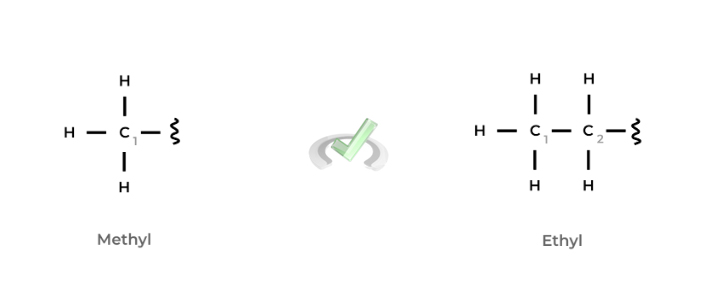
After identifying the various substituents, you can finally number the carbon chain. This might be the trickiest part as you must number the carbons in a way where the first substituent on the chain comes on the lowest possible numbered carbon. If the chain has a functional group that sets the suffix, that group gets the lowest number first, and the substituents are numbered after it. This is a little confusing when put in words, so let’s give an example!
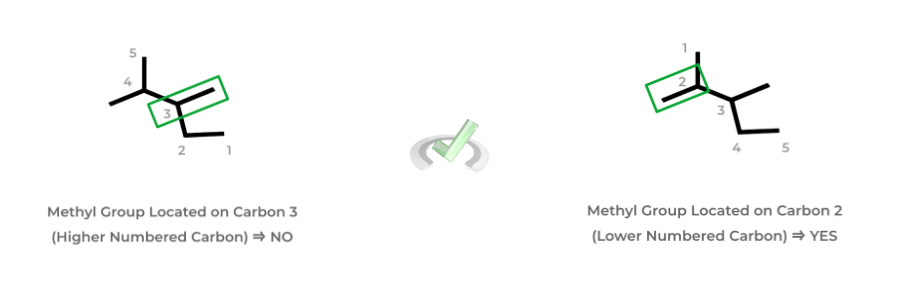
Notice how in the left molecule, the methyl group comes on carbon 3 when numbered this way. The right molecule offers an alternative numbering where now the methyl group is bonded on carbon 2. This is the correct numbering as the first substituent comes on a lower numbered carbon!
You can now start to name the molecule! When naming the molecule, you must take into account the parent chain, the types of substituents (their carbon number and how much of each is present), and the alphabetical order!
If 2 or 3 of the same substituent are present, the prefixes “di-” or “tri-” are added before. Additionally, a number(s) in front of the substituent name is placed in order to indicate their carbon number location.
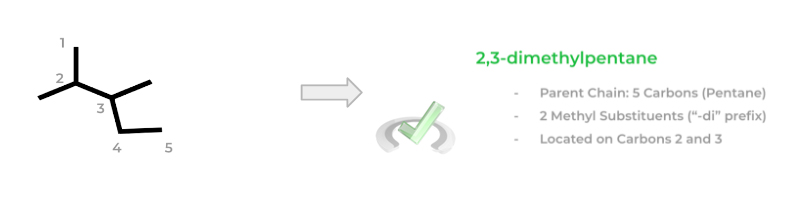
Finally, the listing of the substituents in the molecule name must follow alphabetical order. For example, a hexane parent chain with a methyl group on carbon 2 and an ethyl group on carbon 3 is named 3-ethyl-2-methylhexane. Ethyl comes first because e comes before m in the alphabet, even though the methyl sits on the lower-numbered carbon. The prefixes di- and tri- are skipped when alphabetizing, and so are sec- and tert-, while iso-, neo- and cyclo- count as part of the name. Numbers are separated from each other by commas and from letters by hyphens, so the molecule below is written 2,3-dimethylpentane.
Full Study Notes : Naming Fundamentals of Organic Chemistry Molecules
For more in-depth content review on naming fundamentals of organic chemistry molecules, check out these detailed lesson notes created by top MCAT scorers.
2. Important Common Names and Substituents
While there are numerous organic chemistry molecules and substituents, you’ll most likely encounter only the most common! In this section, we’ll introduce a couple more of these common molecules in addition to the ones we covered above!
There are more unique alkyl functional groups that are built from the straight alkyl chains! When you look at them, you’ll notice that they have the same atom type and quantity, but they’re just arranged in a different way!
These different atomic arrangements of the same molecule are called isomers, a topic that we cover in our other chapter overview! Take a look at some of the more unique alkyl substituents below!
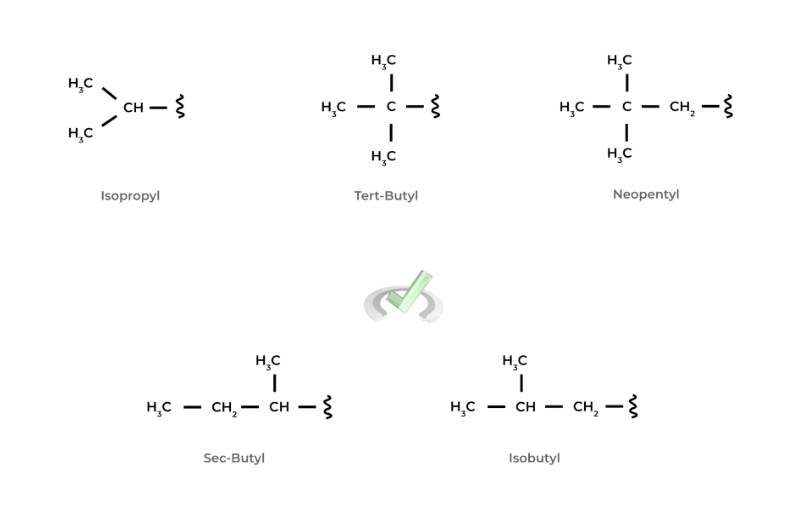
We wanted to include these unique alkyl functional groups because it’s important to note that their names do follow the alphabetical order rule when naming an organic molecule! As you can see, there are lots of little details and nuances to keep in mind!
Also, we’ll introduce 3 main functional groups you’ll meet on the MCAT, which are alcohols, aldehydes, and carboxylic acids. Alcohols have a hydroxyl group (-OH) bonded to a saturated (sp3) carbon.
Aldehydes and carboxylic acids are pretty similar as they both contain a carbonyl group (a carbon atom double bonded to an oxygen atom) and are both located at the end of the molecule. However, aldehydes have their carbonyl carbon bonded to a hydrogen atom while carboxylic acids are bonded to a hydroxyl group!
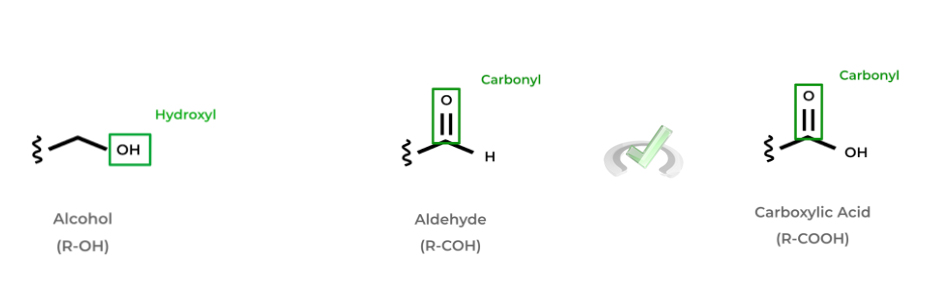
Below are a couple examples of some of the common alcohols, aldehydes, and carboxylic acids. Can you see if you can spot a pattern?
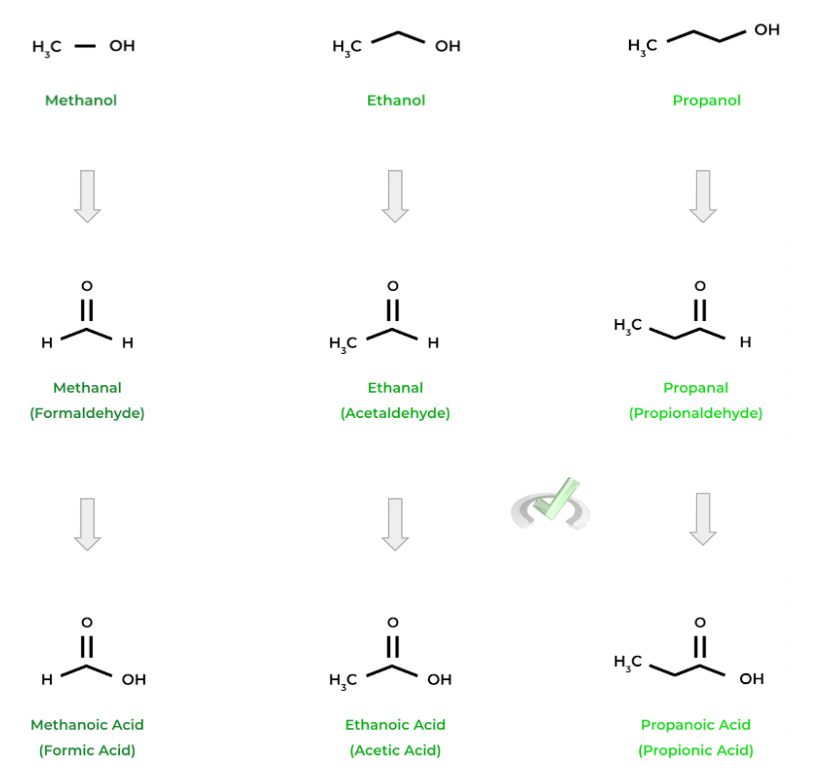
As we can see, the names start with the same prefixes as their alkane counterparts based on the number of carbons (meth- for 1 carbon, eth- for 2 carbons, etc.)! Note also how the common names for aldehydes and carboxylic acids are similar (for example, formaldehyde and formic acid)!
Full Study Notes : Most common names and substituents of organic molecules
For more in-depth content review on most common names and substituents of organic molecules, check out these detailed lesson notes created by top MCAT scorers.
3. Priority Ordering of Functional Groups in Organic Chemistry
As we alluded to above, it’s important to know the priority ordering of functional groups in order to correctly name the organic molecule. But why is the priority of the molecule important in the first place?
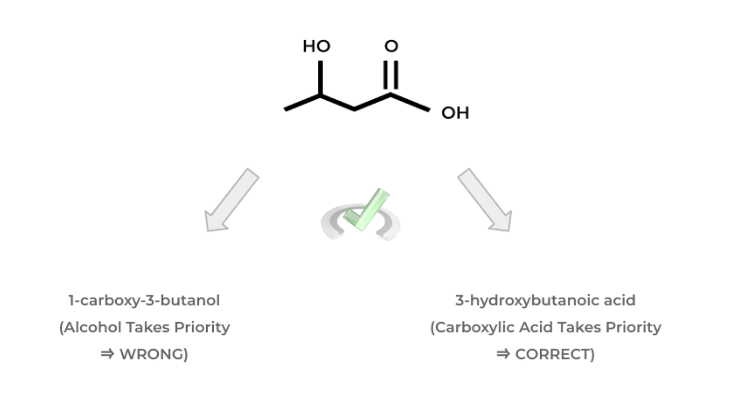
If we have 2 functional groups, let’s say an alcohol and a carboxylic acid, we have to know which one is “higher” in priority in order to choose the appropriate suffix when naming our molecule.
In this case, the carboxylic acid has higher priority than the alcohol which is why we use the suffix “-oic acid”. Take a look at the example below in order to get a better idea of the concept of functional group priority.
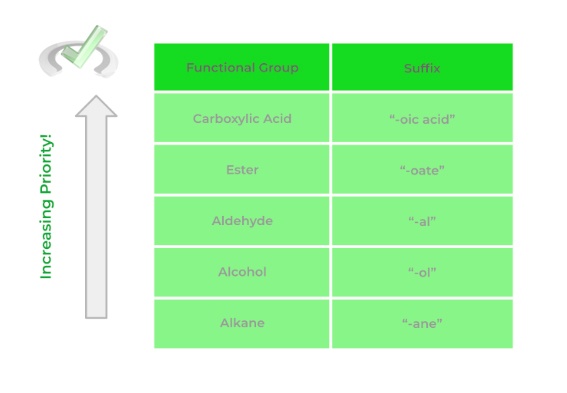
Below is a list of the most common functional groups and their priority! There are a bit more functional groups than the ones shown but these are the ones you're most likely to encounter! Our priority ordering notes below give the full order, including amides, ketones and amines.
Full Study Notes : Priority Ordering of Functional Groups in Organic Chemistry
For more in-depth content review on priority ordering of functional groups in organic chemistry, check out these detailed lesson notes created by top MCAT scorers.
Important Definitions and Key Terms
Below are some high yield definitions and key terms to refer to when reviewing concepts and ideas about organic chemistry nomenclature!
Term | Definition |
|---|---|
Parent Chain | Longest continuous chain of carbon atoms that contains the highest-priority functional group |
Alkane | Simplest organic molecule composed of hydrogen and carbons connected by single bonds |
Alkenes | A derivation of alkanes which contains at least one double bond between 2 carbons |
Alkynes | A derivation of alkanes which contains at least one triple bond between 2 carbons |
Alcohol | Functional group where a hydroxyl group (-OH) is bonded to a saturated (sp3) carbon |
Aldehyde | Functional group which contains a carbonyl group and a hydrogen atom bonded to the carbonyl carbon |
Carboxylic Acid | Functional group which contains a carbonyl group and a hydroxyl group bonded to the carbonyl carbon |
Additional FAQs - Organic Chemistry Nomenclature on the MCAT
Is Organic Chemistry Nomenclature on the MCAT?
What is a Prefix in Organic Chemistry Nomenclature?
What Are The Steps in Organic Chemistry Nomenclature?
What is Additive Nomenclature?
More Study Notes on Organic Chemistry Nomenclature
Other Organic Chemistry Topics on the MCAT
- Aldehydes and Ketones on the MCAT
- Bonding on the MCAT
- Carboxylic Acids and Derivatives on the MCAT
- Isomers on the MCAT
- Laboratory Techniques and Separations on the MCAT
- Nitrogen Containing Compounds on the MCAT
- Phosphorus Containing Compounds on the MCAT
- Alcohols and Ethers on the MCAT
- Nucleophiles and Electrophiles on the MCAT
- Spectroscopy on the MCAT
- Redox Reactions Organic Chemistry on the MCAT
Supplemental Resources
Want to go deeper on this topic? Here's where to read, watch and practice it next.
Read
- Kaplan MCAT Organic Chemistry Review 2026-2027, Chapter 1
Get the IUPAC Nomenclature cheat sheet
On its way.
Check your inbox in the next minute.




 To help you achieve your goal MCAT score, we take turns hosting these