
Follow the instructor hours
MCAT prep pricing looks arbitrary until you count whose hours go where, at which point it becomes very simple.
Three things absorb the money. Lecturing content is the largest block of instructor hours in a traditional course.
Building materials is expensive but one-off, spread across every student who ever buys. Watching an individual student work is expensive per student and cannot be spread at all.
Only the third is scarce. The first is where most of your money goes, and it is already free and abundant elsewhere.
Why re-teaching content costs so much
A course that teaches every topic on the AAMC outline to a consistent standard needs a lot of instructor time, a lot of production, and a lot of scheduling. That is a cost companies are not inventing.
The question is what it buys you. Content delivered free by Khan Academy is not meaningfully worse than content delivered for $3,000, and students routinely tell us they finished a full curriculum, retained it, and did not move.
If free content plus effort were sufficient, that would not keep happening.
So the price is honest and the value is questionable, which is a different complaint from the one most people make.
The expensive part
Somebody watching you work a full passage, in real time, and telling you where the points are leaking cannot be scaled, recorded or amortized. It is the most expensive thing in prep to deliver and the only one nothing free replaces.
That is why our own model spends its instructor hours there and treats content as a gap-filler, a high-yield video library plus one-to-one time on the specific concepts you find hard.
It is also why we can charge less than a company running a full lecture program, because we run fewer instructor hours.
Our tutoring is $99/hour at the 10-session package ($997), our own published figure, and the live course is $1,800. Neither figure is small. Both are lower than the programs with more lecture time attached, for this reason.
Free quiz
The Unbiased MCAT Prep Course Decision Quiz
Three different problems stall an MCAT score, and buying the wrong fix costs months. Six questions sort out which one is yours and what to spend on it. We name competitors and free resources when they beat us, and say so when the answer is spend nothing.
No email required. Your plan appears on screen.
Transparency, before you start. We sell MCAT tutoring and courses, so here are the rules this quiz follows.
- Zero budget, no purchases. Free resources only, and we say so.
- Content gap, buy content first. From whoever does it best, which is usually not us. Our tutoring comes up only as an optional add-on for a big gap.
- Strategy gap, we recommend our own course first. We would put our name against it, and we name a lower-priced alternative beside it so you can price us against it.
- Competitors named and linked when they beat us: UWorld, Kaplan, Blueprint, ExamKrackers, Khan Academy.
- We appear only where we fit, with the budget to match, and always beside a lower-priced option.
- Our free MCAT resources show up wherever they fit, and they ask for nothing.
One more thing behind the price
There is one more thing behind the pricing that rarely gets said out loud. A model built on re-teaching content earns more when a score stalls, because the student keeps buying sessions to fix it.
A model built on strategy earns more when the score jumps and the student leaves, because that frees the seat.
We are one of the companies in this market, so read that as our argument rather than a neutral observation. But it is checkable. Look at what share of any program's instructor hours goes to lecturing, and you will know which model you are buying.
What the price does not buy
A lot of prep marketing implies otherwise.
Price does not buy a score. No published outcome data in this market can be compared like for like, so a claimed point increase tells you nothing you can act on.
Price does not buy teaching ability. Companies screen on scores because scores are easy to verify. Teaching is harder to test and less often tested, which is why a 520 scorer is not automatically better for you than a 515 scorer who struggled first.
Price does not buy time. The most expensive programs assume the largest weekly commitment, so the premium can require more of you rather than less.
How to judge whether a price is fair
Three checks that work regardless of what a company charges.
- What share of the instructor hours is somebody watching me work? Ask for the split between lecture, materials and one-to-one. The ratio tells you more than the total.
- What am I buying that I could get free? Content has a free substitute of comparable quality. Attention does not. Price the difference.
- What does it cost me if it does not work? Switching fees, expiring access windows and guarantee conditions are all part of the price, and those are the parts companies mention last.
A program that scores well on all three can be expensive and still be fair. One that scores badly is a bad deal at any price, which is the more useful way to read this market than low price against high price.
See the 6-Week Live MCAT Accelerator
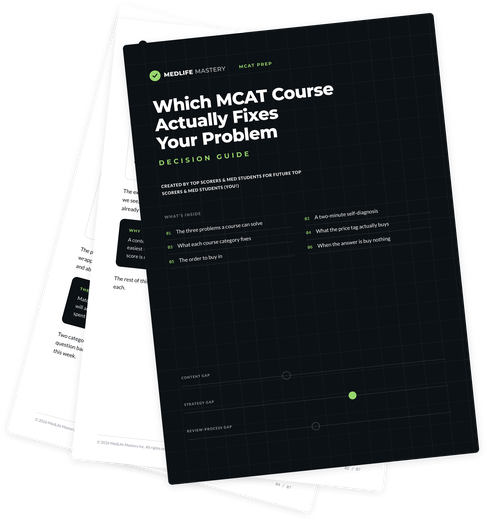
Get the free Decision Guide
On its way.
Check your inbox in the next minute.