How many times can you take the MCAT? Seven times in your lifetime, with no more than three attempts in one testing year and four across two back-to-back years. That's the short answer from the AAMC!
If you're asking, there's a good chance a score just came back lower than you hoped. Or maybe you're weighing up one more attempt. Either way, you're in good company!
According to the AAMC, about 42% of people who took the MCAT between 2023 and 2025 were retesters.
Below we cover what counts as an attempt, what medical schools see, how much scores tend to change on a retake, and what students who sat it three or four times did differently 🙂
Free download
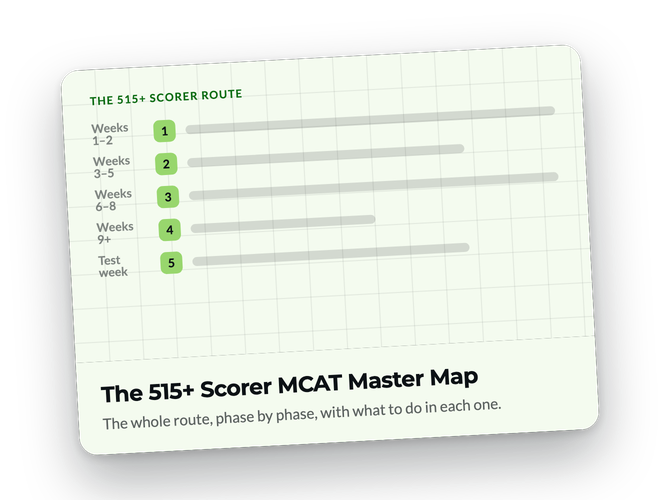
Make your next attempt the one that reaches 515+.
The 515+ Scorer MCAT Master Map lays out the sequence those scorers followed, built for a second or third attempt.
On its way.
Check your inbox in the next minute.
How Many Times Can You Take the MCAT?
The AAMC sets three limits, and every attempt you make counts toward all three of them (AAMC testing attempt limits).
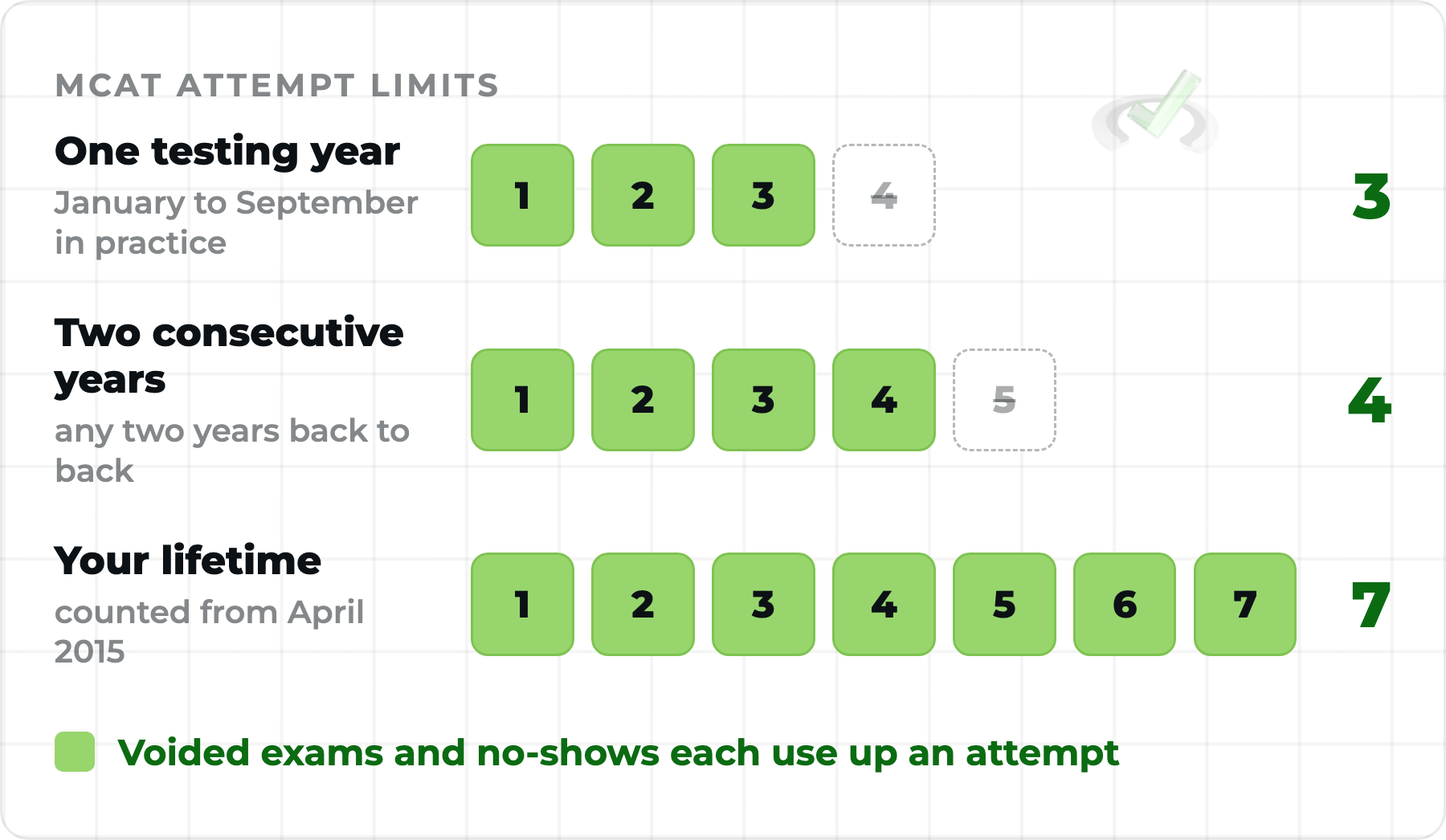
So how many times can you take the MCAT in one stretch? Three in a testing year, four across any two years in a row, and seven in total since the April 2015 test dates.
The tightest of the three is usually the one you'll bump into first!
You can only hold one MCAT appointment at a time, too. The next sitting can't be booked until the current one is behind you.
If something serious stood in your way, the AAMC does consider appeals of these limits. Approval is at its discretion, and it reviews one appeal per test year.
The AAMC's own data guide describes the limits in calendar years, and there are no sittings between October and December. In practice, a testing year runs from January to September. You can see every upcoming sitting on our MCAT test dates page :)
Do Voids and No-Shows Count as MCAT Attempts?
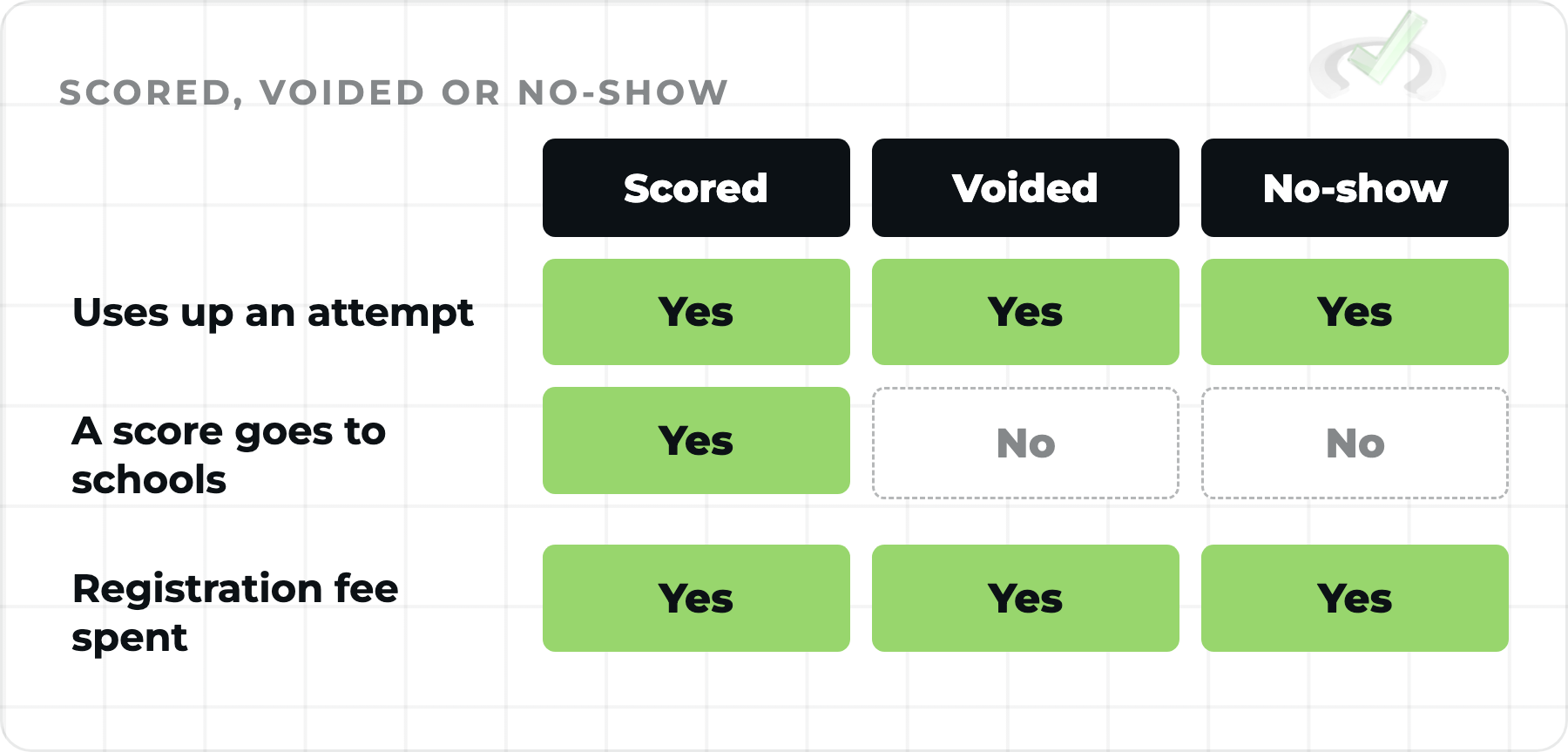
Yes, both of them! A voided exam counts toward your testing limits no matter why you voided it (AAMC scoring or voiding your exam). A no-show costs you an attempt and the full registration fee as well.
The difference is who sees it. Voided exams never appear on the score reports medical schools receive, so a void uses up an attempt and stays off your application.
We hear from students who voided on test day after a wave of panic, and from others who planned to void before they walked in, just to see the exam for themselves. Both used up an attempt.
If you're not sure you're ready, moving your date costs you less. Our guide on whether to void your MCAT walks through the test-day decision.
What Medical Schools See When You Take the MCAT More Than Once
Every scored MCAT you've taken since April 2003 goes to schools, and there's no score choice (AAMC score reporting).
AMCAS pulls in all of your scores on its own. AACOMAS for DO schools and TMDSAS for Texas schools ask you to release every score yourself through the AAMC's score reporting system.
So how many times can you take the MCAT before it counts against you? It depends on the school! Here's how a few describe it on their own admissions pages for the 2027 cycle.
Those last two are behind the Reddit posts saying schools no longer accept more than three attempts. Emory and TCU are the only two published caps we found, so it isn't a rule across schools.
If you're heading into a third or fourth attempt, check the admissions page of every school on your list first!
Retaking after you've already applied works too. List the upcoming test date in your AMCAS application so schools know a new score is coming. Our MCAT retake guide covers whether a retake looks bad and how to judge the score you have.
How Much Do MCAT Scores Change on a Retake?
The AAMC tracked 56,953 people who sat the MCAT a first and second time between 2023 and 2025 (AAMC, Using MCAT Data in 2027 Medical Student Selection). On average, every starting group scored higher the second time!
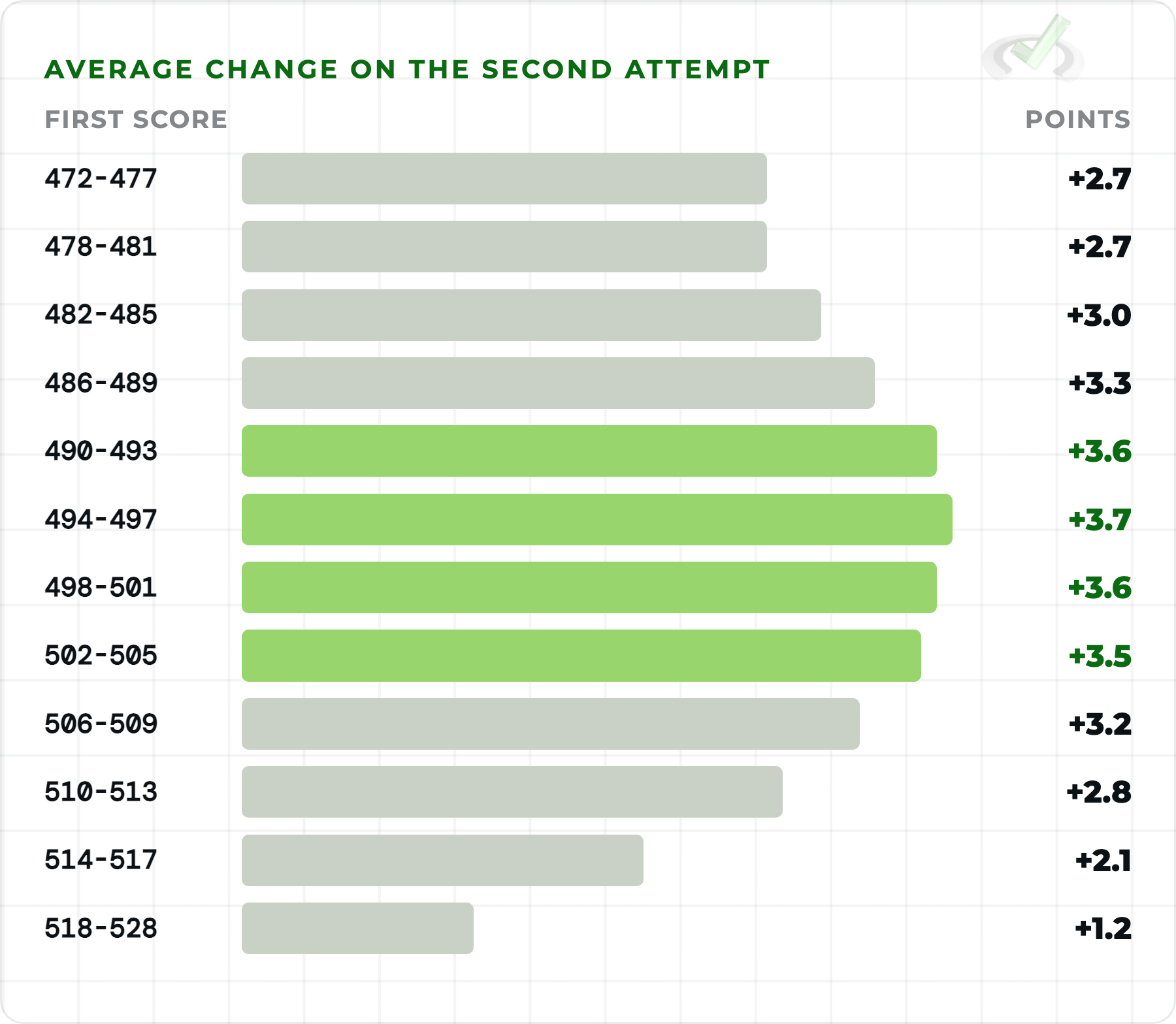
Retesters who started between 490 and 505 gained the most, about 3.5 to 3.7 points on average. The gains shrink near the top of the scale, where there's less room left to climb.
The AAMC adds two cautions. Averages hide a wide spread, and some retesters score lower the second time. Your total score also carries a confidence band of about two points either way, so a gain of one or two points can sit inside the noise.
Bigger gains showed up among retesters who advanced their education between attempts, and the AAMC notes that more time between attempts tends to help as well.
How many times can you take the MCAT and keep improving? The AAMC's numbers only cover the jump from a first to a second attempt, so the stories further down are the better guide past that.
An average gain of three or four points is what happens when most people study the same way twice. Plenty of our students have gone well past that by changing how they prepared :)
To see what your own jump would take, our MCAT retake calculator takes your four section scores, your target and your date. It tells you whether the weeks you have are enough!
What Students Who Took the MCAT Three or Four Times Did Differently
Students who write to us after three attempts often have three scores within a few points of each other. Another round of the same studying tends to land on the same number.
The students below broke that pattern by changing how they studied!
How many times can you take the MCAT before the score finally climbs? For these three, it took three or four.
Priya: 503, then 505, then 513
Priya's journey took three years. After two scores she wasn't proud of, she restructured her approach around her weak points.
She built a four-month schedule and an error log in Google Sheets, swapped textbooks for video lectures, and reviewed every mistake. Read how Priya reached 513 on her third attempt.
Jennifer: 494, then 502, then 513
Jennifer scored 494 in 2015 and let it beat her down for a while. She came back four years later, scored 502, and reached 513 in 2020. Here's what changed between her 502 and her 513.
Kartik: 4 attempts, then 514
Kartik spent months between 485 and 495 on practice exams and needed four sittings to reach his 514. He named anxiety, overconfidence and poor sleep as what hurt his second and third test days.
For the last one he studied from 7am to 2:30pm and kept the rest of the day off. See his full four-attempt story.
Spotting where your own points are going is hard after two or three attempts, because you're so close to it. In 1:1 MCAT tutoring, a 515+ scorer can work through your practice exams with you and find the pattern you keep repeating :)
How Soon Can You Retake the MCAT?
How many times can you take the MCAT in a single testing year? Three, and the spacing between them matters as much as the count!
You can register for your next exam 24 hours after you finish one (AAMC, after the exam). Scores come back 30 to 35 days after test day, though (AAMC score release).
If you'd like to see your score before you decide, plan on about six weeks between sittings!
In 2027, a January 15 sitting releases scores on February 16. Scheduling closes 10 days before each test, so the first date you could book after seeing that score is March 6.
Registration for every 2027 date opens October 20 to 22, 2026, depending on your region.
Being able to book soon doesn't mean you're ready, though! One of our mentors, Ariana, holds off until a student's full-length practice average sits at their goal.
If you're scoring 504 or 505 on practice and aiming for 510, she'd push the date back and use the extra weeks.
It lines up with what retakers say online, too. When students on Reddit post that their retake came in lower, the explanation they give most often is a test day below their practice average.
Should You Use Another MCAT Attempt?
How many times can you take the MCAT is one question. Whether you should take it again is another!
That depends on why your score came in where it did, and how far it sits from where your schools need it.
Our MCAT retake guide walks through the decision, and the retake calculator puts numbers on it.
If you decide to go again, our MCAT retake study plan lays out five steps from a 513 scorer who sat it three times :)
How Many Times Can You Take the MCAT? FAQ
How many times can you take the MCAT in a year?
Three times in one testing year, and four times across two consecutive testing years.
How many times can you take the MCAT in your lifetime?
Seven times, counted from the April 2015 test dates. Voids and no-shows count toward all three limits.
How many times can you take the MCAT in two years?
Four times across two consecutive testing years.
How many times can you take the MCAT back to back?
One appointment at a time, and no more than three sittings in a testing year. You can register for the next one 24 hours after you finish.
How many times can you take the MCAT if you void it?
The same number. A void still uses up an attempt, even though schools never see it.
Can you retake the MCAT after you've applied?
Yes! List the upcoming test date in your AMCAS application so schools know a new score is coming.
Does taking the MCAT multiple times look bad?
Schools see every scored attempt. Most of the schools we checked use your highest or most recent score.
A few say more than two or three attempts read less favorably, and Emory and TCU stop sending secondaries past three and four attempts.
What percentage of people retake the MCAT?
About 42% of people who took the MCAT in 2023, 2024 and 2025 were retesters, according to the AAMC.
Get Help Planning Your Next MCAT Attempt
Every attempt counts toward your limits, so the next one deserves a plan built around what went wrong last time.
Our 6-Week Live MCAT Accelerator gives you live strategy classes across every section and seven 1:1 sessions with a 515+ scorer built in.
If the cohort dates don't line up with your test, 1:1 tutoring on its own works too. Several of our mentors took the MCAT more than once, and we'd love to help you plan yours :)
A second, third or fourth attempt says nothing about the doctor you'll become!
How many times can you take the MCAT? Seven, and you only need one good one. You've got this :)
Get The 515+ Scorer MCAT Master Map
On its way.
Check your inbox in the next minute.
The MedLife Mastery Team

 To help you achieve your goal MCAT score, we take turns hosting these