
The honest answer is that almost nobody publishes a price
The first thing to know about MCAT tutoring pricing is how little of it is public.
Of the eight companies we review, four do not publish a rate at all: The Princeton Review, Altius, Varsity Tutors and MedSchoolCoach each quote you after a consultation or an inquiry.
That is a deliberate sales structure rather than an oversight. A conversation lets a company frame value before naming a number, and it prevents you comparing like for like. Treat it as a cost, because it is one.
Where figures are published, the spread is wide. Wyzant tutors set their own rates and the platform publishes a general average of roughly $35 to $60 an hour across all subjects, with MCAT listings above that. Blueprint's tutoring tier is $2,999.
Kaplan bundles hours into course tiers running $1,599 to $7,299. Our own tutoring is $99/hour at the 10-session package ($997), our own published figure, and the packages run $547 for 5 sessions up to $2,097 for 30.
What the money buys
Course and tutoring pricing looks arbitrary until you count instructor hours, at which point it becomes simple. A program costs what it costs because of how many hours of somebody's time it takes.
That splits three ways. Lecturing content is the largest block of instructor time in a traditional course, and also the block you can get free.
Building materials is expensive but one-off, amortized across every student, which is why a good question bank costs little relative to a course.
Watching you work is expensive per student and impossible to amortize, and nothing free replaces it.
So the useful question is not what the hourly rate is. It is what share of your money buys the third thing.
A $200 hour where somebody watches you work a passage and corrects your approach can be better value than a $60 hour of re-explained content.
Five questions that reveal the full price
- What is the total, not the hourly rate? Companies that steer you toward 25 to 45 hours are quoting a four-figure sum whatever the per-hour figure looks like.
- Is a course bundled into this? Blueprint's $2,999 tutoring tier includes its $1,199 self-paced course, so under two thirds of that price is buying one-to-one time.
- What happens to unused hours? Ours never expire and transfer to application coaching. Many expire with an access window.
- What does switching cost? If a tutor is not working, the cost of changing is part of the price. Ours is free, at any time, for any reason.
- Are there payment plans? Blueprint offers no financing at $2,999. We run plans on every package. That changes affordability more than a small difference in rate.
Free quiz
The Unbiased MCAT Prep Course Decision Quiz
Three different problems stall an MCAT score, and buying the wrong fix costs months. Six questions sort out which one is yours and what to spend on it. We name competitors and free resources when they beat us, and say so when the answer is spend nothing.
No email required. Your plan appears on screen.
Transparency, before you start. We sell MCAT tutoring and courses, so here are the rules this quiz follows.
- Zero budget, no purchases. Free resources only, and we say so.
- Content gap, buy content first. From whoever does it best, which is usually not us. Our tutoring comes up only as an optional add-on for a big gap.
- Strategy gap, we recommend our own course first. We would put our name against it, and we name a lower-priced alternative beside it so you can price us against it.
- Competitors named and linked when they beat us: UWorld, Kaplan, Blueprint, ExamKrackers, Khan Academy.
- We appear only where we fit, with the budget to match, and always beside a lower-priced option.
- Our free MCAT resources show up wherever they fit, and they ask for nothing.
When a higher price is justified
Spend more when the extra money buys attention rather than content. A mentor who prepares before each session, watches how you work a passage, and adapts is doing something a lower-priced hour of content review is not.
Spend less, or nothing, when what you need is content. Khan Academy's MCAT collection is free and not meaningfully worse than content delivered for thousands. If your gap is knowledge, spend there last.
The most expensive mistake in this market is not overpaying per hour.
It is buying a large number of hours aimed at the wrong problem, which is why the section below on deciding whether you need tutoring at all comes before any price comparison.
What a low-priced hour and an expensive hour differ on
Two tutoring hours at very different prices can look identical on a calendar and be completely different products. The variables that move the price are these.
- Vetting. An open marketplace does none, and passes the saving and the risk to you. A specialist screens for score, section strength and teaching ability, and charges for it.
- Preparation. An hour where somebody has reviewed your last full-length beforehand is not the same hour as one where they open a book with you. Ask which you are buying.
- Matching. Being assigned whoever is free costs less than being matched to somebody strong in your weakest section, because matching wastes capacity.
- What surrounds the hour. Recordings, office hours, a question bank and a strategy course either come with it or do not.
None of that means expensive is better. It means the hourly figure on its own tells you very little, and the comparison that matters is what each hour includes.
A sensible order to spend in
If money is finite, and it usually is, spend in an order where each purchase answers a question rather than hedging against one.
- The official AAMC material first. Nothing substitutes for it and everything else is judged against it.
- A question bank second. It is the lowest-priced way to find out which problem you have, and it stays useful whichever answer you get.
- Free content third, if the diagnosis is a content gap. Exhaust it before buying a curriculum.
- Hours last, and only aimed at strategy or review process. It is the only thing on the list with no free substitute, which is why it earns its price and why it should not be the first thing you buy.
Buying the largest package first is the most common order and the worst one, because it answers no question. If it works you do not know which part worked, and if it does not you have spent both the money and the weeks.
See the 6-Week Live MCAT Accelerator
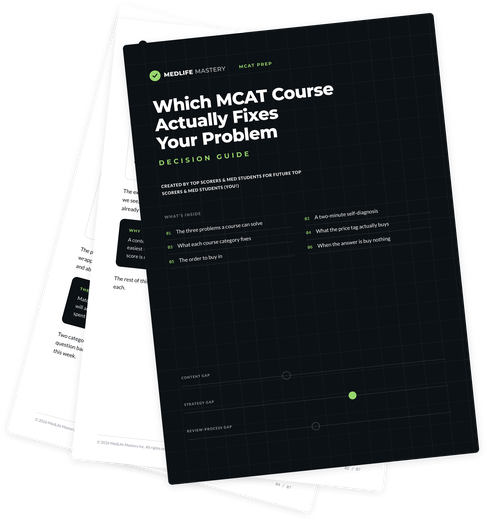
Get the free Decision Guide
On its way.
Check your inbox in the next minute.