How to Study for the MCAT: A Phase-by-Phase Plan for Any Timeline
Working out how to study for the MCAT can feel overwhelming at the start, and that's completely normal! The exam covers biology, biochemistry, general and organic chemistry, physics, psychology and sociology, plus a reading section called CARS.
Test day runs about 7.5 hours. The good news is that every strong plan follows the same five phases, whether you have two months or six 🙂
Below we walk through each phase, link the study plan for your timeline, and share the strategies 510+ scorers use on passages and timing.
How to Study for the MCAT in Five Phases
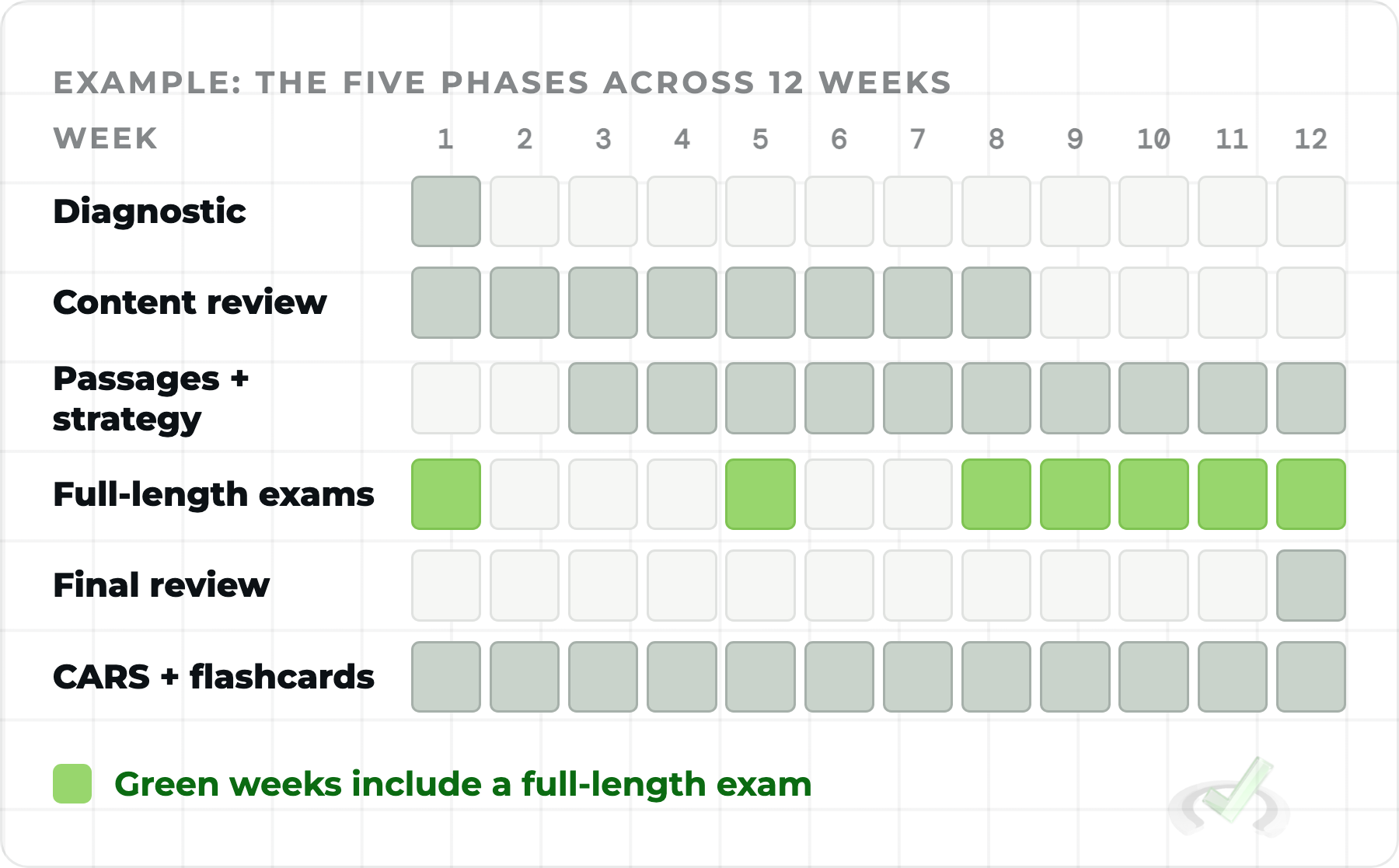
Here's how to study for the MCAT, whatever your timeline. Take a diagnostic exam, review the content, practice passages with a strategy, take full-length practice exams, and use the final weeks to sharpen up and rest.
Diagnostic. One timed full-length exam shows your starting score and your weakest sections.
Content review. Rebuild the science and psych/soc knowledge the passages draw on.
Practice and strategy. Work timed passage sets and learn how top scorers read questions.
Full-length exams. Build stamina and check your timing on AAMC practice exams.
Final weeks. Work through your mistake log, keep your routine steady and rest.
The phases overlap. In a 12-week plan, content review runs into passage practice, and CARS and flashcards run from the first week to the last!
With three months, each phase gets a few weeks. With one or two months the phases overlap more, and with five or six you've got room to go deeper in each one 🙂
Phase 1: Find Out Where Your Score Starts
The first step in how to study for the MCAT is one timed full-length exam, taken before you open a content book. Your results show where you stand today and which sections pull your score down.
The AAMC gives every student two free full-length exams, Practice Exam 1 and the Unscored Sample Test, each with 230 questions. Practice Exam 1 reports a scaled score and percentile. The sample test comes back without one, so we built a tool for it!
Before you can raise a score you need a reliable baseline. The MCAT score calculator converts your raw answers on the free AAMC unscored sample test into a scaled score and percentile, and links you to the test if you have not taken it.
A low first score is normal, so try not to read too much into it! Some of the top scorers we've interviewed started in the 490s on their first practice exam.
Before you start content review
Note your score in each section, the topics you missed most, and how your timing held up. Those three notes become your plan for phase 2 🙂
Phase 2: Rebuild the Content the Passages Draw On
The MCAT draws on introductory biology, general chemistry, organic chemistry, physics, biochemistry, psychology and sociology. CARS tests reading and reasoning and needs no outside content. Our breakdown of what's on the MCAT lists the topics in each section!
Work through every content area, and give the weakest ones from your diagnostic the most time. A set of MCAT prep books gives you a structure to follow, one chapter at a time.
Practice questions make content stick. After each chapter, do a short set of questions on that topic, and put the facts you'll need to recall (amino acids, hormones, equations) into flashcards you review every day. It adds up fast!
CARS has no content to review, so it builds through practice. Several of the top scorers we've interviewed did CARS every day, anywhere from one passage to three, while they worked through the sciences. A little every day goes a long way 🙂
Phase 3: Practice Passages Like a Top Scorer
Most MCAT questions come with a passage, and many ask you to apply what you know to a study or an experiment you haven't seen before.
Once you've covered a topic, start timed passage sets on it, then mix in sets from every section. It gets easier with every set!
The AAMC writes the MCAT, so its own practice material is the closest match to the exam's style. We'd save some of it for the final weeks, and the full list is in phase 4.
Review every set as long as you spent on it
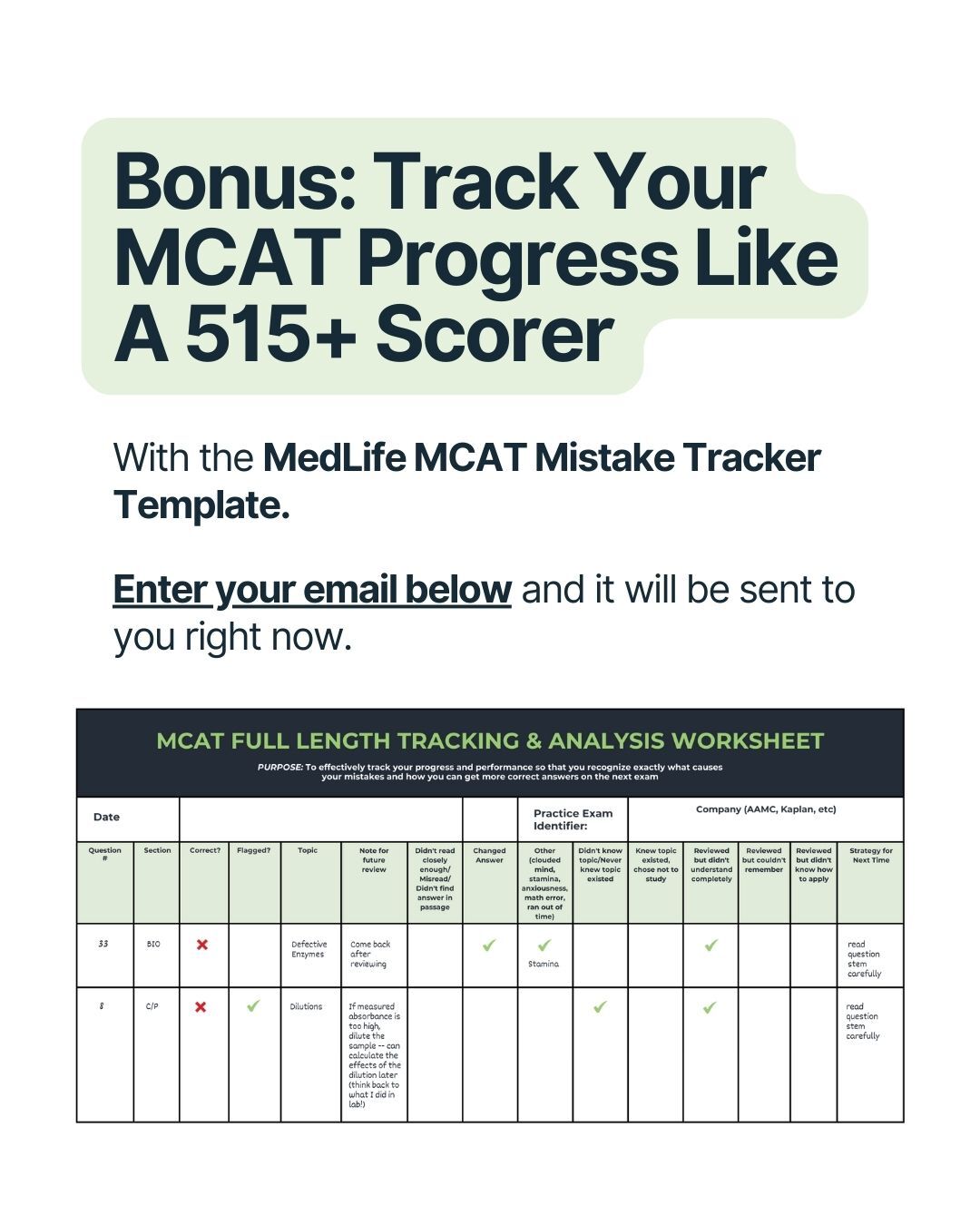
Go back through the questions you got right as well as the ones you missed, and write down why each wrong answer choice was wrong. A mistake log shows you the patterns, like a content gap, a misread question or running out of time. Patterns are fixable!
How top scorers use strategy on passages
Strategy is a skill you can learn, and the 510+ scorers we've interviewed lean on it in four places. Each one shows up in your mistake log, so you'll see which to work on first 🙂
Reading the question. Each question names a variable, a claim or a finding. Spot it first, then go back to the part of the passage that holds it.
Unfamiliar passages. You'll meet research you've never seen and sentences that make no sense on a first read. Pull out the variables and the result, and answer from what the passage gives you.
Timing. Set a pace for each passage, and move on from a question that's eating your time. Mark it, guess, and come back if you finish early.
Figures. Read the axes, the units and the legend before the data, so you know what each line or bar measures.
(Optional) If you'd like to work through passages with a mentor, our 6-Week Live MCAT Accelerator practices live passages in every section, and every class is recorded.
Phase 4: Build Stamina With Full-Length Exams
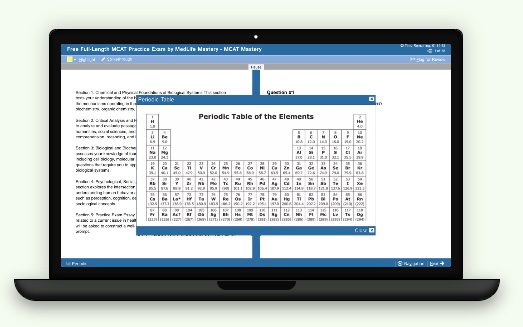
Full-length exams build the stamina a 7.5-hour test day asks for, and the AAMC's scored practice exams report a scaled score and percentile rank like test day does.
Take them in test-day conditions, with the same start time, the same breaks, one sitting and your phone away. One of the top scorers we interviewed took one every Saturday for the last month!
Reviewing a full-length can take a whole day. Space your exams out so each one gets that review, and fold what you find into the next week's practice 🙂
Full-length, 230 questions, scaled score and percentile
Free
Practice Exams 2 to 6
Five full-lengths, 230 questions each, scaled score and percentile
Sold by the AAMC
Section Bank, Volumes 1 and 2
Passage sets from the three science sections
Sold by the AAMC
CARS Question Bank
575 passage-based CARS questions
Sold by the AAMC
Biology, Chemistry and Physics Question Packs
120 questions per pack (two Biology volumes)
Sold by the AAMC
Independent Question Bank
150 questions without a passage
Sold by the AAMC
How many AAMC full-lengths there are
The AAMC offers two free full-length exams and five more for purchase, seven in all. For options beyond those, see our guide to the best MCAT practice exams.
Phase 5: Sharpen Up in the Final Weeks
In the last two to three weeks, spend most of your time on your mistake log and on any AAMC material you've saved. Redo the questions you missed, reread your notes on each one, and keep your flashcards going.
The day before, take it easy. Confirm your test center, your ID and your start time, and plan your snacks for the breaks. If nerves build in that last stretch, our guide to MCAT anxiety has a plan for it. You've got this!
When to take your last full-length
We'd take it about a week before test day, then switch to lighter review so you walk in rested. You've done the work by then!
If your practice scores sit well below your goal a few weeks out, you can move your date. The AAMC sets rescheduling deadlines and fees for each date, and our MCAT test dates guide lists them.
A stuck score is also the point where a second pair of eyes helps most. Our 1:1 MCAT tutoring pairs you with a 515+ scorer, and you book sessions whenever you hit a wall 🙂
MCAT Study Plans for Every Timeline
Whichever plan you pick, the same five phases apply. Your timeline decides how long each one lasts, so pick the plan closest to the time you have before test day!
About 15 hours a week, 20 in a full-length week, so it fits around classes or work.
On a longer timeline, each phase gets more weeks and you can go deeper on your weakest sections. For a 3-month plan from someone who's done it, read a 99th percentile scorer's 3-month plan.
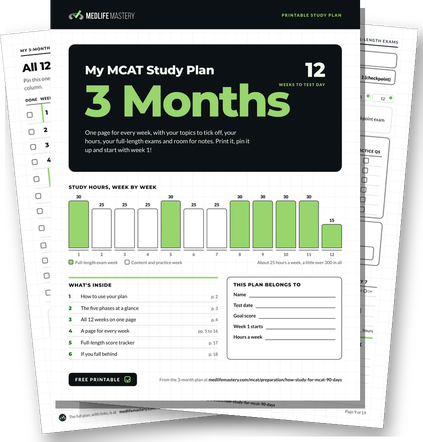
Three months is enough time for all five phases if you can study about 25 hours a week. Our 3-month MCAT study plan lays out all 12 weeks, from your diagnostic to test day, and shows what to do if you fall behind!
Weeks
What you're working on
Week 1
Diagnostic full-length exam, then start content review
Weeks 1 to 8
Content review, with practice questions after every topic
Weeks 9 to 11
Timed passages and full-length exams while you finish the last topics
Week 12
Mistake-log review and rest before test day
If you'd like the whole plan as a printable PDF, we'll send it to you 🙂
3-Month MCAT Study Plan
On its way.
Check your inbox in the next minute.
Why so many plans aim for 510+
Students who started medical school in 2025 averaged 512.1 on the MCAT, up from 511.8 in 2024, and their average GPA was 3.81. That year 54,699 people applied to US medical schools and 23,440 enrolled, according to the AAMC.
How to Study for the MCAT: Your Questions Answered
How long should I study for the MCAT?
It depends on your starting score, your goal and how many hours a week you have. Our 3-month plan runs about 25 hours a week, a little over 300 hours in all. With fewer hours a week, give yourself more months, and that's completely fine!
What's the best way to study for the MCAT?
Follow the five phases in order. Take a diagnostic, review content with practice questions, practice timed passages, take full-length exams, and spend the final weeks on your mistake log.
How do I study for the MCAT while working full-time?
Plan fewer hours a week over more months. Some of the top scorers we've interviewed studied about three hours a day around a full-time job. Our guide to studying while working or in school goes deeper.
When should I start taking full-length exams?
Take one at the very start as your diagnostic, one or two as checkpoints during content review, and then about one a week in the last month.
Should I study for the MCAT alone or in a group?
Most of your hours will be solo, and a group can help with accountability and explaining concepts out loud. Our guide to MCAT study groups covers how to find a good one :)
Learn the Strategies 510+ Scorers Use
If you'd like to learn these strategies with a mentor, our 6-Week Live MCAT Accelerator practices live passages in every section, and every class is recorded.
If the cohort dates don't line up with your test date, 1:1 MCAT tutoring with a 515+ scorer works on your schedule. We'd love to help :)
Amanda and Troy both self-studied with the strategy guide we published as MCAT Mastery, our earlier name. Here's what they told us, in their own words!
Amanda Naylor
MCAT 514
"Using the strategies in this guide, I was able to achieve my goal score and then some… This guide is perfect for MCAT test takers..."
This guide helped me plan my studies, which was very important for me as a self-study MCAT test taker. The MCAT Mastery guide covers all areas of MCAT prep very well. Using the strategies in this guide, I was able to achieve my goal score and then some. Specifically, I used the Feynman Technique... Choosing a concept I needed to understand better, simplifying my explanation to an elementary school level, revising my explanation as difficulties arose, and utilizing analogies. This strategy is perfect for MCAT test takers and has helped me both in MCAT prep and graduate school. Thank you, MCAT Mastery, for sharing your useful guide!
Troy Dolmetsch
MCAT 512
“The MCAT Mastery Guide is what I turned to when my practice exam scores stalled… my only regret is not getting the Guide sooner!”
The MCAT Mastery Guide is what I turned to when my practice exam scores stalled and my self-studying needed to be revamped. The strategies offered through MCAT Mastery made total sense to me, yet I had not seen these sort of tips offered in other study resources. After reading my MCAT Mastery resources I immediately restructured my mindset and my study habits, which made the difference in obtaining a desirable score on test day. The MCAT Mastery Guide is applicable for all types of students with strategies that are both easy and worthwhile to implement; my only regret is not getting the Guide sooner!
Scores are from each student's official AAMC score report. Every student's results are different.
Want the 3-month plan in your inbox? It's free :)
3-Month MCAT Study Plan
On its way.
Check your inbox in the next minute.
{"email":"Email address invalid","url":"Website address invalid","required":"Required field missing"}
Your MCAT Success Mentors
About the Author
We're a team of future doctors passionate about giving back and mentoring other future doctors! All mentors on the team are top MCAT scorers and we all are committed to seeing you succeed in achieving your physician dreams To help you achieve your goal MCAT score, we take turns hosting these Live MCAT Courses and are also available for 1:1 private tutoring!




 To help you achieve your goal MCAT score, we take turns hosting these