
What a high score tells you
Every tutoring company leads with a number. 515+. 520+. 90th percentile. Those bars matter and you should insist on one, because somebody who has not scored well on this exam cannot teach it.
A score is evidence that a person solved the MCAT. It says nothing about whether they can explain how, and nothing about whether they ever had your problem.
There is a specific version of this. A tutor who scored 520 on their first attempt often found the exam manageable from the start. They may have an excellent memory, or strong reading speed, or a background that made the sciences easy.
None of that is a route out of a plateau, because they were never in one. What reliably unsticks a stalled student is somebody who was stuck the same way and remembers what changed.
Which is why the most useful question you can ask a prospective tutor is not what they scored. It is what they scored the first time, and what they did between then and their final score.
A tutor who went 498 to 517 has walked the path you are on. A tutor who opened at 519 has not.
The eleven things that separate one tutor from another
Below is the full set of variables to evaluate. We use these to decide who we hire, so treat this as a company showing you its own scorecard rather than a neutral checklist.
Every one of them is something you can ask about before you spend money.
1. Did they struggle themselves? We weight this one most heavily. A mentor who remembers being stuck can locate your problem faster, because they have debugged it once already on themselves. Ask for their starting score and their timeline.
2. How fast did their own score rise? Slow improvement over eighteen months is a different skill set from a large jump in a compressed window. If you have eight weeks, you want somebody who has solved the eight-week version of this problem.
3. Are they still on the path? A current or future doctor is living the thing you are working toward.
Someone who left medicine can still teach the content well, and the relationship is different, and their advice about what comes after the MCAT is several years cold.
4. Were they hired for teaching, or only for scoring? Most companies screen on score because score is easy to verify. Teaching ability is harder to test and is often assumed. Ask directly whether the company tests for it, and what that test involves.
5. Do they teach strategy or content? Content is free and abundant.
If a tutor's plan for session one is to review a topic, you are spending a premium hourly rate on something a textbook does. The scarce thing is somebody watching how you work a passage.
6. How recently did they sit the exam? The MCAT changes. Advice from six years ago is confidently wrong in places, and a tutor who has recently sat the current version knows what it feels like rather than what it used to feel like.
7. Do they handle mindset at all? Test anxiety, burnout and motivation are usually treated as outside scope because they are not considered high yield.
For a large number of students they are the actual bottleneck, and a tutor who cannot discuss them is working with one hand tied.
8. What happens after the MCAT? Most tutoring ends at your score release. If a tutor already knows your history, they are well placed to help with applications, so find out whether that continuity exists before you build a relationship.
9. What does the business model reward? This is the least comfortable question and the most revealing. A company that profits from more sessions has a structural reason to want your progress to be gradual.
A company that profits from freeing the seat wants you gone quickly and happy. Ask how they measure a successful engagement.
10. What is the relationship? Some tutoring is transactional by design. A booked hour, a defined agenda, done. Some is closer to mentorship. Neither is wrong, and you should know which you are buying, because the second only works if you want it.
11. What does the price signal? Rates in MCAT tutoring run from about $35 an hour on an open marketplace to $200 or more through a specialist.
Price tracks vetting, matching and overhead far more closely than it tracks teaching quality. High is not automatically better and low is not automatically worse; what matters is what the money is buying.
Seven questions to ask before you book any hours
Condensed into what you would say on a call or in a first message.
- What did you score, and what did you score the first time? The gap is what maps onto your situation.
- When did you last sit the MCAT? Recency beats credentials on this exam.
- What did you score by section? A strong total can hide a weak section, and you want somebody strong where you are weak.
- How would you approach a CARS passage you have never seen? Listen for a repeatable process. "Read carefully" is not one.
- What will we do in session one? A good answer involves watching you work. A weak one involves reviewing content.
- Do you prepare before sessions? Preparation is the difference between coaching and a conversation.
- What happens if this is not working? Ask about switching and refunds before you need either.
Free quiz
The Unbiased MCAT Prep Course Decision Quiz
Three different problems stall an MCAT score, and buying the wrong fix costs months. Six questions sort out which one is yours and what to spend on it. We name competitors and free resources when they beat us, and say so when the answer is spend nothing.
No email required. Your plan appears on screen.
Transparency, before you start. We sell MCAT tutoring and courses, so here are the rules this quiz follows.
- Zero budget, no purchases. Free resources only, and we say so.
- Content gap, buy content first. From whoever does it best, which is usually not us. Our tutoring comes up only as an optional add-on for a big gap.
- Strategy gap, we recommend our own course first. We would put our name against it, and we name a lower-priced alternative beside it so you can price us against it.
- Competitors named and linked when they beat us: UWorld, Kaplan, Blueprint, ExamKrackers, Khan Academy.
- We appear only where we fit, with the budget to match, and always beside a lower-priced option.
- Our free MCAT resources show up wherever they fit, and they ask for nothing.
Red flags
They will not tell you the price before a call. Four of the eight companies we review do this. It is a legitimate sales structure and it costs you the ability to compare. Decide your ceiling first.
Session one is a content lecture. If nobody has watched you work a passage, nobody has diagnosed anything, and you are several hundred dollars into a relationship built on a guess.
No published standard for who teaches. On an open marketplace anyone can list. That can be a fine trade at the right price, as long as you know the vetting has been handed to you.
A guarantee you could not realistically claim. Most carry attendance and completion conditions. Read them before the guarantee influences the purchase, not after.
They talk about their score more than your problem. A first conversation that is mostly the tutor's credentials is a preview of the sessions.
What a good first session looks like
The first session tells you nearly everything, and it should not be a lecture.
A good one has you working. You attempt a passage or a block while the tutor watches, and the conversation afterward is about what you did rather than what the content says: where you started reading, what you did with the question stem, when you committed to an answer, where the clock went.
A strategy problem only becomes visible while you are working, so a session that never has you work cannot find it.
A weak first session is a content review chosen from your weakest topic list. It feels productive and teaches you something you could have got free.
If session one is a lecture, ask for session two to be different, and treat the answer as information about the rest of the package.
How to make the hours count
Tutoring is unusual in that the buyer controls a large share of the return. Four things separate students who get a lot from a package from students who get very little out of the same one.
- Bring data. Arrive with a recent full-length and your wrong answers already sorted into "did not know it" and "knew it and missed it anyway". A session that starts with diagnosis you could have done yourself is a session half spent.
- Ask for the process, not the answer. The useful output is a repeatable method for the next passage, not an explanation of this one.
- Do the thing between sessions. A changed approach only shows up in a score once you have used it enough times for it to become automatic.
- Say when it is not working. Tutors cannot see confusion you hide, and a method that is not landing should be named inside the session rather than after the package.
Marketplace, big brand, or specialist?
Three models, three different trades.
An open marketplace like Wyzant is the lowest-priced and least filtered. Tutors set their own rates, nobody vets for MCAT specifically, and your first hour with anyone new is covered.
If you are willing to interview several people, that free first hour keeps the cost of the search low, and the vetting work is entirely yours.
A big brand like Kaplan or The Princeton Review gives you scale, a deep bench and long institutional experience.
Tutoring is generally bundled into course tiers rather than sold as clean hours, so the effective hourly cost is hard to work out, and matching tends to run on availability.
A specialist gives you exam fluency, deliberate matching and accountability, at a higher price than a marketplace. The question to ask a specialist is what their hiring bar is, because the whole value of the model is the filtering they do on your behalf.
For this exam specifically, recent first-hand experience of it outweighs general teaching skill more than it would for most subjects, which is the argument for a specialist. If budget is the binding constraint, the marketplace plus a disciplined interview process is a legitimate answer.
How we hire, since you can check it
We are one of the companies you might be choosing between, so the fair thing is to show you our own bar rather than describe it. These are the criteria on our mentor application, in our own words.
We require "someone who achieved a competitive MCAT score (515+)", and then, in the same breath, "someone who has struggled during MCAT prep, but still managed increase their scores" and "someone who achieved a fast score increase".
Applicants send their score breakdown, their lowest practice or official score, their timeline to improvement, and their scores at one month and two months out.
That second requirement is the unusual one and it is deliberate. It is why we regularly turn away 520+ scoring applicants. A 520 with no struggle in their history cannot teach the route out of a plateau, because they have never been on it.
We also screen for teaching rather than assuming it. Our tutoring page puts it as mentors "hired and trained specifically for ability to teach and connect, not just scores. We test for this".
And we do not hire people who have left medicine. Our mentors are current or future doctors, tutoring part-time while on the same path you are on.
You can hold any company to the same questions. Ask what their minimum score is, whether they ask applicants about their starting score, and whether they test teaching ability or infer it.
Where we land against the eleven, including where we lose
Running our own list against ourselves, with the losses left in.
Where we are strong. Our mentors struggled to their scores and improved fast, because that is a hiring requirement.
They are current or future doctors, so they are on your path and can help after the MCAT as well as during it. We test teaching ability rather than assuming it. Sessions are strategy-first, with content as a gap-filler.
Mentors have recently sat the current exam. Mindset is built into the process rather than treated as out of scope.
You are matched to a 515+ scorer strong in your weakest section within 24 hours, your mentor prepares before every session, sessions are recorded, and switching is free at any time for any reason with sessions that never expire.
On the business model. Our own tutoring page says so: "our success is defined by how fast we can get you to your score goal, not by how long you spend working with us."
That is a claim about incentives, and you should test it by asking any company how they define a successful engagement.
On price. Packages run $547 for five sessions to $2,097 for thirty, which works out at $99 an hour at the ten-session tier, with payment plans on every package. That is well below the specialist end of this market and well above an open marketplace.
Where we lose. We have no free trial and no sample session, and we discontinued consultation calls in 2026, so you cannot meet a mentor before committing.
Wyzant covers your first hour and The Princeton Review runs a 14-day trial, and if trying before buying is what would decide it for you, that is a fair point against us.
We are also a much smaller brand than Kaplan, The Princeton Review or Blueprint, with a smaller materials library, and we point students at AAMC and UWorld rather than producing our own replacements.
Our answer to the trial problem is free switching rather than a sample, which is a weaker reassurance and the honest one.
If you want to see who you would be working with, the mentor team is public.
See the 6-Week Live MCAT Accelerator
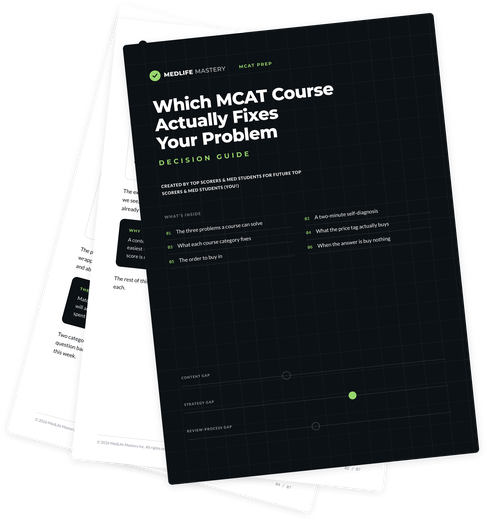
Get the free Decision Guide
On its way.
Check your inbox in the next minute.