
How Kaplan sells tutoring, and why that matters
Kaplan does not sell MCAT tutoring the way you would expect. There is no rate card and no standalone hourly price.
One-to-one time is bundled into course tiers that ran $1,599 to $7,299 when we checked in August 2026, with more hours attached as you move up.
That structure is the single most important thing to understand before buying, because it means you cannot easily answer the question that should decide the purchase, namely what am I spending per hour for someone to sit with me?
The tier price answers a different question, which is what the whole course costs.
What the hours buy
A full content curriculum across every section, a very large question bank, full-length exams, and instructor time that scales with the tier. The teaching is professional and standardized.
That gives you a reliable floor and a low ceiling. You will not get a bad instructor, and you will not get one who rebuilds their approach around you either.
A Higher Score Guarantee attaches to qualifying tiers. As everywhere in this market, it carries conditions about completing the course requirements and submitting official score reports, and those conditions are what decide whether you could ever claim it.
Tutors are assigned rather than chosen, largely on availability. Changing yours goes through support. That is a slower path than companies which let you switch on request, so ask about it before you commit a four-figure sum.
What almost 4,000 students told us about Kaplan
Kaplan is named in almost 4,000 conversations students have started with us, more than any other company. In 700+ of them the same student also described a score that had stopped rising, and in 500+ they mentioned a retake.
Two caveats have to travel with those numbers. Kaplan appears most often partly because Kaplan is the most-used name in MCAT prep, so a large share of anyone's archive would name it.
And these are patterns in inbound support mail rather than measured outcomes, from students who wrote in precisely because something was wrong. None of it shows Kaplan caused a stalled score.
What it does show is narrower and still useful. Several hundred students completed a thorough, expensive, well-taught program, retained the material well enough to discuss it in detail with us, and did not move.
Whatever was stopping them was not a content gap, and what they had bought was built to close content gaps.
Free quiz
The Unbiased MCAT Prep Course Decision Quiz
Three different problems stall an MCAT score, and buying the wrong fix costs months. Six questions sort out which one is yours and what to spend on it. We name competitors and free resources when they beat us, and say so when the answer is spend nothing.
No email required. Your plan appears on screen.
Transparency, before you start. We sell MCAT tutoring and courses, so here are the rules this quiz follows.
- Zero budget, no purchases. Free resources only, and we say so.
- Content gap, buy content first. From whoever does it best, which is usually not us. Our tutoring comes up only as an optional add-on for a big gap.
- Strategy gap, we recommend our own course first. We would put our name against it, and we name a lower-priced alternative beside it so you can price us against it.
- Competitors named and linked when they beat us: UWorld, Kaplan, Blueprint, ExamKrackers, Khan Academy.
- We appear only where we fit, with the budget to match, and always beside a lower-priced option.
- Our free MCAT resources show up wherever they fit, and they ask for nothing.
Where it makes sense, and where it does not
Buy it if you have genuine content gaps. If there are topics you have never properly learned, Kaplan will teach them, thoroughly, and the price starts to make sense. This is what the product is built for.
Think hard if you already know the material. Buying a premium tier to get tutoring hours means also buying a curriculum you may not need. Work out how many one-to-one hours the step up buys before you decide.
Price the hours separately in your head. Take the gap between two tiers, divide it by the extra one-to-one hours it adds, and compare that figure against buying tutoring on its own. It often costs less unbundled, and the exercise takes two minutes.
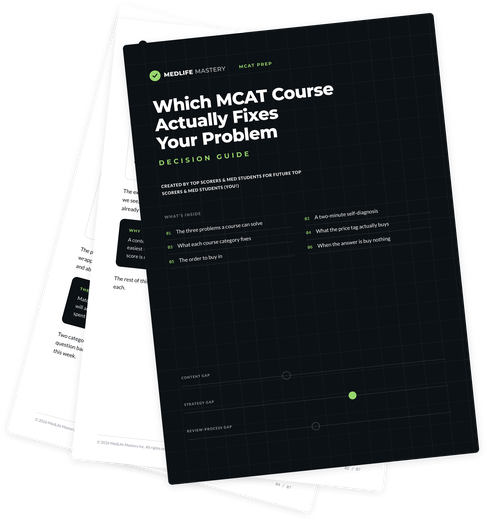
Get the free Decision Guide
On its way.
Check your inbox in the next minute.