There are eight types of lipids on the MCAT, and they don't share a building block. A lipid is defined by how it behaves. Anything greasy, insoluble in water and happy in a nonpolar solvent counts, which is why the family runs from a triglyceride in a fat cell to cholesterol, vitamin A and the prostaglandins behind a headache.
That variety makes the types of lipids feel slippery on test day. Every one of them still sorts into a small number of classes, and each class has one or two features that give it away in a passage figure. We'll go through them one at a time, then finish with a routine you can run on any lipid you haven't seen before!
What Are Lipids?
Lipids are biomolecules that dissolve poorly in water and well in nonpolar solvents. Most of each molecule is carbon and hydrogen, so most of it is nonpolar. Some types of lipids are entirely hydrophobic, like triacylglycerols. Others are amphipathic, with a polar head attached to a nonpolar tail, like the phospholipids of the cell membrane!
Lipids do three jobs in the body:
- Energy storage. Triacylglycerols pack about 9 kcal per gram, more than twice the roughly 4 kcal per gram from carbohydrate or protein!
- Structure. Glycerophospholipids, sphingolipids and cholesterol build the membranes around every cell and organelle, and waxes form protective coatings.
- Signaling. Steroid hormones, eicosanoids such as prostaglandins, and the fat-soluble vitamins carry messages or act as cofactors.
The AAMC lists lipids twice in its MCAT content outline, once for structure and once for function, so expect them in both science sections!
Free cheat sheet
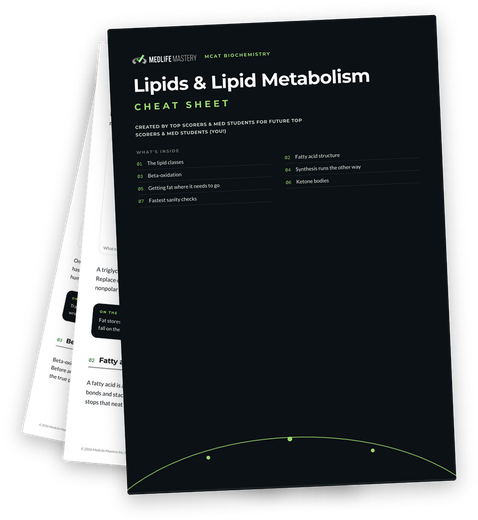
Free Lipids & Lipid Metabolism cheat sheet
Fatty acid structure, beta-oxidation, synthesis, lipoproteins and ketone bodies.
On its way.
Check your inbox in the next minute.
Hydrolyzable vs Nonhydrolyzable Types of Lipids
Before you worry about names, look for the bond holding the lipid together. If you find an ester or an amide, water (usually with an acid, a base or an enzyme) can split the molecule into its parts, so it's a hydrolyzable lipid. If there's only a carbon skeleton with a few functional groups hanging off it, there's nothing to split, and it's nonhydrolyzable. Once you've got this sort down, the rest of the chapter falls into place!
The hydrolysis you're most likely to see is saponification, the cleavage of ester bonds with a strong base such as NaOH or KOH. A triacylglycerol comes apart into glycerol and three fatty acid salts, and those salts are soap! You can review the mechanism in our notes on other reactions of carboxylic acids.
Storage Lipids: Triacylglycerols
A triacylglycerol (triglyceride) is glycerol with a fatty acid attached by an ester bond to each of its three carbons. With all three hydroxyl groups tied up in esters, the molecule has almost no polarity left, so it clumps into droplets that don't hold water.
That's a big part of why fat is such a compact fuel store. Glycogen carries a lot of bound water, and a triacylglycerol carries almost none!
Adipocytes store triacylglycerols in large droplets, mainly under the skin and around the organs. When the body needs fuel, lipases release the fatty acids, which travel through the blood bound to albumin.
The physical properties follow the fatty acid tails. Saturated tails pack tightly and give a solid fat like butter, and cis double bonds kink the tails and give a liquid oil! Our fatty acid notes cover saturation, cis and trans bonds, and omega numbering in detail.
Structural Types of Lipids
Membrane lipids are amphipathic, with a polar head that faces water and a nonpolar tail that hides in the middle of the bilayer. In water they arrange themselves without any help, forming bilayers, liposomes or micelles depending on their shape!
Glycerophospholipids
A glycerophospholipid (phosphoglyceride) is built on glycerol. Two fatty acids are attached by ester bonds to C1 and C2, and a phosphate on C3 links to a polar head group through a phosphodiester bond.
They're named for the head group, so phosphatidylcholine carries choline and phosphatidylethanolamine carries ethanolamine. The head group sets the charge and the surface properties of the membrane!
Sphingolipids
Sphingolipids swap glycerol for sphingosine, an 18-carbon amino alcohol. Sphingosine already carries a long hydrocarbon tail of its own (with a trans double bond), so it only needs one fatty acid to make the familiar two-tailed shape. That fatty acid attaches to the nitrogen on C2 through an amide bond, and a head group can attach to the oxygen on C1.
The sphingosine tail isn't a fatty acid, because it has no carboxyl group. So a sphingolipid contains only one fatty acid, and a nitrogen in the backbone of a membrane lipid is a strong sign you're looking at a sphingolipid. That one clue answers a lot of passage questions!
Sphingomyelin trips a lot of us up, so don't worry if it caught you too! It's a sphingolipid and a phospholipid at the same time, because phospholipid only means a lipid with a phosphate in its head group. Any lipid bonded to a sugar is a glycolipid, and the sugar-bearing sphingolipids are called glycosphingolipids.
Several inherited diseases come from failing to break these down. In Niemann-Pick disease, sphingomyelin builds up because sphingomyelinase is missing. In Tay-Sachs disease, a ganglioside builds up in neurons!
Cholesterol in the Membrane
Cholesterol also sits in the bilayer, with its single -OH near the phospholipid heads and its rings among the tails. It buffers fluidity in both directions. At high temperature it restrains the tails and keeps the membrane from getting too fluid and leaky, and at low temperature it keeps the tails from packing into a rigid solid!
Our biological membranes chapter covers the bilayer as a whole.
Waxes
A wax is an ester of a long-chain fatty acid and a long-chain alcohol, with a long hydrocarbon chain on each side of the ester bond. The chains are so long that London dispersion forces give waxes high melting points, so they stay solid well above room temperature!
Waxes protect and waterproof. They coat plant leaves to cut water loss, keep feathers dry, and make up part of the oily sebum on human skin. On complete hydrolysis, a wax releases one fatty acid and one long-chain alcohol :)
Signaling Types of Lipids
Terpenes and Terpenoids
Terpenes are built from isoprene units. Isoprene (C5H8) is a five-carbon unit with a methyl branch on its second carbon, and cells link these units together, usually head to tail.
In the body, the activated five-carbon building blocks are isopentenyl pyrophosphate (IPP) and dimethylallyl pyrophosphate (DMAPP), made from mevalonate. The step that makes mevalonate, catalyzed by HMG-CoA reductase, is the rate-limiting step of cholesterol synthesis and the target of statin drugs!
For a counting question, count the carbons and divide by five to get the number of isoprene units. The naming is the tricky part, because a "terpene unit" is a pair of isoprenes. So the prefix counts pairs, and a monoterpene already has two isoprene units! Count carefully and these questions become free points :)
Sesqui- means one and a half, so a sesquiterpene has one and a half pairs, or three isoprene units. It's the only prefix that doesn't follow the usual number words!
A terpenoid is a terpene that's been modified, by adding oxygen-containing groups or by rearranging or removing carbons. Terpenoids keep the isoprene-based skeleton, but the carbon count may no longer divide by five. Cholesterol comes from squalene (30 carbons) but ends up with 27, because three carbons are removed along the way!
Steroids
A steroid has four fused rings, three with six carbons and one with five, giving a 17-carbon core. The rings make steroids rigid and almost entirely nonpolar. Steroids come from terpenes. Squalene folds and closes into the four rings to make lanosterol, and lanosterol is trimmed down to cholesterol!
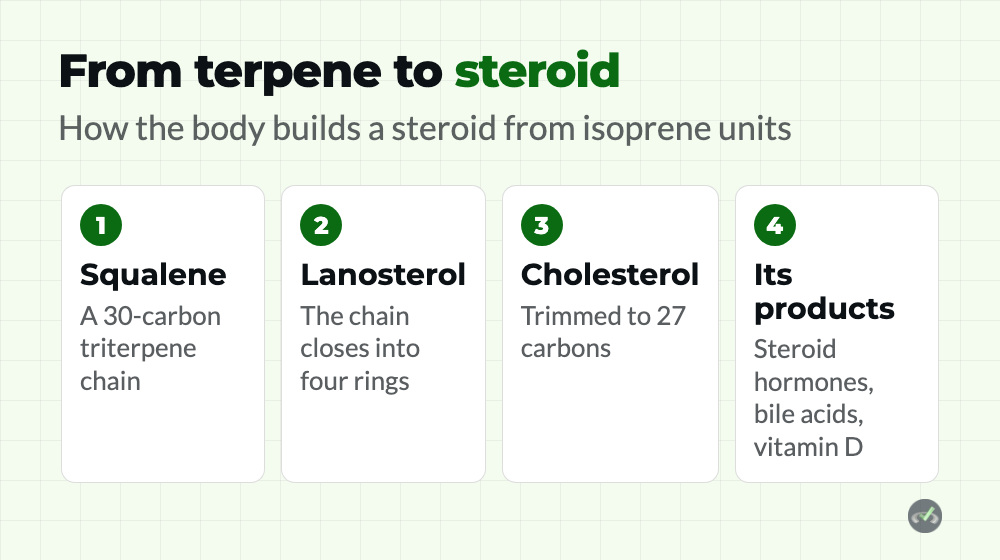
Cholesterol is the parent of every other steroid in the body. It's converted into the steroid hormones, into bile acids that help digest fat, and (in the skin) into vitamin D!
Keep two terms apart. A steroid is any molecule with the four-ring structure. A steroid hormone is a steroid that acts as a hormone. Cortisol, aldosterone, testosterone, estradiol and progesterone are made in the adrenal cortex, the gonads and the placenta.
Because they're nonpolar, steroid hormones travel through the blood on carrier proteins, cross the plasma membrane on their own, bind receptors inside the cell and change gene transcription. Their effects start slower and last longer than those of peptide hormones. For more on how they signal, see our notes on hormone basics.
Eicosanoids: Prostaglandins, Thromboxanes and Leukotrienes
Eicosanoids are 20-carbon signaling lipids made from arachidonic acid, an omega-6 fatty acid (the prefix eicosa- means twenty). Cells don't store them. When a cell is stimulated, phospholipase A2 cuts arachidonic acid out of membrane phospholipids, and the cell turns it into eicosanoids on the spot. They act locally (paracrine or autocrine signaling) and break down within minutes!
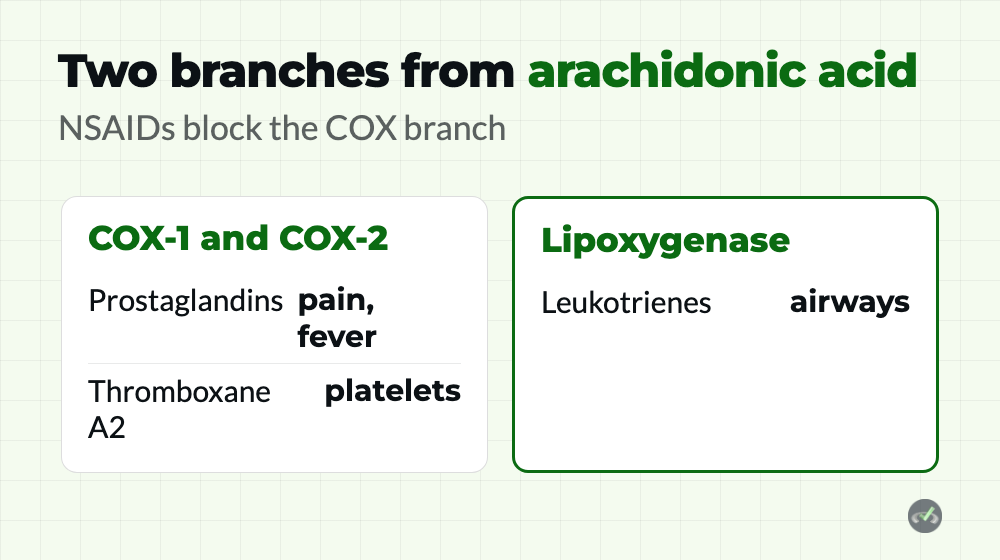
- Cyclooxygenase (COX-1 and COX-2) makes the prostaglandins, which have a five-carbon ring and drive pain, inflammation and fever and adjust smooth muscle tone. The same pathway makes thromboxane A2, which makes platelets aggregate and constricts blood vessels, and prostacyclin, which opposes it.
- Lipoxygenase makes the leukotrienes, which recruit white blood cells and constrict the bronchioles. That's a major part of what happens during an asthma attack!
NSAIDs such as ibuprofen and aspirin block COX, which cuts prostaglandin production and eases pain, inflammation and fever. Aspirin blocks COX irreversibly by acetylating it. Platelets have no nucleus to make new COX, so a single dose lowers thromboxane A2 for the rest of each platelet's life. Low-dose aspirin is used to prevent clots for this reason, and it can cause bleeding!
The StatPearls review of lipid metabolism follows these pathways further if you want the clinical side :)
Fat-Soluble Vitamins: A, D, E and K
Vitamins A, D, E and K are lipids, so they're absorbed along with dietary fat. Bile salts gather them into micelles in the small intestine, and anything that blocks fat absorption, such as a gallstone blocking bile or pancreatic insufficiency, can leave a person deficient in all four!
The body stores them in the liver and fat tissue. That storage helps during a stretch of low intake, and it also lets them build up to toxic levels, which is much harder to do with water-soluble vitamins. A, E and K are built from isoprenoid pieces, and D is made from a cholesterol derivative!
Lipids also serve as cofactors. Ubiquinone (coenzyme Q), which carries electrons in the electron transport chain, stays in the inner mitochondrial membrane thanks to its long isoprenoid tail. The LIPID MAPS consortium keeps the formal classification scientists use for all of these types of lipids!
How to Classify Types of Lipids on Test Day
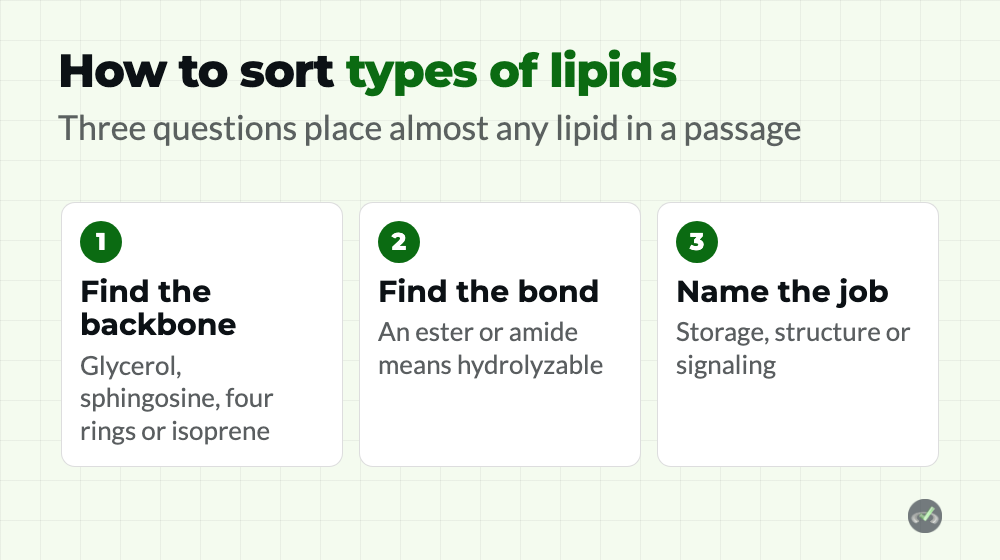
Passages love a structure you've never seen, and three questions will place almost any of them. Work through them in order:
- Find the backbone. Glycerol, sphingosine, a four-ring steroid core, a chain of isoprene units, or a 20-carbon chain with a five-carbon ring each point to one class.
- Find the bond. An ester or amide means hydrolyzable. An amide in the backbone of a membrane lipid points to a sphingolipid. No ester or amide means a terpene, a steroid, an eicosanoid or a fat-soluble vitamin.
- Name the job. Storage, structure or signaling. The job usually decides the answer choice!
Counting questions come up too. This is how many fatty acids each of the types of lipids releases on complete hydrolysis, and you'll see these come up again and again:
Key Terms for the Types of Lipids
- Amphipathic, having both a polar and a nonpolar region, like a membrane lipid.
- Triacylglycerol, glycerol esterified to three fatty acids, the main storage fat.
- Glycerophospholipid, glycerol with two fatty acids and a phosphate-linked head group.
- Sphingolipid, a lipid built on sphingosine, with one fatty acid attached by an amide bond.
- Ceramide, the simplest sphingolipid, with a hydrogen as its head group.
- Glycolipid, any lipid bonded to a sugar, including cerebrosides, globosides and gangliosides.
- Wax, an ester of a long-chain fatty acid and a long-chain alcohol.
- Isoprene, the five-carbon (C5H8) building block of terpenes.
- Terpenoid, a terpene modified by oxygen-containing groups or a rearranged skeleton.
- Steroid, a lipid with four fused rings (three six-membered, one five-membered).
- Eicosanoid, a 20-carbon signaling lipid made from arachidonic acid.
- Saponification, base-driven hydrolysis of ester bonds, which turns a fat into glycerol and soap.
Practice Questions
Sample Practice Question 1
A passage shows a straight-chain hydrocarbon lipid with 30 carbons and six double bonds, and calls it a precursor of cholesterol. How many isoprene units is it built from, and what class of terpene is it?
A. 3 units, sesquiterpene
B. 6 units, triterpene
C. 6 units, sesquiterpene
D. 3 units, triterpene
Click to reveal answer
Ans. B
Thirty carbons divided by five carbons per isoprene gives six units. The prefix counts pairs of isoprene units, so three pairs make a triterpene. This molecule is squalene.
Sample Practice Question 2
A membrane lipid is found to contain a nitrogen joined to a fatty acid by an amide bond, a phosphate, and a choline head group. Which lipid is it?
A. Phosphatidylcholine
B. Ceramide
C. Sphingomyelin
D. Ganglioside
Click to reveal answer
Ans. C
The amide-linked fatty acid means a sphingosine backbone, so it's a sphingolipid. Among sphingolipids, a phosphocholine head group means sphingomyelin. Phosphatidylcholine also carries choline, but it's built on glycerol and holds its fatty acids with ester bonds.
Sample Practice Question 3
A patient taking daily low-dose aspirin bruises more easily than before. Which change best explains this?
A. Less leukotriene made by lipoxygenase
B. Less thromboxane A2 made by cyclooxygenase
C. Less vitamin K absorbed from the gut
D. More prostaglandin made by cyclooxygenase
Click to reveal answer
Ans. B
Aspirin irreversibly blocks cyclooxygenase, and platelets can't replace the enzyme. With less thromboxane A2, platelets aggregate less, so clots take longer to form. Aspirin doesn't act on lipoxygenase or on vitamin K absorption.
You've now seen every one of the types of lipids the MCAT tests, and that's a big chunk of biochemistry done! Come back to the test-day routine whenever a passage throws a strange structure at you. It gets easier every time you use it, and we're cheering you on :)
Supplemental Resources
Want to go deeper on this topic? Here's where to read, watch and practice it next.
Read
- Kaplan MCAT Biochemistry Review 2026-2027, §5.1 and §5.2 and §5.3
Watch
- “Lipids as cofactors and signaling molecules” (Khan Academy)
- “Lipids, Structure in cell membranes” (Khan Academy)
Official AAMC practice that tests this topic
- Chem/Phys Section Bank, Passage 3, Q18
- Chemistry Question Pack, Passage 12, Q68
Get the Lipids & Lipid Metabolism cheat sheet
On its way.
Check your inbox in the next minute.



 To help you achieve your goal MCAT score, we take turns hosting these