
In chemistry, reactions don’t just stop once they’ve started—they often reach a state where everything is in balance. This state is called equilibrium, where the reactions seem to pause, but there’s more happening beneath the surface. Understanding how this balance works and what happens when it's disturbed is key to mastering the concept of equilibrium in solutions.
I. Introduction to Equilibrium
Solutions are where equilibrium stops being abstract. A solute dissolving in a solvent is a reversible process, and it settles at a point where dissolving and precipitating happen at the same rate. Sections I to V below are a short recap of the equilibrium machinery you need in order to handle solutions. If any of it is unfamiliar, work through the Equilibrium chapter first, then come back. From section VI onward we apply it to what actually dissolves.
Equilibrium refers to a state in which the concentrations of reactants and products remain constant over time. It occurs when the forward reaction rate equals the reverse reaction rate.

Free cheat sheet
The Solubility & Molarity Cheat Sheet
Molarity and molality, the solubility rules worth memorising, Ksp and the common ion effect. Four pages.
On its way.
Check your inbox in the next minute.
II. Dynamic Nature of Equilibrium
In a chemical equilibrium, reactions are dynamic, meaning they continue to occur without a net change in the concentrations of reactants and products.
Example:
A + B ⇌ C + D
At equilibrium, the rate of A + B → C + D equals the rate of C + D → A + B.
III. The Equilibrium Constant (K)
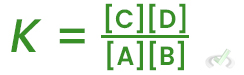
The equilibrium constant (K) is a number that expresses the relationship between the concentrations of reactants and products at equilibrium for a given reaction.
General Form:
IV. Le Chatelier’s Principle
Le Chatelier’s Principle states that if a system at equilibrium is disturbed, it will adjust to counteract the disturbance and restore a new equilibrium.
Types of Disturbances
Example:
For the reaction N2 + 3H2 ⇌ 2NH3:
increasing temperature shifts the equilibrium to the left (producing less NH3) because the reaction is exothermic (releases heat).
V. Calculating Equilibrium Concentrations
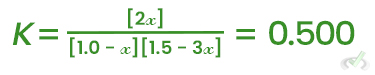
To calculate equilibrium concentrations, we often organize data and solve for unknowns using an ICE table (Initial, Change, Equilibrium).
Example Problem:
For the reaction N2 + 3H2 ⇌ 2NH3 with Kc = 0.500 at a certain temperature:
- Set up the ICE table with initial concentrations.
- Write the expression for the equilibrium constant.
- Solve for the unknown concentrations at equilibrium.
Species | Initial (M) | Change (M) | Equilibrium (M) |
|---|---|---|---|
N2 | 1.0 | -x | 1.0 - x |
H2 | 1.5 | -3x | 1.5 - 3x |
NH3 | 0.0 | +2x | 2x |
VI. Acid-Base Equilibria
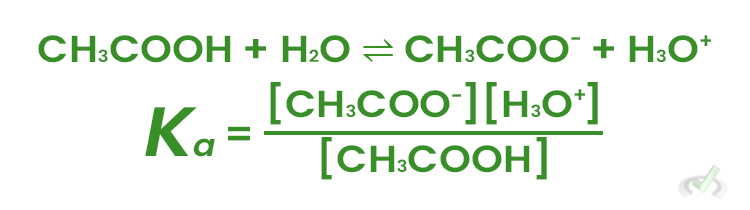
Acids and Bases in solutions reach equilibrium based on their strength, represented by their dissociation constants Ka for acids and Kb for bases.
Example:
For acetic acid (CH₃COOH) in water:
VII. Solubility Equilibria
Solubility Equilibria involve the dissolution of solids in water to form a saturated solution.
Example:
For calcium fluoride (CaF₂):
The equilibrium constant for a dissolving salt has its own name: the solubility product, Ksp. It is written like any other equilibrium constant, with one difference worth memorising: the undissolved solid is left out. A pure solid has no meaningful concentration, so only the dissolved ions appear. For CaF₂ → Ca2+ + 2F−, that gives Ksp = [Ca2+][F−]2.
A larger Ksp means a more soluble salt. Be careful comparing two salts by Ksp alone though: it is only a fair comparison when they produce the same number of ions, because the exponents differ otherwise.
Molar solubility is the quantity you are usually asked for: the moles of salt that dissolve per liter before the solution saturates. You get it from Ksp by letting the molar solubility be s, writing each ion concentration in terms of s, and solving. For CaF₂, [Ca2+] = s and [F−] = 2s, so Ksp = (s)(2s)2 = 4s3.
The ion product (IP) is to solubility what the reaction quotient Q is to a gas-phase reaction: the same expression as Ksp, but using whatever concentrations you have right now rather than the equilibrium ones. Comparing the two tells you what the solution will do:
IP < Ksp: unsaturated. More solute can still dissolve.
IP = Ksp: saturated. The solution holds as much as it can; any further solid added just sits there.
IP > Ksp: supersaturated. The solution is holding more than it should, usually because it was heated, saturated, then cooled slowly. It is unstable, and a disturbance will drop the excess out as a precipitate.
That last comparison is how the MCAT asks whether mixing two solutions produces a precipitate: work out the concentrations after mixing, compute the ion product, and compare it with Ksp.

VIII. Common Ion Effect
The common ion effect occurs when a salt containing an ion in common with a dissolved substance is added to the solution, reducing the solubility of the dissolved substance.
Example: Adding NaF to a solution of CaF₂ decreases the solubility of CaF₂ because the concentration of F⁻ increases, shifting the equilibrium.
This is really just Le Chatelier applied to a dissolving salt, and it comes up often enough to have its own article. The Common Ion Effect covers it properly, including the calculations.
IX. Bridge/Overlap
Understanding equilibrium helps in other areas of chemistry, such as:
Reaction Kinetics
Equilibrium concepts explain how fast reactions reach equilibrium and how catalysts affect these rates.
Thermodynamics
The position of equilibrium relates to the energy changes in reactions. Understanding Gibbs free energy helps predict the direction of equilibrium.
Biochemistry
Equilibrium principles apply to metabolic pathways and enzyme reactions. For example, in glycolysis, the equilibrium of each step ensures efficient energy production.
X. Wrap-Up and Key Terms
Understanding equilibrium in solutions involves mastering several key concepts and terms. Equilibrium explains how reactions reach a state where reactants and products do not change over time. This balance is influenced by concentration, temperature, and pressure changes.
Key Terms
XI. Practice Questions
Sample Practice Question 1
The Ksp of silver chloride (AgCl) is 1.8 × 10⁻¹⁰. What is its molar solubility in pure water?
A. 1.8 × 10⁻¹⁰ M
B. 1.3 × 10⁻⁵ M
C. 9.0 × 10⁻¹¹ M
D. 3.6 × 10⁻¹⁰ M
Ans. B
AgCl dissolves 1:1, so if the molar solubility is s, then [Ag+] = [Cl−] = s and Ksp = s2. So s = √(1.8 × 10⁻¹⁰) = 1.3 × 10⁻⁵ M. Option A is the Ksp itself, which is the trap.
Sample Practice Question 2
Equal volumes of 0.02 M Pb(NO3)2 and 0.02 M NaCl are mixed. The Ksp of PbCl2 is 1.7 × 10⁻⁵. Will a precipitate form?
A. Yes, because the ion product exceeds Ksp.
B. No, because the ion product is below Ksp.
C. Yes, because both salts are soluble.
D. Cannot be determined without the temperature.
Ans. B
Mixing equal volumes halves both concentrations, so [Pb2+] = 0.01 M and [Cl−] = 0.01 M. The ion product is [Pb2+][Cl−]2 = (0.01)(0.01)2 = 1 × 10⁻⁶, which is below the Ksp of 1.7 × 10⁻⁵. IP < Ksp, so the solution is unsaturated and nothing precipitates. Forgetting to halve the concentrations after mixing is the usual mistake.
XII. Supplemental Resources
Want to go deeper on this topic? Here's where to read, watch and practice it next.
Read
- Kaplan MCAT General Chemistry Review 2026-2027, §9.3 and §6.1
- The Princeton Review MCAT General Chemistry Review, sections 10.1 through 10.7
Official AAMC practice that tests this topic
- Chemistry Question Pack, Q92
- Chemistry Question Pack, Passage 17, Q98
Get the Solubility cheat sheet
On its way.
Check your inbox in the next minute.




 To help you achieve your goal MCAT score, we take turns hosting these